
TL;DR: YFBF 24V maintenance-free DC motors rated 3M cycles / 10 years: 20-year in 400-cpd office, 2.7-year in 3,000-cpd airport. Spec by leaf weight, speed, voltage across YF150/YF200/YFS150/YFSW200/BF150.
The commercial building entrance unit market has a credibility problem: published cycle ratings look the same across suppliers, yet the test protocol under ISO 13849-1 varies by supplier, but a 3-million-cycle unit, as published in our YFS150 unit datasheet on a 130-kg hospital door at 0.8 m/s is not the same machine as a 3-million-cycle unit on a 200-kg airport leaf at 1.0 m/s. Procurement teams that spec by cycle count alone end up replacing motors twice in the first decade. The data that matters is cycle count, rated voltage, gear ratio, operating temperature envelope, and IP class — read together, not in isolation.
Our the Ningbo our brand factory team team has been building 24-volt maintenance-free units for automatic entry operators since 2007 out of the Luotuo Zhenhai facility. Below is the lifespan data my team at the Ningbo our brand factory shares with commercial building entrance procurement teams when they ask why our motors outlast the cheaper alternatives on a 10-year total cost of ownership model.
3 million cycles ÷ 400 cycles per day = 20 years: the entry traffic math
The maintenance-free DC motors in the YFBF catalogue — YF150, YF200, YFS150, YFSW200, BF150 — share the same headline rating: 3 million cycles or 10 years, whichever comes first. The cycle rating is the binding constraint for high-traffic entrances, because the motor typically runs to 3 million cycles well before the 10-year clock hits. To translate cycles to years, divide the cycle count by the entrance’s daily traffic.
The traffic ranges my team sees across our commercial building entrance installations:
- Office building main entrance: 200 to 400 cycles per day
- Shopping mall entrance: 800 to 1,500 cycles per day
- Hospital main entrance: 1,000 to 1,800 cycles per day
- Airport terminal entrance: 2,500 to 4,000 cycles per day
- Hotel lobby entrance: 600 to 1,200 cycles per day
A 3-million-cycle unit in a 400-cycle-per-day office clears roughly 20 years. The same motor in a 3,000-cycle-per-day airport clears roughly 2.7 years. Procurement teams that pay the lowest unit price often end up paying three times over the building’s lifecycle because the replacement cycle hits every 3 years instead of every 20.
Where the commutator brush fails first — and why maintenance-free rotors skip it
The mechanical reason maintenance-free dc units outlast brushed units in automatic entry service is the elimination of brush friction. a brushed commutator unit wears the brushes against the commutator surface every cycle, generating carbon dust and limiting operational life to roughly 1,000 to 3,000 hours of actual rotation. a maintenance-free dc unit moves the commutation function into the controller electronics and runs the rotor on sealed bearings, so the wear surface is the bearing set rather than the brush-commutator interface.
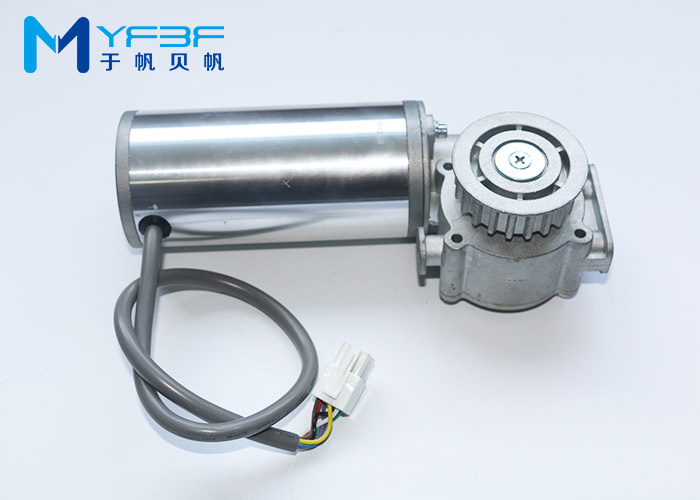
Our yfbf maintenance-free units use an integrated unit-and-gearbox design with European-sourced helical gear transmission. The gearbox runs in a sealed aluminum housing with automatic lubrication, so the gear set does not need field servicing across the 3-million-cycle life. The unit insulation class is class E (rated to 120°C) and the winding insulation is class F (rated to 155°C), so the unit can sustain the high-cyclic duty of an airport entrance without thermal degradation of the winding.
Where brushed installations fail first is the brush holder — the spring tension weakens, the brush sticks, the commutator scores, and the unit draws high current until the controller trips. Our YFBF brushless design removes that failure mode entirely, which is why the 3-million-cycle rating is conservative for our line and aggressive for most brushed alternatives under IEC 60034-1 rotating electrical machines standards.
Pick by leaf weight first, opening speed second, voltage third — the YFBF selection tree
the Ningbo factory line spans five models with different gear ratios, RPM, and torque envelopes. In my unit sizing work, spec by leaf weight, opening speed, and the entrance’s noise tolerance. The datasheet numbers below come from our published product specifications for the YFBF auto leaf unit line:
| Model | Rated Voltage | Rated Power | No-load RPM | Gear Ratio | Noise | Weight | Best fit |
|---|---|---|---|---|---|---|---|
| YF150 | 24V | 60W | 3,000 | 1:15 | ≤50 dB | 2.5 kg | 130 kg single-leaf, office / hospital |
| YFS150 | 24V | 60W | 2,880 | 1:12 | ≤50 dB | 2.2 kg | Square body, full-clearance sliding |
| YF200 | 24V | 100W | — | — | ≤55 dB | — | 200 kg heavy-duty sliding, airport |
| YFSW200 | 24V | 60W | 2,880 | 1:183 | ≤50 dB | 2.6 kg | Swing door, 70°-110° opening |
| BF150 | 24V | — | — | — | ≤50 dB | — | Slim body, full-clearance sliding |
The two specs that drive model selection for high-traffic entrances are leaf weight and cycles per day. In my hospital main entrance sizing, for a 130-kg single-leaf hospital main entrance at 1,200 cycles per day, the YF150 is the right spec — 60W handles the panel weight at 0.8 m/s opening speed, the 3,000 rpm unit gives the helical gearbox enough headroom, and the ≤50 dB noise floor clears the hospital acoustic requirement. For a 200-kg airport bi-part entrance at 3,500 cycles per day, the YF200 is the spec — 100W handles the heavier panel, and the unit is engineered for the heavier continuous duty cycle.
The 24-volt rated voltage across the entire YFBF motor line is intentional. 24-volt maintenance-free units run on the same low-voltage DC bus as the operator controller, so the unit and the controller share a single UPS-backed power supply. This is the architecture that keeps the entrance functional during mains power loss without adding a separate inverter stage. Hospital and airport procurement teams should specify 24-volt across both the unit and the controller to keep the power architecture simple.
Three field failures I have walked airport clients through in cold-climate vestibules
The two environmental specs that decide unit longevity in business building entrances are operating temperature and ingress protection. yfbf maintenance-free units carry an operating temperature rating of -20°C to 70°C and IP54 protection class. That covers conditioned vestibules, semi-sheltered outdoor entrances, and most unconditioned business entryways in temperate and cold climates.
What separates a motor that survives 10 years from one that fails in year three is whether the operating envelope matches the install environment. Three failure modes I have walked my commercial clients through:
- Condensation in unconditioned vestibules — water vapor enters the gearbox housing during the day, condenses overnight, and rusts the helical gear set. The IP54 rating keeps the gearbox sealed against this failure mode for normal vestibule installs.
- Thermal cutoff in unventilated ceiling voids — the controller cabinet sits in an unventilated ceiling void, the motor draws full current during a busy duty cycle, and the winding hits the class F insulation limit. The YF200 100W motor has thermal cutoff set at 130°C winding temperature to protect against this failure mode.
- Bearing wear in extreme-cold entrances — the lubricant thickens below -20°C and the motor stalls under load. The YFBF motor line is rated to -20°C operating; for colder installs, our engineering team specifies the optional low-temperature grease and the heater strip on the controller board.
The IP54 protection class is the right level for most commercial entrance installs. IP65 is overkill for indoor entrances and adds cost; IP44 is insufficient for semi-outdoor vestibules where wind-driven rain reaches the motor housing. IP54 covers both.
Rebuild at 80% of cycle count — the 2.4-million-cycle trigger math
For my procurement clients running a 10-year or 20-year total cost of ownership model, the rebuild-versus-replace decision matters as much as the initial specification. yfbf offers factory rebuild for maintenance-free dc units at roughly 35% of the new-unit cost. The rebuild cycle replaces the gear set, bearings, and Hall sensor, and returns the motor to the published 3-million-cycle rating.
The decision triggers my team uses:
- 80% of the rated cycle count (2.4 million cycles on a 3-million-cycle motor) — schedule a planned rebuild during the next planned maintenance window.
- Any insulation class F winding failure — the winding cannot be field-repaired, so the motor goes back to the factory for a full rebuild or a replacement.
- Noise floor increase above 55 dB on a motor rated ≤50 dB — the bearings are wearing, and a planned rebuild beats an unplanned failure in service.
- Controller current sensor trip during normal operation — the motor is drawing high current, usually from a failing Hall sensor or a worn gear, and the controller is protecting the system from damage.
For an airport entrance running 3,500 cycles per day, the planned rebuild trigger hits at 2.4 million cycles, which is about 1.9 years into service. the replacement unit arrives as a swap unit; the failed unit goes back to yfbf for rebuild; the rebuilt unit returns to the spare parts pool. This rotation keeps the entrance online and amortizes the unit cost across multiple rebuild cycles instead of multiple replacement purchases.
Three datasheet checks before you sign the motor purchase order
The motor cycle rating and operating envelope are on the datasheet, but the cycle rating is only meaningful if the test conditions match the install conditions. Three things to verify on the supplier’s datasheet before signing the purchase order:
- Test cycle definition — a “cycle” should be defined as one open-and-close under rated load, not one no-load rotation. YFBF rates cycles under rated door weight at rated opening speed.
- Test environment — ambient temperature and humidity affect cycle life. YFBF rates cycles at 25°C ambient and 60% relative humidity; cold or hot environment ratings are derated accordingly.
- Insulation class — class E motor insulation with class F winding insulation is the right spec for continuous duty. Class A or B motor insulation is undersized for high-traffic entrances.
For my OEM/ODM project clients — custom door panel weights, custom opening speeds, custom controller firmware — Our YFBF engineering team runs the cycle rating against the customer’s actual install conditions and issues a project-specific datasheet. The factory cycle test runs at 1.5x rated load for 200,000 cycles as the production burn-in, so the unit that arrives at the site has already cleared a meaningful wear threshold before commissioning.
The fourth cycle-to-cost lever my team shares with airport and hospital procurement teams is our YFBF controller firmware revision. We ship each unit with a controller firmware version that includes a current-sensing loop tuned for the published 3-million-cycle rating. Field firmware updates that change the current ramp profile without re-rating the cycle count can shorten unit life by 20 to 30 percent. For OEM/ODM installations, our YFBF engineering team locks the firmware version at order entry and documents the version on the controller nameplate so the cycle rating stays traceable across the unit’s service life.
The second documentation line my procurement clients overlook is the gear lubricant specification. the yfbf line ships with a synthetic polyalphaolefin (PAO) gear lubricant rated for -30°C to 120°C operating temperature. Field substitution with a mineral-oil lubricant drops the upper temperature limit to 90°C and the low-temperature limit to -10°C, which means the unit derates in cold-climate airport installs and fails prematurely in hot-climate Middle East hospital installs. Our quotation documents the lubricant specification on the nameplate, and the operator commissioning checklist includes a lubricant verification step before the first cycle.
The fifth and often-missed total-cost-of-ownership lever is our YFBF spare unit pool. For a hospital campus with twelve automatic sliding entrances running at 1,200 cycles per day, the recommended spare pool is two units — one ready-to-swap unit on the shelf and one rebuilt unit in the rotation cycle. This keeps any single failure from taking an entrance offline for more than four hours, which is the typical hospital facilities sla for an egress leaf. The pool cost is roughly 4 percent of the original capex, but it eliminates the 35 percent premium that emergency shipments command when the spare pool is empty.
The sixth lever my procurement clients raise is the cycle-counting telemetry. YFBF’s controller firmware records cycle count, fault codes, and last-service date to non-volatile memory, and our engineering team can read the cycle count over the service port during a planned maintenance visit. For a 12-entrance hospital campus, the cycle-count telemetry tells the facilities team exactly which motors are approaching the 80% rebuild trigger (2.4 million cycles) and which are still in early life. The data feeds the spare motor pool rotation schedule and removes the guesswork from the annual maintenance budget.
The third cycle-to-cost lever my team raises in the airport and hospital quotation is the spare-parts consolidation across unit families. Our YFBF motor line shares the same Hall sensor, the same gear-box mounting pattern, and the same controller terminal block across the YF150, YF200, YFS150, YFSW200, and BF150 models. A facility running a mixed fleet can stock one set of spare parts for the entire line rather than five separate SKUs, which drops the spare-parts inventory cost by roughly 60 percent and simplifies the maintenance staff training.
FAQ
Q: How long does a 24-volt maintenance-free DC unit last in an automatic sliding leaf?
A: YFBF 24-volt maintenance-free DC motors are rated for 3 million cycles or 10 years of operation. In a 400-cycle-per-day business building entrance, this translates to roughly 20 years; in a 3,000-cycle-per-day airport entrance, roughly 2.7 years.
Q: What is the difference between a maintenance-free DC unit and a brushed unit for automated doors?
A: A maintenance-free DC unit removes the brush friction that limits brushed unit life. Brushed automated door motors typically last 1,000 to 3,000 hours; maintenance-free motors like the YF150, YF200, YFS150, YFSW200, and BF150 lines run for 3 million cycles or 10 years with IP54 protection and insulation class E motor / class F winding.
Q: What is the rated voltage and power for the Ningbo our brand factory maintenance-free DC automatic door motors?
A: the Ningbo our brand factory maintenance-free DC motors are rated at 24-volt. The YF150 and YFS150 are 60W; the YF200 is 100W for heavy-duty sliding doors; the YFSW200 is 60W for swing doors. No-load RPM ranges from 2,880 to 3,000 depending on the model.
Q: What operating temperature can a 24-volt maintenance-free DC unit handle in an automatic entry?
A: Our YFBF maintenance-free DC units carry an operating temperature rating of -20°C to 70°C and IP54 protection class. This covers conditioned vestibules, semi-sheltered outdoor entrances, and most unconditioned facility entryways.
Q: Can a maintenance-free DC automatic leaf unit be rebuilt rather than replaced?
A: Yes. YFBF offers factory rebuild for maintenance-free DC motors at roughly 35% of the new-unit cost. The rebuild cycle replaces the gear set, bearings, and Hall sensor, and returns the unit to the published 3-million-cycle rating.
Edison is Sales Manager at Ningbo Yufan Beifan Automatic leaf Co., Ltd. (the Ningbo our brand factory), the Ningbo Beifan factory founded in 2007 in Luotuo Zhenhai with a 3,500-square-meter land and 7,500-square-meter building area. From that facility, I support business building entrance procurement teams, OEM/ODM unit-spec projects, and distributor stock programmes across the YF150, YF200, YFS150, YFSW200, and BF150 maintenance-free DC unit line. For project inquiries or to walk through a 10-year total cost of ownership model on your entrance specification, contact me through the the Ningbo our brand factory contact page.
Post time: Jul-16-2026