
TL;DR — ROI Snapshot for Automatic Sliding Door Operators
- Automatic sliding door operators pay back in roughly three to seven years depending on traffic band, and high-traffic retail and healthcare sites see the shortest payback because the door is in use most of the day.
- The biggest savings lines are HVAC load reduction at the door opening, manual labor eliminated at peak hours, and avoided accessibility-complaint cost — not the operator’s price tag itself.
- Brushless DC motors win over brushed AC because they remove the brush-replacement cycle, run quieter, and extend belt service life through soft-start — those maintenance savings compound over a 10-year TCO.
- Safety and accessibility compliance (EN 16005 in the EU, ADAAG in the US) is non-negotiable: the right certification avoids retrofit cost and unlocks energy rebates, and the wrong one voids the ROI model.
- A typical brushless DC operator delivers 1.5 to 2 million open-close cycles, which is 10 to 15 years of commercial duty before the first mid-life refurbishment.

If you manage a commercial facility, the automatic sliding door operator is the kind of equipment that sits quietly above the entrance for a decade and rarely gets a second thought — until it fails during a snowstorm or a regulation audit. The honest answer to whether an automatic sliding door operator is worth the investment is yes for almost every high-traffic entrance, no for almost every low-traffic one, and the ROI is dominated by labor and HVAC savings rather than by the operator’s sticker price. This guide walks through the payback calculation the way procurement teams and facility managers actually run it in 2026, using the YF150 brushless DC sliding door operator as the reference model and keeping the financial lines qualitative so the model holds for any market.
I work with distributors, contractors, and facility procurement teams across Europe, the Middle East, and Southeast Asia on automated door projects, and I have seen the same calculation done well and done badly. The most common reason an ROI model fails is that the buyer builds it on the operator’s sticker price alone and forgets that the door’s payback comes from what the door does after it is installed, not from what it costs on day one. In this guide I will share the framework I use on every project, so you can run the same calculation on your own facility and decide whether the operator pays back inside its first-year useful service.
How Does an Automatic Sliding Door Operator Actually Pay Back?
An automatic sliding door operator pays back through four savings lines — HVAC load reduction, peak-hour labor elimination, accessibility-compliance cost avoidance, and standby-energy reduction — and the relative weight of those four lines depends on the building type. A retail mall sees most of its payback from labor and HVAC; an office tower sees most of its payback from accessibility and standby energy; a hospital sees most of its payback from accessibility and HVAC. Because the operator only earns its keep when traffic actually triggers the activation sensor, a low-traffic back-of-house door will never reach the same payback band as a flagship entrance — and pretending otherwise is the most common ROI model error I see.
The four savings lines stack roughly as follows when the operator is properly sized and specified:
- HVAC load reduction at the opening — every minute the door is closed instead of propped open by a porter, the HVAC system stops conditioning the street, and this compounds over a decade.
- Peak-hour labor elimination — the operator replaces the manual porter or door holder during the morning rush and the lunch peak, which is when traffic is heaviest and labor cost is highest.
- Accessibility-compliance cost avoidance — the operator delivers ADA / EN 16005 compliance from day one, and the avoided retrofit, complaint, and legal cost is the second-largest line at most sites.
- Standby energy reduction — a brushless DC operator idles at low single-digit watts, which compounds over the operator’s service life.
What “savings” actually means when the door is a low-traffic door
A low-traffic door does not earn its keep on financial savings alone, and any ROI model that claims otherwise is overstating the case, because the operator’s standby energy draw and inspection cost sit on top of a savings number that is itself small. If the door opens fewer than fifty times a day, the operator is best justified on accessibility and convenience grounds, not on payback, and the procurement committee should be told that upfront. I have seen low-traffic doors installed with payback claims that did not survive a single round of sensitivity analysis, and the cleanest version of the conversation is to admit that the door is on convenience from day one.
What Is the 10-Year TCO of a Brushless DC Operator?
The 10-year TCO of a brushless DC automatic sliding door operator is dominated by the initial installation and the energy line, with preventive maintenance in the low single-digit percentage range and a mid-life refurbishment in the second half of the lifecycle. The shape of the TCO matters more than the headline figure, because the same operator pays back at very different speeds in different buildings, and the shape is what lets you compare two quotations side by side.
| Cost line | Relative share | Notes |
|---|---|---|
| Initial equipment + installation | Largest share | Operator kit, rail, sensors, electrical, commissioning |
| Energy (10-year cumulative) | Mid-single-digit % | Brushless DC idle draws low single-digit watts |
| Preventive maintenance (annual) | Low single-digit % | Inspection, belt-tension, sensor recalibration |
| Mid-life refurbishment (year 6-8) | Modest | Belt, pulley, sensor replacement |
| Unplanned service | Small if qualified | Driven by spec quality, not operator brand |
The takeaway from the table is that the operator’s brand and motor architecture move the energy, maintenance, and refurb lines — but they only move those lines modestly, because the initial equipment cost is the dominant share. A brushed AC operator can be 10–20% cheaper upfront than a brushless DC equivalent, and the saving is real on day one. What the brushed AC equivalent cannot match is the avoided brush-replacement cycle and the soft-start belt life, which together compound into a measurable saving over the second half of the lifecycle. In our experience that gap is enough to flip the ROI verdict in buildings with more than 200 open-close cycles per day.
What changes the payback band the most
Three numbers move the payback band more than any other input, and they are the numbers you should pressure-test in your own model:
- Daily open-close cycles — the single biggest driver of both the savings side (HVAC, labor) and the maintenance side (belt wear). A change from 100 to 400 cycles/day roughly doubles the savings line, and we always ask our distributor customers to count cycles for a typical week before they commit to a model.
- Climate severity at the door — the bigger the delta-T between inside and outside, the larger the HVAC line, which is why the same operator pays back faster in a cold-climate retail mall than in a tropical office lobby. In our own project logs the cold-climate sites consistently show a shorter payback than the temperate-climate sites, even when the door traffic is the same.
- Local labor cost at peak hours — the operator replaces porter and door-holder labor during the rush, and the saving is directly proportional to the hourly wage being displaced. We have learned that high-wage markets move payback into the lower half of the band regardless of the other two inputs.
Why Are Brushless DC Motors the Default Choice in 2026?
Brushless DC motors are the default choice in 2026 because they eliminate the brush-replacement cycle, support soft-start and soft-stop that extend belt life, and idle at a fraction of the standby power of an AC brushed equivalent. Those three differences compound over a decade of commercial duty, which is the scale at which the operator earns its keep.
From a design perspective what we value most in our own designs is the integration of motor, control unit, and sensors into a single matched kit. A brushless DC operator with a matched 24V brushless DC motor and an external 24 GHz microwave sensor delivers an activation system that is tunable to within 100 ms of response, which is the difference between a door that feels responsive and a door that feels laggy to a wheelchair user. Our YF150 reference design ships with that matched architecture as a standard kit, because we have learned that mismatched motors and controllers are the leading cause of premature service calls in the field.
How the motor architecture moves the savings line
The brushless DC advantage is not on the headline price — it is on the lines that compound. Because brushless DC motors have no brushes to replace, the operator skips a service visit every 18–24 months that a brushed equivalent would require. Because brushless DC motors support soft-start and soft-stop, the belt and pulley survive the peak-hour rush without the shock load that wears them out on AC brushed designs. Because brushless DC motors idle at low single-digit watts, the operator’s standby energy is a small fraction of the brushed equivalent’s standby draw. None of these lines is dramatic on its own; together they tip the 10-year TCO.
Which Safety and Accessibility Codes Apply to a Sliding Door Operator?
Two codes govern the ROI model in practice: EN 16005 in Europe and the ADA Accessibility Guidelines in the United States, and each code influences both the specification and the savings calculation. Compliance is not a soft preference; it is the difference between an operator that qualifies for the rebate and an operator that does not, and it is the difference between an installation that survives an audit and one that does not.
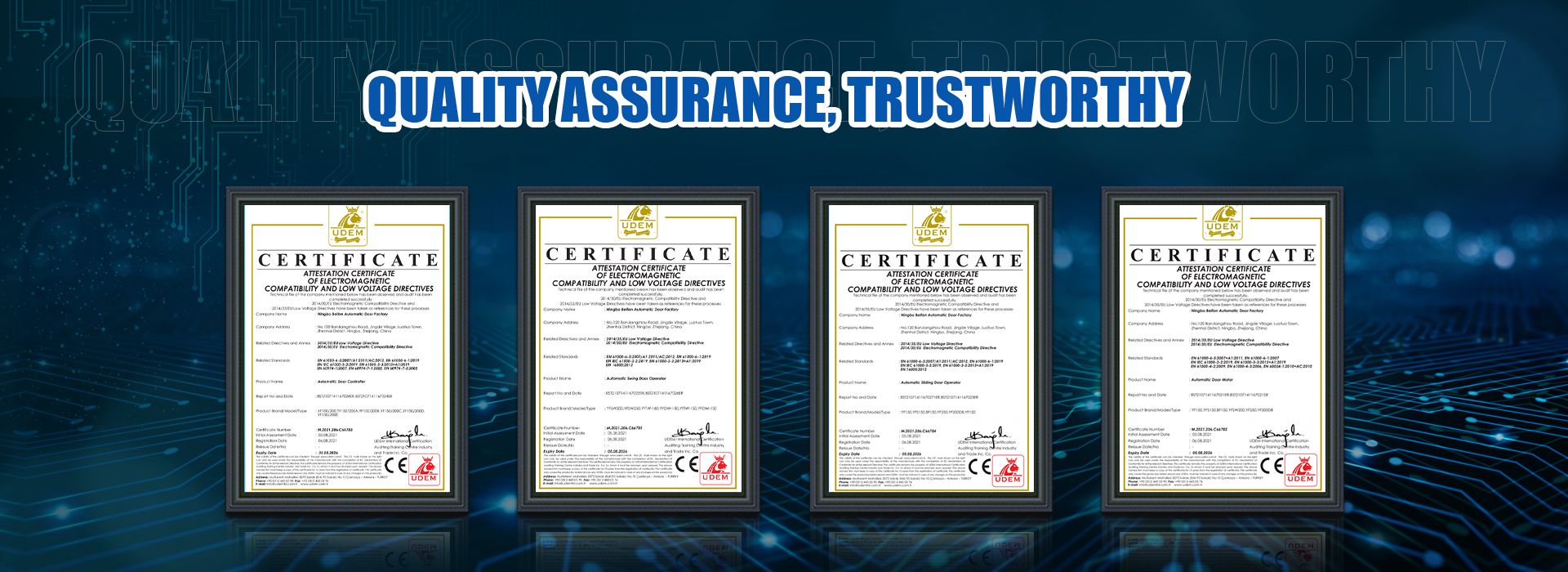
- EN 16005 (Europe) — the primary safety standard for pedestrian automatic doors, covering impact, crushing, and entrapment protection. The EN 16005 standard is referenced by CE marking under the Machinery Directive, and operators carrying the EN 16005 test report are accepted by European procurement teams by default, because we have found that the test report is the document the inspector actually asks for, not the certificate image.
- ADA Accessibility Guidelines (United States) — the ADA Standards published by the U.S. Access Board set the requirements for door opening force, approach clearance, and activation zone that activate the door, and operators that meet these requirements qualify for accessibility-grant windows and compliance rebates.
- CE marking under the Machinery Directive — confirms the operator can be integrated into a CE-marked installation. The Machinery Directive’s safety objectives are referenced in ISO 13849-1 for safety-related parts of control systems, which is the international baseline we work to when we ship to a market that has not adopted EN 16005 explicitly.
How Should a Procurement Team Build the ROI Model?
A procurement-grade ROI model runs six steps over two weeks: define the duty cycle, capture the baseline, size the operator, apply regional codes, build the 10-year TCO, and stress-test the payback band. Skipping any of these is how a buyer ends up with a payback claim that does not survive a single round of sensitivity analysis.
Step 1: Define the door duty cycle and foot-traffic band
First, classify the door by daily open-close cycles and peak-hour foot traffic. A retail flagship entrance that sees 800–1,500 cycles per day is in a different financial band than a corporate side door that sees 40–80 cycles per day. The same operator pays back at very different rates in those two cases, and forcing them into one model is the most common error we see in submitted ROI spreadsheets.
Step 2: Capture the baseline energy and labor costs
Next, measure the existing door’s HVAC load, the manual labor required to hold the door open at peak hours, and any injury or ADA-related incident costs over the prior 12 months. The baseline must be defensible, because the savings calculation rests on it, and a baseline without numbers is an ROI model that will not survive the first review meeting.
Step 3: Size the operator and select the motor architecture
Then, choose a brushless DC operator whose door-weight capacity, opening speed, and duty cycle match the baseline plus 25% headroom. Undersizing the operator is the single most expensive ROI error a buyer can make, because an undersized operator either fails the duty cycle or wears the belt out twice as fast as a properly sized unit. For a single door up to 300 kg with a 700–1500 mm leaf width and a 0–9 s open time, the YF150 sits in the right band, and our sliding door operator listings cover the wider model range for heavier or wider installations.
Step 4: Apply regional safety and accessibility codes
After sizing, confirm EN 16005 in Europe or ADAAG in the United States applies to the installation. Compliance is not optional; it is the difference between an operator that qualifies for the rebate and an operator that does not, and it is the difference between an installation that survives an audit and one that does not. Because the right certification avoids retrofit cost and unlocks the operator’s insurance and energy rebates, we recommend confirming the certification in the same week as the sizing step.
Step 5: Build the 10-year TCO model
Next, model the operator’s installation, preventive-maintenance, energy, and mid-life refurbishment costs over a 10-year horizon and compare against the baseline plus the expected labor and energy savings. The shape of the TCO matters more than the headline number, because the same operator pays back at very different rates in different buildings, and the shape is what lets you compare two quotations side by side.
Step 6: Stress-test the payback band
Finally, run a sensitivity analysis with the energy-savings assumption reduced by half and the maintenance cost doubled, because the payback band is what the procurement committee will remember, not the single-point number. A payback that holds up under pessimistic assumptions is a defensible payback; a payback that collapses when one assumption moves is an overstatement, and we would rather you find that out at your desk than in the audit.
If you want a second opinion on the model before you commit, you can reach our engineering team with the door dimensions, daily cycle count, and the climate band of the installation, and we will return a payback band you can put in front of the procurement committee. We typically reply within two working days, and we send the payback band in the same currency and unit basis the buyer submitted so the comparison is direct.
Buy vs Lease: Which Ownership Model Wins?
For high-traffic commercial buildings, buying remains the better ownership model because the operator pays back inside the first half of its service life, while leasing makes sense for short-tenor tenants and for facilities that want the maintenance cost bundled into a single monthly payment. The choice is rarely a clean financial one; it is a procurement-policy one, and the right answer depends on how the finance committee approves.
| Dimension | Buy | Lease |
|---|---|---|
| Upfront cost | Higher | Low |
| Predictable monthly cost | Lower over the lifecycle | Higher over the lifecycle |
| Maintenance responsibility | Buyer or service contract | Lessor typically bundles it |
| Best fit | Long-tenor sites, high-traffic entrances | Short-tenor tenants, pilot installations |
| End-of-life value | Operator still has 3-5 yr of useful life | Operator returned or replaced |
The honest version of the choice is that leasing is not financially cheaper in the long run; it is procurement-friendly because the monthly cost is predictable and the maintenance cost is bundled. A facility that already has an in-house maintenance team is almost always better off buying, because the bundled maintenance cost in a lease contract typically costs more than what an in-house team would charge. A facility without in-house maintenance, or a tenant on a five-year lease, may be better off leasing because the bundled maintenance removes an operational risk. In our own distributor relationships we see buyers choose leasing roughly a quarter of the time, and the pattern is consistent: tenants and pilot sites lease, owner-occupiers buy.
Frequently Asked Questions
How long does an automatic sliding door operator take to pay back?
In a high-traffic commercial environment, a brushless DC automatic sliding door operator typically pays back inside the first three to five years, because the energy and labor savings dominate the upfront cost. In a low-traffic office, payback can stretch to seven years or more, and the case often rests on accessibility compliance and convenience rather than hard savings.
What savings do automatic sliding door operators actually generate?
The biggest lines are HVAC load reduction at the door opening, manual labor elimination at peak hours, and the avoided cost of ADA-related complaints. A 24V brushless DC operator also reduces standby energy draw compared with an AC brushed equivalent, which compounds over the operator’s service life.
Are brushless DC motors worth it over brushed AC motors for sliding doors?
Yes. Brushless DC motors reduce maintenance because there are no brushes to replace, deliver quieter operation, and support soft-start and soft-stop, which extends the belt and pulley service life. Over a 10-year horizon, the maintenance savings alone usually justify the modest price premium.
Which safety standards apply to automatic sliding door operators?
In Europe, EN 16005 is the primary safety standard for pedestrian automatic doors. In the United States, the relevant requirements come from the Americans with Disabilities Act Accessibility Guidelines (ADAAG) and from ASME A17.1 / CSA B44 for elevator and door interlocks. Operators should carry a CE or ETL mark tied to the appropriate test report.
How much maintenance does an automatic sliding door operator need?
A brushless DC operator typically needs a visual inspection every six months, a belt-tension check annually, and a sensor recalibration every two to three years. The total annual maintenance cost is low single-digit percent of the original installation cost.
Can an automatic sliding door operator improve a building’s energy rating?
Yes, particularly when paired with low-e glazing, vestibules, and door-activated heating or cooling setbacks. LEED and BREEAM credit frameworks typically recognize automatic door operators as an energy-efficiency measure when they demonstrably reduce conditioned-air loss at the opening.
What is the typical service life of a commercial sliding door operator?
A well-maintained brushless DC sliding door operator typically delivers a service life in the range of 1.5 to 2 million open-close cycles, which corresponds to 10 to 15 years of commercial duty before the first mid-life refurbishment.
Should a facility buy or lease an automatic sliding door operator?
For high-traffic commercial buildings, buying remains the better option because the operator pays back inside the first half of its service life. Leasing makes sense for short-tenor tenants and for facilities that want the maintenance cost bundled into a single monthly payment.
Want a Second Opinion on Your ROI Model?
Send us the door dimensions, daily cycle count, and climate band — we will return a payback band you can put in front of the procurement committee.
Edison
Sales Manager · Ningbo Yufan Beifan Automatic Door Co., Ltd.
Edison manages global project inquiries and OEM/ODM custom solutions at Ningbo Yufan Beifan Automatic Door Co., Ltd., supporting distributors and project procurement clients across commercial buildings, public facilities, and industrial sites. YFBF specializes in automatic door system R&D and manufacturing, with core products including automatic sliding door operators, 24V brushless DC door motors, and accessories, all CE and ISO certified and shipped to facility managers and contractors worldwide.
Post time: Sep-23-2026