

TL;DR — Compliance Map for Automatic Door Buyers
- CE alone is not enough for Saudi Arabia: SASO IECEE Recognition plus a SABER-issued CoC are required for customs clearance.
- GSO harmonizes technical rules across all six GCC states; SASO enforces them in Saudi Arabia.
- In Southeast Asia, Malaysia (SIRIM), Indonesia (SNI), Singapore (Safety Mark), Thailand (TISI), and the Philippines (BPS) each run their own national approval track.
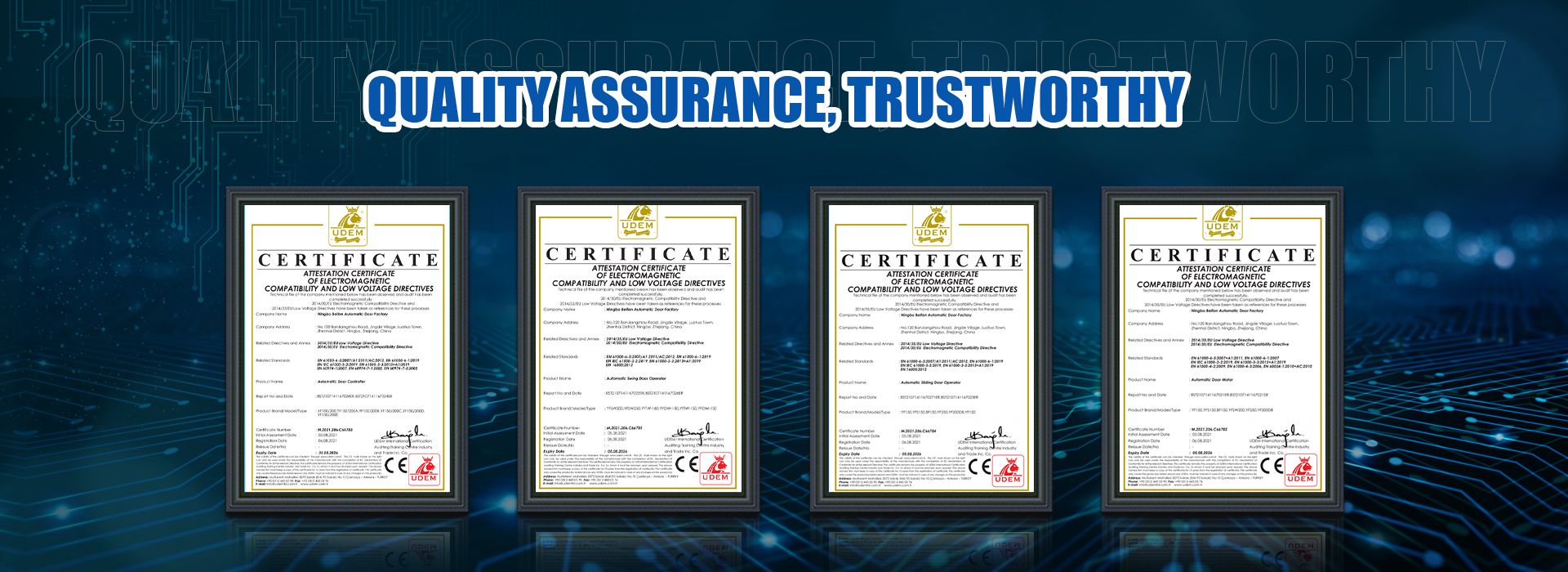
- EN 16005 and ISO 9001 form the common technical and quality baseline that almost every regional scheme accepts as a starting point.
- Plan certification in months, not weeks, and always request the active certificate number from suppliers before booking a vessel.
The fastest way for an automatic sliding door operator to fail a Middle East or Southeast Asia shipment is not a mechanical fault. It is a paperwork fault. I have watched buyers in Saudi Arabia, the UAE, Malaysia, and Indonesia open containers at the port only to find that the operator carries a CE plate, an ISO 9001 certificate on the letterhead, and nothing else — and that the importer of record cannot get a CoC issued in time.
This guide is written for the procurement, project, and compliance professionals on the buying side. It maps how a CE and ISO 9001 base package expands into SASO, GSO, ESMA, SIRIM, SNI, and TISI, what documents to demand from your Chinese supplier before shipment, and how to read a regional certification so you can spot the difference between an active certificate and a recycled marketing claim. The worked example I will return to throughout is the YF200 heavy-duty automatic sliding door operator on our own product page, because its specifications sit in the band that most hotel, airport, hospital, and shopping mall tenders specify across both regions.
What Does “Automatic Door Certification” Actually Mean for the Middle East and Southeast Asia?
Automatic door certification in these two regions is a layered stack: a CE + ISO 9001 foundation, a regional technical regulator (GSO, ESMA), and a country-level issuing body (SASO, SIRIM, SNI, TISI). When buyers say “we need automatic door certification,” they usually mean the whole stack, not just one stamp on the nameplate.
Most project specifications in Riyadh, Dubai, Doha, Kuala Lumpur, and Jakarta converge on the same baseline because they all accept EN 16005 — the harmonized European standard for power-operated pedestrian doorsets, last amended in 2024 — as proof that the safety-in-use requirements have been met. Where they diverge is in the in-country paperwork loop. That divergence is where most shipments stall.
The three layers every regional scheme tests against
- Layer 1 — Product safety baseline. EN 16005 covers the kinetic energy, force, and reversal behavior of the door panel. A compliant operator must detect an obstruction and reverse within the time and distance the standard defines.
- Layer 2 — Quality management system. ISO 9001 covers how the factory controls design, production, and after-sales. Most regional regulators require a current ISO 9001 certificate issued by an accredited body before they will issue their own.
- Layer 3 — Country-specific in-country evidence. This is the layer that differs the most. It includes the SASO IECEE Recognition in Saudi Arabia, the CoC issued through SABER, the ESMA registration in the UAE, the SIRIM Certificate of Approval in Malaysia, and the SNI mark in Indonesia.
How Does CE Marking Expand Into the Middle East Compliance Chain?
CE Marking is the entry ticket, not the destination, for GCC markets. The CE Declaration of Conformity tells a buyer that the manufacturer takes responsibility for compliance with the relevant EU directives — most commonly the Machinery Directive 2006/42/EC and the EMC Directive 2014/30/EU. Saudi Arabia, the UAE, Bahrain, Kuwait, Oman, and Qatar accept that CE as evidence of underlying safety, but each country layers its own approval on top.
The practical effect for buyers is that you do not start the paperwork again. You reuse the EN 16005 test report, the technical file, and the ISO 9001 certificate as the supporting documents for the regional application. The supplier is asked to translate, attest, and in some cases re-test through a regional partner — but the underlying work is the same. This is the first efficiency win on a multi-region project.
GCC: GSO sets the rules, SASO enforces them in Saudi Arabia
The Gulf Standardization Organization publishes the technical regulations that all six member states apply. For automatic doors, the GSO references a bundled set of IEC standards covering electromechanical safety, EMC, and low-voltage behavior. GSO itself does not issue product certificates; the national bodies do.
Saudi Arabia is the strictest market in the GCC for compliance enforcement, because every shipment passes through the SABER electronic platform. Two documents matter:
- SASO IECEE Recognition Certificate — issued after the regulator accepts CB scheme test results from approved labs. It confirms the product family is registered.
- SASO Certificate of Conformity (CoC) — issued per shipment, per importer, after the SABER platform validates the Recognition Certificate and the commercial documents.
United Arab Emirates: ESMA and the ECAS/EQM programs
The UAE runs the Emirates Authority for Standardization and Metrology (ESMA) — now operating as MOIAT — through the ECAS (Emirates Conformity Assessment Scheme) and EQM (Emirates Quality Mark) tracks. For automatic sliding door operators, the ECAS product registration is the relevant track. The supplier submits technical files, test reports, and a labeling undertaking; ESMA returns a registration certificate that the customs broker presents at the port.
Other GCC states (Kuwait, Oman, Qatar, Bahrain)
These four markets either mirror SASO directly or accept a SASO CoC as a regional pass-through. The pattern is consistent: GSO technical rules at the top, national customs check at the bottom. If your supplier already has an active SASO Recognition, the additional cost to extend to the other four is in the low-to-moderate range. The bigger cost is time and the multiple in-country importer registrations.
What Are the Mandatory Certificates for Southeast Asia?
Southeast Asia does not have a single regional certification for automatic doors. Each major market runs its own national scheme: SIRIM in Malaysia, SNI in Indonesia, Safety Mark in Singapore, TISI in Thailand, and BPS in the Philippines. The good news is that all of them accept EN 16005 and ISO 9001 as the starting point.
Malaysia: SIRIM and the ST designation
SIRIM QAS International operates as the national standards body and the certification arm. Automatic door operators fall under the regulated electrical equipment list, and importers work with SIRIM to obtain one of two outcomes:
- A Certificate of Approval (CoA) issued after in-country or CB scheme testing, or
- A test report recognition based on CB scheme results from a SIRIM-accepted lab.
The certificate is valid for a fixed term (typically a moderate number of years) and must be renewed before expiry. The Malaysian Communications and Multimedia Commission and the Energy Commission (ST) also publish scope notes that determine whether a particular product line falls under mandatory approval.
Indonesia: SNI through the BSN national framework
Indonesia’s national standards are managed by BSN (Badan Standardisasi Nasional) and most product certifications are issued by LSPro bodies under BSN accreditation. For automatic sliding door operators, SNI compliance is mandatory for public-sector tenders — airports, hospitals, government buildings, and state-owned commercial projects. Private commercial projects can sometimes accept equivalent foreign certifications, but the trend is moving toward mandatory SNI. Bidders should expect SNI documentation to be a tender requirement rather than a nice-to-have.
Singapore: Safety Mark and the Enterprise Singapore track
Singapore runs a tighter, lighter scheme. The Safety Mark issued by Enterprise Singapore covers controlled electrical goods, and automatic door operators may be in scope depending on the specific motor and control category. Singapore is also the easiest ASEAN market for accepting CB scheme + ISO 9001 documents without re-testing.
Thailand (TISI) and the Philippines (BPS)
Thailand’s TISI runs mandatory Thai Industrial Standards for many electrical goods. The Philippines’ BPS (Bureau of Philippine Standards) operates the Philippine Standard (PS) mark and the Import Commodity Clearance (ICC) system. Both accept CB scheme test reports as the technical foundation and add a country-level sticker or registration step on top.
Which Standards Should a Buyer Demand From a Chinese Automatic Door Supplier?
Demand the documents, not the promises. A CE plate on the operator housing, an ISO 9001 certificate on the letterhead, and a printed spec sheet are not the same as an active certificate you can verify in a regulator’s database.
Here is the document checklist I use every time a buyer emails me asking whether our YF200 or YF150 is ready for their tender:
>Required
| Document | GCC (Saudi / UAE) | ASEAN (Malaysia / Indonesia / Singapore) | Verify Where |
|---|---|---|---|
| CE Declaration of Conformity (current date) | Required | Required | Supplier’s technical file |
| EN 16005 test report (CB scheme preferred) | Required | Required | IECEE CB certificate database |
| ISO 9001 certificate (issued by an accredited body) | Required | IAF CertSearch or issuing body’s directory | |
| Country-level recognition / registration | SASO IECEE Recognition + SABER CoC (Saudi) / ECAS registration (UAE) | SIRIM CoA (Malaysia) / SNI registration (Indonesia) / Safety Mark (Singapore) | Regulator’s online database |
| Batch-level CoC | SASO CoC per shipment | Country-specific, per shipment | SABER (KSA) / national portal |
| Nameplate / label language | Arabic + English recommended | Local language + English | Physical inspection on receipt |
How to verify an “active” certificate
A supplier PDF is not a certificate — it is a claim. Cross-check every claim in the corresponding regulator’s public directory or database. For SASO, the SABER platform returns a status; for SIRIM, the certificate number is searchable in the SIRIM QAS directory; for SNI, the LSPro-issued certificate can be cross-checked against the BSN database. If a supplier cannot or will not share the certificate number, treat it as not certified.
How Do Temperature, Voltage, and Hardware Specs Affect Regional Approval?
Hardware specifications matter because regional regulators often require evidence that the product performs in local conditions, and MEC (Middle East Climate) and tropical ASEAN both push the operating envelope to extremes. Two specs I watch closely on every YF200 inquiry are operating temperature and voltage.
The published operating temperature range on the YF200 product page is -20°C to 70°C, with a motor rated at 24V 60W brushless DC and an input voltage range of AC 90–250V at 50–60 Hz. That envelope is deliberately wide for a reason: a Riyadh airport door in summer and a Jakarta shopping mall door in monsoon season are at opposite ends of the same thermal and humidity spectrum, and the certification lab tests against that envelope. A motor that only survives 0°C to 40°C will not pass GCC summer testing, and a controller that fails at 95% relative humidity will not pass an equatorial ASEAN site audit.
Two other specs to confirm on the data sheet before you commit:
- Opening/closing speed range (YF200: 150–500 mm/s opening, 100–450 mm/s closing, both adjustable). EN 16005 sets kinetic energy limits, and a supplier that publishes an adjustable range is showing they tested the full band.
- Reversal and obstacle detection behavior. The YF200 reverses on obstruction in both directions. That is the exact clause EN 16005 audits.
How Do Multi-Region Projects Actually Bundle Their Certification Packs?
Smart multi-region buyers bundle their certification packs by reusing the CE + EN 16005 + ISO 9001 foundation across every regional application, then paying only for the country-level registrations. This is how project procurement teams running mixed GCC + ASEAN portfolios get the unit cost of certification down to a moderate per-region figure.
Here is the pattern that works in practice on a 200–500 door hotel or hospital project:
- Lock the operator model first. A single SKU across the project is the cheapest path. Mixing YF200 and YF150 within the same project adds certification surface area you do not need.
- Confirm CE + ISO 9001 + EN 16005 once. Ask for the certificate numbers, not the PDFs. Verify them in the issuing body’s database.
- Register the model family in each destination country. Saudi Arabia is the longest lead. Start the SASO IECEE Recognition as soon as the contract is signed, not after goods are ready to ship.
- Issue per-shipment CoCs against the active registrations. For SASO, this means a CoC for every commercial invoice through SABER. For SIRIM, the CoA is per-importer and per-model; for SNI, the LSPro registration is per-model and per-factory.
- Audit the nameplate before container stuffing. Arabic or local-language labeling, regulatory marks, and the importer of record name must match the CoC.
What Are the Common Compliance Mistakes B2B Buyers Make?
The most expensive mistakes are always paperwork mistakes, not engineering mistakes. Here are the seven I see every quarter, with how to avoid each.
1. Treating “CE” as universal
CE is accepted as a baseline everywhere, but it is not a substitute for SASO, ECAS, SIRIM, SNI, or TISI. A CE-only shipment into Saudi Arabia will fail SABER.
2. Forgetting that the SASO CoC is per-shipment
The Recognition Certificate is multi-year. The CoC is per-shipment. Buyers sometimes think the Recognition covers them and skip the SABER application, then watch the container sit at the port for weeks.
3. Using the wrong importer of record
The CoC applicant and the importer of record on the commercial invoice have to match. A common scenario is the Chinese supplier applying for the CoC using their Hong Kong trading entity, when the Saudi importer of record is a local Riyadh partner. SABER rejects it.
4. Recycling old certificates
Some factories reuse expired ISO 9001 certificates or CE Declarations signed three years ago. Always ask for the current validity period and the issuing body’s accreditation mark.
5. Skipping the local-language label
GCC inspectors and ASEAN customs officers look at the physical nameplate. Arabic (GCC) and Bahasa Indonesia or Thai (ASEAN) labels are part of the compliance proof, not optional branding.
6. Underestimating lead time
SASO IECEE Recognition on a new model family typically runs in the moderate range from application to issuance, not the short range that some suppliers quote. Plan the procurement timeline accordingly.
7. Treating the factory’s CB scheme report as the final word
A CB scheme test report is the most widely accepted technical foundation. It is not, by itself, a country-level certificate. The country step is still required.
How Should You Engage Your Chinese Supplier on Multi-Region Certification?
Engage the supplier early, ask for documentation discipline, and treat certification as a parallel workstream to production — not a sequential gate. This is the operational discipline that separates smooth ME/SEA shipments from stuck ones.
For our automatic sliding door operator range at Ningbo Yufan Beifan, the practical engagement flow looks like this:
- Send your tender spec to the supplier’s sales engineer with the destination countries marked. A one-line “Saudi + Malaysia + Indonesia” tells us which certification packs to scope.
- Request a certification matrix per project. We provide CE + ISO 9001 + EN 16005 baseline and the SASO / SIRIM / SNI readiness status per model.
- Lock the model early. Once the YF200 is selected, we register the model family with the relevant regional bodies. Re-selecting later means restarting the registration clock.
- Coordinate the importer of record details. We need the local partner’s name, address, and commercial registration for the CoC application. This is the step that often gets delegated to a junior on the buyer’s side and comes back wrong.
- Verify the certificates when they arrive. Use the public databases. We send the certificate numbers proactively so you can verify them on your side.
- Schedule the nameplate audit before container stuffing. A 10-minute photo check of the operator’s data plate saves a 10-day port delay.
When buyers run this flow, our project cycle from purchase order to vessel loading typically sits in the moderate range of weeks. When buyers skip steps — especially step 4, the importer of record — the cycle stretches into months and the unit cost rises because every additional week of demurrage gets charged somewhere.
Where Can You Get More Detail or Quote a Project With Active ME/SEA Certification?
If you are scoping a tender right now — whether it is a hotel in Riyadh, a hospital in Dubai, a mall in Jakarta, or a mixed GCC + ASEAN portfolio — the fastest path is to contact our sales team directly with your destination countries, operator model (or let us recommend based on door weight), and project volume. We respond with a certification matrix per model, a target lead time for each regional registration, and the active certificate numbers for the CE, ISO 9001, and EN 16005 baseline that is already on file.
Need an Automatic Sliding Door Operator With Active ME/SEA Certification?
Send your destination countries, door weight, and project volume. We will return a certification matrix per model and a lead-time estimate per regional registration within one business day.
Frequently Asked Questions
Is a CE Mark on an automatic sliding door operator enough for Saudi Arabia?
No. Saudi Arabia requires a separate SASO IECEE Recognition Certificate plus a SASO CoC for customs clearance. A CE Declaration of Conformity alone is treated as non-compliant for goods entering the Kingdom under the SABER platform.
What is the difference between SASO and GSO for automatic doors in the GCC?
GSO is the Gulf Standardization Organization that publishes harmonized technical regulations adopted by all six GCC member states. SASO is the Saudi national body that issues country-specific certifications. For automatic sliding door operators, GSO defines the technical rules while SASO enforces them at Saudi customs.
Do I need SIRIM approval to import automatic door operators into Malaysia?
Yes. Automatic door operators fall under the regulated electrical equipment list maintained by the Malaysian regulators, and importers work with SIRIM QAS International to obtain a Certificate of Approval (CoA) or a test report recognition based on CB scheme results before goods can be cleared.
Is SNI mandatory for automatic sliding doors in Indonesia?
For public and commercial buildings, the Indonesian National Standard (SNI) framework applies, and many large infrastructure projects require SNI-marked or SNI-tested products. While not every private installation is audited, government, airport, hospital, and state-owned building tenders in Indonesia routinely reject bidders without SNI documentation.
How long does it typically take to add SASO or SIRIM to a CE-certified automatic door operator?
On a CE and ISO 9001 base, typical additional timeframes run in the moderate range for document preparation plus the issuing body’s review. Buyers should plan in months, not weeks, and should require suppliers to show the active certificate number before shipment, not just a promise of future compliance.
What paperwork should I request from a Chinese automatic door supplier before shipping to the GCC?
Request the active CE Declaration of Conformity, the EN 16005 or equivalent test report, the ISO 9001 certificate, the SASO IECEE Recognition Certificate for Saudi-bound shipments, the GSO conformity evidence for other GCC destinations, and a batch-specific SASO CoC issued through SABER. Verbal or scanned confirmations are not substitutes.
Can a single operator model serve both the Middle East and Southeast Asia?
The hardware can usually be the same, because the technical performance standards are broadly compatible across both regions. The differences sit in paperwork, marking language, in-country testing partners, and importer of record responsibilities. A single SKU with multi-region certification packs is the most efficient way to serve both.
Edison
Edison is a Sales Manager at Ningbo Yufan Beifan Automatic Door Co., Ltd., the manufacturer behind the YFBF automatic door brand. He works with distributors, project procurement teams, and OEM/ODM buyers across the Middle East and Southeast Asia, scoping automatic sliding door operators against CE, ISO 9001, EN 16005, SASO, ECAS, SIRIM, SNI, and TISI requirements. His focus is on translating certification paperwork into plain-language project timelines so buyers can move from inquiry to vessel loading without surprises.
Post time: Sep-17-2026