
TL;DR
- Specify an airport sliding door by opening ID, leaf mass and travel, peak operating profile, and the required behavior of the complete doorset.
- Count completed cycles, partial reversals and time held open separately. Passenger volume alone cannot establish operator duty.
- The YFBF YF200 is listed for one leaf up to 300 kg or two leaves up to 200 kg each. Ask for endurance and peak-duty evidence for the proposed build.
- Accept the installed opening only after its safety, accessibility and emergency functions have been verified under the project’s requirements.
Select an automatic door for an airport by matching its operator to the heaviest moving configuration and the busiest repeatable operating sequence at that opening. A curbside entrance, a baggage-claim exit and a staff corridor can have very different workloads. Specify the opening’s actual moving mass and stroke, cycle and reopening rates, environmental exposure, and required emergency states. Then verify the complete door under those conditions before approving the equipment package.
When I review an airport project inquiry, I ask for the door schedule and peak operating profile together. The schedule tells us what has to move. The operating profile tells us how often it has to move and how long it must repeat that work before it gets a shorter or quieter period.
How should you describe airport door traffic?
Measure high-cycle demand in door movements at each opening. Count a full opening followed by a full closing as one cycle, and record partial reversals separately. Several passengers can pass on one opening if the door remains open. A closing door can also reverse for another arriving group, which adds movement before a full cycle finishes. Confirm how the controller counts events so tendered endurance and site logs use comparable definitions.
For an existing terminal, gather counts over normal and peak periods and compare them with observations at the door. For a new terminal, estimate using expected arrival patterns, the number of parallel doors in operation, and the proposed activation and hold-open logic. Flight banks, curbside traffic and the temporary loss of an adjacent door can concentrate demand on one opening. Ask operations which of those cases belongs in the design.
| Operating window | Hours per day | Full cycles per hour | Full cycles per day |
|---|---|---|---|
| Peak periods | 4 | 90 | 360 |
| Other active periods | 14 | 30 | 420 |
| Inactive period in this scenario | 6 | 0 | 0 |
| Total | 24 | Varies | 780 |
Use cumulative cycles to plan endurance and use the longest sustained peak and shortest repeated intervals to assess thermal duty. At the assumed rate of 780 daily cycles for 365 days, the opening would accumulate 284,700 full cycles a year. If the assumed peak includes eight seconds of powered travel per full cycle, 90 cycles represent 720 seconds of travel per hour, or 20% of that hour. This is an estimate of moving time only. It excludes additional travel from incomplete cycles and any loads while stationary. Supply the timing sequence and the longest contiguous peak to the operator manufacturer for review.
Keep a separate record of reopening events and long hold-open periods when the same daily count can come from very different traffic patterns. A queue may hold one set of leaves open through a whole arrival wave. Intermittent groups may cause repeated starts and reversals during an equally busy period. Store the peak window, maximum observed burst, and typical time open so the supplier can review the sequence and the airport can distinguish a capacity issue from a change in activation behavior.
What does the 200 kg sliding operator rating cover?
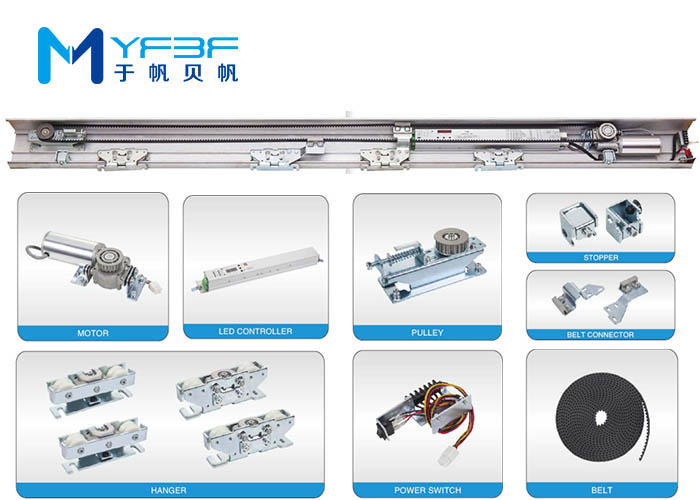
For the YF200, the published 200 kg figure is the maximum per leaf in the double-leaf configuration. The single-leaf configuration is listed at up to 300 kg. Use the heavy-duty 200kg sliding operator (model details) and YF200 specification page to identify the candidate. The specification lists leaf widths of 700–1,500 mm and a 24 V, 60 W brushless DC motor. The listed adjustable speed ranges are 150–500 mm/s opening and 100–450 mm/s closing. Those are catalog inputs. Confirm the usable combination for your assembly with the supplier and commission the settings for the applicable project requirements.
Calculate moving mass with the installed glazing, frame and hardware for each leaf, and quote the actual travel and running resistance. A heavy leaf demands more force to accelerate. Drag from guides, seals or pressure-induced contact can add load throughout travel. A tall exposed entrance may behave differently from a similar leaf in an internal corridor. Ask the supplier to assess the proposed motion profile with the final rails, hangers and floor guides before treating the listed mass as usable for that duty.
The YF200 published kit includes a controller, hangers, belt and microwave sensors. Specify activation and protective devices separately on the project scope matrix so the quoted package can be checked against the doorset design. If an indoor opening has lighter leaves and lower duty, view automatic sliding door operator series to compare configurations and request evidence for each shortlisted model.
What evidence shows that an operator can handle the duty?
Ask for endurance evidence that identifies tested mass, travel, operating sequence and replaced parts. A cycle total means more when the tested assembly resembles your opening. Request the full configuration, controller and drive revision, rates and pauses, environmental conditions, and the acceptance criteria at the end of the test. Where the tested setup differs, ask how the manufacturer assessed the effect of the difference. The public YF200 specifications provide a starting point for sizing. The project submittal should establish the peak workload and endurance it can support.
Check the drive and controller during the sustained peak, because heat can build when there is little recovery time between movements. Use the proposed leaf set and motion profile. Ask the supplier to report temperature limits or the relevant measured temperatures, any protective shutdown or speed reduction, and the recovery behavior. Include realistic reopen events in the agreed validation profile. For a vestibule, also check whether pressure differences or air movement affect running resistance and sensor operation under typical HVAC and weather conditions.
Tie the maintenance plan to actual usage and exposure rather than relying on a calendar alone. Ask for inspection tasks and recommended service limits for the rail, hangers, belt and guides, plus the method for tracking cycles and faults if supported. As an example of the information to request, the ASSA ABLOY SL500 manual groups maintenance intervals by cycles per hour and environment for that product. Use the selected operator’s own guidance to set the service schedule. ASSA ABLOY SL500 service manual.
Agree what counts as a pass after the endurance sequence, including what maintenance was allowed during the test. A report should show whether the operator completed the test with the original belt, controller and hangers, or whether adjustments or part changes occurred. Ask for the condition of the track and carriers and the functional checks performed after cycling. Apply this review to the submitted build, particularly if the tender proposes a different hanger, rail length or firmware from the tested assembly.
How should the airport verify the complete doorset?
Assign safety and emergency behavior to the complete installed doorset, including the leaves, sensors, controller, locks and any standby power. Have the project design team identify the governing code, standard edition and opening classification. BHMA publishes ANSI/BHMA A156.10-2024 for power-operated pedestrian doors. BSI lists BS EN 16005:2023+A1:2024 for safety in use of power-operated pedestrian doorsets. The U.S. Access Board separately publishes ADA requirements for automatic doors on accessible routes. Confirm the applicable references and editions for the actual jurisdiction and opening. BHMA standard overview · BSI doorset standard · U.S. Access Board accessibility standards.
Keep approach detection and presence protection explicit in the submittal, then verify both on the installed opening. Approach detection requests opening. Presence protection addresses people or objects remaining in a hazardous area. The installer should verify the approved zones, protective response and fault behavior under the adopted procedure, including how the doorway serves people with luggage, carts or mobility aids. Coordinate the test with terminal operations and record the sensors and settings actually used. AAADM automatic door safety checks.
Document the required state during power loss, an emergency input and recovery before choosing the backup or breakout arrangement. Decide the approved sequence with the airport’s life-safety, accessibility and security teams. A battery can support movement, but the doorset still needs to demonstrate the required operation and clearance in each designated state. Test the installed assembly against the approved sequence and record the result. Use the same approach for systems in series where the neighboring door may affect the opening’s behavior.
What should the tender and handover include?
Issue an opening-by-opening schedule that ties the proposed operator and doorset configuration to both the traffic profile and the acceptance plan. For each opening, record the single or bi-parting layout, leaf weights, required clear width and travel, exposure and power, applicable safety requirements, and normal and emergency modes. Include which parts are supplied with the operator and who delivers the remaining doorset and interfaces.
- Ask the supplier to return the proposed model, drawings, applicable test evidence and written exceptions against each opening ID.
- Agree on a representative operating sequence and the endurance and peak-duty evidence that procurement must receive before release.
- Agree on the site test procedure and define which parties witness safety, accessibility and emergency functions and sign the record.
- Hand over the approved component list, configuration records, maintenance tasks and contacts for service. Confirm lead times for the wear parts and spares required to keep the opening available.
A well-documented handover also lets the maintenance team compare new noise, slow travel or repeated faults with the baseline. After a change to the leaf, track, sensor or controller, review whether the approved configuration, tests or maintenance instructions need to be updated before returning the door to passenger service.
For an external entrance, attach the expected weather and cleaning exposure and identify who owns the vestibule pressure assumptions. On an internal opening, document movement patterns from carts, queues and cross traffic as applicable. The supporting drawings should show space to inspect and replace the drive components without unnecessary removal of finishes. Where the terminal depends on several adjacent doors, agree with operations which openings can be isolated for service and how that changes the workload on those that remain available.
Frequently asked questions
How many cycles should an airport door operator support?
Set the requirement from the specific opening’s daily use, operating calendar and service plan. Specify the sustained peak and repeated short intervals alongside the cumulative cycle target.
Does 200 kg mean the total weight of both YF200 leaves?
YFBF lists the double configuration at up to 200 kg per leaf and the single configuration at up to 300 kg. Confirm the allowable combination of mass, travel and duty for the proposed installation.
Is a brushless motor enough for high-cycle operation?
Motor type is one input to selection. Review the complete drive, controller, track, thermal behavior and endurance evidence at the planned leaf mass and operating sequence.
Can passenger throughput be used as the door cycle count?
Track actual movements where possible. Multiple passengers can use one opening, and the mechanism can perform partial travel and reversals before completing a full cycle.
Is battery backup required for every automatic airport door?
Determine that from the opening designation and the applicable project requirements. Specify the required passage and door state during outage and emergency conditions, then verify the selected doorset on site.
What should we send for an operator quote?
Send the door schedule, moving mass and travel, expected peak and daily cycles, environment, and required safety and emergency interfaces. Ask for a configuration-specific response with evidence and exceptions.
Submit the airport opening schedule
Send the drawings and duty assumptions for each opening when you reach our sales engineers. Ask for the proposed operator, included and optional components, confirmed mass and motion limits, and available endurance evidence. Identify any doors that need a separate doorset approval or witnessed site test before ordering.
Post time: Nov-23-2026