

By Edison, Sales Manager, Ningbo Yufan Beifan Automatic Door Co., Ltd.
Specify a hotel automatic sliding door as a complete entrance, with an operator sized to the actual moving leaves and a noise test at the places guests will hear it. Choose single-slide, bi-parting, or vestibule arrangements from the opening and traffic plan. Then verify how the assembled door starts, travels, slows, and closes under the hotel’s normal operating conditions.
At a glance
- Put finished leaf mass, width, travel, and traffic conditions on the door schedule before comparing operators.
- Inspect the track, guides, seals, and header when diagnosing noise because each can contribute a different sound.
- Set noise acceptance points at occupied positions, such as the reception desk or nearby guest corridor.
- Approve sensing, accessibility, emergency behavior, and finished-door sound together before handover.
The entrance sounds acceptable at noon. What changes at night?
Picture a hotel where the main entrance seems quiet during daytime arrivals. After the lobby empties, the night receptionist hears a knock every time the door closes. On the other side of the entrance, the drive sounds smooth through most of its travel. That distinction tells the project team which part of the cycle to reproduce. A mid-travel rolling sound and a single knock near closure need different checks. If the procurement note only says “quiet motor,” the installer has no agreed location or operating condition for the retest.
Record when each unwanted sound occurs because its timing helps distinguish rolling noise from an impact or vibration at the end of travel. A repeated tick at the same point on the rail can justify checking the running surface and carriers. A scrape near the floor points toward inspecting guide clearance or seals. A knock at closure can justify examining the meeting edges, deceleration, and stops. Treat those as clues for qualified service staff. Check the affected components together before attributing the sound to a single part.
Review the operator and its mounting structure together because a header can transmit and amplify vibration from the moving assembly. In a glazed entrance, review the header stiffness, supports, covers, and adjacent finishes on the shop drawing. Ask whether the approved mounting arrangement can be built without loose trim or clashes between the cover and adjoining finishes. Where a noise issue shows up after interior fit-out, compare the entrance with the cover and surrounding trim in their final positions. An industry example is dormakaba’s description of a sound-dampening track, which identifies vibration transfer into the building as a design consideration.
Which door layout fits the guest route?
Choose the sliding layout from the required clear opening and the side space available when each leaf is fully open. A single-slide entrance can suit an asymmetrical frontage with enough space on one side for the moving leaf. A bi-parting entrance can suit a central arrival route where both sides have room for leaf travel. Check the drawing with luggage and staff carts in mind, including where users approach from the side and where people wait clear of the entrance. The clear passage is a dimension of the completed opening, including the framing and specified hardware.
A vestibule can help manage exposure to outdoor conditions, but it brings two independently moving openings into the same guest route. Check the inner and outer doors during typical passage, including a guest pulling luggage and someone who pauses between them. If an outer door is exposed to wind or drafts, ask the entrance designer how seals, guide loads, and door behavior will be verified under the relevant site conditions. The interior door may require a more demanding sound review near seating or reception even when outdoor exposure is lower.
Decide header access and threshold details before the architect closes the surrounding finishes. A concealed operator can suit a clean facade, provided the approved service opening gives technicians access to the drive, control unit, and wear parts. Coordinate the floor guide, drainage where applicable, entrance mats, and walking surface with the interior and facade teams. A raised edge, poorly coordinated mat, or rubbing guide can affect the guest route or door movement. Make the conditions visible on a coordinated elevation and section, especially on a refurbishment where the old floor and new glazing meet.
What can you verify from the YF150 specification?
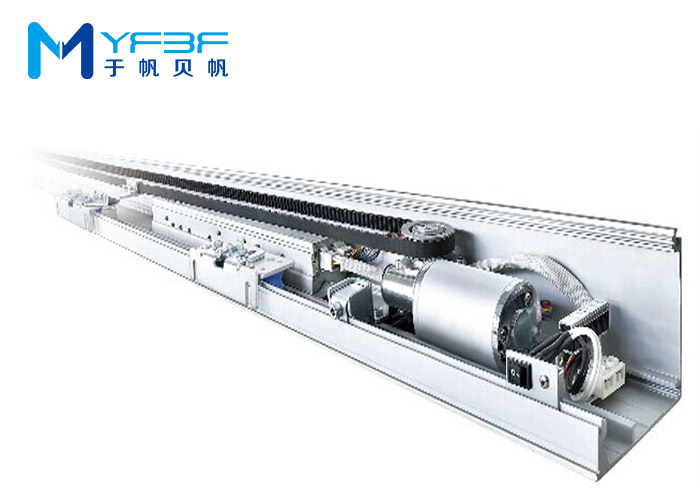
Use the automatic sliding door operator overview page to compare operator families, including the YF150 and the YF200, which the site presents as a heavier-duty option. Then use the YF150 sliding door operator specifications to start a model-specific review. The YF150 page describes a belt-driven unit mounted above the sliding leaves. Its ratings are useful for screening a candidate against the door schedule.
| Item | Manufacturer listing | Project check |
|---|---|---|
| Maximum door weight | One leaf at 300 kg, or two leaves at 200 kg each. | Verify the finished moving mass and get approval for the actual layout, travel, and duty. |
| Leaf width | 700–1,500 mm. | Check the moving leaf dimension separately from the required clear opening. |
| Drive and supply | 24 V, 60 W brushless DC motor. Operator supply listed as AC 90–250 V, 50–60 Hz. | Match the electrical submittal, control options, and incoming supply to the project. |
| Adjustable speeds and open time | Opening 150–500 mm/s, closing 100–450 mm/s, and open time 0–9 seconds. | Have the installer use settings approved for the complete entrance and verify operation for the intended pedestrian traffic. |
| Kit and options | The listed kit includes the rail, belt, hangers, control unit, and microwave sensors. Backup batteries are described as an option. | Verify the exact hardware list, protective sensing, and required response to a power loss. |
Ask the operator supplier to confirm the combination of leaf weight, travel, and expected cycles before approving a hotel application. Use finished mass including glass, framing, and attached hardware. State whether users arrive steadily or in bursts, such as a coach unloading luggage. The listed maximum mass and adjustable speeds are separate catalog fields. Request confirmation for the combination you intend to use, especially if a heavy leaf also sees frequent use. The product page gives no measured installed-door noise figure. Ask for the measurement setup if an operator noise result is offered, then agree a test on the completed entrance.
How should the hotel verify quiet operation?
Agree a repeatable site test with named listening points, background conditions, and the door modes that matter to the hotel. Identify one reference point near the entrance and the occupied positions where quiet matters, such as reception and a nearby guest corridor. Record the microphone position and height, HVAC state, occupancy, and whether either vestibule door is moving. Measure the background and several representative cycles after the final leaves, trim, floor guides, and seals are installed. Record which part of the movement creates any peak. IEC 61672-1 describes sound level meter performance. The project acoustical brief should define the applicable metrics, setup, and limits for this door.
If the complaint is a sharp closing knock, have the project team consider an A-weighted maximum with a specified time weighting, in addition to any average over a clearly defined cycle. A short sound can be prominent in a quiet lobby while making little difference to a longer average. A steady rolling or humming complaint calls for a different comparison. Keep the trace or notes that tie the observation to the cycle stage. Where guest conversations or cleaning equipment dominate the readings, repeat the agreed test when those sources can be accounted for.
Keep protective sensing and the approved door settings in place during acoustic verification. Ask a qualified door installer or inspector to verify detection, movement, clearances, and the project’s power-loss and emergency behavior on the complete entrance. In applicable U.S. projects, ANSI/BHMA A156.10 covers relevant power-operated pedestrian door applications, and the U.S. Access Board door guidance explains accessibility provisions and referenced editions. Confirm the requirements that govern the property. A catalog sensor list or optional battery does not establish the required safety or egress behavior of an installed entrance.
Separate movement noise from street noise at the entrance
A quiet operator can still sit in a lobby that sounds loud whenever the doorway opens. Stand at the same occupied position for a closed-door observation, a movement cycle, and an open-door observation under comparable outdoor conditions. If the change is mainly traffic sound while the passage is open, review the entrance layout and the closed-door sealing strategy with the facade team. If the sound is tied to a particular moment of travel, review that event with the installer. Record both observations so the operator supplier and facade contractor can act on the issues within their packages.
For a property that wants a quieter secondary entrance beside a lounge, the approved glazing and frame finish can be carried through from the main lobby design while the opening layout and controls receive a separate review. Keeping finishes consistent does not require using the same operator configuration on openings that carry different traffic or use different leaf weights.
Give the mockup the same finishes and floor details as the project
A factory demonstration can reveal backlash, uneven motion, or an objectionable tone, but the demonstration stand rarely reproduces a hotel header or lobby finishes. If several entrances share a design, use the first representative installed opening to check the facade interface. If the project includes a thinner header or a different pocket arrangement elsewhere, decide whether that opening needs its own check. Photograph the finished mounting condition and identify which doors the result can represent.
Document acoustic and door-safety checks as separate acceptance items on the same entrance schedule. Have the project team resolve any conflict before handover. For example, if the door opens repeatedly when guests queue near reception, review the approved activation layout and queue position with the installer. That may explain why the desk hears more cycles than expected. Keep protective coverage and traffic requirements in the review while investigating the repeated activations.
Capture the accepted settings and conditions so facilities staff can compare later noise complaints against a real baseline. Record the operator and sensor model, adjustments made by the installer, test locations, and the finished hardware schedule. State who is responsible for the track, guides, and other service items, and retain the approved spares list. If the louder sound reappears after a wheel, seal, or cover is changed, the handover pack gives the service team a starting point for a comparable check.
When the elevation and door schedule are ready, send your requirements with the leaf dimensions and weights, traffic pattern, header and threshold constraints, required safety functions, and acoustic acceptance locations. Ask the supplier to flag anything that remains outside the quoted operator package before a prototype or bulk order is released.
Frequently asked questions
Does a brushless motor guarantee a quiet hotel sliding door?
Sound also depends on the installed track, mounting, guides, seals, and door movement. Test the assembled entrance at representative hotel listening positions.
Should I choose a single-slide or bi-parting hotel entrance?
Use the required clear opening, available space for the leaves, and guest approach route to decide. Confirm the layout on the coordinated drawing and test passage with representative luggage or carts.
Is the YF150′s 1,500 mm figure the clear opening?
The manufacturer lists 1,500 mm as the upper end of the leaf-width range. Verify the clear passage on the finished entrance drawing for the intended leaf and frame configuration.
How should a hotel compare door noise from two quotes?
Ask both suppliers to identify the test assembly, listening location, operating settings, and background conditions. Agree a common on-site procedure if the supplier measurements are not directly comparable.
Does the optional battery show what the door will do during an outage?
The product page identifies backup power as an option. The design team and qualified installer should specify and verify the required power-loss, access-control, and emergency behavior for that entrance.
What should a hotel send before requesting an operator quote?
Send the layout drawing, leaf size and mass, required clear opening, traffic profile, and any limits on header access or threshold design. Include safety interfaces and the proposed quiet-operation acceptance points.
Post time: Nov-26-2026