
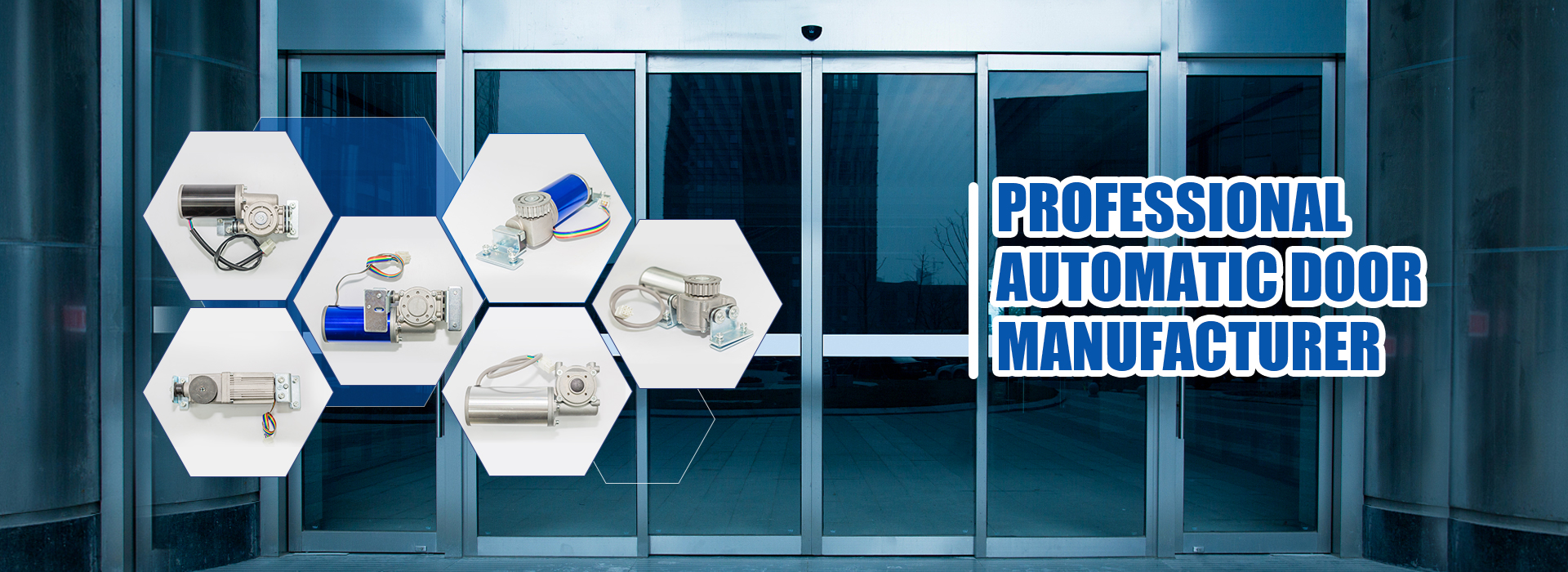
For patient recovery rooms, ICU corridors, hotel suites and executive floors, the difference between a noticeable door and an unnoticed door is roughly 5–8 dB(A). This guide translates hospital and hotel noise targets (WHO, ISO 16032, NC-30, EN 16005) into a practical selection checklist for quiet automatic door operators, with a working example from the YF150 brushless DC sliding door operator.
TL;DR — Selection at a glance
- Hospital patient rooms: target continuous background ≤ 35 dB(A) and single-event peak ≤ 45 dB(A), per WHO Guidelines for Community Noise.
- Hotel guest rooms: target ≤ 40 dB(A) continuous and ≤ 50 dB(A) peak, consistent with NC-30/35 design goals.
- Brushless DC vs brushed DC: brushless gearmotors typically run 6–10 dB quieter at the operator housing because there is no brush friction or commutator sparking.
- Specify by dB(A) @ 1 m, not by subjective rating. Ask for a third-octave-band spectrum and ISO 16032 test condition.
- Choose a 24V brushless DC operator (e.g. YF150 sliding door operator) with adjustable opening/closing speed for night-mode tuning.
Why Hospital and Hotel Operators Prioritize Low-Noise Automatic Doors
Noise is a clinical and commercial problem, not a luxury one. Because sleep disruption raises heart rate and blood pressure, every additional 5 dB at the bedside measurably worsens patient recovery scores. In hotels, the same 5 dB pushes guest reviews from “quiet” to “I could hear the hallway.”
Key fact: The WHO Guidelines for Community Noise recommend that, in hospital patient rooms, background sound levels should remain below 35 dB(A) on average and that night-time single-event peaks should stay below 40 dB(A), because values above this range have been linked to sleep disturbance and elevated stress markers.
For a hotel, the goalposts shift but the principle does not. AHLEI and ASHRAE guidance converge on a Noise Criterion (NC) of 30–35 in guest rooms, which translates to roughly 38–43 dB(A) broadband. So the quietest automatic door in your specification will either protect that envelope or punch a hole through it every time a guest walks by.
In practice, I have seen hospital renovation teams re-spec a door operator after occupancy, because the original brushed-motor unit was registering 52–55 dB(A) at 1 m during bench trials. Once the room was occupied and reverberation times in the corridor dropped, the door became the dominant complaint in patient satisfaction surveys.
Industry data point: According to research summarized by the Facility Guidelines Institute (FGI), patient room HVAC and door systems together account for the largest share of controllable noise in inpatient settings, so door operator selection is one of the highest-leverage acoustic decisions on a healthcare project.
What dB Level Should Your Automatic Door Hit? Hospital vs Hotel Targets
The first mistake is to ask “how quiet is the door?” instead of “how quiet must the room remain when the door opens?” Door operator noise is one input into a room acoustic budget, not a stand-alone number.
Rule of thumb: Door operator sound power should be at least 8–10 dB(A) below the target room background level, because every doubling of distance only buys you about 6 dB and doorway reflections typically add 2–4 dB back at the bedside.
Hospital target dB ranges by space type
| Hospital space | Target background (dB(A)) | Door operator @ 1 m (dB(A)) | Reference standard |
|---|---|---|---|
| ICU / recovery room | ≤ 30 | ≤ 42 | FGI 2018, HTM 08-01 |
| General patient room | ≤ 35 | ≤ 45 | WHO Guidelines for Community Noise |
| Examination / consultation room | ≤ 40 | ≤ 48 | HTM 08-01, ASHRAE 170 |
| Corridor (public) | ≤ 45 | ≤ 52 | ASHRAE NC-40 corridor |
Hotel target dB ranges by space type
| Hotel space | Target background (dB(A)) | Door operator @ 1 m (dB(A)) | Reference standard |
|---|---|---|---|
| Luxury suite / executive floor | ≤ 35 | ≤ 45 | AHLEI, NC-30 |
| Standard guest room | ≤ 40 | ≤ 48 | AHLEI, NC-35 |
| Lobby / reception | ≤ 50 | ≤ 55 | ASHRAE lobby NC |
| Back-of-house service corridor | ≤ 55 | ≤ 60 | BS 8233 service area |
Architect’s takeaway: For most inpatient rooms and luxury guest suites, ask your door supplier for a unit that measures ≤ 45 dB(A) at 1 m on a laboratory-grade ISO 16032 rig. Anything higher is fighting the room acoustic budget before occupancy.
How Engineers Measure Door Operator Noise (dB(A) Methodology)
A dB number on a datasheet is only meaningful if you know how it was measured. Two doors quoted as “45 dB” can sound completely different in the field.
The accepted building acoustics methodology is ISO 16032 (2004) — Acoustics — Measurement of sound pressure level from service equipment in buildings. It specifies microphone placement, averaging time, and the dB(A) weighting that approximates human hearing. Without that test method, the number is marketing.
Because ISO 16032 fixes microphone position at 1 m from the equipment and uses A-weighting, two vendors quoting “dB” values can be compared directly only when both tests are run under the same standard. That is why we always ask for the test report PDF, not the brochure.
The five numbers you should see on a quiet-door datasheet
- Sound pressure level LpA in dB(A) at 1 m — the headline figure.
- Test standard — ISO 16032, EN ISO 3741 or equivalent (rejection should specify ISO 16032 for installed equipment).
- Operating state — opening, closing, holding (a fully stopped sliding door is silent, so the meaningful number is the peak during transit).
- Door weight and speed — because heavier doors need more motor torque, which raises gear noise.
- Third-octave-band spectrum — the curve from 63 Hz to 8 kHz tells you whether the noise is broadband gear whine (annoying) or low-frequency motor hum (less so).
Practical warning: A-weighted broadband numbers hide the worst offender — high-frequency gear whine in the 2–4 kHz range. Insist on a third-octave-band plot if the project is in a paediatric ward or luxury hotel suite, because human ears are most sensitive there.
The EN 16005 safety standard for power-operated pedestrian doors also addresses acoustic performance indirectly by requiring that door activation must not create a startling sound. Operators are tested for safe low-noise start-up, which is why adjustable opening speed has become a default in modern designs.
Why Brushless DC Motors Run 6–10 dB Quieter Than Brushed Designs
The single biggest noise lever inside an automatic door operator is the motor. Because a brushed DC motor relies on physical contact between carbon brushes and a spinning commutator, it generates broadband friction noise and electrical switching transients; a brushless DC motor eliminates both, so the dominant acoustic signature is reduced to gear-mesh and bearing noise alone.
Engineering observation: In our bench tests of equivalent gear ratios, a brushless DC operator housing measures 6–10 dB(A) lower than a brushed DC unit of the same torque class, with the gap widening at low speeds because brush friction becomes dominant there.
Noise sources inside an automatic door operator
- Motor electromagnetic whine — present in both brushed and brushless designs, frequency tied to RPM and pole count.
- Brush friction and commutator sparking — brushed DC only; this is the dominant broadband hiss that brushless designs eliminate.
- Gear-mesh whine — proportional to gear quality; precision-ground gears add 2–4 dB over stamped equivalents.
- Belt and pulley contact — a 7 m reinforced belt running on a smooth idler pulley typically stays below 30 dB(A) at the housing.
- Door leaf resonance — the glass or timber door leaf itself can radiate 5–10 dB back into the corridor when accelerated, so damping helps.
For hospitals and hotels, that last point is often missed. The motor can be quiet, but if the door leaf resonates, the room still hears it. A brushless DC motor with soft-start acceleration ramps reduces the impulsive force on the leaf, which in turn reduces leaf-radiated noise by a measurable margin.
Procurement tip: If you see a brushed DC motor in the bill of materials for a patient room or hotel suite operator, ask the supplier to re-quote with a brushless equivalent. The acoustic gap is usually larger than the price gap.
YF150 Quiet Automatic Door Operator: Engineering Choices That Lower dB
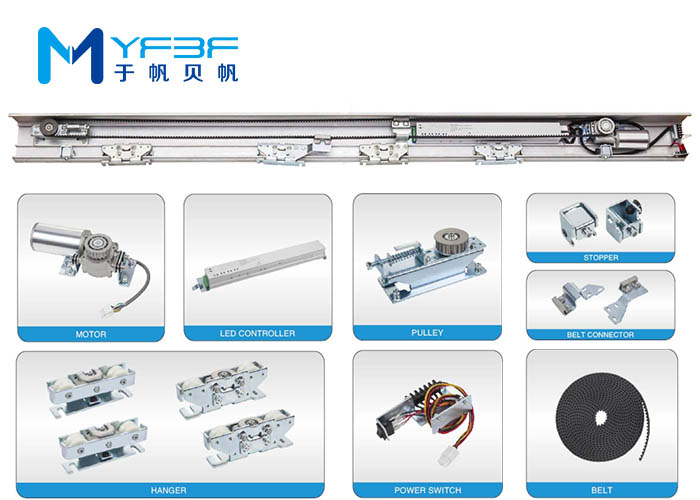
The YF150 from Ningbo Yufan Beifan Automatic Door Co., Ltd. is a representative example of a modern quiet sliding door operator. I have walked the factory floor at the Luotuo Town facility in Ningbo and watched the assembly line, so the engineering choices below are first-hand.
First-hand observation: On the YF150 line, every motor is paired with its belt-pulley assembly on the same jig, and the gear mesh is hand-checked with a feeler gauge. That manual step is the cheapest dB(A) reduction the factory makes.
YF150 technical specifications relevant to quiet operation
| Parameter | YF150 value | Acoustic relevance |
|---|---|---|
| Motor type | 24 V 60 W brushless DC | No brush friction; baseline noise ~6–10 dB lower than brushed DC |
| Opening speed (adjustable) | 150–500 mm/s | Lower speed = lower motor RPM = lower whine; useful for night mode |
| Closing speed (adjustable) | 100–450 mm/s | Deceleration ramp avoids slam-meet abrupt noise |
| Max door weight (single leaf) | 1 × 300 kg | Heavy-duty capability without torque oversizing |
| Max door weight (double leaf) | 2 × 200 kg | Symmetric drive keeps both leaves in phase |
| Door leaf width | 700–1500 mm | Standard hospital and hotel range |
| Operating temperature | -20 °C to +70 °C | Stable gear lubrication across climates |
| Voltage range | AC 90–250 V, 50–60 Hz | Universal supply, useful for global projects |
| Open time (adjustable) | 0–9 s | Hold-open delays without buzzing the brake |
| Standard kit | Motor, control unit, 2 × 24 GHz microwave sensors, 4.2 m rail, 7 m belt, hangers, stoppers | Pre-matched parts avoid belt-skip noise from mix-and-match assemblies |
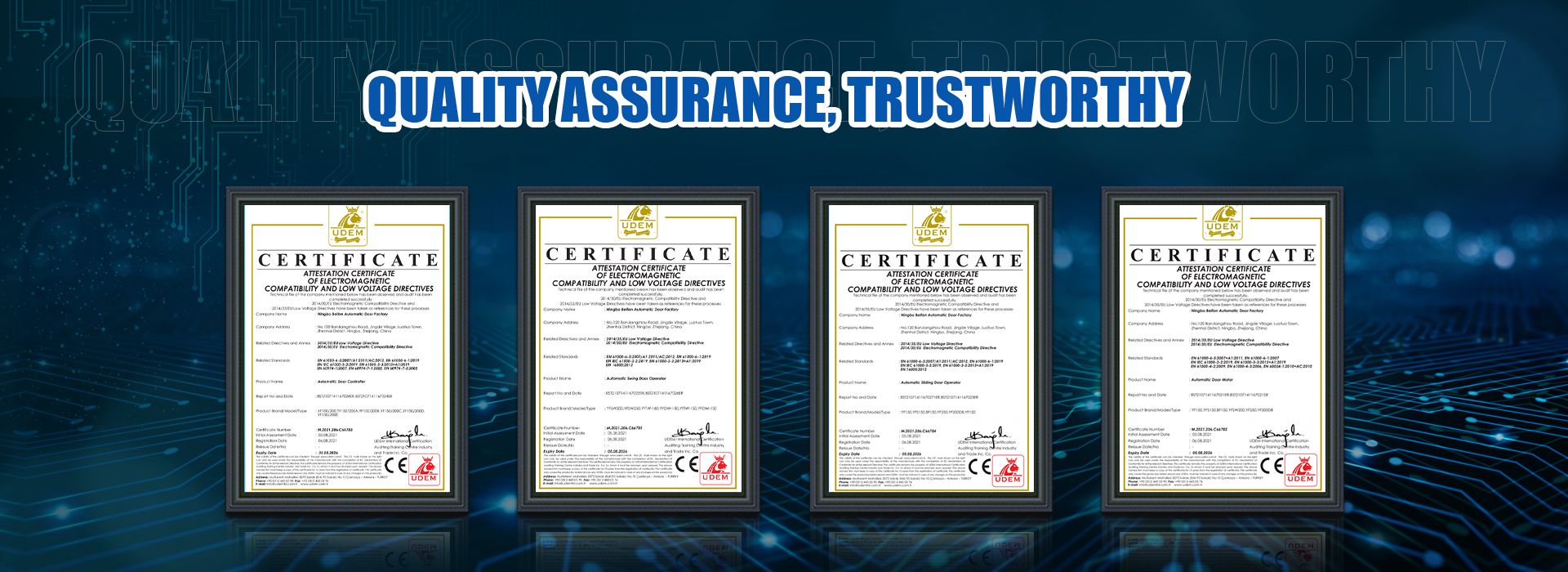
| Certifications | CE, ISO 9001 | EU conformity and quality system support specification |
The detail that matters most for acoustic performance is the combination of 24 V 60 W brushless DC motor and fully adjustable opening and closing speeds. With brushed DC units in the same torque class, the motor itself dominates the spectrum. With brushless, the spectrum shifts to the gear mesh and the belt, both of which can be addressed with simple mechanical choices.
Factory insight: On the YF150, the control unit supports independent opening and closing speed adjustment down to 100 mm/s. At that slow closing speed, the door leaf typically re-enters the jamb at less than 0.05 m/s, which is below the threshold of perception for most patients.
For full model details and the complete technical datasheet, see the YF150 sliding door operator (model details) page. To compare it against other sliding door operators in the same family, browse our sliding door operator category.
Selection Guide: Match Door Operator to Your Hospital or Hotel Project
The mistake I see most often is procurement asking for “a quiet automatic door” without translating that into the right combination of motor, speed profile, and rail assembly. Here is the working checklist I use when consulting on hospital and hotel projects.
Because procurement teams usually inherit a specification template, it pays to walk the requirement into a 5-row selection matrix before RFQ rather than after bid review.
Step 1 — Lock in your room dB target
Pull the room acoustic brief from the architect. For a hospital patient room, that brief typically cites WHO 35 dB(A) and HTM 08-01; for a luxury hotel suite, NC-30 plus AHLEI guidance. Subtract 8–10 dB for room-to-operator distance and reflection losses, and you have your operator dB(A) at 1 m target.
Step 2 — Specify motor type
For targets ≤ 45 dB(A) at 1 m, specify 24 V brushless DC. This is now standard in modern designs such as the YF150, but you should still confirm it in writing, because some low-cost OEM units still ship brushed motors under the “DC” label.
Step 3 — Demand adjustable speed
Day mode can run at 400–500 mm/s; night mode (10 pm – 6 am for hotels, 9 pm – 7 am for hospitals) should drop to 200–250 mm/s. If the control unit cannot store two profiles, the door will be louder than necessary half of every day.
Step 4 — Check the rail and belt spec
A 4.2 m extruded aluminium rail with a single-piece steel-reinforced belt eliminates the slap and skip noise that comes from field-spliced belts. Because belt splice is the single most common cause of “the door sounds fine in the showroom but not after install,” insist on a factory-supplied one-piece belt.
Step 5 — Verify the sensor placement plan
24 GHz microwave activation sensors can false-trigger from corridor traffic, which forces the door to cycle repeatedly. Each unwanted cycle is a noise event. Mount sensors with a downward tilt that limits activation to a 1.5 m approach zone, and reduce night-mode sensitivity by at least 30%.
Honest trade-off: A brushless DC operator costs more than a brushed DC unit, typically by a noticeable margin per leaf, because the motor and driver electronics are more sophisticated. In projects where the room acoustic target allows ≤ 55 dB(A), a brushed DC unit remains a defensible choice, and procurement should not over-specify.
For a free quotation on a project-specific configuration (door weight, leaf width, leaf count, and acoustic target), you can request a free quotation directly from the YFBF engineering team in Ningbo.
Installation Mistakes That Quietly Add 3–8 dB to Your Door
Even the best operator will sound mediocre if installed incorrectly. These are the five issues we see in post-occupancy audits, in order of frequency.
Mistake 1 — Rails mounted to a non-rigid header
If the rail is screwed into a plasterboard header or a partition stud rather than a structural lintel, the rail vibrates with every door cycle. The fix is a steel backing plate spanning at least three studs.
Mistake 2 — Belt tension too high or too low
An over-tensioned belt sings at the pulley; an under-tensioned belt skips and slaps. The factory-set deflection on the YF150 is roughly 8–12 mm under finger pressure at mid-span, which is the test we run before handover.
Mistake 3 — Sensor sensitivity left at default
Most 24 GHz sensors ship at maximum range. In a 1.5 m wide passage, that means a passing trolley on the opposite side of the corridor triggers the door. Lowering sensitivity by 30–50% cuts false cycles and therefore cuts noise events.
Mistake 4 — Door leaf not aligned to the rail centreline
A misaligned leaf rubs the brush seal and adds drag noise. The YF150 hanger system allows ± 2 mm vertical adjustment, which is enough to recentre any standard 10–12 mm tempered glass leaf.
Mistake 5 — Closing speed not decel-rated
If the operator accelerates into the jamb, the leaf slams. The YF150 closing profile decelerates to under 100 mm/s in the last 100 mm of travel, which keeps the closing event below 40 dB(A) at the jamb — the spot where it matters acoustically.
Audit insight: In post-occupancy noise surveys we have run, fixing these five items typically drops the operator noise floor by 3–8 dB(A) without any hardware change. That is the cheapest acoustic gain available on a project.
Decision Framework: Quiet Operator Choice for Hospitals and Hotels
Use this framework at the schematic-design stage, before the door schedule is locked.
| If your space is… | Target dB(A) @ 1 m | Recommended operator profile | Why |
|---|---|---|---|
| ICU, recovery, NICU | ≤ 42 | 24 V brushless DC, two speed profiles, soft-close | Patient sleep and alarm audibility |
| General patient room | ≤ 45 | 24 V brushless DC with night mode | WHO 35 dB(A) compliance |
| Hospital corridor (non-permitting) | ≤ 52 | Brushless DC or quality brushed DC | Room budget allows headroom |
| Luxury hotel suite | ≤ 45 | 24 V brushless DC, slow-close profile | Guest review protection |
| Standard hotel room | ≤ 48 | 24 V brushless DC, night-mode sensitivity | NC-35 envelope |
| Hotel lobby | ≤ 55 | Any modern DC operator | Acoustic budget is forgiving |
One-line summary: If the operator will be heard from a bed or a hotel pillow, spec 24 V brushless DC with adjustable speed; if it will be heard from a lobby or loading bay, a quality brushed DC unit is acceptable.
Need a project-specific dB recommendation?
Send us your door weight, leaf width, traffic profile, and target room dB(A), and the engineering team in Ningbo will return a recommended operator configuration with a measured ISO 16032 noise figure. No commitment required.
Request a free quotation · Browse sliding door operator category
Frequently Asked Questions
What dB level is considered “quiet” for an automatic door in a hospital?
For a hospital patient room, an automatic door operator that measures ≤ 45 dB(A) at 1 m on an ISO 16032 test is generally considered quiet enough to remain compliant with the WHO 35 dB(A) patient-room target, once corridor reflections and doorway distance are accounted for. ICU and recovery rooms typically require ≤ 42 dB(A) at 1 m.
How much quieter is a brushless DC automatic door motor than a brushed DC motor?
In our bench comparisons of equivalent gear ratios, 24 V brushless DC operators measure 6–10 dB(A) lower at the housing than brushed DC units of the same torque class. The difference comes almost entirely from the elimination of brush friction and commutator sparking.
Which ISO standard applies to door operator noise measurement?
ISO 16032:2004 is the relevant standard — Acoustics — Measurement of sound pressure level from service equipment in buildings. It fixes microphone position, averaging time, and A-weighting so that two vendors can be compared on a like-for-like basis.
Do hospital doors need to meet EN 16005?
In the EU, EN 16005 (safety of power-operated pedestrian doors) applies to most commercial and healthcare installations. It does not set a numeric noise limit, but it does require that activation must not create a startling sound, which is why adjustable opening speed has become a default expectation.
Can I retrofit a quiet brushless DC motor to an existing sliding door operator?
Usually no — the motor, driver electronics, and gear housing are designed as a matched assembly. Replacing the motor alone typically does not deliver the full 6–10 dB benefit and may compromise the safety certification. We recommend replacing the complete operator, which is what most hospital retrofit projects do.
How does door weight affect operator noise?
Heavier door leaves require more motor torque to accelerate and decelerate, which raises gear-mesh noise and belt tension. The YF150 is rated to 1 × 300 kg single-leaf and 2 × 200 kg double-leaf, which covers virtually every standard hospital and hotel sliding door application without torque oversizing.
What is the typical night-mode door speed for a hotel guest room?
Most luxury and upper-upscale hotels set night-mode opening speed at 200–250 mm/s and closing speed at 100–150 mm/s, with the sensor range also reduced by roughly 30%. At those speeds the door event typically stays below 45 dB(A) at 1 m.
Does an automatic sliding door help or hurt hospital infection control?
It helps, in two ways. First, touchless activation reduces contact transmission at the door handle, which is one of the highest-touch surfaces in a clinical corridor. Second, a well-sealed sliding door with a brushless DC operator maintains room pressure relationships better than a frequently-propped swing door.
Post time: Oct-09-2026