
I remember the conversation vividly. The building services manager of a 32-floor commercial tower in Hangzhou called me after his fourth failed attempt to get the fire-rated door on Level 14 to respond reliably to the building management system. The system integrator had specified a door control unit from a major European brand — a well-engineered product, frankly — but it had been designed for standalone operation in a single-door configuration. When the project expanded to include 28 synchronized doors across the building, the integration complexity multiplied exponentially. Multiple RS-485 communication loops, conflicting timing parameters, and a control unit that had no concept of cross-door coordination turned what should have been a manageable BMS integration project into an ongoing maintenance headache. When I explained to him how a self-learning microprocessor control unit with multi-door synchronization capability could address his problem, his response was: “Why is this not the standard approach?” It is a good question, and the answer involves a combination of legacy design philosophy, cost sensitivity, and a lack of understanding of how modern automatic door systems in commercial buildings actually need to operate.
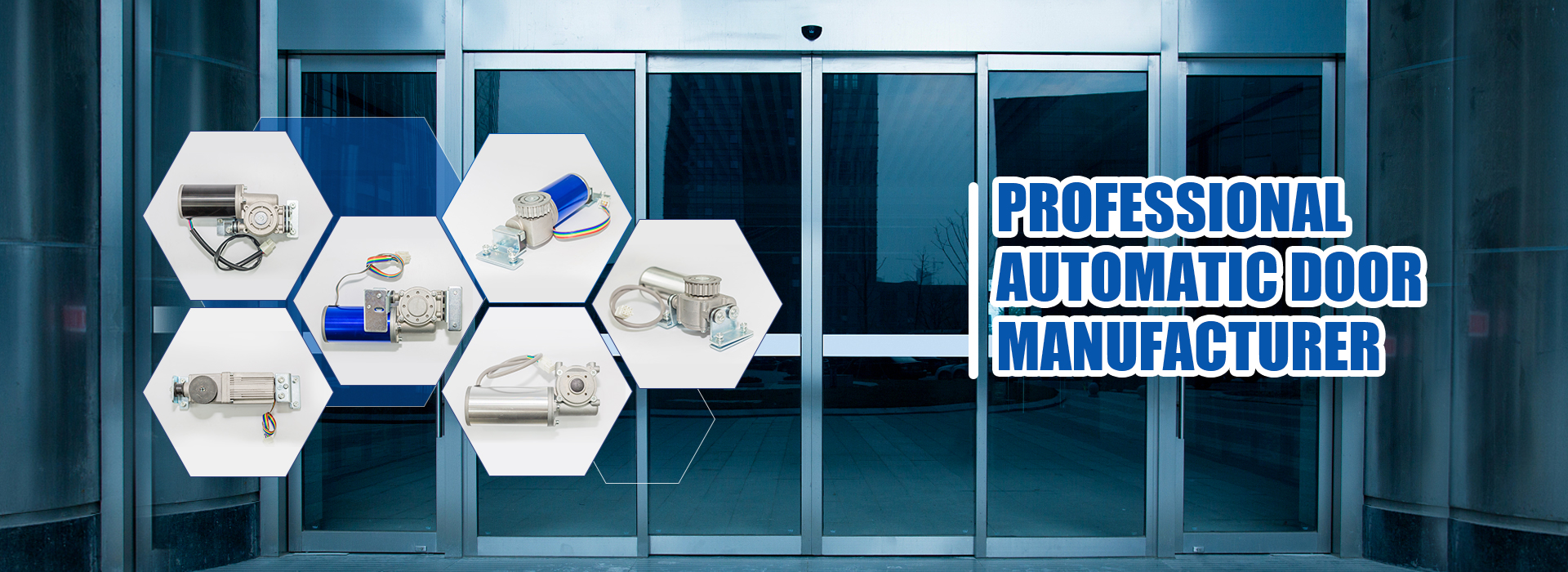
At Yufan Beifan, we have been designing and manufacturing automatic door systems — including 24V brushless DC door motors, control units, and complete operator assemblies — for over a decade. When I joined the company in my current role five years ago, one of the first things I noticed was how many of our international customers were coming to us specifically because they needed multi-door coordination capabilities that their existing suppliers could not provide. This is not surprising. As building management systems become more sophisticated and as energy efficiency regulations tighten, the demand for door control units that can learn from building usage patterns, coordinate opening and closing sequences across multiple doors, and integrate seamlessly with BMS platforms without requiring custom programming has grown substantially. In this article, I want to explain what self-learning microprocessor control units actually do, why they matter for building management applications, and how to evaluate whether a particular control unit and door operator combination is the right choice for your specific installation.
The Multi-Door Coordination Problem That Legacy Control Units Cannot Solve
To understand why self-learning microprocessor control units represent a meaningful advance in automatic door technology, you need to understand the specific problems that arise when you move from managing a single door to managing a coordinated door network across a building. In my conversations with building services managers and electrical contractors, the most common pain points I encounter are related not to the door operators themselves but to the control and coordination layer — and they fall into three categories.
The first problem is timing inconsistency. In a commercial building with multiple entrances, fire stair doors, elevator lobby doors, and parking area doors, each door has its own mechanical characteristics — different door weights, different hinge friction levels, different spring closer tensions for fire-rated doors. A standard control unit with fixed timing parameters can be programmed to open a door to a specific angle or width, but it cannot compensate for these mechanical variations. The result is that some doors in the building open to 80 degrees while others open to 65 degrees. Some doors close in 4 seconds while others take 7 seconds. From a building aesthetics and user experience standpoint, this inconsistency is immediately noticeable and reflects poorly on the building management quality. From a functional standpoint, it can create safety issues — a door that closes too quickly may trap a pedestrian, while a door that closes too slowly may fail to latch properly, compromising fire compartmentation.
The second problem is independent door behavior in a coordinated system. In a large commercial building, there are scenarios where multiple doors need to operate in a coordinated sequence — for instance, in a commercial building lobby where a set of three sliding doors should open and close together to manage traffic flow during peak hours, or in a loading dock area where a sequence of doors between the exterior and interior spaces must be managed to prevent pressure imbalances or unauthorized access. Legacy control units that operate independently cannot manage these sequences without extensive custom programming and additional relay logic. Every time the building usage pattern changes — a new tenant moves in, peak traffic hours shift, or the building’s access control policy changes — the system requires a service engineer to reprogram the coordination logic.
The third problem is the integration gap between door control and building management. A modern commercial building BMS typically expects to communicate with connected systems via standard protocols — BACnet, Modbus, or TCP/IP-based protocols are the most common. A door control unit that does not natively support these protocols requires a protocol gateway or custom integration driver, which adds cost, complexity, and potential points of failure. The building services team ends up maintaining a parallel control infrastructure specifically for the door system, rather than managing it through the unified BMS platform they already have.
What “Self-Learning” Actually Means in a Door Control Unit
The term “self-learning” is used in marketing materials for a wide range of products, and it can mean very different things depending on the implementation. I want to be specific about what self-learning capability means in the context of a microprocessor-based door control unit and what practical benefits it delivers for building management applications.
In the Yufan Beifan control unit design, the self-learning function operates on the following principle: during an initial calibration sequence, the control unit measures the actual mechanical characteristics of the specific door assembly it is controlling — including the door’s mass, the friction in the guide track, the resistance of the spring closer (for fire-rated doors), and the back-pressure from weather stripping or seal compression. It does this by monitoring the current draw of the 24V brushless DC motor during the opening and closing cycle, interpreting the motor current signature as a proxy for mechanical load. This data is stored in the control unit’s non-volatile memory and used to adjust the motor drive parameters for every subsequent cycle.
What this means in practice is that each door in a building of 30 or 40 doors can be individually calibrated to achieve consistent opening angle, closing speed, and latching force — without manual adjustment of mechanical components or individual programming of timing parameters. When I first demonstrated this to the building services manager in Hangzhou I mentioned earlier, his immediate comment was: “The doors are all moving at the same speed now.” That observation — simple and practical — captures the core value of the self-learning approach. It is not a theoretical performance specification. It is a tangible improvement in how the doors behave in the building.
The self-learning capability also extends to usage pattern learning over time. The control unit can record door cycling data — number of cycles per hour, peak traffic periods, average time between activations — and use this data to optimize operating parameters. For instance, in a commercial office building, the system can identify that the main entrance doors experience their heaviest traffic between 8:00 and 9:30 in the morning and between 17:30 and 19:00 in the evening. Based on this pattern, it can automatically adjust the door hold-open time during these peak periods (longer hold-open time to reduce congestion) and return to standard timing during off-peak hours (shorter hold-open time to maintain thermal isolation and security). This adaptive behavior is not something that can be programmed in advance by a technician — it emerges from the control unit’s ongoing learning from actual usage data.
Why 24V Brushless DC Motors Are the Right Choice for Modern Building Door Systems
When I discuss automatic door operator specifications with building developers, electrical contractors, and system integrators, one of the most important technical decisions is the motor type — specifically, the choice between 24V brushless DC motors and traditional 220V AC motors. This choice has implications that extend well beyond the motor itself and affect the entire system architecture, safety performance, and integration capability.
The case for 24V brushless DC motors in building automatic door applications is grounded in three fundamental advantages: safety, efficiency, and controllability. On safety: a 24V DC motor operating at low voltage presents significantly lower electrical shock hazard than a 220V AC motor, which is particularly important in door installations where the operator is mounted at accessible heights on the door frame, maintenance technicians may be working on ladders near live electrical components, and the door operator may be installed in public areas where water or cleaning solutions could create electrical hazards. In my experience, the safety advantage of 24V operation is one of the primary reasons why building developers and facility managers in regulated markets increasingly specify low-voltage door operators for public-access installations.
On efficiency: brushless DC motors convert electrical energy to mechanical energy with significantly higher efficiency than AC induction motors — typically 85-90% efficiency compared to 60-70% for AC motors of equivalent mechanical output. In a building with 30 or 40 automatic doors, each running 100-200 cycles per day, the aggregate electricity consumption difference between brushless DC and AC motor operators is meaningful — typically 30-40% lower energy consumption for the brushless DC solution. Over a ten-year building operational lifecycle, this energy saving is substantial.
On controllability: brushless DC motors respond to variable speed signals with precise, reproducible performance. The motor speed is controlled by the frequency and voltage of the drive signal from the microprocessor controller, which means the self-learning algorithm can modulate door opening and closing speed with high precision based on the learned mechanical characteristics of the specific door assembly. This level of control is simply not achievable with AC motors, which run at fixed speed and require mechanical variators or complex gearbox designs to achieve variable opening/closing speeds.
Multi-Door Synchronization: How the Architecture Works
For building management applications where multiple doors need to operate in a coordinated manner, the synchronization architecture is a critical design element. I want to explain how the Yufan Beifan multi-door synchronization system is structured because understanding the architecture helps building services managers and system integrators evaluate whether this approach will meet their specific requirements.
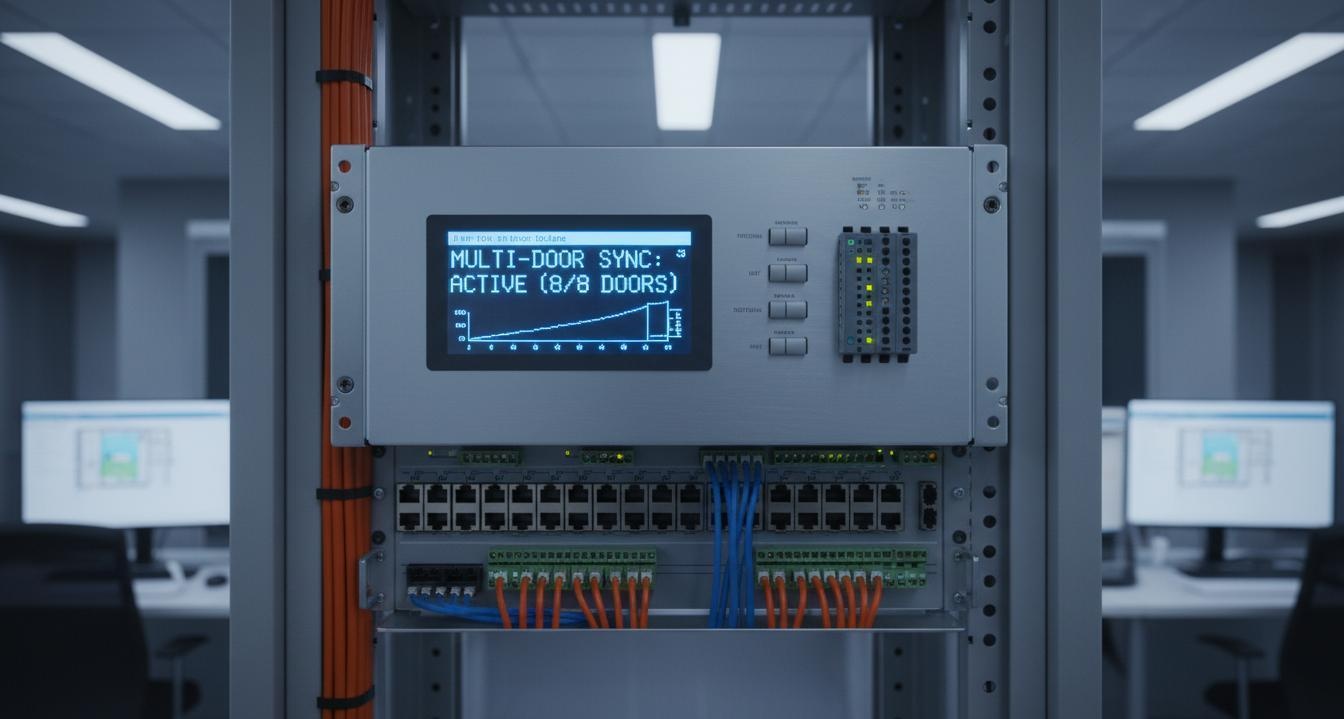
The synchronization system uses a master-slave configuration over an RS-485 bus. One control unit is designated as the master for a door group — typically a group of 2 to 8 doors that need to operate in a coordinated sequence. The master control unit maintains a synchronization clock and sends coordinated command messages to the slave units on the bus. Each slave control unit executes its assigned door movement in synchronization with the master, using the timing parameters it has learned during its self-learning calibration phase. The result is that all doors in the group move together with consistent timing, regardless of their individual mechanical characteristics.
The RS-485 bus also connects the door group master to the building management system via a protocol converter. We offer native BACnet and Modbus support, and we can provide TCP/IP integration for buildings that use IP-based building management platforms. The BMS sends high-level commands — “open Group 3 doors,” “set Group 3 to night mode,” “report door Group 3 status” — to the master control unit, which interprets these commands and coordinates the appropriate actions across all doors in the group. This is a significant simplification compared to integration architectures where the BMS must communicate individually with each door controller, and it dramatically reduces the programming complexity of the BMS integration.
I should also mention the fire alarm integration, because this is a non-negotiable requirement in most commercial building codes. The master control unit accepts a dry-contact fire alarm signal from the building’s fire alarm system. When the fire alarm signal is received, all doors in the group execute their fire-rated door sequence — typically opening fully to clear the egress path, then releasing any door hold-open mechanisms so that spring-loaded fire doors close and latch. The microprocessor control unit logs the fire alarm event with a timestamp, which is useful for post-incident review and for building code compliance documentation.
OEM and ODM Customization: Why It Matters for Building Projects
One of the most significant trends I have observed in our international business over the past five years is the increasing demand from project developers and system integrators for OEM and ODM customization of automatic door control units and operators. The reason is straightforward: the automatic door market is fragmented, with many building projects requiring specific combinations of form factor, communication protocol, and functional behavior that standard catalog products cannot provide.
At Yufan Beifan, we have built our manufacturing capability around flexible OEM and ODM production — meaning we can modify the mechanical form factor of our door operators, customize the firmware behavior of our control units, and adapt the communication protocol stack to meet specific project requirements. This capability is particularly valuable for building projects in markets with specific regulatory requirements or aesthetic standards that differ from the mainstream market. For example, we have supplied door operators with custom housing colors and finishes for architectural projects where the door operator must match the building’s visual design language, and we have developed custom BMS integration firmware for buildings that use proprietary building management protocols not supported by standard catalog products.
The ODM process at Yufan Beifan typically begins with a technical consultation where we review the project specifications, the building management system architecture, and any specific functional requirements. From this consultation, we develop a specification document that defines the mechanical, electrical, and firmware modifications required. We then produce prototypes for testing and validation, typically within 8-12 weeks of the specification being finalized. For production volumes, we maintain the custom configuration as a dedicated product variant, ensuring consistency across all units supplied to the project. This approach has allowed us to support projects ranging from small commercial fit-outs with 4-6 doors to large-scale installations with 200+ doors across multiple buildings.
Evaluating a Door Control Unit for Multi-Door Building Management Applications
If you are specifying door control units for a building project with multi-door coordination requirements, I recommend evaluating potential suppliers against the following criteria, based on the questions we receive most frequently from customers during the specification phase.
First, verify the synchronization architecture. Ask specifically how the supplier’s control unit handles a door group where individual doors have significantly different mechanical characteristics — for instance, a heavy fire-rated door compared to a lightweight interior door in the same group. The correct answer is that each control unit should individually calibrate to its door’s mechanical characteristics, with the master unit coordinating timing at the group level rather than imposing uniform timing parameters across doors with different mechanical loads.
Second, confirm BMS protocol support. Ask whether the control unit supports native BACnet or Modbus, or whether it requires an external protocol gateway. Native protocol support reduces integration cost and complexity, and it eliminates a potential failure point. Ask specifically about the BMS integration: what high-level commands does the control unit accept, how does it report status back to the BMS, and how is the fire alarm integration handled at the protocol level?
Third, evaluate the self-learning calibration procedure. Ask how long the calibration takes, whether it requires special tools or training, and whether it can be performed by a building maintenance technician or requires a specialist. The calibration process should be straightforward and repeatable — ideally a push-button sequence that the control unit executes autonomously without requiring external measurement equipment or manual adjustment of parameters.
Fourth, assess the supplier’s customization capability. If your project has specific requirements — a particular housing form factor, a custom communication protocol, a specific behavior during power failure or fire alarm — ask the supplier to describe their customization process, timeline, and cost implications. The best suppliers will treat customization as a standard part of their business rather than an exception that requires senior management approval.
The Building Management Evolution Is Already Happening
I want to close with an observation about where I see the automatic door market heading, based on my experience working with building developers, system integrators, and facility management teams across multiple markets.
The building management industry is moving toward integrated, data-driven building operation. Modern BMS platforms are no longer simply control systems — they are analytics platforms that collect operational data from all building systems and use that data to optimize energy consumption, predict maintenance needs, and improve occupant comfort and safety. For automatic door systems to participate in this evolution, the door control unit needs to be more than a simple relay that opens and closes a door in response to a sensor signal. It needs to be an intelligent node on the building network — capable of reporting operational status, recording usage patterns, and adapting its behavior based on both programmed parameters and learned data.
The self-learning microprocessor control units that Yufan Beifan and other leading manufacturers are developing are the foundation of this evolution. They represent a shift from door control as a mechanical function to door control as an integrated building systems function — one that contributes data to the BMS, receives coordinated commands from the BMS, and adapts its behavior to optimize building performance as a whole. For building developers and facility managers who are planning for the next decade of building operation, this is the specification direction that makes sense. The buildings that are being designed and built today will be in operation for 30-50 years. Ensuring that their door systems are integrated, adaptable, and capable of participating in evolving building management architectures is not a luxury — it is a sound investment in building operational quality.
Frequently Asked Questions
Internal Links:
YF200 Automatic Sliding Door Operator — Yufan Beifan Automatic Door
Full Product Range — Yufan Beifan Automatic Door Systems
Contact:
Contact Yufan Beifan — Request a Custom Door System Quote
External References: EN 16005 Power Operated Doors · CE Machinery Directive · ISO 9001 Quality Management · Yufan Product Catalogue
Post time: Jun-22-2026