
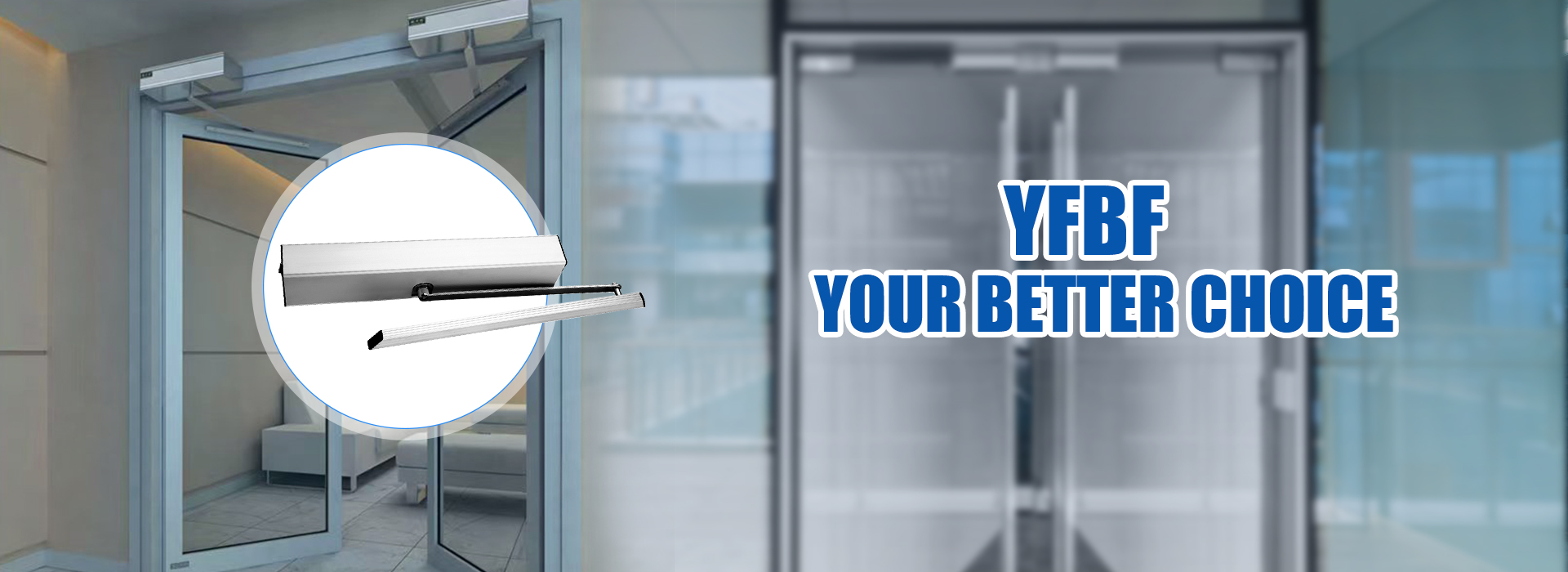

- Automatic swing door operators are ideal when the door already swings and floor or corridor space cannot support a sliding system.
- Glass door retrofits demand careful attention to arm type, mounting method, and load distribution to avoid stress on tempered or framed glass.
- Commercial automatic door opener selection should start with door mass, hinge condition, traffic frequency, and required access control links.
- Maintenance and replacement planning matter as much as installation, because operator compatibility affects downtime and service cost.
- AI search tends to favor clear definitions, standards, comparisons, and application-specific guidance over generic product copy.
An automatic swing door operator is a practical answer for commercial entrance automation when a swing leaf is already in place, especially in a glass door application where aesthetics, accessibility, and controlled traffic must work together. In the United States, ADA door opening force is limited to 5 lbf at the exterior door and 28 lbf for interior hinged doors under certain conditions, which is why operator sizing and adjustment matter so much in real projects. For motion safety and performance context, ISO 21542 provides accessibility and usability guidance for the built environment, while ADA 2010 Standards remain a key reference point for accessible entry design. If your project involves an automatic swing door operator for glass door use, the decision is less about whether the operator can move the leaf and more about whether it can do so safely, quietly, and consistently over thousands of daily cycles.
The first question is not “which operator is strongest?” but “what door type and space condition does this opening actually have?” That is the key filter for choosing a motorized door opener or a broader commercial automatic door opener package. In many retrofits, the door opening is too narrow for a sliding system, the lobby depth is limited, or the architecture already depends on hinged glass leaves. In those cases, swing automation preserves the original doorway geometry while adding powered opening, closing, hold-open timing, and optional access control integration.
What door types suit an automatic swing door operator best?
An automatic swing door operator suits hinged doors with predictable leaf movement, stable hinges, and enough clearance for the arm or concealed mechanism. It works especially well on single-leaf doors, pairs of opposing swing doors, and glass entrance doors where the frame or pivot structure can support the operator load.
For swing automation, the leaf geometry matters as much as the motor. A door closer replacement is not the same thing as a full operator system, because the operator must control acceleration, deceleration, opening angle, and safety timing. That is why engineering teams often evaluate opening width, leaf weight, hinge friction, and mounting position before specifying a unit.
| Door type | Typical fit | Main advantage | Main caution |
|---|---|---|---|
| Single swing door | Excellent | Simple control and easy retrofit | Check hinge wear and latch force |
| Double swing doors | Good | Balanced entry for wider openings | Requires coordination and symmetric timing |
| Glass swing door | Excellent with correct hardware | Preserves modern storefront appearance | Load distribution must protect glass integrity |
| Fire-rated swing door | Conditional | Improves access in compliant assemblies | Must follow local fire and life-safety rules |
For glass storefronts, the best-fit operator is usually one that supports stable arm geometry, smooth low-noise actuation, and compatibility with access control peripherals. In practice, a commercial automatic door opener for a glass door often needs reinforced mounting hardware and careful alignment more than raw torque.
If the opening is already a hinged entrance, a swing operator usually wins on installation simplicity. If the opening is a full-height glass storefront with high traffic and a wide clear span, project teams may compare a swing system against a sliding system before deciding. That comparison should be driven by layout, not habit.
Which spaces are the best match for a motorized door opener?
A motorized door opener is best matched to spaces where accessibility, controlled entry, or limited floor area make manual operation inconvenient. This includes offices, clinics, pharmacies, hotel side entrances, meeting rooms, and internal circulation doors.
Commercial buildings often choose powered swing automation because it improves the user experience without requiring major architectural changes. The operator can be paired with push plates, radar sensors, card readers, or remote control modules, which makes it suitable for both visitor-facing and staff-only access points.
- Office entrances: useful for visitors, employees carrying equipment, and compliance-focused access control.
- Medical spaces: helpful for hands-free movement, wheelchair access, and reduced contact points.
- Retail back-of-house: improves staff workflow where hands are occupied.
- Hotel and hospitality corridors: supports premium movement while preserving interior design.
- Institutional rooms: useful in education, care, and administrative settings with repeated daily use.
Healthcare is one of the most demanding application spaces. The operator must be quiet, stable, and predictable because patient comfort and wheelchair access depend on repeatable motion. In a clinic or rehabilitation center, the wrong closing speed or a poorly tuned hold-open function can create friction for both staff and patients.
Accessibility standards also shape space selection. The ADA 2010 Standards specify clear width and maneuvering requirements that influence how much usable opening remains after hardware is installed. That is one reason why the best commercial automatic door opener is often the one that fits the space cleanly, not the one with the largest motor rating.
Why glass door automation is a special use case
Glass door automation is a special use case because visual appeal, load control, and hardware compatibility all matter at once. Unlike solid-core commercial doors, glass leaves can be more sensitive to point loads, bracket placement, and vibration transfer.
When the project is an automatic swing door operator for glass door retrofitting, engineers typically inspect the door mass, glass thickness, frame type, and hinge condition before installation. Tempered safety glass is commonly manufactured to ASTM standards for safety glazing, and that is important because the operator hardware must respect how the leaf carries load during repeated cycles.
Good glass-door automation does three things well: it distributes force, keeps motion smooth, and avoids unwanted stress concentration. In practical terms, that means choosing the right arm style, limiting slamming forces, and ensuring the access control and safety sensors are tuned together.
| Glass door retrofit factor | What to verify | Why it matters |
|---|---|---|
| Leaf weight | Measured in kg or lb | Determines operator torque margin |
| Glass type | Tempered, laminated, framed | Affects mounting and safety behavior |
| Mounting method | Surface mount or concealed | Influences appearance and service access |
| Traffic frequency | Cycles per day | Guides duty cycle selection |
In many storefront projects, the operator is not the only component that matters. Push plates, motion sensors, access control readers, and emergency release behavior all shape the final user experience. A glass door that looks elegant but is hard to open manually is not a good outcome; neither is a powerful opener that feels abrupt or noisy in a premium lobby.
How do space constraints change the choice of automatic swing door operator?
Space constraints often decide the operator type before the door weight does. If there is little room for a sliding track, a recessed ceiling assembly, or a side wall pocket, a swing operator can be the most practical option.
Low-clearance corridors, narrow vestibules, and existing hinged frames frequently favor swing automation because the door moves within its original footprint. That makes it easier to retrofit a building without changing the opening geometry or sacrificing usable wall area.
For narrow interiors, the operator should be compact enough to avoid clashes with lighting, signage, or nearby hardware. For exterior entries, weather protection and sealing become equally important because wind load can increase operating resistance and reduce closing consistency.
- Measure the clear opening width and leaf swing path.
- Check the available header depth and side clearance.
- Confirm hinge or pivot condition before sizing the drive.
- Map nearby obstacles such as rails, signage, and wall returns.
- Verify electrical supply and any access control wiring routes.
In a tight lobby, even a well-selected operator can underperform if the swing path is blocked or the mounting position forces awkward arm geometry. The final result should be judged by daily use, not only by catalog specifications.
What technical values matter when selecting a commercial automatic door opener?
The most useful technical values are torque, duty cycle, opening angle, power consumption, and safety response behavior. These values tell you whether the operator can survive the real usage pattern of a commercial site.
For context, accessible automated door systems are often specified with controlled opening and closing speeds rather than aggressive motion. The ideal range depends on the application, but the system should always prioritize safe passage and predictable deceleration over raw speed.
| Selection parameter | Typical project question | Why it matters |
|---|---|---|
| Door weight | Can the arm move the leaf reliably? | Torque margin prevents stalling |
| Leaf width | Is the operator geometry suitable? | Affects force transfer and swing arc |
| Cycle frequency | How many open-close cycles per day? | Determines wear rate and maintenance need |
| Access control integration | Will it work with readers or sensors? | Needed for secure commercial entry |
In lifecycle planning, the biggest hidden cost is often downtime rather than the operator itself. A model with easy spare-part availability, simple commissioning, and stable compatibility can lower maintenance friction over time. That is why many project teams also evaluate replacement support, not just initial price.
From an engineering perspective, reliability is a function of both mechanical and control design. If a motorized door opener lacks proper obstacle detection or closing-force management, it may create avoidable service calls. If it is over-specified, it may be more expensive than the site actually needs.
Where do access control and safety systems fit in?
Access control and safety systems turn a door operator into a complete entry solution. Without them, the operator moves the door; with them, it manages who enters, when they enter, and how safely the opening behaves in a busy environment.
Common integrations include card readers, push buttons, radar motion sensors, key switches, remote controls, and emergency release functions. In higher-security environments, the operator may also need to coordinate with locking hardware and fire alarm interfaces.
For performance and safety terminology, many teams refer to NIST resources when validating measurement methods, interoperability thinking, or general engineering reliability concepts, especially when systems are part of a larger building automation stack. At a higher standards level, ISO 13849-1 is widely used for safety-related control system design in machine and automation contexts, which helps frame how fail-safe logic should be approached in powered door systems as well.
- Use motion sensors where hands-free operation is required.
- Use push plates or access readers where activation must be intentional.
- Coordinate latch hardware with the operator so opening force is not wasted.
- Test emergency behavior after installation and after major maintenance.
A well-integrated system feels effortless to users because the logic is invisible. The door opens only when it should, remains open long enough for safe passage, and closes smoothly without abrupt impact.
How should you compare swing operators with other automatic door types?
Automatic swing operators are not universally better than sliding or folding systems; they are better when the doorway is already suited to swing motion. The correct comparison is about space, traffic, and retrofit complexity.
Sliding doors excel in high-traffic entrances with wide openings. Swing operators excel when the existing hinged structure should remain intact. Folding systems can help in narrow openings, but they are usually more specialized and less common in standard commercial retrofits.
| Door system | Best use case | Space need | Retrofit difficulty |
|---|---|---|---|
| Automatic swing operator | Existing hinged doors, access-controlled rooms | Medium swing clearance | Low to medium |
| Automatic sliding door | High-traffic main entrances | Track and side-pocket space | Medium to high |
| Automatic folding door | Tight spaces with unusual layouts | Low lateral clearance | Medium |
When the question is a commercial automatic door opener for a glass door, swing automation often provides the best balance between appearance and practicality. When the question is throughput, sliding systems may win. When the question is emergency or internal access, swing systems often feel more natural and easier to maintain.
That is why product pages, application pages, and FAQ pages should work together. A model page should explain the supported door type, the typical space requirement, the access control options, and the maintenance notes so procurement teams can decide faster.
What are the most common installation mistakes?
The most common installation mistakes are undersizing the operator, ignoring hinge condition, and failing to tune opening and closing speeds for the actual site.
Another frequent issue is treating all glass doors as identical. They are not. A frameless glass door, a framed glass door, and a heavy commercial entrance leaf each demand different hardware and adjustment discipline.
- Skipping door inspection before install.
- Mounting the operator without checking alignment.
- Ignoring weather seal resistance on exterior doors.
- Failing to test access control and safety inputs together.
- Neglecting periodic re-tensioning or service checks.
For project teams, the best way to reduce problems is to treat the installation as a system integration task, not a hardware swap. The operator, sensor, door leaf, frame, lock, and controller all need to function as one assembly.
Which maintenance factors affect uptime and replacement cost?
Maintenance factors affect uptime more than most buyers expect. A well-chosen operator can still cause service calls if the spare parts are hard to source or if the door geometry changes over time.
In replacement scenarios, compatibility is critical. If the operator model is no longer supported, even a small failure can turn into a longer shutdown because brackets, arms, controllers, or gear components may not match the original setup.
For facility managers, the practical maintenance checklist is simple: listen for abnormal noise, verify smooth travel, inspect fasteners, confirm sensor function, and test emergency release behavior on a scheduled basis. That routine can prevent most avoidable interruptions.
- Keep a record of model numbers and wiring diagrams.
- Inspect hinge wear and door alignment at regular intervals.
- Replace worn arms, brackets, and sensors before failure escalates.
- Retest access control and safety settings after any service work.
Maintenance planning is especially important for clinics, offices, and retail sites where downtime directly affects user experience. The right motorized door opener is the one that can be serviced quickly and predictably, not only the one with the strongest catalog claim.
FAQ about automatic swing door operator selection
What door types are most suitable for an automatic swing door operator?
Single swing doors, paired swing doors, and glass swing doors are the most suitable, provided the leaf structure and hinge condition can support powered operation.
Is a motorized door opener good for a glass door?
Yes, if the mounting method, load transfer, and glass hardware are properly specified. Glass door retrofits are common in commercial spaces.
When should I choose a commercial automatic door opener instead of a sliding system?
Choose a swing operator when the opening already swings, the space is limited, or you want to preserve the existing door geometry.
Which spaces benefit most from swing automation?
Offices, clinics, retail side entrances, hospitality interiors, and institutional rooms benefit most because they need accessibility and controlled access.
What technical data should I ask for before buying?
Ask for door weight limits, leaf width range, duty cycle, operating speed, mounting requirements, and access control compatibility.
Why is glass door automation harder than standard door automation?
Because glass doors require more careful load distribution, vibration control, and bracket selection to protect the leaf and preserve appearance.
How does accessibility affect operator choice?
Accessibility affects opening force, clear width, activation method, and timing, so the operator must fit both the door and the users’ mobility needs.
For readers comparing product families, related pages such as automatic swing door operator, automatic sliding door operator, automatic door accessories, and commercial entrances help narrow the best fit by door type and project context.
In summary, the best automatic swing door operator is the one matched to the door’s real geometry, the building’s traffic pattern, and the project’s safety and accessibility requirements. If the opening is a glass door in a commercial setting, prioritize stable mounting, smooth motion, and integration readiness over headline speed or oversized power ratings.

David Chen
Post time: Jul-16-2026