
If you have ever spec’d an automatic door for a US commercial, healthcare, or public facility, you have hit the same wall: the ADA rules say automatic, but they do not always say what kind of automatic. Choosing the wrong category does not just delay commissioning — it triggers re-work at acceptance testing, fails the building inspector, and forces the contractor to put the door back into compliance before the building opens.
This guide covers what ADA Standards 404.3 actually require for automatic doors, how ANSI/BHMA A156.19 and A156.10 carve up the operator categories, what the opening-timer and kinetic-energy limits are, where EN 16005 intersects for international projects, and the seven things you should confirm with a manufacturer before placing a US-bound order.
By the end, you should be able to read a manufacturer’s spec sheet and tell whether the operator is suitable for an ADA-regulated entrance at the door weight and swing geometry you are installing — and what to ask if the spec sheet is silent.

1. What the ADA Actually Says About Automatic Doors
When project specifiers say “the ADA,” they usually mean the 2010 ADA Standards for Accessible Design. The operative section for automatic doors is 404.3 — “Automatic Doors and Power-Assisted Doors.” It is short, but it does most of the regulatory lifting, and the references inside it route you to the standards that fill in the technical detail.
404.3 has two practical effects. First, it sets the accessibility baseline — clear-width, maneuvering clearance, threshold geometry, and controls that any automatic door must satisfy. Second, it routes the operator category to two ANSI/BHMA standards: A156.19 for low-energy power-operated doors, and A156.10 for full-power power-operated doors. These two standards are where the technical detail (speed, force, kinetic energy, sensor coverage, re-opening) actually lives.
Full-power vs. low-energy: the ADA’s two paths
The split between full-power and low-energy is the most consequential decision in automatic-door compliance.
- Full-power (ANSI/BHMA A156.10): Higher-traffic or heavier-panel entrances. Faster opening and closing speeds, higher kinetic energy, safety relies on sensors that reverse the door before contact-injury. Used in airports, hospitals, large retail, and transit hubs.
- Low-energy (ANSI/BHMA A156.19): Typical pedestrian entrances. Slower speeds, capped kinetic energy so the door is safe even if the safety re-opening fails, activation by push-button or knowing-act sensor. The default category for ADA-regulated automatic doors in most retail, office, hospitality, healthcare-adjacent, and education facilities.
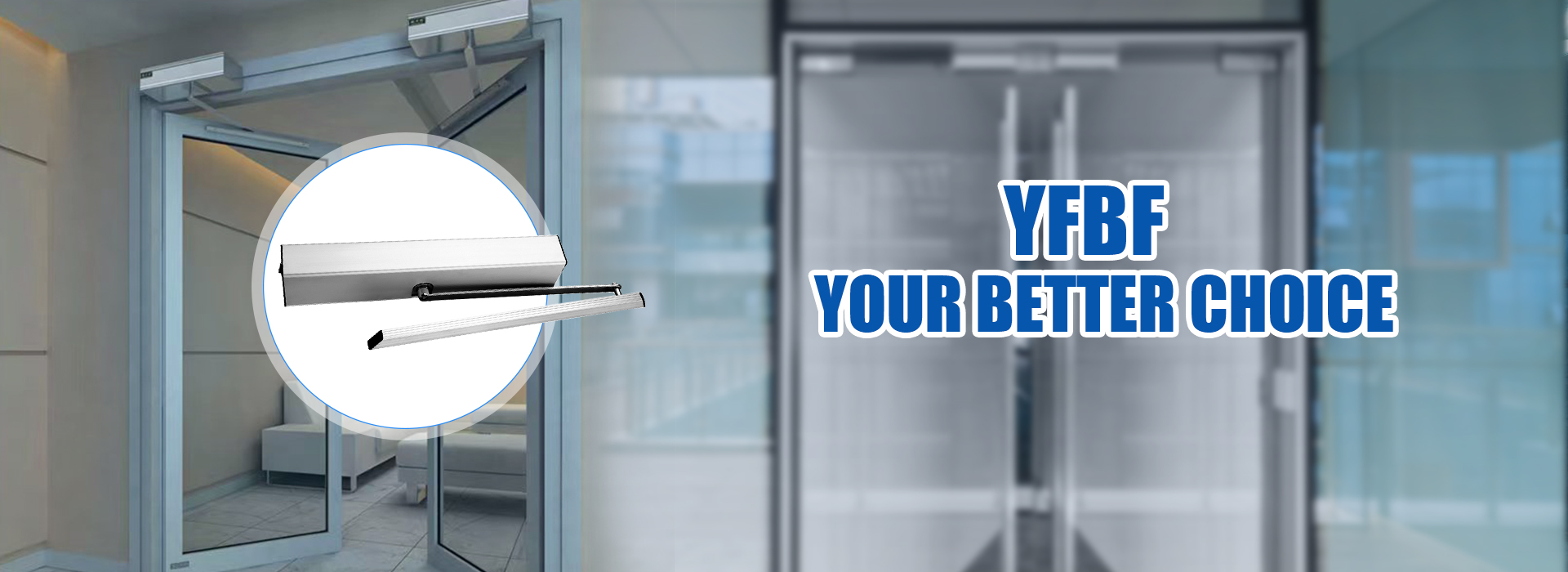
The YFSW200 swing door operator, for example, is a low-energy operator in the A156.19 category — the appropriate default for an ADA-regulated entrance in a typical commercial facility. Choosing a full-power operator for a low-traffic office door usually adds cost and sensor complexity without a usability benefit.
What 404.3 does not say
404.3 does not specify opening time, closing time, or hold-open duration in seconds. Those numbers come from A156.19 / A156.10 and from the manufacturer’s tested performance at the door weight installed. The ADA also does not specify which percentage of entrances must be automatic — that is a scoping question handled by sections 206 and 404, with separate scoping for alterations and additions.
The practical takeaway: read 404.3 for the accessibility geometry, then read A156.19 (or A156.10, whichever you specified) for the operational performance. The two documents work together — neither is sufficient on its own.
Practical takeaway
The fastest way to mis-spec an automatic door is to assume “ADA-compliant” means “any operator that opens automatically.” It does not. The ADA pulls in A156.19 or A156.10 for the operational side, and the operator category you pick determines the equipment, the sensor suite, the kinetic-energy test, and the documentation you need at handover.
2. Low-Energy Operator Requirements: Speed, Force, and Timing
Low-energy operators under ANSI/BHMA A156.19 have to satisfy four operational criteria, each verified at commissioning by the manufacturer’s test report at the actual door weight installed.
Opening time
A156.19 specifies a minimum time for the door to swing from fully closed to fully open. The minimum exists to give users — particularly wheelchair, walker, and slow-ambulatory users — enough time to clear the doorway as the door opens behind them. Typical installations use opening times in the low single-digit seconds range.
Speeds faster than the A156.19 minimum can be unsafe: a user approaching the door may not have time to recognise that the door is opening, locate the threshold, and clear it before the door begins to close. Slower is fine for safety but can be a usability problem in heavy-traffic entrances.
Closing time
The closing cycle has a similar floor, also defined in A156.19. Closing too fast risks contact injury at the closing edge; closing too slow is an energy-efficiency problem (heat loss, conditioning loss) and a security concern if a door stays open longer than necessary.
Kinetic energy cap
The defining safety number for a low-energy door is the kinetic energy of the closing door, calculated as a function of door weight and closing speed. A156.19 publishes a maximum that keeps the closing energy below the threshold at which a door edge contacting a stationary body part would cause injury. This is what makes low-energy doors different from full-power doors: even if the sensor suite fails to detect an obstacle, the door itself is mechanically incapable of inflicting a serious impact injury.
Reputable manufacturers publish a test report showing the kinetic energy of their operator at your specific door weight (and at a worst-case closing speed). The number is rarely on the marketing spec; it is in the compliance documentation. If a manufacturer cannot produce that report at quote stage, the door is not actually A156.19-compliant for your door weight.
Re-opening on obstacle
The fourth operational requirement is that the door re-open (or stop and reverse) if an obstacle is detected during closing. For a low-energy door, this is a secondary safeguard behind the kinetic-energy cap — for a full-power door, it is the primary safeguard, with much faster response required by A156.10.
| Requirement | A156.19 (low-energy) target | Verified by |
|---|---|---|
| Opening time | Minimum (low single-digit seconds typical) | Manufacturer test report at installed door weight |
| Closing time | Minimum (low single-digit seconds typical) | Manufacturer test report at installed door weight |
| Kinetic energy cap | Maximum published in A156.19 | Manufacturer test report at installed door weight |
| Re-opening on obstacle | Reverse or stop during closing | Knowing-act sensor coverage diagram + commissioning test |
Practical takeaway
Request the A156.19 compliance documentation before you order, not after. The four items in the table are verified against your door weight and geometry, not a generic reference door. A spec sheet that says “A156.19-compliant” without a test report attached is a marketing claim, not a verified one.
3. ADA Opening Timer Rules: How Long a Door Must Stay Open
The opening-timer question is the one US project specifiers ask most often. There are two timer regimes — one for push-button-activated doors, one for sensor-activated doors — and the ADA rule differs between them.
Push-button-activated doors: the minimum hold-open
When the activation device is a push button, the door has to remain open long enough for a mobility-aid user to clear the doorway at a normal pace. The common industry practice — and the de-facto rule inspectors check against — is a minimum hold-open in the range of five seconds. Setting it too short causes a real-world failure: a user presses, door opens, door closes before the user clears the threshold.
Sensor-activated doors: presence-based timing
Sensor-activated doors close when the sensor no longer detects a user. There is no fixed minimum hold-open in seconds, because the closing trigger is the user’s physical absence from the activation zone, not a timer. The ADA does require that the door provide adequate time for the slowest expected user to clear the doorway, usually verified at commissioning by timing a representative mobility-aid user.
Vestibule and two-way traffic rules
Vestibules (small enclosed entry chambers common in cold-climate US commercial buildings) add a third timing concern: if two sets of doors are in series, they have to be sequenced so they do not close on a user mid-vestibule. A156.19 and the manufacturer’s commissioning guide cover this via a vestibule controller that holds the first door open until the second door has opened, and vice versa. For two-way traffic, the standard approach is a sensor on the approach side of each leaf, with the controller deciding which side the door is open to at any given moment.
What the timer does not control
The opening timer does not handle the door-locked state (that is the access-control system) or emergency-exit timing (NFPA 101 and the local fire marshal’s requirements can pre-empt the ADA timer in some configurations).
Practical takeaway
If the door is push-button-activated, ask for the hold-open setting at commissioning. If it is sensor-activated, ask for the sensor presence diagram and a commissioning test record. Both regimes have to demonstrate that a mobility-aid user clears the doorway — the only difference is whether the timer is expressed in seconds or in sensor presence.
4. Where ADA Requires Automatic Doors (and Where It Doesn’t)
The scoping question — where in a building the ADA actually requires an automatic door — is the most frequently misunderstood part of the ADA for project specifiers.
The 10% rule (and its scoping cousins)
For most facility categories, the ADA scoping language requires that a defined percentage of public entrances be accessible (with or without automatic operation) and that a further defined subset be automatic. The headline numbers vary: “at least 60% of public entrances in new construction” or “at least one automatic door per entrance where two or more entrances are provided” are starting points, not the whole rule. Healthcare, transit, and hospitality have stricter or differently-structured scoping. Treat any single percentage in marketing material as a starting point for the conversation, not the final answer.
Exceptions: employee-only entrances
Employee-only entrances are a common exception. Where an entrance serves only employees and is not the only accessible entrance to the facility, the ADA scoping for automatic doors does not apply. The accessibility baseline still applies (maneuvering clearance, threshold geometry), but the operator is not required to be automatic.
Exceptions: existing facilities
For existing facilities, the ADA requires barrier removal where readily achievable, not full new-construction compliance. Automatic doors are not usually required as a remediation step unless the facility is undergoing an alteration that triggers the new-construction rules. The practical test is whether the work is maintenance (barrier-removal standard) or alteration (new-construction standard).
Exceptions: historic preservation
For facilities listed on (or eligible for) the National Register of Historic Places, the ADA allows an exception when compliance would threaten the historic significance of the building. The exception is narrow and case-by-case. Engage with the State Historic Preservation Officer (SHPO) and the local building inspector before assuming the exception covers the proposed work.
Equivalent facilitation
Where strict ADA compliance is not feasible, the ADA permits “equivalent facilitation” — an alternative design that provides equivalent or greater accessibility (a powered door opener, a call button to staff, or a designated accessible entrance that is not the main entrance). Equivalent facilitation is documented case-by-case and reviewed at inspection.
For international projects, the scoping categories differ from the ADA. EN 16005 in the EU and the IBC in the US use different scoping rules for automatic doors — an EU-specifier looking at an ADA-regulated US project should confirm the ADA scoping at the facility category in question.
Practical takeaway
Before specifying an automatic door, confirm three scoping questions: which facility category the building falls into; whether the entrance is a public, employee, or service entrance; and whether the project is new construction, alteration, or maintenance.
5. Safety Sensors, Know-Act, and the Re-Engagement Rule
The safety story for an automatic door is the combination of three elements: the kinetic-energy cap (covered in H2 #2), the knowing-act sensor (or push button), and the re-engagement rule that re-opens the door if an obstacle appears during closing. None is sufficient alone; the door is only ADA-compliant when they work together at the actual door weight installed.
The knowing-act requirement
A156.19 requires that a low-energy door not start moving unless there is a deliberate signal that a person wants it to open. This rules out motion sensors that fire on any movement in the approach zone (which would cause the door to open for any passing pedestrian, including those who are not approaching the door).
The two practical implementations are: a push button or push plate (typically wall-mounted, at an ADA-compliant height of around 36–48 inches above the floor), or a knowing-act sensor that detects a deliberate approach — usually by sensing the user’s path and direction of travel, not just any movement. The automatic-swing-door-opener category on our site covers operator models that work with both activation modes.
Sensor coverage: approach side and threshold side
Low-energy automatic doors usually carry two sensors: one on the approach side (to detect a user about to use the door) and one on the threshold / closing side (to detect a user still in the doorway when the door begins to close). The combination is what allows the door to be operated safely in both directions and to re-open if a user moves into the closing path unexpectedly.
Sensor coverage is adjustable (height, angle, detection distance, sensitivity) and has to be set at commissioning. The manufacturer’s coverage diagram is the reference, and the installer verifies the diagram against the installed geometry before sign-off.
The re-engagement rule
If an obstacle is detected during closing, A156.19 requires the door to re-open (or stop and reverse). For a low-energy operator, the kinetic-energy cap is the primary safeguard; the re-opening requirement is the secondary safeguard. Both have to be functional — a sensor failure that prevents re-opening is a separate non-conformance, not “balanced” by the kinetic-energy cap.
The commissioning test is straightforward: place an obstacle (a soft test object) in the closing path, initiate the close cycle, verify the door reverses within the standard-defined response time.
Manual breakout force
A related requirement is the manual breakout force — the force required to push the door open manually when the operator is not powered (or in fail-safe mode). For a low-energy swing door, this is usually defined as a force limit in the low tens of pounds — light enough for an ambulatory user to push the door open without assistance if the operator fails. The exact limit is published in A156.19 and verified at commissioning.
Practical takeaway
The three safety elements (kinetic energy, sensors, re-engagement) have to be specified together. A complete quote for an ADA-regulated entrance should include the kinetic-energy test report at your door weight, the sensor coverage diagram, and a commissioning test plan for the re-engagement rule.
6. ADA vs. EN 16005: A Side-by-Side for International Projects
For international project specifiers — and for Chinese factories selling into both US and EU markets — the relationship between ADA and EN 16005 is a common source of confusion. The two standards overlap in scope but diverge in detail. Treating them as interchangeable is a mistake that surfaces at acceptance testing.
Where the two standards overlap
Both ADA (via A156.19 / A156.10) and EN 16005 cover the safety basics: kinetic-energy limits, re-opening on obstacle, knowing-act activation, sensor performance, and test methodology. A well-designed low-energy swing door operator can — and usually does — meet both standards with the same hardware, provided the manufacturer has tested both regimes and documented compliance to each.
For manufacturers selling in both markets, the typical engineering pattern is to design to the stricter of the two requirements on each parameter, then document compliance to both. This is how operators like our YFSW200 swing door operator are typically sold into US, EU, and Asian projects from a single product platform, with EN 16005 documentation issued by the manufacturer’s test lab alongside the ANSI/BHMA test report.
Where they diverge
The differences are in detail, not in principle. Divergences to watch for:
- Scoping rules. ADA scoping is set by sections 404 and 206; EN 16005 does not set scoping, which is left to national building codes in each EU member state.
- Force and energy limits. Both standards cap kinetic energy, but the formulae, test methods, and pass/fail thresholds differ. A kinetic-energy value that passes EN 16005 does not automatically pass ADA/A156.19.
- Sensor coverage diagrams. EN 16005 specifies sensor coverage in more detail than A156.19. Coverage that meets EN 16005 typically meets A156.19, but the inverse is not always true.
- Test report format. US-bound delivery typically needs an ANSI/BHMA-aligned test report; EU-bound delivery typically needs an EN 16005 test report.
What this means for project procurement
For US projects, ADA + A156.19 (or A156.10) documentation is what you request and verify. EN 16005 is a useful secondary check — if the operator carries both certifications, the engineering is more robust — but EN 16005 is not a substitute for ADA Title III compliance on US projects.
For EU projects, EN 16005 is the primary standard, with national building codes providing the scoping context. ADA documentation is not a substitute for EN 16005 on EU projects.
For international project procurement, the safe approach is to require both compliance documents at quote stage. Manufacturers who design for both markets will not object; manufacturers who design for one market only may not have the test data to back up the other.
Practical takeaway
Request both ADA + A156.19 and EN 16005 test reports at quote stage. The two documents overlap but are not substitutes. If a supplier can only provide one, the engineering may not be tested for both regimes.
7. Specifying an ADA-Compliant Automatic Door: A 7-Point Pre-Purchase Checklist
Before you place a US-bound order, work through this checklist with the manufacturer. Each item is something inspectors check at commissioning.
- Confirm the operator category. Low-energy (ANSI/BHMA A156.19) for typical pedestrian entrances; full-power (ANSI/BHMA A156.10) for higher-traffic or heavier-panel entrances where low-energy operation is impractical.
- Confirm opening and closing speeds at your door weight. The test report has to be at the actual door weight and geometry installed — not at a generic reference door.
- Confirm the hold-open time or sensor presence logic. For push-button activation, request the factory-set hold-open in seconds. For sensor activation, request the sensor coverage diagram and the commissioning test record.
- Confirm the kinetic-energy compliance. Request the test report showing the kinetic energy at your door weight and closing speed. The number has to satisfy A156.19 (or A156.10, whichever you specified).
- Confirm the sensor suite and coverage. Request the approach-side and threshold-side sensor coverage diagram. Verify the diagram against the site geometry.
- Confirm the push-button placement and ADA geometry. Push buttons at ADA-compliant height (typically 36–48 inches above the floor), with a clear floor space for approach.
- Confirm the documentation package. ADA Declaration of Conformity; ANSI/BHMA test report; sensor coverage diagram; commissioning checklist; (for EU projects) EN 16005 test report. All at quote stage, not after delivery.
For international project procurement, the same seven points apply, with two additional considerations: documentation language (English for the US, local language for the EU) and the local inspection authority.
Frequently Asked Questions
No. The ADA requires that a defined percentage of entrances be accessible, and that a further defined subset be automatic when the facility is large enough to meet the scoping thresholds. Existing facilities have separate obligations, with exceptions for employee-only entrances, historic preservation, and equivalent facilitation.
A low-energy operator (ANSI/BHMA A156.19) has slower speeds, a kinetic-energy cap, and push-button or knowing-act sensor activation. A full-power operator (ANSI/BHMA A156.10) requires safety sensors that reverse the door when an obstacle is detected, and is intended for entrances where higher traffic or heavier panels make low-energy operation impractical.
For push-button activation, common industry practice is a minimum hold-open of about five seconds — verified by timing a representative mobility-aid user. Sensor-activated doors close when the sensor no longer detects a user; there is no fixed minimum in seconds, but the door still has to provide adequate time for the slowest expected user to clear the doorway.
Practically yes — sensor-activated doors close when the sensor no longer detects a user, which is typically faster than a fixed push-button hold-open. The ADA does not mandate a fixed minimum for sensor-actuated doors, but the door still has to provide adequate time for the slowest expected user. This is usually verified at commissioning by timing a representative mobility-aid user passing through.
Both. The 2010 ADA Standards apply to new construction, alterations, and additions. For existing facilities, the ADA requires barrier removal where readily achievable. Automatic doors are not usually required as a remediation step unless the facility is undergoing an alteration that triggers the new-construction rules. The historic-preservation exception applies when compliance would threaten the historic significance of a building.
ANSI/BHMA A156.19 caps the kinetic energy at a defined threshold, expressed as a function of door weight and closing speed. Specific unit values are published in the A156.19 standard; project specifiers should request the manufacturer’s test report showing compliance at the door weight installed.
Often, but not automatically. EN 16005 is the European standard for power-operated pedestrian doorsets; the two standards overlap in scope but diverge in detail (test methods, performance thresholds, scoping rules). A door shipped in the US by a manufacturer who also sells in Europe should be supplied with both compliance documents.
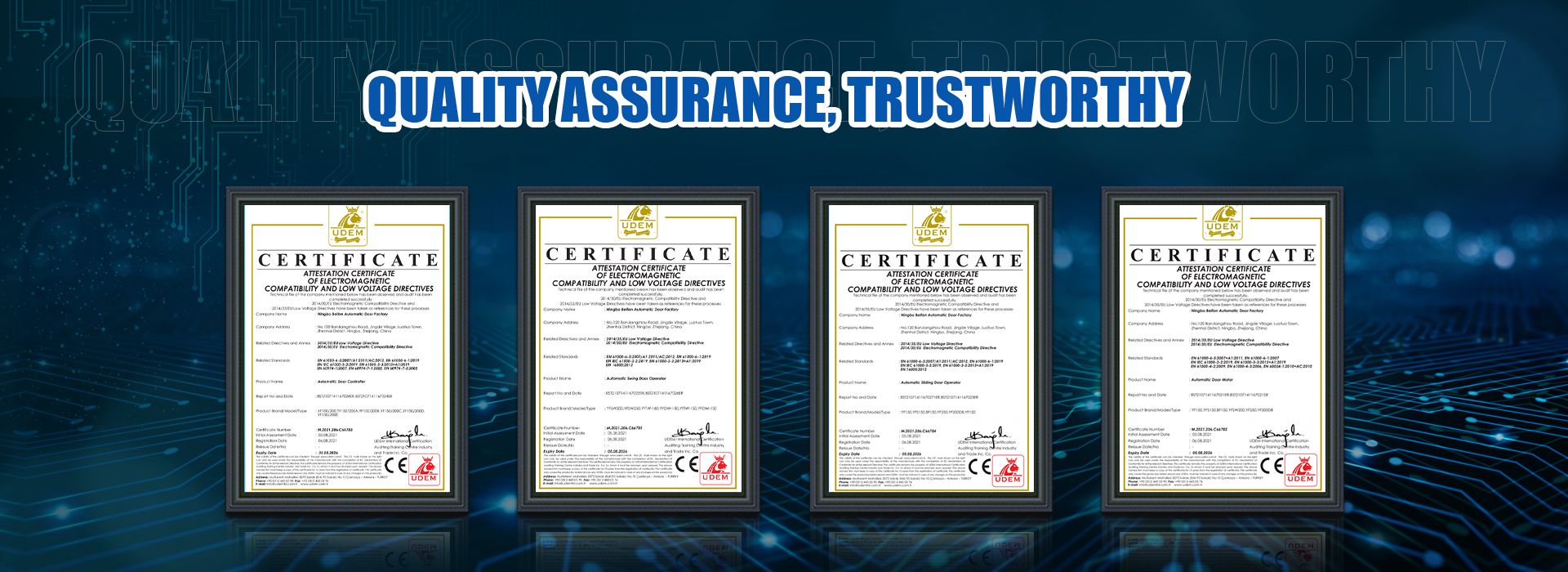
At minimum: a Declaration of Conformity referencing ADA Standards 404.3 and the relevant ANSI/BHMA standard (A156.19 or A156.10); a factory test report showing closing force, opening/closing time, kinetic energy, and re-opening requirements at the door weight installed; a sensor coverage diagram; a wiring and commissioning checklist; and (for EU markets) an EN 16005 test report. Reputable manufacturers supply these at quote stage. See our EN 16005 FAQs for the EU side of the same documentation set.
Edison — Sales Manager, Ningbo Yufan Beifan Automatic Door Co., Ltd.
Edison manages global project inquiries and OEM/ODM custom solutions for Ningbo Yufan Beifan Automatic Door Co., Ltd. The company specialises in automatic door system R&D and manufacturing, with core products including automatic sliding door operators, 24V brushless DC door motors, and accessories, widely used in commercial buildings, public facilities, and industrial sites.
Edison works directly with distributors and project procurement clients worldwide, supporting scope definition, operator category selection, and documentation packages for ADA + ANSI/BHMA A156.19 and EN 16005 compliance. For project quotation, share the door weight, swing geometry, traffic profile, and target destination country.
Post time: Sep-30-2026