
TL;DR
- An automatic door system has six functional groups: the operator and motor, the controller, activation sensors, safety sensors, mode-switching and access-control accessories, and the power and mechanical transmission parts.
- The motor moves the door, the controller decides when it moves, and the sensors decide when the controller is allowed to respond, so a fault in any one of the three changes the behaviour of the whole door.
- The M-254 presence sensor covers a 1600 mm by 800 mm field, responds in under 100 milliseconds and draws 30 mA standby at DC 12 V, which is a meaningful difference on a door that runs sixteen hours a day.
- The M-218D safety beam reaches 10 metres with 5.5 m leads on both the transmitter and the receiver side, so it suits wide openings where a single overhead presence field cannot cover the threshold.
- The M-204G microwave sensor detects movement as slow as 5 cm/s across a 4 m by 2 m field at a 2.2 m mounting height, which is why it is the usual activation sensor on an exposed entrance.
- Mode control is a hardware component rather than a software setting: a five-key function selector exposes five operating states and is rated for more than 75,000 mechanical operations.
- Compliance belongs to the doorway rather than to the individual part. The ANSI/DCEA A156.10 low-energy doorway standard, the BS EN 16005 pedestrian doorset standard and the US Access Board ADA Standards judge opening force and safety sensing separately, so one component rarely satisfies both.
An automatic door components guide has to answer one question before anything else: which part is responsible for what. The answer is that a working automatic door is built from six functional groups. The operator and its 24V brushless DC motor produce the force that moves the leaf. The controller decides when that force is applied. Activation sensors request an opening. Safety sensors prevent the door from closing on somebody. Mode-switching and access-control accessories define what the doorway is allowed to do at any given moment. Power supply and mechanical transmission support the other four. In my experience, when an automatic door behaves badly, the motor is the part everybody blames and the controller and sensors are the parts that are actually mismatched.
This guide works through each group in the order a specifier meets them, explains what the published figures on a component actually mean in practice, and identifies the three or four places where a specification decision quietly determines whether the finished door passes inspection. It is written for procurement teams, installers and OEM integrators rather than for end users, because that is where most component choices are locked in.
What Are the Main Automatic Door Components?
An automatic door system consists of six functional component groups: operator and motor, controller, activation sensors, safety sensors, mode and access-control accessories, and power plus mechanical transmission. The motor provides the force, the controller provides the logic, the activation sensor provides the request and the safety sensor provides the veto. Each group has a different failure mode, and because the groups are chained, a weak link anywhere changes the behaviour of the whole assembly.
When I walk a customer through a quote, I always draw the same six-box diagram. It is simple, and it consistently prevents the two mistakes I see most often. The first is buying one large sensor and expecting it to cover activation, presence and safety, which it cannot, because activation needs range while safety needs certainty. The second is treating the function selector as decoration, when in a multi-use building it is usually the component that determines how the building is actually operated at seven in the morning versus nine at night.
Our full automatic door accessories range is a useful reference for this, because it shows how the same accessory families, the sensors and the mode selector in particular, are built around consistent voltage levels and relay conventions rather than around one-off designs. That consistency is what lets a multi-site rollout be serviced with one spare list rather than one spare list per building.
How Does a 24V Brushless DC Automatic Door Motor Work?
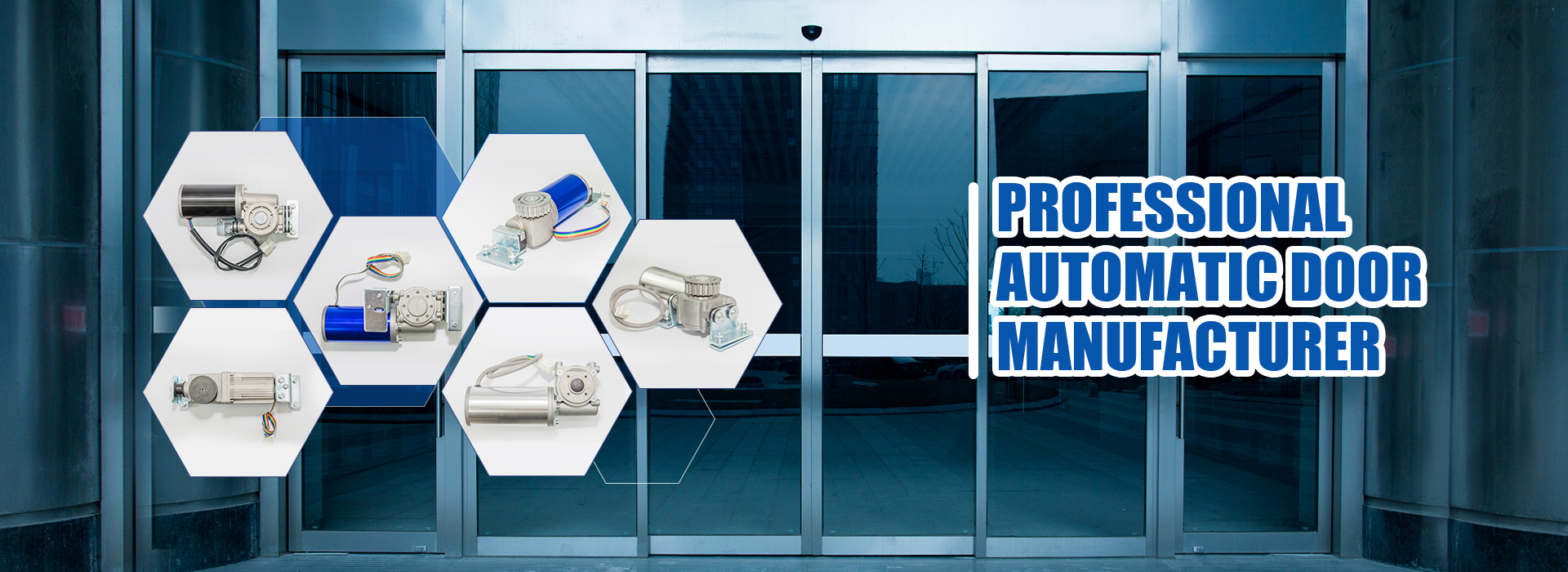
A 24V brushless DC automatic door motor converts low-voltage DC into controlled rotary motion, and its value lies in delivering repeatable torque without the wear and electrical noise associated with a brushed motor. The operator housing couples that motion to a belt or gear train, which converts rotation into the linear travel of the sliding leaf. Because the motor runs on low voltage, the whole power chain stays below the thresholds that complicate site wiring and integration with access-control equipment.
Low voltage alone is not the reason to choose brushless DC. Repeatability is. A brushed motor wears its commutator over time, and as the wear progresses the starting torque and the closing effort drift, which shows up as a door that closes faster in summer than in winter. Because automatic doors are judged on whether they close consistently and stop in the same position every time, a motor that does not drift is what turns a closed loop into a dependable door.
We size the motor against the measured leaf mass and the required opening speed rather than against the door width, because width is a proxy and mass is the load. That is one of the few places in the specification where a two-minute measurement on site saves a much longer argument later. If the mass is estimated rather than weighed, the commissioning team ends up adjusting the closing speed and force parameters to compensate, and the sensor timing inherits that compensation without anyone deciding it deliberately.
What Does the Automatic Door Controller Actually Do?
The controller is the automatic door component that converts sensor signals and mode selections into motor commands, and it is where timing, force, hold time and safety logic are configured. It reads the activation sensor, reads the safety sensor, checks the selected mode, and then commands the operator to open, hold or close. It also determines what happens when a sensor fails, which is the part most specifiers never ask about.
That last point deserves emphasis. A controller configured only for normal operation will often treat a broken safety beam as a reason to hold the door, which is safe but not necessarily correct for the facility. A controller configured for fire and emergency interfaces will behave differently again. Because sensor failure behaviour is a facility decision rather than a hardware decision, it belongs in the written specification and not in an installer’s default.
Practically, this means the controller has to be matched to the motor voltage and current, and it has to have enough auxiliary outputs for the sensors, the electric lock and the access-control readers you actually intend to fit. Adding a reader and a lock to a controller with no spare output is a design error, and no amount of careful wiring recovers it afterwards.
Which Sensors Does an Automatic Door Need?
A compliant automatic door needs at least one activation sensor to request an opening and at least one safety sensor to hold it open when the threshold is occupied, and these are two different jobs that happen to share one doorway. The activation sensor is optimised for range and approach detection. The safety sensor is optimised for certainty inside the swing zone. Combining them into one housing is possible and increasingly common, but combining them into one function is not.
Infrared motion and presence sensing
The M-254 integrates motion and presence detection in one housing using modulated infrared light, and it is the part we specify when a doorway needs a true hold-open field rather than a simple approach trigger. The M-254 has a published detection field of 1600 mm wide by 800 mm deep, a response time under 100 milliseconds and a standby current of 30 mA at DC 12 V against an action current of 110 mA. The sixteen presence spots from four emitters are what allow it to hold the door open for a stationary person, while the forty-eight motion spots from the twelve emitters handle the approach. The unit self-learns its background over about ten seconds, which is what lets it compensate for gradual changes in ambient light and direct sunlight rather than drifting out of calibration over a season.
The 940 nm infrared source, the ABS cover, the 2.5 m cable and the operating range of minus 40 to plus 60 degrees Celsius define where it can be installed. Maximum installation height is 3000 mm and the unit measures 229 mm by 67 mm by 41 mm. Our own preference is to use its separate motion and presence relay outputs so the controller treats activation and safety as independent signals, rather than tying both functions to one output and hoping the timing works out.
Through-beam safety sensing
The M-218D is the through-beam alternative for openings that an overhead field cannot serve. The M-218D has a published maximum matched distance of 10 metres with 5.5 m leads on both the transmitting and the receiving side, draws 18 mA standby current and supports single-beam or double-beam configurations. The colour-coded plug and socket pairing reduces wiring errors on site, which matters more than it sounds when the same kit is being installed across a multi-site rollout.
Installation geometry is specific and worth quoting exactly. Single-beam units mount at about 600 mm above the floor, while a double-beam arrangement places one set at about 300 mm and the second at about 900 mm. The electric eyes use 13 mm mounting holes, the controller measures 105.5 mm by 53.4 mm by 28.5 mm, and the output is selectable between normally open and normally closed by dip switch. The receiving head includes a short-circuit fault alarm, which is one of those features that only earns its cost on a high-traffic door.
Microwave activation sensing
The M-204G is the activation sensor for exposed entrances, where wind, rain and wide approach areas make optical activation less predictable. The M-204G detects movement as slow as 5 cm/s across a 4 m by 2 m field at a 2.2 m mounting height, operates at 24.125 GHz below 20 dBm EIRP, and is adjustable from 30 to 60 degrees. It accepts an AC 12 to 24 V supply within plus or minus 10 percent, draws less than 2 VA, and provides a COM and NO relay output rated at 1 A with a hold time of two seconds.
The caveat matters as much as the specification. Microwave sensing is motion-based, so a stationary person is not a presence, which is why a microwave sensor cannot be the only safety device on a door. The product documentation also warns against fluorescent lighting, moving objects and placement behind a shield, and notes that rain can trigger repeated operation unless a waterproof accessory is fitted. The factory default angle is 45 degrees and the widest setting can cause the door to cycle on its own, so we always set angle and sensitivity together at commissioning rather than accepting the default and hoping the building stays unchanged.
| Specification | M-254 infrared motion and presence | M-218D through-beam safety | M-204G microwave motion |
|---|---|---|---|
| Primary role | Activation plus hold-open presence | Safety interruption | Activation request |
| Power input | AC/DC 12–24 V ±10% | AC/DC 12–30 V per the parameter table | AC 12–24 V ±10%, 50–60 Hz |
| Standby current | 30 mA at DC 12 V | 18 mA | Less than 2 VA total |
| Detection geometry | 1600 mm wide by 800 mm deep | Up to 10 m matched beam distance | 4 m by 2 m at 2.2 m mounting height |
| Response behaviour | Under 100 ms response, 10 s self-learning | NO/NC output selected by dip switch | 2 s hold time, 5 cm/s minimum speed |
| Operating temperature | −40 °C to 60 °C | −42 °C to 45 °C | −20 °C to 55 °C |
| Housing and lead | ABS, 229 by 67 by 41 mm, 2.5 m cable | Controller 105.5 by 53.4 by 28.5 mm, 5.5 m transmitter and receiver leads | ABS, 120 by 80 by 50 mm, 2.5 m cable |
Why Sensor Selection Matters More Than Most Buyers Realize
Sensor selection determines whether a door is usable rather than merely operational, because a door that opens too readily is a nuisance and a door that fails to detect is a safety exposure. Those two failure modes pull in opposite directions, which is why tuning one sensor to fix one problem often creates the other problem on a different day.
Because a microwave sensor detects movement rather than occupation, a doorway protected by microwave activation alone will eventually close on a person who has stopped moving, so the safety function must be carried by a separate presence or beam sensor. That is not a criticism of microwave technology. It is a statement about the job each technology was built to do, and it is why we treat the sensor list as a safety-critical part of the specification rather than as an accessory line that can be trimmed to hit a budget.
There is a second causal chain worth naming, and it concerns environments rather than people. Metal louvres, revolving elements, fluorescent lighting, rainwater and moving signage all create reflections or movement that a microwave sensor reads as a request to open. Because those conditions change over the life of a building rather than over the life of a component, a sensor that is correctly installed on day one can still need adjustment in year three. That is an argument for specifying an adjustment procedure and recording a documented baseline, not an argument for buying a more expensive sensor and hoping the environment stays still.
Our practical position is deliberately unglamorous. We record the mounting height, the sensor angle and the sensitivity setting at commissioning, we photograph the installed position, and we repeat the check at each maintenance visit. In the United States, microwave sensing devices also fall under the federal radio rules published in 47 CFR Part 15, so the emission figures on the datasheet are not marketing detail but part of the compliance record.
What Does a Five-Key Function Selector Change in Daily Operation?
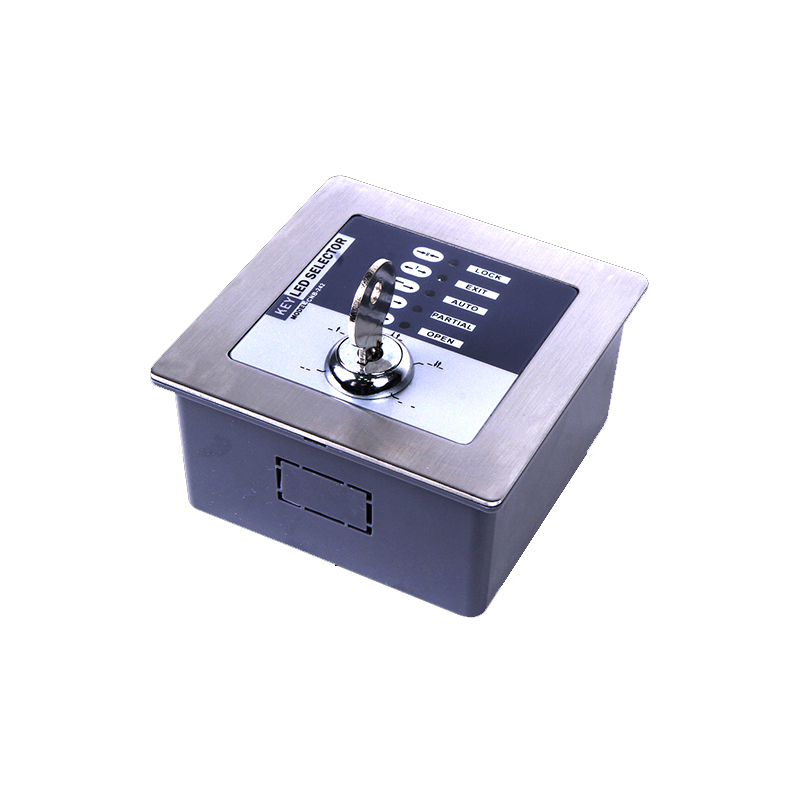
A five-key function selector gives an automatic doorway five hand-selected operating states, and it is the component that lets one door serve normal traffic, energy-saving partial opening, ventilation, controlled egress and full lockdown. Without it, each of those behaviours has to be implemented by reprogramming the controller or by fitting separate hardware, and in practice it is the changeover schedule that gets abandoned within a few weeks of handover.
The five published modes are specific about what each key does to the sensors and the lock. In automatic mode, both internal and external sensors operate and the electric lock stays released. In half-open mode, all sensors remain effective but each activation takes the leaf only to the half position before it returns, which is the energy-saving mode and requires an operator with a half-open function. In full-open mode, the internal and external sensors and the access-control devices are all overridden and the door remains fully open, which is the handling, temporary ventilation and emergency state. In unidirectional mode, the external sensor is disabled and the external lock is locked while the external access controller and the internal sensor stay effective, so entry is by card only and egress remains available. In full-lock mode, every sensor is disabled, the lock is locked and the door stays closed, which is the night and holiday state.
Published mechanical working life for the selector is more than 75,000 operations, and at four manual selections per day that rating corresponds to more than 50 years of service. The panel measures 92 mm by 92 mm by 46 mm with an 85 mm by 85 mm by 43 mm mounting cut-out, and the display is a 34 mm by 25 mm TFT colour screen. The unit is powered from low-voltage DC, and the exact input range should be confirmed against the current datasheet for the revision being supplied rather than assumed from an older catalogue entry, because that figure has changed between product revisions.
The programming model is worth understanding before installation. Mode switching is protected by a four-digit password, and the initial factory value should be changed during commissioning. The panel can also be configured to switch modes without a password using an internal setting, which is useful for an unattended lobby but should be a deliberate decision rather than a default. Our own position is that password-free switching belongs only where the electrical enclosure itself is access-controlled. The full mode behaviour is set out on our five-key function selector product page, and the panel in the figure above is that same unit.
Commissioning note. A five-key selector changes what the sensors are allowed to do, so it must be commissioned after the sensors rather than before. Set the sensor fields first, then enable the half-open and full-open modes, then verify each mode with the safety sensors still active. Commissioning the selector first is one of the more common ways a door ends up sitting in full-lock mode at opening time.
How to Specify a Complete Automatic Door Assembly
The correct specification order is geometry, motor and operator, controller, sensors, modes, market compliance and finally commissioning, and changing that order is what creates rework. Each step constrains the next, and a decision taken out of order has to be revisited once the missing information finally arrives.
- Record the opening geometry. Write down clear opening width, opening height, sliding leaf mass and available header depth. These four figures determine which operator and transmission are physically possible, and we prefer the measured leaf mass over an estimate.
- Choose the motor and operator duty. Select a 24V brushless DC motor and operator rated for the measured mass and the required opening speed, and confirm the rated cycle figures against expected daily traffic rather than against door width.
- Select the controller. Match controller voltage and current to the motor, then confirm the number of auxiliary outputs available for activation sensors, safety sensors, electric locks and access-control readers.
- Choose activation and safety sensing. Specify at least one activation sensor for the approach field and at least one safety sensor covering the threshold, confirming detection field, mounting height, power input and relay output type for each device.
- Define the required operating modes. List every state the doorway must support, such as automatic, half open, full open, unidirectional and full lock, and confirm the operator has a half-open function before specifying a half-open mode.
- Confirm the target market requirements. Identify the destination market and its standards, then request conformity documentation for the complete assembly rather than for an individual component.
- Run a documented commissioning test. Test every mode, test the hold-open behaviour with a stationary person in the field, verify the safety beam response, change any default operating password, and record the final sensor positions.
Which Standards Govern Automatic Door Components?
Automatic door components are governed by doorway-level standards rather than by component-level standards, which is why individual parts are commonly sold with specifications that do not add up to a compliant door. These standards judge opening force, closing behaviour, safety sensing and obstruction response across the installed assembly. A motor datasheet cannot demonstrate compliance on its own, because compliance is a property of the finished door rather than of one enclosure.
According to the ANSI and DCEA A156.10 low-energy doorway standard, low-energy sliding doors in North America are evaluated on opening force, opening time and the reduced breakout behaviour of the door leaf. In Europe, the BS EN 16005 power operated pedestrian doorset standard covers the same class of performance for power-operated doorsets, and it is the reference most often cited when a European project asks for the EN 16005 declaration. In the United States, UL 325 covers automatically controlled doors and gates, and the US Access Board ADA Standards address the accessible route requirement that frequently becomes the governing constraint in public buildings.
Two further references matter at component level. The European Machinery Directive 2006/42/EC applies to the operator as machinery when it is supplied into the European Economic Area, and 47 CFR Part 15 governs the microwave sensing devices described above. The practical request to make to a supplier is therefore simple: ask which of these documents cover the exact model and revision being ordered, and ask for the file numbers rather than a statement that the product is compliant.
What Are the Common Automatic Door Failure Modes?
The recurring automatic door failures we see fall into six groups, and every one of them is caused by a specification or commissioning decision rather than by a failed component. That matters commercially, because it means the fix is almost never a replacement part and almost always a correction to the original configuration.
- False opening from self-detection. A microwave sensor detects the movement of the door leaf or a nearby moving object, so the door opens repeatedly with nobody present. The fix is to reposition the sensor above the leaf path and reduce sensitivity rather than to change the controller.
- Interference from lighting or reflective surfaces. Fluorescent fittings, metal louvres and moving signage distort the sensing field, and the cure is physical relocation or shielding rather than a software change.
- The door fails to hold open for a stationary person. This occurs when a motion-only sensor has been used for a safety duty, and the correction is to add a true presence sensor such as the M-254 or a beam such as the M-218D.
- Rain-driven cycling on an exposed entrance. Water movement in the sensing field triggers repeated opening, and a waterproof accessory combined with a reduced mounting angle resolves it.
- Mode confusion between operating states. A facility loses track of whether the door is in automatic, unidirectional or full lock because no physical indication exists at the panel, and the remedy is a keyed selector with labelled LED positions.
- Forgotten factory programming. Default passwords and default switching permissions are left in place after installation, which quietly turns a mode-control device into an unrestricted override. This is corrected during commissioning, not afterwards.
How to Evaluate an Automatic Door Component Supplier?
A reliable automatic door component supplier is the one that publishes complete electrical and mechanical specifications, holds recognised system and product certification, and will confirm accessory behaviour in writing against a specific model revision before tooling starts. Catalogue photographs and a one-line description are not a specification, and a supplier who cannot tell you the standby current of a sensor or the mechanical life of a selector is asking you to discover those numbers during commissioning.
Our own facility was founded in 2007 and operates from Luotuo in Zhenhai District, Ningbo, with a factory area of about 3,500 square metres and a building area of about 7,500 square metres, working to ISO 9001 and CE requirements. That scale matters commercially because it determines whether an OEM customer can scale a design without changing supplier. The company background is described on our about Ningbo Beifan page, and the practical contact route for a specific project is listed there.
The second half of supplier evaluation is the part that is easy to skip and expensive to miss. Ask whether the supplier will confirm, in writing and against a specific model revision, the relay output type, the power input range, the detection geometry and the operating mode behaviour. Ask whether custom lead lengths and connector variants are available for OEM builds. Ask for the certification file numbers rather than a statement that the product is compliant. These are four short emails, and they settle more disputes than any amount of sample comparison.
Discuss Your Automatic Door Specification
If you are specifying an automatic sliding door assembly for a commercial building, a public facility or an industrial site, send us the opening width, the leaf mass, the target market and the operating modes you need. We will come back with a component list, the published specifications behind each part, and any compliance gap we can identify before you order.
Contact Ningbo Yufan Beifan Automatic Door or browse the automatic door accessories range.
Frequently Asked Questions
What are the main components of an automatic door system?
An automatic door system has six functional groups: the operator and motor that move the leaf, the controller that decides when it moves, activation sensors that request an opening, safety sensors that prevent it closing on a person, mode-switching and access-control accessories, and the power supply and mechanical transmission parts that support the other four.
Is an automatic door motor or a controller the more important component?
Neither is more important in isolation. The motor produces the force and the controller decides when that force is applied, so a correctly sized motor with an incorrectly configured controller still produces a door that does not behave correctly. In our experience the two should be specified as one assembly rather than ordered independently.
What is the difference between a microwave sensor and an infrared presence sensor on an automatic door?
A microwave sensor such as the M-204G detects movement across a 4 m by 2 m field at speeds as low as 5 cm/s and is used to request an opening. An infrared presence sensor such as the M-254 detects both movement and a stationary body across a 1600 mm by 800 mm field and responds in under 100 milliseconds, which is what allows it to hold the door open while someone stands still in the threshold.
When is a through-beam safety sensor needed instead of a presence sensor?
A through-beam sensor such as the M-218D is needed when the threshold is too wide or too irregular for an overhead presence field. It reaches a matched distance of 10 metres with single or double beam configurations and provides a defined interruption output when the beam is broken, which gives a more certain safety response than a field sensor in a difficult geometry.
What does a five-key function selector do?
A five-key function selector gives the operator five discrete operating states that a facility can select by hand: automatic, half open, full open, unidirectional and full lock. This allows one doorway to move between normal traffic, reduced opening for energy saving, ventilation, controlled egress and complete lockdown without reprogramming the controller.
How many operations will a five-key automatic door function selector withstand?
Published mechanical working life is more than 75,000 operations. At four manual selections per day that corresponds to more than 50 years before the mechanical rating is reached, so in practice the electrical contacts and the display age long before the mechanism does.
Which standards apply to automatic door components?
The main references are ANSI and DCEA A156.10 for low energy doorways in North America, EN 16005 for power operated pedestrian doorsets in Europe, UL 325 for automatically controlled doors and gates in the United States, the Machinery Directive 2006/42/EC for operator machinery in the European Economic Area, and FCC Part 15 for microwave sensing devices in the United States. These are doorway-level requirements rather than component-level ones.
What is the most common cause of a false automatic door opening?
The most common cause is a microwave activation sensor whose mounting angle or sensitivity has drifted so that it detects the movement of the door leaf itself. The second most common cause is interference from fluorescent lighting, reflective surfaces or moving objects near the sensing field.
How should I choose a supplier for automatic door components?
Check that the supplier publishes complete electrical and mechanical specifications rather than catalogue descriptions, can point to a quality system certification such as ISO 9001 and safety certification such as CE, and will confirm the operating mode behaviour of mode-selection accessories in writing against a specific model revision before tooling begins.
Can one sensor replace both an activation sensor and a safety sensor?
A combined sensor such as the M-254 provides separate relay outputs for motion and presence, so it can carry both duties from one housing. However, a motion-only sensor cannot perform the safety function and a safety beam cannot request an opening, so the two duties remain logically separate even when they share a housing.
About the author
Edison is Sales Manager at Ningbo Yufan Beifan Automatic Door Co., Ltd., a manufacturer of automatic door system research and production whose core products include automatic sliding door operators, 24V brushless DC door motors and automatic door accessories.
These systems are used in commercial buildings, public facilities and industrial sites. Edison manages global project enquiries and OEM and ODM custom solutions, supporting distributors and project procurement clients worldwide, with a particular focus on matching operator, controller and sensor components to the opening and to the target market before anything is ordered.
For a specific automatic door project, contact Edison and the Ningbo Yufan Beifan team. The most useful first message includes the clear opening width, the sliding leaf mass, the target market, the required operating modes and the sensor coverage you need.
Post time: Oct-23-2026