
Ningbo Yufan Beifan Automatic Door Co., Ltd. — specializing in automatic door system R&D and manufacturing — produces 24V brushless DC door motors and complete automatic door operators for commercial, public, and industrial applications. Edison’s team manages global project inquiries and wholesale procurement support for distributors and project procurement clients worldwide.
The Technology Decision That Determines Your Maintenance Cost for the Next Decade
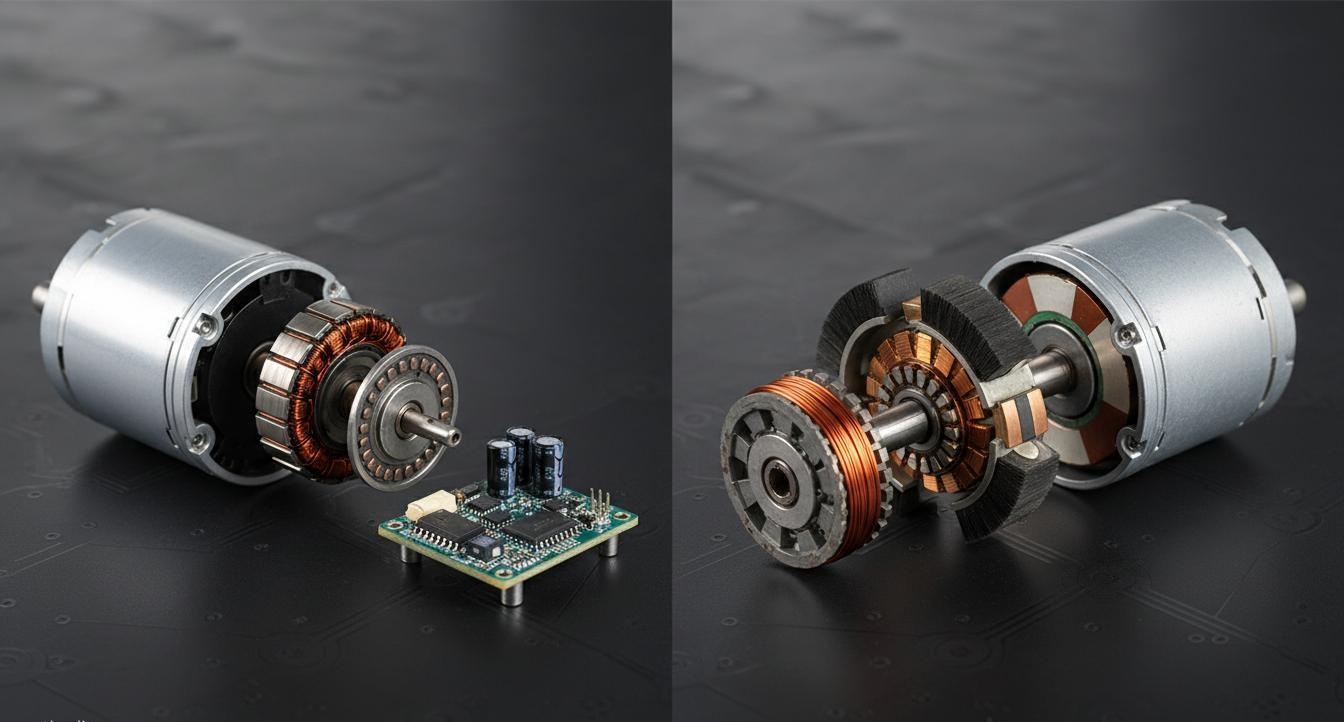
The motor type in your automatic door operator is not a detail — it is the component that determines how often your maintenance team will be visiting that door for the next 10–15 years. A brushed DC motor has a defined wear life at which the brushes and commutator require replacement — typically 2–5 years in high-traffic commercial installations. A brushless DC motor has no such wear point: the electronic commutation system (ESC) has no mechanical contact, no friction surface, and no consumable parts. The brushless motor simply runs — and when properly specified and installed, it runs for the life of the door operator without the maintenance event that the brushed motor will require at a predictable interval. When you are buying 50, 100, or 200 door motors per year for commercial installation projects, this maintenance cost differential compounds significantly in your total cost of ownership calculation.
Brushed vs. Brushless DC Automatic Door Motors: The Full Comparison
Brushed DC vs. Brushless DC Door Motor — Side by Side
| Parameter | Brushed DC Motor | Brushless DC Motor |
|---|---|---|
| Commutation mechanism | Mechanical brushes + commutator | Electronic (ESC — no mechanical contact) |
| Consumable wear parts | Brushes (wear in 2–5 years in high traffic) | None |
| Service life (high traffic) | 3–5 years before brush replacement | 8–15 years (no maintenance-required wear) |
| Energy efficiency | 60–70% (significant heat generation) | 85–92% (much lower heat) |
| Noise level | Higher — brush friction noise, commutator noise | Lower — no brush friction noise |
| Electromagnetic interference | Higher — commutator arcing | Lower — no arcing |
| Heat dissipation | Poor — heat in rotor, difficult to cool | Good — heat in stator, easily managed |
| Initial cost | 20–40% lower than BLDC equivalent | Higher initial cost, amortized over longer life |
| Speed control precision | Moderate — varies with brush wear | High — ESC provides precise digital control |
| Motor operating temperature | Higher (brush friction + commutation losses) | Lower (efficient operation) |
The Total Cost of Ownership Case for Brushless DC in High-Traffic Installations
Maintenance Cost Differential
In a high-traffic commercial door installation (300+ cycles per day), a brushed DC door motor will require brush replacement at year 2–3 of operation. The service visit for brush replacement includes: technician labor (typically 1–2 hours), replacement brushes, and commutator surface inspection. In 2026, a commercial door motor service visit typically costs $150–$350 depending on the region and the contractor. Over a 10-year operating period, a brushed motor will require 2–3 such service events; a brushless DC motor requires none (assuming no other component failure).
Energy Cost Differential
Brushless DC motors are 25–35% more energy-efficient than brushed DC motors in automatic door applications. For an operator running 16 hours per day at 100W average power consumption, the energy difference over 10 years:
- Brushed motor: 100W average → 584 kWh/year → approximately $175–$230/year at typical commercial electricity rates
- Brushless motor at 70% of brushed power: 70W average → 409 kWh/year → approximately $123–$160/year
- Energy savings: $52–$70 per operator per year × 10 years = $520–$700 per operator over 10 years
For a distributor purchasing 100 operators per year for commercial installation projects, the cumulative energy savings across their installed base over 10 years is $52,000–$70,000 — a number that significantly outweighs the per-unit price difference between brushed and brushless DC motors.
Downtime and Service Call Cost
A door operator that fails in a commercial building entrance is a high-visibility problem. The cost of an unscheduled service call — including emergency response, technician dispatch, and the reputation cost of a non-functional entrance — is typically $300–$600 per incident. A brushless DC motor, with no wear mechanism, fails for reasons other than wear (bearing failure, electronics failure, mechanical linkage failure) — which are less predictable but significantly less frequent in properly designed motors from quality manufacturers.
Specifying 24V Brushless DC Door Motors for Commercial Projects
Key Electrical Specifications
| Parameter | Specification Requirement | Notes |
|---|---|---|
| Voltage | 24V DC nominal (operating range 20–28V DC) | 24V SELV enables battery backup operation |
| Power consumption | 60–150W depending on door size and traffic | Higher for heavy doors, high-cycling installations |
| Peak current | Confirm motor can handle start-up surge (typically 3–5x rated current) | Critical for heavy door leaves |
| Speed control | Variable speed via PWM or voltage signal | Required for smooth open/close profiles |
| Thermal protection | Integrated thermal cutoff or PTC protection | Protects motor from overload damage |
Key Mechanical Specifications
- Rated torque and speed: Must match the door operator’s mechanical requirement — confirm the motor provides sufficient torque at the required RPM for your specific door configuration
- Shaft dimensions and interface: The motor shaft diameter, length, and keyway or flat configuration must match the gearhead or direct-drive coupling in the door operator mechanism
- Mounting configuration: Flange mount, foot mount, or face mount — must match the operator’s motor mounting provision
- Ingress protection (IP rating): For outdoor or damp environment installations, a minimum IP44 rating is required; for areas with direct water exposure, IP56 or higher is appropriate
The 24V DC Standard: Why It Matters for Commercial Installations
The 24V DC operating voltage has become the standard for commercial automatic door operators globally — for specific reasons that buyers need to understand:
- Safety extra-low voltage (SELV): 24V DC is classified as SELV in IEC/EN standards, meaning no electrical safety hazard during installation or maintenance — this matters for building code compliance in most international markets
- Battery backup compatibility: A 24V DC door operator can connect directly to a 24V emergency battery backup system — the door continues to operate during power failures, which is a code requirement for egress doors in most jurisdictions
- Solar and low-power applications: 24V DC is the standard voltage for solar-powered door operators, where a small photovoltaic panel and battery provide operating power
- Reduced wiring cost: 24V DC power circuits can use smaller gauge wiring than 110V/220V AC circuits, reducing installation material and labor cost
Wholesale Procurement: Evaluating Automatic Door Motor Suppliers
Manufacturing Capability Assessment
For wholesale buyers purchasing 100+ door motors per year, the supplier’s manufacturing capability matters as much as the product specification:
- In-house motor production vs. assembly: Does the supplier manufacture their own motor stators and rotors, or do they source complete motors from a third party and assemble them into the operator housing? A supplier who manufacturers their own motors has better control over quality and lead time
- Production capacity and lead time: Confirm the supplier can meet your volume requirements within your project timeline — request their current production lead time for standard configurations and ask about capacity for peak order periods
- Quality control and testing: Each motor should undergo automated testing for: no-load current, locked-rotor current, hi-pot dielectric testing, and functional testing in the complete operator assembly
Customization Capability for Wholesale Orders
Wholesale buyers for commercial projects frequently require configurations not in the supplier’s standard catalog:
- Custom shaft dimensions and interfaces: For integration with specific door operator mechanisms
- Custom voltage configurations: 12V DC for battery-powered applications, 110V AC input with internal rectification for specific markets
- Custom connector and wiring: Pre-attached connectors matching specific control board interfaces, or custom wiring harness lengths
- Custom nameplate and branding: Buyer’s brand marking on the motor nameplate
Ningbo Yufan Beifan Automatic Door Co., Ltd. supports custom BLDC motor configurations for wholesale procurement — Edison’s team coordinates with buyers’ engineering teams on custom specifications for commercial installation projects.
Supply Chain Stability for Long-Term Wholesale Relationships
A wholesale buyer committing to 100+ units per year needs supply chain stability from their automatic door motor supplier:
- Component sourcing continuity: Confirm the supplier has multiple qualified sources for key components ( bearings, stators, electronic speed controllers) — single-source dependency creates supply risk
- Engineering change notification: The supplier must agree to notify the buyer in advance (60 days minimum) before any material or process changes that could affect the motor’s performance or dimensions
- Buffer stock policy: For established accounts with stable volume, the supplier should be willing to maintain buffer inventory of standard configurations to protect against demand spikes and lead time variability
Procurement Checklist: Automatic Door Motor Wholesale
- Specify brushless DC motors for all high-traffic commercial installations (300+ cycles/day) — brushed motors are not appropriate
- Confirm 24V DC operating voltage for SELV compliance, battery backup compatibility, and solar application support
- Verify motor torque and speed match the door operator’s mechanical requirements — do not assume a standard motor fits your specific mechanism
- Request the motor’s complete electrical specification sheet including: rated power, no-load current, locked-rotor current, thermal protection parameters, and IP rating
- Confirm the supplier manufactures their own motors (not just assembles purchased complete motors)
- Request sample units for integration testing with your door operator mechanism before committing to volume orders
- Verify the supplier’s quality management system (ISO 9001) and request their defect rate data for recent production batches
- Clarify the warranty period and what it covers — motor windings, ESC electronics, bearing, mechanical interface
- Discuss custom configurations ( shaft dimensions, connector type, voltage, branding ) and confirm MOQ and lead time for customization
- Establish a buffer inventory and engineering change notification agreement in the purchase contract
Need an Automatic Door Motor Wholesale Supplier for Commercial Projects?
Ningbo Yufan Beifan Automatic Door Co., Ltd. — specializing in automatic door system R&D and manufacturing — produces 24V brushless DC door motors and complete automatic door operator systems for commercial, public, and industrial applications worldwide. The automatic door motor range covers torque ratings for commercial sliding doors, swing doors, and industrial door applications, with custom configurations available for project-specific requirements. Edison’s team supports wholesale procurement clients with technical specifications, sample evaluation, and volume pricing for commercial installation projects. Browse the complete product range including automatic sliding door operators and door motor accessories.
Frequently Asked Questions
Q1: What is the realistic service life difference between brushed and brushless DC door motors in high-traffic commercial installations?
In high-traffic commercial installations (300+ cycles per day), a brushed DC door motor typically requires brush replacement at 2–5 years of operation. The brush wear rate is higher in dusty or humid environments, and the commutator surface degrades with each brush change cycle. A brushless DC door motor in the same installation environment operates for 8–15 years without any consumable-part maintenance — the electronic commutation system has no wear mechanism. For a commercial building with 50+ automatic doors, this maintenance reduction is significant in total maintenance cost and in building service disruption.
Q2: Can a brushless DC door motor be powered from a standard 24V AC transformer, or does it require DC input?
Brushless DC door motors require a DC power supply — either direct 24V DC from a battery or DC power supply, or 24V DC produced by rectifying and regulating an AC input. Most commercial door operators have an internal AC-DC power supply that accepts 110V–240V AC input and produces the 24V DC rails required by the motor and control electronics. When specifying the motor for a wholesale order, confirm the motor’s voltage requirement matches the door operator’s power supply output — you cannot directly connect a 24V AC transformer to a BLDC motor without rectification.
Q4: What IP rating is appropriate for automatic door motors in commercial building installations?
For indoor commercial installations (lobby, corridor, conditioned space): IP44 is generally adequate — protected against solid objects over 1mm and water splash. For outdoor or semi-protected outdoor installations (canopy entrances, loading docks): IP54 minimum — protected against dust and water spray from any direction. For installations with direct water exposure (car wash entrances, uncovered exterior doors): IP56 or higher. The motor’s IP rating should be specified based on the actual installation environment, not a standard assumption about commercial vs. outdoor use.
Q5: How do I calculate the energy savings from using brushless DC door motors instead of brushed in a commercial building with multiple automatic doors?
Use this formula: Annual energy savings per operator = (Brushed motor power – BLDC motor power) x hours/day x days/year x electricity cost/kWh. For a typical commercial door operating 16 hours/day: if the brushed motor averages 100W and the BLDC motor averages 70W, the difference is 30W. Over 16 hours/day x 365 days = 175,200 Wh/year = 175.2 kWh/year. At $0.10–$0.14/kWh commercial electricity rate: $17.52–$24.53 per operator per year. For a building with 40 operators: $700–$981 per year. Over 10 years: $7,000–$9,810. This calculation should be part of your procurement specification justification for choosing BLDC motors over brushed equivalents.
Q6: What customization options are typically available for wholesale automatic door motor orders?
Common customization for wholesale orders: custom shaft dimensions (diameter, length, keyway configuration) to match specific door operator mechanisms; custom connector and wiring harness (pre-attached connectors matching specific control board interfaces, custom wire lengths); custom voltage configurations (12V DC for battery-powered, custom AC input ranges); custom nameplate and branding (buyer’s brand on motor nameplate and housing); custom thermal class upgrade for high-temperature environments; and custom IP rating for specific installation environments. MOQ for custom configurations varies by complexity — minor shaft changes may have MOQ of 50–100 units; custom electronics require 100–200+ units.
Ningbo Yufan Beifan Automatic Door Co., Ltd. specializes in automatic door system R&D and manufacturing, with core products including automatic sliding door operators, 24V brushless DC door motors, and accessories for commercial buildings, public facilities, and industrial sites. Edison manages global project inquiries and OEM/ODM custom solutions for distributors and project procurement clients worldwide. For wholesale procurement inquiries, custom motor specifications, or volume pricing, contact Edison’s team directly.
Post time: May-26-2026