
TL;DR — Quick Answer for Private-Label Buyers
- OEM for an automatic door means the factory builds the operator to your spec and labels it with your brand; ODM means the factory’s stock platform is re-skinned with your label. Most first-time buyers actually want ODM, not full OEM.
- MOQ for stock-platform private-label runs is typically 50 PCS; full custom OEM runs start at 200-500 PCS; full mold customisation requires 1,000-2,000 PCS plus a tooling amortisation fee.
- Lead time is 15-30 workdays for ODM, 30-90 days for full OEM after artwork and spec lock-down, plus 7-10 days for pre-production sample evaluation.
- Brushless 24V DC motors outlast brushed motors by a factor of 3-5× in commercial door duty — a 24V brushless DC motor is typically rated for 3 million cycles (~10 years).
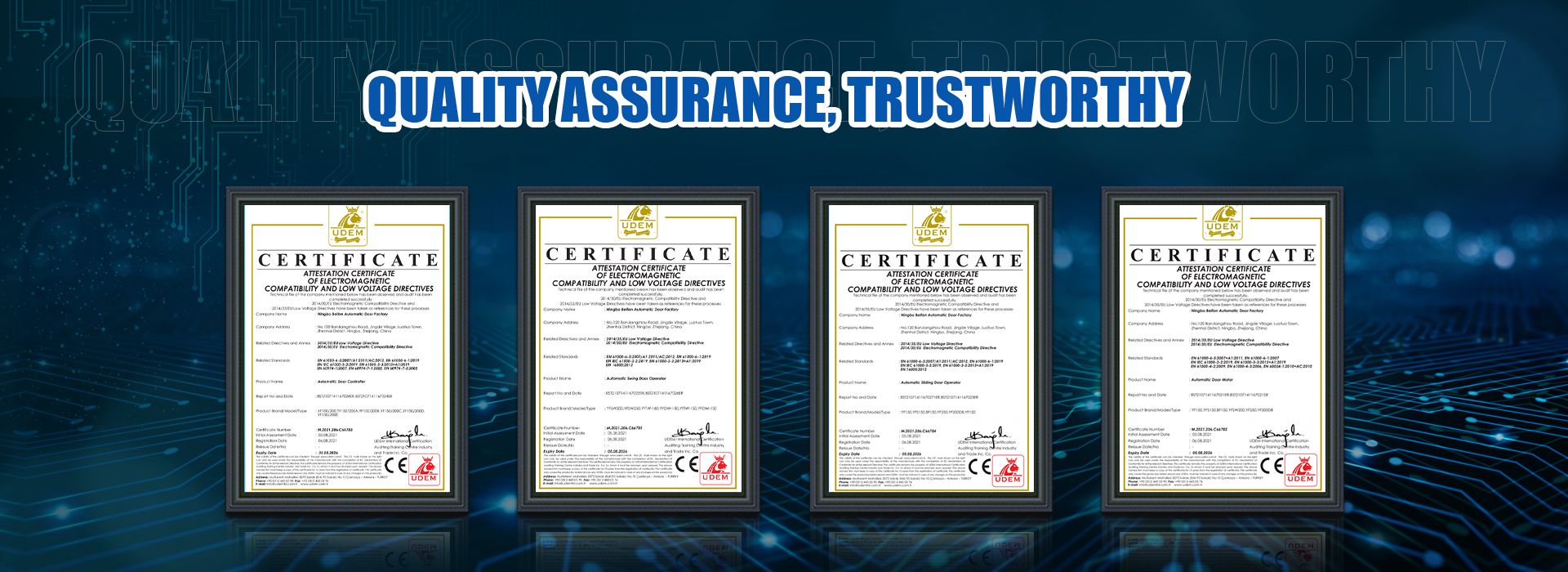
- CE marking transfers via a parallel Declaration of Conformity with your brand as distributor — most private-label buyers do not need to retest from scratch.
When a buyer emails us asking for “OEM automatic door operators,” we have learned to ask three questions before quoting a price: what brand name do you want on the housing, what spec do you want changed versus our stock YFS150, and which market is the operator being sold into? Almost every OEM project that gets stuck does so because the buyer’s answer to one of those three is “we’ll figure that out after the first sample” — and “after the first sample” is exactly when the factory’s tooling and artwork decisions have already been made.
The good news is that the OEM process for an automatic door operator is well understood. Because the underlying electromechanical platform (24 V brushless DC motor, helical gearbox, controller, sliding rail) is already type-tested and CE-certified, what most buyers are really commissioning is a packaging and documentation exercise — not a new product design. The trick is knowing which knobs you actually need to turn, and which ones the factory is happy to leave at default.
What Does “OEM” Actually Mean for an Automatic Door Operator?
In the automatic door industry, “OEM” covers everything from a logo swap to a full custom mold, and the term means very different things to different factories. The most common confusion we see is a buyer who thinks they are ordering an OEM operator but is actually buying an ODM (stock platform, new label). The price, the MOQ, the lead time, and the legal exposure are all different, so the distinction matters from the very first inquiry email.
| Model | Who designs it | Who labels it | Typical MOQ | Typical lead time |
|---|---|---|---|---|
| ODM (Original Design Manufacturer) | Factory | Buyer | 50 PCS | 15-30 workdays |
| OEM (Original Equipment Manufacturer) | Buyer-driven changes | Buyer | 200-500 PCS | 30-90 workdays |
| OBM (Own Brand Manufacturer) | Factory | Factory | n/a — stock order | 5-15 workdays |
Most “OEM” requests we receive are really ODM. Because the bulk of commercial automatic doors share the same 24V brushless DC motor architecture, a stock ODM platform already delivers 95% of what an integrator needs — and the remaining 5% (logo, color, packaging, manual language) is what ODM actually buys you. True OEM work — custom gearbox ratio, custom firmware, custom housing geometry — adds 60 days and a 5-10× MOQ. It is worth it only if the integrator has a market reason the stock platform cannot serve.
Which Specifications Should a Private-Label Buyer Lock Down First?
The first spec to lock down is the motor voltage and lifetime rating, because these two numbers cascade into every other decision. A 24 V brushless DC operator is the industry default for commercial sliding doors — it is safe for installers (low voltage, SELV-class), it works with the standard controller electronics, and it is the platform most CE certificates already cover. Going to 36 V or 48 V requires a separate CE technical file and longer EMC testing.
Motor Voltage, Duty Cycle, and Lifetime
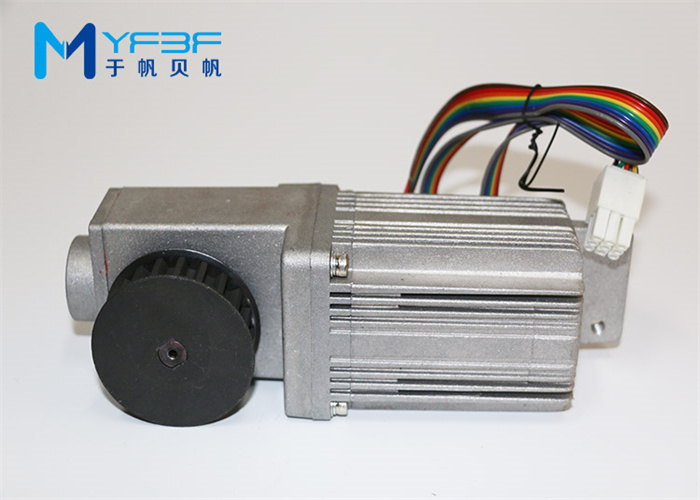
The YFS150 24V brushless DC motor runs at 2,880 RPM no-load with a 1:12 gear ratio, producing 60 W of mechanical output at the gearbox. Because the brushless architecture eliminates the commutator, the lifetime of the YFS150 motor is rated for 3,000,000 cycles at rated load — equivalent to about 10 years of hotel or airport use. A brushed DC motor in the same duty typically needs a brush service at 1.5-3 years, and a full motor replacement at 4-6 years. Over a 10-year life, the brushless architecture typically halves the field-service cost of the door.
| Parameter | Specification | OEM impact |
|---|---|---|
| Rated voltage | 24 V DC | Compatible with SELV-class installers; matches standard controllers |
| Rated power | 60 W | Suitable for single-leaf ≤150 kg or double-leaf ≤2×100 kg |
| No-load RPM | 2,880 RPM | Determines opening/closing speed after gear reduction |
| Gear ratio | 1:12 | Custom ratios available for faster or slower door cycles |
| Noise level | ≤50 dB @ 1 m | Meets EN 16005 acoustic expectations for indoor commercial use |
| Protection class | IP54 | Suitable for sheltered vestibules and indoor entrances |
| Lifetime | 3,000,000 cycles / ~10 years | Sets the field-service interval the buyer can publish |
| Certification | CE | Parallel DoC transfer available for OEM branding |
Noise, IP Rating, and Duty Class
The 50 dB noise rating is a real spec, not a marketing figure — it is measured at 1 m in a free field with the operator running under no-load. Because 50 dB at 1 m drops to roughly 38 dB at the operator’s typical 4 m listening position, the door will not be the loudest object in a hotel lobby. Indoor commercial operators in the EN 16005 region typically target 55 dB maximum at 1 m, so the YFS150 has a 5 dB margin already built in.
The IP54 rating is enough for sheltered vestibules and indoor entrances, but it is not enough for an outdoor gate operator exposed to rain. Because the IP code only protects against splashing water and dust ingress, not direct jet spray or submersion, an OEM buyer reselling into outdoor applications must specify an upgraded seal package. This is a $4-8 per-unit BOM upgrade at the factory; it is not a separate motor platform.
Real-world example: YFS150 OEM platform
The YFS150 24V brushless DC motor is one of the OEM/ODM platforms most often used for private-label hotel and airport door operators. Because the stock platform ships with a CE certificate, a 3,000,000-cycle lifetime, and an IP54 housing, an integrator can re-label it for commercial sale with the addition of a logo, a custom carton, and a parallel Declaration of Conformity — typically in 15-30 workdays.
How Do MOQ, Lead Time, and Capacity Realities Shape an OEM Program?
The honest answer on MOQ is that the factory’s number reflects its own setup cost, not your resale potential. Most Chinese automatic door factories set MOQ at 50 PCS for a stock-platform ODM run with your logo, and 200-500 PCS for an OEM run with packaging customization. The MOQ exists because the factory has to set up a custom label, print cartons, and produce a pilot batch before the production line stabilizes — not because the underlying motor is expensive.
Reading the Factory’s Real Production Capacity
A factory that claims 30,000 PCS per month is materially different from one that ships 30,000 PCS across 40 SKUs. Because an OEM run for a single buyer typically wants a dedicated production window, the relevant capacity figure is monthly output on a single SKU, not the factory’s blended monthly output. For the YFS150 platform, the relevant figure is 30,000 PCS per month on a single SKU, which means a 500-PCS order occupies about 1.5 production days — small enough that the factory can schedule it without disrupting stock-customer shipments.
Lead Time Tiers by Order Volume
- Sample evaluation (1-3 PCS): 7-10 workdays after spec confirmation. Stock platform with your logo can sometimes ship in 3-5 days.
- ODM pilot run (50-200 PCS): 15-30 workdays, including pilot batch and final QC.
- OEM run (200-1,000 PCS): 30-60 workdays, including custom artwork, packaging printing, and firmware flashing.
- Full custom OEM (1,000+ PCS): 60-90 workdays, including mold work, tooling setup, and a parallel CE technical file if applicable.
Because the standard business terms are T/T 30% deposit + 70% balance against B/L copy, OEM buyers should plan cash flow around a 15-30 day deposit-to-shipment window, not around the lead-time number alone. Western Union and PayPal are accepted by most factories for orders under $5,000 but become uneconomical above that.
What Branding, Packaging, and Documentation Can an OEM Factory Customize?
On a first OEM order, the realistic customization scope is logo, model number, carton artwork, and user manual — not housing color or firmware. Going beyond that scope on a 50-PCS first order is the most common way buyers burn money, because the artwork setup fee and the production-line changeover end up being amortized across too few units. The factory will agree to it; you will not enjoy the unit price.
| Customization item | Minimum order | Setup fee | Lead-time impact |
|---|---|---|---|
| Logo printing on stock housing | 50 PCS | Low (laser etch or sticker) | None |
| Custom model number | 50 PCS | None | None |
| Custom carton artwork | 100 PCS | Carton print plate | 3-5 days for first print |
| Custom user manual (your language) | 100 PCS | Translation + layout | 5-7 days |
| Custom housing color | 300 PCS | Housing tooling setup | 10-15 days |
| Custom firmware | 300 PCS | Firmware dev + flash setup | 15-25 days |
| Full custom mold | 1,000-2,000 PCS | Tooling amortization | 30-60 days |
Because documentation is the cheapest customization to commission, it is also the highest-leverage one for the buyer. A custom user manual with the buyer’s brand, the buyer’s installation guide, and the buyer’s warranty terms costs almost nothing per unit but transforms the buyer’s brand perception in the installer’s hands. The factory will provide a Word or InDesign template; you add your logo, your contact info, and your warranty language, and the factory prints and inserts.
How Does CE Certification Transfer When You Private-Label an Automatic Door?
CE marking on a private-label automatic door is the buyer’s responsibility, not the factory’s — even if the underlying operator is already CE-certified. The factory’s CE certificate covers the factory’s name on the Declaration of Conformity. The buyer’s brand needs a parallel Declaration of Conformity listing the buyer (or the buyer’s EU representative) as the responsible party, referencing the factory’s test reports under the EMC Directive and the Low Voltage Directive.
The relevant EU framework is the CE marking framework, with the EMC Directive 2014/30/EU, the Low Voltage Directive 2014/35/EU, and the Machinery Directive 2006/42/EC (which governs automatic doors specifically). The harmonized standard for automatic doors is EN 16005, which covers both safety sensors and motor braking performance.
For most private-label buyers, the practical path is to issue a parallel Declaration of Conformity under their own brand, with the factory’s existing test reports attached as evidence. Because the parallel DoC approach avoids the cost of fresh EMC testing (typically $3,000-8,000 per SKU), it is what most OEM programs targeting EU sale actually use. For North American sale, the equivalent is FCC Part 15B unintentional-radiator compliance, which the factory typically signs under its own name and the private-label buyer references.
Evaluating an OEM automatic door partner?
If you are scoping a private-label automatic sliding door program for hotels, airports, hospitals, or commercial buildings, send us your target SKU, your market, and your expected annual volume. Our engineering and sales team will respond with a feasibility review, a sample timeline, and an OEM quotation referencing the automatic sliding door operator platform or the OEM/ODM sliding door motor product line.
Contact our OEM team to start a private-label conversation.
Frequently Asked Questions
What does “OEM” actually mean for an automatic door operator?
In the automatic door industry, OEM (Original Equipment Manufacturer) typically means the factory builds the operator to your specification and labels it with your brand. ODM (Original Design Manufacturer) means the factory’s existing platform is re-skinned with your brand and minor cosmetic changes. Pure OEM work usually implies firmware, gear ratio, or housing customization; ODM implies a stock platform with your label on it.
What is the typical MOQ for an OEM automatic door operator?
Most Chinese automatic door factories set MOQ at 50 PCS for a stock-platform ODM run with your logo, and 200-500 PCS for an OEM run with packaging customization. The MOQ exists because the factory has to set up a custom label, print cartons, and produce a pilot batch before the production line stabilizes — not because the underlying motor is expensive.
How long does a private-label OEM order take?
Standard lead time on a private-label run is 15-30 workdays after the artwork and spec sheet are locked. Custom-tooled housing or firmware work adds 30-60 days on top of that. Sample evaluation typically adds 7-10 days before the production order is placed.
Can I keep my own brand on the CE certificate?
Yes, but only if your name appears as the manufacturer on the Declaration of Conformity. The factory can keep its own CE certificate (with its name), and you can additionally request the factory issue a parallel DoC referencing your brand as the distributor. For private-label programs targeting EU sale, most buyers use the parallel DoC approach to avoid the cost of fresh EMC testing.
What is the difference between a brushed and brushless DC motor in an automatic door?
A brushless DC door motor eliminates the brush-commutator wear that limits brushed motors to roughly 1-3 years in commercial duty. A 24 V brushless DC sliding door motor is typically rated for 3 million cycles (about 10 years) under rated load, because the only wear surface is the gearbox and the bearing.
What brand customization is realistic on a first OEM order?
A first OEM order typically supports logo printing on the housing, custom model number, custom carton artwork, and a custom user manual. Custom housing color, custom firmware, and custom remote-control codes usually require 300 PCS minimum and a tooling fee. Full custom mold work starts at 1,000-2,000 PCS and a separate tooling amortisation.
How do I verify the factory’s actual capacity before placing an OEM order?
Ask for three things: a video walkthrough of the assembly line during a normal production day, the monthly output number split by SKU (not just a headline capacity), and the names of two reference customers buying your proposed SKU volume. A factory running 30,000 PCS/month on a single SKU is materially different from one running 30,000 PCS across 40 SKUs.
Ningbo Yufan Beifan Automatic Door Co., Ltd. specializes in automatic door system R&D and manufacturing. Core products include automatic sliding door operators, 24V brushless DC door motors, and accessories, widely used in commercial buildings, public facilities, and industrial sites. Edison manages global project inquiries and OEM/ODM custom solutions, supporting distributors and project procurement clients worldwide.
Post time: Sep-10-2026