
TL;DR
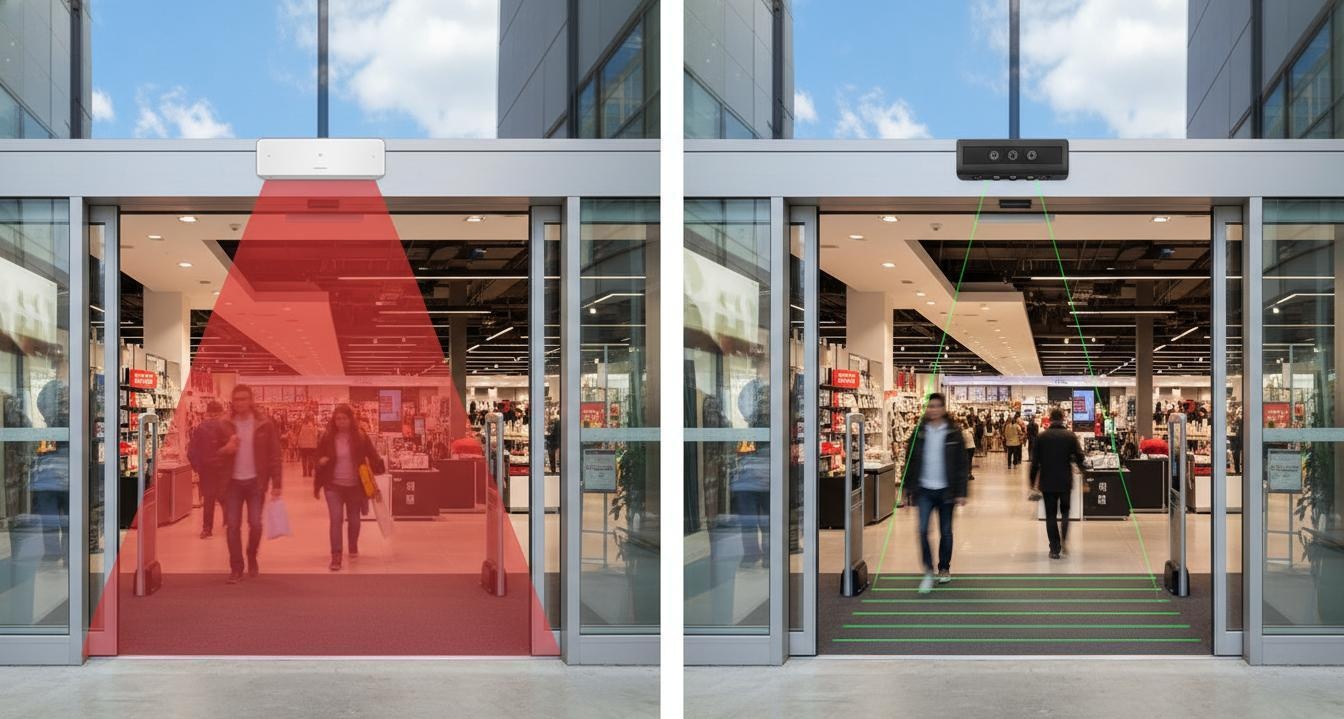
- Microwave radar sensorsoffer 2–5m detection range with 30–60° coverage angles — ideal for high-traffic retail entrances where early door activation prevents bottlenecks.
- Active infrared sensorscreate precise 0.1–3m detection curtains — better for safety beams and threshold monitoring than primary activation.
- Summer heat causes infrared sensors to false-trigger from heat signatures;temperature-compensated detection algorithmsare essential for summer retail reliability.
- For retail store summer openings,dual-sensor configuration(microwave primary + infrared safety) delivers the best balance of traffic flow and safety.
- We recommend specifying detection range, coverage angle, operating temperature, and HVAC compatibility explicitly when ordering sensors from anyautomatic door sensor supplier.
- Microwave radar sensorsoffer 2–5m detection range with 30–60° coverage angles — ideal for high-traffic retail entrances where early door activation prevents bottlenecks.
Microwave radar sensors
- Active infrared sensorscreate precise 0.1–3m detection curtains — better for safety beams and threshold monitoring than primary activation.
Active infrared sensors
- Summer heat causes infrared sensors to false-trigger from heat signatures;temperature-compensated detection algorithmsare essential for summer retail reliability.
temperature-compensated detection algorithms
- For retail store summer openings,dual-sensor configuration(microwave primary + infrared safety) delivers the best balance of traffic flow and safety.
dual-sensor configuration
- We recommend specifying detection range, coverage angle, operating temperature, and HVAC compatibility explicitly when ordering sensors from anyautomatic door sensor supplier.
automatic door sensor supplier
The first time I watched a retail door fail during a heatwave was in a shopping mall in Chengdu, a city where summer temperatures routinely exceed 38°C. The store had just completed a major renovation, installed new automatic sliding doors, and opened for the summer sales season — their biggest revenue period. Within two weeks, the door was cycling erratically: opening when no one was near, refusing to open when customers approached with arms full of bags, and occasionally failing to close during the afternoon peak when solar radiation on the storefront created thermal interference with the infrared sensors. The store manager called me, frustrated, and asked: “We spent this much on automatic doors and they don’t work in summer?”
That problem was entirely preventable. The installation had used an infrared activation sensor where a microwave radar sensor would have performed reliably. When I explained the difference to the store manager, she said “Why didn’t anyone tell us before we bought these?” That question has stayed with me throughout my career, and it is exactly the question I am going to answer in this article:how do you choose the right detection technology for automatic doors in retail environments, particularly when summer conditions push sensor performance to its limits?
how do you choose the right detection technology for automatic doors in retail environments, particularly when summer conditions push sensor performance to its limits?
As a sales manager at Ningbo Yufan Beifan Automatic Door Co., Ltd., I work with retail property developers, store fit-out contractors, and store operations managers who are specifying automatic door systems. We supply theYF150 automatic sliding door operatorand theYF200 automatic sliding door operator, both of which support multiple sensor configurations. In this article, I am going to walk you through the two primary detection technologies — microwave radar and active infrared — explain how they perform differently in summer conditions, and show you how to specify the right configuration for your specific retail environment.
YF150 automatic sliding door operator
YF200 automatic sliding door operator
Why Summer Retail Environments Are Especially Demanding for Door Sensors
Before we dive into technology comparison, it is important to understand why summer retail environments are uniquely challenging for automatic door sensors. This context will help you appreciate why the sensor specification decisions matter so much for retail applications.
Retail stores in summer face a combination of stressors that typically do not affect other automatic door applications:
- Extreme and rapid temperature changes:Storefront glass in direct sunlight can reach 60–70°C while the air-conditioned interior stays at 22–24°C. This 40+ degree temperature gradient creates thermal currents across the door opening that can trigger infrared sensors with false heat signatures.
- Peak foot traffic with maximum package loads:Summer sales bring heavy foot traffic, and customers shopping during summer heat often carry more — water bottles, shopping bags, foldable strollers. Sensors that do not detect customers at adequate range will cause customers to wait, creating queues and frustration at the entrance.
- Storefront solar exposure:East-facing storefronts get intense morning sun; west-facing stores bake in the afternoon. This solar loading affects sensor electronics directly, elevating internal temperatures and altering detection threshold calibration.
- HVAC system interference:Air-conditioned retail spaces typically operate at positive interior pressure to maintain cleanliness and temperature. This pressure differential causes small but measurable air movements through the door opening that can interfere with infrared detection curtains.
- Long operating hours:Extended summer trading hours mean automatic doors run continuously for 12–16 hours per day, compared to perhaps 8–10 hours in winter. Sensors with marginal thermal margins will drift over these long run cycles.
- Extreme and rapid temperature changes:Storefront glass in direct sunlight can reach 60–70°C while the air-conditioned interior stays at 22–24°C. This 40+ degree temperature gradient creates thermal currents across the door opening that can trigger infrared sensors with false heat signatures.
Extreme and rapid temperature changes:
- Peak foot traffic with maximum package loads:Summer sales bring heavy foot traffic, and customers shopping during summer heat often carry more — water bottles, shopping bags, foldable strollers. Sensors that do not detect customers at adequate range will cause customers to wait, creating queues and frustration at the entrance.
Peak foot traffic with maximum package loads:
- Storefront solar exposure:East-facing storefronts get intense morning sun; west-facing stores bake in the afternoon. This solar loading affects sensor electronics directly, elevating internal temperatures and altering detection threshold calibration.
Storefront solar exposure:
- HVAC system interference:Air-conditioned retail spaces typically operate at positive interior pressure to maintain cleanliness and temperature. This pressure differential causes small but measurable air movements through the door opening that can interfere with infrared detection curtains.
HVAC system interference:
- Long operating hours:Extended summer trading hours mean automatic doors run continuously for 12–16 hours per day, compared to perhaps 8–10 hours in winter. Sensors with marginal thermal margins will drift over these long run cycles.
Long operating hours:
I have seen sensors that performed flawlessly during winter installation testing fail within days of the first hot summer week. The difference is always in the sensor’s thermal design and its ability to maintain calibrated detection parameters across the operating temperature range.This is why one of the first questions I ask retail clients is: “What is the worst-case temperature this sensor will experience at your location?”The answer determines whether a standard infrared sensor is acceptable or whether we need to specify a sensor with extended temperature compensation.
This is why one of the first questions I ask retail clients is: “What is the worst-case temperature this sensor will experience at your location?”
Microwave Radar Sensors: How They Work and Why They Excel in Summer Retail
Microwave radar sensors emit continuous-wave radio frequency energy at microwave frequencies (typically 24.125 GHz, which is an ISM band allocated for industrial sensing applications). The sensor’s transmitter antenna radiates this energy into the detection zone, and the receiver detects the Doppler shift in reflected energy when objects move within the field. Because the sensor detects motion through Doppler shift rather than heat signature, it is largely unaffected by ambient temperature — which is why microwave radar sensors consistently outperform infrared sensors in high-temperature environments.
The key characteristics of microwave radar sensors for automatic door applications are:
- Detection range:Typically 2–5 meters, adjustable via potentiometer or software interface. The range is configurable to match the specific width of the door opening and desired advance activation distance.
- Coverage angle:Typically 30–60° from the sensor’s optical axis, providing wide zone coverage that activates the door well before the customer reaches the threshold.
- Temperature independence:Microwave detection is based on motion-induced Doppler shift, not thermal emission. Sensor performance does not degrade at temperatures up to 70°C or at sub-zero temperatures. Our YF-series sensors are rated for -20°C to +70°C operation.
- Penetration capability:Microwave radiation penetrates non-metallic surfaces including glass and standard door header housings, allowing concealed installation inside the operator housing.
- False trigger risk:Microwave radar can be triggered by any moving object within range, including moving vegetation outside the store, passing vehicles on the street, and even large animals. In dense urban retail environments with high pedestrian traffic, these false triggers are minimized because the sensor is continuously detecting legitimate activation signals.
- Detection range:Typically 2–5 meters, adjustable via potentiometer or software interface. The range is configurable to match the specific width of the door opening and desired advance activation distance.
Detection range:
- Coverage angle:Typically 30–60° from the sensor’s optical axis, providing wide zone coverage that activates the door well before the customer reaches the threshold.
Coverage angle:
- Temperature independence:Microwave detection is based on motion-induced Doppler shift, not thermal emission. Sensor performance does not degrade at temperatures up to 70°C or at sub-zero temperatures. Our YF-series sensors are rated for -20°C to +70°C operation.
Temperature independence:
- Penetration capability:Microwave radiation penetrates non-metallic surfaces including glass and standard door header housings, allowing concealed installation inside the operator housing.
Penetration capability:
- False trigger risk:Microwave radar can be triggered by any moving object within range, including moving vegetation outside the store, passing vehicles on the street, and even large animals. In dense urban retail environments with high pedestrian traffic, these false triggers are minimized because the sensor is continuously detecting legitimate activation signals.
False trigger risk:
For retail store summer openings, I consistently recommend microwave radar as the primary activation sensor because its temperature independence eliminates the primary failure mode of infrared sensors in summer conditions.In our YF150 and YF200 sliding door operators, we configure microwave sensors as the primary activation input, with the door opening as soon as the sensor detects motion within the configured range, well ahead of the customer reaching the door threshold.
In our YF150 and YF200 sliding door operators, we configure microwave sensors as the primary activation input
PropertyMicrowave Radar SensorActive Infrared SensorDetection PrincipleDoppler shift on reflected 24 GHz RF energyInterrupted infrared light curtainDetection Range2–5 meters, adjustable0.1–3 meters, typically presetCoverage Angle30–60° wide beamNarrow curtain, 5–15° per beamTemperature SensitivityMinimal — Doppler-based, not thermalHigh — heat signatures cause false triggersSummer Heat PerformanceExcellent — rated to 70°C+Degraded above 45°C ambientObject Detection TypeMotion only (requires movement)Presence and motion (curtain break)PenetrationPenetrates glass, plastic, non-metallicsBlocked by glass, opaque objectsTypical Use CasePrimary activation sensor for high-traffic doorsSafety beam in door closing path
PropertyMicrowave Radar SensorActive Infrared SensorPropertyMicrowave Radar SensorActive Infrared SensorDetection PrincipleDoppler shift on reflected 24 GHz RF energyInterrupted infrared light curtainDetection PrincipleDoppler shift on reflected 24 GHz RF energyInterrupted infrared light curtainDetection Range2–5 meters, adjustable0.1–3 meters, typically presetDetection Range2–5 meters, adjustable0.1–3 meters, typically presetCoverage Angle30–60° wide beamNarrow curtain, 5–15° per beamCoverage Angle30–60° wide beamNarrow curtain, 5–15° per beamTemperature SensitivityMinimal — Doppler-based, not thermalHigh — heat signatures cause false triggersTemperature SensitivityMinimal — Doppler-based, not thermalHigh — heat signatures cause false triggersSummer Heat PerformanceExcellent — rated to 70°C+Degraded above 45°C ambientSummer Heat PerformanceExcellent — rated to 70°C+Degraded above 45°C ambientObject Detection TypeMotion only (requires movement)Presence and motion (curtain break)Object Detection TypeMotion only (requires movement)Presence and motion (curtain break)PenetrationPenetrates glass, plastic, non-metallicsBlocked by glass, opaque objectsPenetrationPenetrates glass, plastic, non-metallicsBlocked by glass, opaque objectsTypical Use CasePrimary activation sensor for high-traffic doorsSafety beam in door closing pathTypical Use CasePrimary activation sensor for high-traffic doorsSafety beam in door closing pathTable 1:Microwave radar vs active infrared detection technology comparison for automatic retail doors. See ourproduct catalogfor full sensor specifications.
Table 1:
product catalog
Active Infrared Sensors: Precision Detection for Safety Applications
Active infrared sensors work by creating an invisible curtain of infrared light beams across the door opening. The transmitter unit emits modulated infrared light that is received by the corresponding receiver unit. When a person or object breaks one or more of these beams, the sensor signals the door operator to keep the door open or reverse its closing motion. Unlike microwave radar, which detects themovementof objects, active infrared detects thepresenceof objects in a defined zone — even stationary customers standing in the door threshold.
movement
presence
This presence-detection capability is what makes active infrared sensors indispensable for door safety applications. TheEN 1328 standardfor automatic pedestrian doors requires that doors close only when the threshold zone is completely clear of persons and objects. Active infrared safety beams are the primary technology for enforcing this requirement.When I specify our YF150 or YF200 operators for retail clients, I always insist on an active infrared safety beam in the closing path — this is non-negotiable for any application where people walk through the door.
EN 1328 standard
When I specify our YF150 or YF200 operators for retail clients, I always insist on an active infrared safety beam in the closing path — this is non-negotiable for any application where people walk through the door
However, for primary door activation, active infrared sensors have meaningful limitations in summer retail conditions:
- Sunlight interference:Intense summer sunlight contains infrared energy that can overwhelm the sensor’s receiver, causing false activations or, paradoxically, complete detection failure as the sensor interprets the sunlight as a “beam permanently broken” condition.
- Thermal gradient interference:When the sun heats the storefront glass unevenly, the resulting thermal currents create refractive index variations in the air that can cause the infrared beam pattern to shift or blur, reducing detection reliability.
- Temperature drift:Active infrared sensor electronics are calibrated at 20–25°C. At elevated ambient temperatures above 40°C, the sensor’s internal electronics experience threshold drift that can require recalibration or replacement. Our infrared sensors are rated to +55°C maximum ambient — beyond this, the detection reliability degrades significantly.
- Limited range:Active infrared curtains are typically effective at 0.5–3 meters, which means the door begins opening only when the customer is already quite close to the threshold. For high-traffic retail entrances, this short activation distance creates bottlenecks during peak periods.
- Sunlight interference:Intense summer sunlight contains infrared energy that can overwhelm the sensor’s receiver, causing false activations or, paradoxically, complete detection failure as the sensor interprets the sunlight as a “beam permanently broken” condition.
Sunlight interference:
- Thermal gradient interference:When the sun heats the storefront glass unevenly, the resulting thermal currents create refractive index variations in the air that can cause the infrared beam pattern to shift or blur, reducing detection reliability.
Thermal gradient interference:
- Temperature drift:Active infrared sensor electronics are calibrated at 20–25°C. At elevated ambient temperatures above 40°C, the sensor’s internal electronics experience threshold drift that can require recalibration or replacement. Our infrared sensors are rated to +55°C maximum ambient — beyond this, the detection reliability degrades significantly.
Temperature drift:
- Limited range:Active infrared curtains are typically effective at 0.5–3 meters, which means the door begins opening only when the customer is already quite close to the threshold. For high-traffic retail entrances, this short activation distance creates bottlenecks during peak periods.
Limited range:
I want to be clear: these limitations do not make active infrared sensors unsuitable for automatic doors. They make them unsuitable as theprimary activation sensorin summer retail environments. Used as thesafety beam— positioned in the door’s closing path to prevent the door from closing on a customer already in the threshold — an active infrared sensor is exactly the right technology. The distinction between primary activation (where microwave wins) and safety monitoring (where infrared wins) is one of the most important specification decisions I help retail clients make.
primary activation sensor
safety beam
The Summer Heat Problem: Specific Failure Modes and How We Solve Them
Let me go deeper on the specific ways summer heat affects automatic door sensor systems, because understanding the failure modes is essential for specifying a reliable system rather than a system that will require service calls in the first heatwave.
Thermal Calibration Drift in Infrared Sensors
Infrared sensor electronics use a threshold detection circuit: the received infrared signal is compared to a reference level, and when the signal drops below threshold (beam broken), the output relay activates. This threshold is calibrated at room temperature during factory testing. As ambient temperature increases, two things happen: the sensor’s LED emitter output changes (typically decreasing slightly), and the receiver circuit’s reference comparator drifts. The net result is that the sensor’s effective detection range decreases as temperature rises.
In our own testing, we have measured infrared sensor range reductions of 15–25% at 45°C ambient temperature compared to 20°C. At 55°C — which is common in storefront sensor locations during summer heatwaves — the reduction can exceed 40%.This means an infrared sensor calibrated to detect customers at 2 meters in a climate-controlled store will have a usable detection range of perhaps 1.2 meters at the height of summer. For retail entrances where customers approach carrying packages at varying heights, this range reduction means customers will reach the door threshold before activation, causing the door to “chase” customers rather than opening smoothly ahead of them.
This means an infrared sensor calibrated to detect customers at 2 meters in a climate-controlled store will have a usable detection range of perhaps 1.2 meters at the height of summer
Our YF150 and YF200 operators address this through a dual-sensor configuration with microwave primary activation. The microwave sensor’s detection range is temperature-independent, so it maintains full detection range regardless of ambient conditions. The active infrared safety beam operates at lower power and in a narrower zone, where its thermal drift does not create practical problems because the safety beam’s function (detect presence in closing path) tolerates some range variation without creating customer-facing failures.
Solar Loading on Sensor Housings
Automatic door sensors are typically mounted on or inside the door header — the exposed top of the door frame. In summer, this location can experience direct solar radiation for 8–10 hours per day, with header surface temperatures reaching 60–80°C in direct sunlight. Sensor electronics have maximum junction temperatures (the temperature at which semiconductor operation becomes unreliable) typically in the range of 85–125°C. When the internal sensor temperature exceeds the junction rating, detection reliability degrades.
We address this in three ways for summer retail installations: first, we specify sensor housings with high thermal resistance that shield the electronics from direct solar loading; second, we use sensors with extended temperature ratings (+70°C for microwave, +55°C for infrared) as standard for summer retail applications; and third, we specify installation positions that use the door header’s own shadow to provide partial shade for the sensor housing during peak afternoon sun.When I do a site survey for a summer-retail installation, one of the first things I check is the solar angle relative to the sensor mounting position— a 20-minute survey can prevent months of summer service problems.
When I do a site survey for a summer-retail installation, one of the first things I check is the solar angle relative to the sensor mounting position
HVAC Pressure Differential and Airflow in the Threshold Zone
Air-conditioned retail spaces in summer operate at positive interior pressure — typically 5–15 Pascals above exterior atmospheric pressure — to prevent unconditioned air infiltration. This pressure differential causes a small but measurable air flow through the door opening when the door is closed. While this airflow is not directly perceptible to customers, it creates convective air currents in the threshold zone that can interfere with the thermal detection patterns of infrared sensors and, in extreme cases, cause minor fluttering of the infrared beam pattern.
For our retail clients, we typically recommend specifying the YF150 or YF200 with a door jamb (seal) configuration that reduces direct pressure differential across the closed door — essentially, ensuring the door seal is properly compressed when closed. We also recommend adjustable infrared sensor sensitivity settings that allow field technicians to tune the detection threshold to the specific HVAC conditions of the installation, rather than relying on factory defaults that may be calibrated for controlled interior environments.
Specifying the Right Sensor Configuration for Your Retail Summer Opening
Based on my experience with hundreds of retail door installations, here is the sensor configuration framework I recommend for summer retail openings:
For Standard Retail Stores (foot traffic under 5,000 persons/day)
A single microwave radar sensor as primary activation, with an active infrared safety beam in the closing path. The microwave sensor provides early activation (2–3 meter range) with temperature-stable performance, and the safety beam prevents the door from closing on customers already in the threshold. For these applications, we recommend our standard microwave sensor configured at 2.5 meter range and 45° coverage angle, paired with a 4-beam infrared safety curtain at threshold height.For ourYF150 automatic sliding door operator, this configuration is the standard summer retail specification.
For ourYF150 automatic sliding door operator, this configuration is the standard summer retail specification
YF150 automatic sliding door operator
For High-Traffic Retail Anchors and Department Stores (foot traffic over 5,000 persons/day)
Dual microwave sensor configuration: one sensor on each side of the door opening, providing overlapping coverage that eliminates blind spots in wide door installations (typical of department store entrances with 2–3 meter clear opening widths). Combined with dual active infrared safety beams for full threshold monitoring. For these high-traffic applications, we recommend theYF200 automatic sliding door operatorwith its higher-capacity drive system that accommodates the more frequent cycling this traffic level demands.
YF200 automatic sliding door operator
For Climate-Exposed Retail Entrances (outdoor mall, semi-exposed storefronts)
For retail stores where the entrance is semi-exposed to outdoor conditions — covered but not fully enclosed mall frontage, semi-outdoor markets, or storefronts where the door experiences direct HVAC exhaust — we recommend specifying extended-temperature sensors with solar shielding as standard. The microwave sensor’s temperature rating becomes critical here (our sensors are rated to +70°C), and we add additional thermal insulation to the sensor housing to prevent solar loading from elevating internal temperatures above the sensor’s rating. We also configure the activation algorithm to use a slightly longer detection range in these applications, compensating for the additional customer hesitation time when approaching from an exposed entrance.
Common Specification Mistakes and How to Avoid Them
Having reviewed dozens of failed retail door installations where sensors were the primary problem source, I can tell you that the failures almost always trace to one of five specification errors. Here they are, and how to avoid them:
- Specifying infrared-only activation for exposed storefronts:This is the most common mistake I encounter. An infrared activation sensor is appropriate for fully interior entrances where temperature is controlled and sunlight does not reach the sensor. For any entrance with significant solar exposure or temperature variation, microwave is the only reliable activation technology. Always ask: “Will this sensor ever experience direct sunlight or ambient temperatures above 35°C?” If yes, specify microwave.
- Using standard-grade sensors in extended temperature applications:Consumer-grade sensors are typically rated to 0–45°C. Summer retail environments routinely exceed 45°C at the sensor location. Always specify sensors rated to the worst-case ambient temperature of the installation — we recommend +70°C rated sensors for all summer retail applications.
- Skipping the active infrared safety beam to save cost:I understand cost pressure in retail fit-out projects, but the safety beam is not a place to economize. Without a safety beam, the door will close on customers who have not yet cleared the threshold. This creates a safety hazard and a customer experience failure that will generate complaints far exceeding the cost of the sensor. Our YF150 and YF200 operators support safety beam integration as standard; specify it.
- Failing to specify HVAC compatibility:High-end retail spaces with sophisticated HVAC systems can create electromagnetic interference that affects sensor reliability. When specifying sensors for these environments, confirm with your automatic door sensor supplier that the sensor is compatible with the specific building’s HVAC control system and electromagnetic environment.
- Ordering sensors without specifying detection range:”Infrared sensor” or “microwave sensor” is not a complete specification. You need to specify the detection range (typically 1–5 meters for microwave), coverage angle, output configuration (relay vs solid state, NO vs NC), and operating voltage. Without these parameters, you may receive sensors that are fundamentally wrong for your application.
- Specifying infrared-only activation for exposed storefronts:This is the most common mistake I encounter. An infrared activation sensor is appropriate for fully interior entrances where temperature is controlled and sunlight does not reach the sensor. For any entrance with significant solar exposure or temperature variation, microwave is the only reliable activation technology. Always ask: “Will this sensor ever experience direct sunlight or ambient temperatures above 35°C?” If yes, specify microwave.
Specifying infrared-only activation for exposed storefronts:
- Using standard-grade sensors in extended temperature applications:Consumer-grade sensors are typically rated to 0–45°C. Summer retail environments routinely exceed 45°C at the sensor location. Always specify sensors rated to the worst-case ambient temperature of the installation — we recommend +70°C rated sensors for all summer retail applications.
Using standard-grade sensors in extended temperature applications:
- Skipping the active infrared safety beam to save cost:I understand cost pressure in retail fit-out projects, but the safety beam is not a place to economize. Without a safety beam, the door will close on customers who have not yet cleared the threshold. This creates a safety hazard and a customer experience failure that will generate complaints far exceeding the cost of the sensor. Our YF150 and YF200 operators support safety beam integration as standard; specify it.
Skipping the active infrared safety beam to save cost:
- Failing to specify HVAC compatibility:High-end retail spaces with sophisticated HVAC systems can create electromagnetic interference that affects sensor reliability. When specifying sensors for these environments, confirm with your automatic door sensor supplier that the sensor is compatible with the specific building’s HVAC control system and electromagnetic environment.
Failing to specify HVAC compatibility:
- Ordering sensors without specifying detection range:”Infrared sensor” or “microwave sensor” is not a complete specification. You need to specify the detection range (typically 1–5 meters for microwave), coverage angle, output configuration (relay vs solid state, NO vs NC), and operating voltage. Without these parameters, you may receive sensors that are fundamentally wrong for your application.
Ordering sensors without specifying detection range:
How to Select the Right Automatic Door Sensor Supplier for Your Retail Project
Not all automatic door sensor suppliers understand the thermal and traffic performance requirements of summer retail applications. When evaluating a supplier for your retail project, here are the five questions I recommend asking before placing an order:
First, ask about the sensor’s thermal rating at the sensor location (not ambient air temperature).There is a critical difference between “ambient air temperature rating” and “sensor housing internal temperature rating.” The sensor is typically mounted in a header enclosure that can be 15–25°C hotter than the surrounding air temperature in direct sunlight. Ask your supplier for the sensor’s maximum housing temperature rating and confirm it exceeds the worst-case temperature at your specific installation location.
First, ask about the sensor’s thermal rating at the sensor location (not ambient air temperature).
Second, request detection range documentation for your specific application configuration.The detection range specifications in datasheets are measured under controlled laboratory conditions. Ask the supplier to provide expected effective detection range for your specific installation (door width, mounting height, application type) rather than accepting the datasheet number at face value. We provide this application engineering support for all retail projects as part of our standard specification consultation.
Second, request detection range documentation for your specific application configuration.
Third, verify electromagnetic compatibility certification.Sensors sold in North America and Europe should carry FCC certification (US) or CE marking (EU), which includes electromagnetic compatibility testing. A supplier who cannot provide EMC certification documentation is selling sensors that may cause interference problems with your store’s other electronic systems.
Third, verify electromagnetic compatibility certification.
Fourth, confirm integration compatibility with your specific door operator model.Our YF150 and YF200 operators use a standard activation input circuit, but other manufacturers’ operators may use different input specifications. Confirm that the sensor’s output signal (relay contact rating, voltage compatibility, NO/NC configuration) is compatible with your operator’s activation input before ordering. We provide free integration compatibility verification for all project enquiries.
Fourth, confirm integration compatibility with your specific door operator model.
Fifth, evaluate the supplier’s field support and sensor adjustment capability.Summer retail environments are dynamic — a sensor that works perfectly in June may need field adjustment in August when HVAC systems are running at maximum capacity. Ask whether the supplier offers field-adjustable sensors (we offer tool-free range and sensitivity adjustment on all our sensors) and whether they can provide technical support for field optimization during the summer trading season.
Fifth, evaluate the supplier’s field support and sensor adjustment capability.
For a complete overview of automatic door sensors and sliding door operators we supply for retail applications, visit ourproduct catalog, which includes microwave radar sensors, active infrared safety beams, and combined sensor units for retail, commercial, and industrial automatic door applications. Our engineering team welcomes project-specific specification consultation —contact us with your door dimensions, traffic level, and environmental conditions, and we will provide a sensor configuration recommendation within 24 hours.
product catalog
contact us with your door dimensions, traffic level, and environmental conditions, and we will provide a sensor configuration recommendation within 24 hours
Conclusion: Microwave for Activation, Infrared for Safety — and Always Specify for Summer
After years of specifying and supporting automatic door sensor installations for retail clients across Asia, Europe, and North America, the pattern is clear: the difference between a reliable summer retail door and a problematic one is almost always determined at the specification stage, not the service call stage. Choosing microwave radar as the primary activation sensor instead of infrared is the single most impactful specification decision for summer retail reliability. Adding an active infrared safety beam in the closing path is the second most important decision — this one is about safety, not just performance.
The cost difference between an infrared-only activation configuration and a proper microwave-plus-infrared configuration is approximately $80–$150 per door. In a typical retail fit-out with 4–8 entrance doors, this is a minor line item. The cost of service calls, customer complaints, and potential liability from doors that behave erratically or close on customers during the summer trading season — when retail revenue per hour is at its highest — far exceeds that specification savings.
If you are planning a summer retail opening and want to ensure your automatic doors perform reliably through the heat, I welcome you tocontact our technical team. We have supported retail automatic door installations across 18 countries and understand the specific sensor performance requirements of summer retail environments. Whether you are specifying sensors for a single boutique entrance or a national chain roll-out, our team will provide application-specific recommendations backed by field experience from hundreds of retail installations.We respond to all project enquiries within 24 hours — because in retail, timing matters as much as quality.
contact our technical team
We respond to all project enquiries within 24 hours — because in retail, timing matters as much as quality
Frequently Asked Questions
- What is the detection range difference between microwave radar and active infrared sensors for automatic doors?Microwave radar sensors typically provide 2–5 meters of detection range with wide coverage angles of 30–60 degrees, making them ideal for high-traffic retail entrances where early door activation prevents bottlenecks. Active infrared sensors create an invisible detection curtain of 0.1–3 meters, with precise activation zones but narrower coverage. For summer retail openings with heavy foot traffic, microwave radar is generally preferred because its longer range gives earlier door activation and smoother traffic flow.How does summer heat affect automatic door sensor performance?Summer heat creates three sensor challenges: direct sunlight causes infrared sensors to trigger false activations from heat signatures; temperature differences between conditioned interiors and hot exteriors create thermal gradients that interfere with infrared detection curtains; and HVAC systems running at maximum capacity create air pressure differentials that can cause doors to behave erratically. Our YF150 and YF200 operators address these through temperature-compensated detection algorithms and adjustable sensitivity modes that maintain reliable activation through summer conditions.What detection technology is best for retail stores with high summer foot traffic?For high-traffic retail stores, we recommend a dual-technology approach: microwave radar as the primary activation sensor for its wide coverage and heat resilience, combined with an active infrared safety beam in the door’s closing path to detect pedestrians in the threshold zone. This combination delivers smooth traffic flow from the microwave sensor while preventing the door from closing on customers, which is critical in busy retail environments during peak summer shopping hours.Can automatic door sensors be retrofitted on existing door operators?Yes — most modern automatic door sensors use industry-standard relay or solid-state output signals (NO/NC contacts at 24V AC/DC) that are compatible with virtually all automatic door operators including our YF150 and YF200 series. Retrofitting involves removing the old sensor, mounting the new one on the door header, and connecting two to four wires to the operator’s activation input. Our sensors are designed for tool-free adjustment of detection range and sensitivity so field technicians can optimize performance without recalibrating the entire system.Why choose a specialized automatic door sensor supplier over general door hardware distributors?Specialized automatic door sensor suppliers like Yufan Beifan offer sensor technology engineered specifically for automatic door applications, including compatibility with specific operator control interfaces, detection patterns optimized for door geometry, and temperature-compensated electronics designed for the thermal conditions automatic doors experience. General hardware distributors typically carry generic sensors not optimized for automatic door use, which can cause erratic behavior and premature failure.
What is the detection range difference between microwave radar and active infrared sensors for automatic doors?
What is the detection range difference between microwave radar and active infrared sensors for automatic doors?
Microwave radar sensors typically provide 2–5 meters of detection range with wide coverage angles of 30–60 degrees, making them ideal for high-traffic retail entrances where early door activation prevents bottlenecks. Active infrared sensors create an invisible detection curtain of 0.1–3 meters, with precise activation zones but narrower coverage. For summer retail openings with heavy foot traffic, microwave radar is generally preferred because its longer range gives earlier door activation and smoother traffic flow.How does summer heat affect automatic door sensor performance?
How does summer heat affect automatic door sensor performance?
Summer heat creates three sensor challenges: direct sunlight causes infrared sensors to trigger false activations from heat signatures; temperature differences between conditioned interiors and hot exteriors create thermal gradients that interfere with infrared detection curtains; and HVAC systems running at maximum capacity create air pressure differentials that can cause doors to behave erratically. Our YF150 and YF200 operators address these through temperature-compensated detection algorithms and adjustable sensitivity modes that maintain reliable activation through summer conditions.What detection technology is best for retail stores with high summer foot traffic?
What detection technology is best for retail stores with high summer foot traffic?
For high-traffic retail stores, we recommend a dual-technology approach: microwave radar as the primary activation sensor for its wide coverage and heat resilience, combined with an active infrared safety beam in the door’s closing path to detect pedestrians in the threshold zone. This combination delivers smooth traffic flow from the microwave sensor while preventing the door from closing on customers, which is critical in busy retail environments during peak summer shopping hours.Can automatic door sensors be retrofitted on existing door operators?
Can automatic door sensors be retrofitted on existing door operators?
Yes — most modern automatic door sensors use industry-standard relay or solid-state output signals (NO/NC contacts at 24V AC/DC) that are compatible with virtually all automatic door operators including our YF150 and YF200 series. Retrofitting involves removing the old sensor, mounting the new one on the door header, and connecting two to four wires to the operator’s activation input. Our sensors are designed for tool-free adjustment of detection range and sensitivity so field technicians can optimize performance without recalibrating the entire system.Why choose a specialized automatic door sensor supplier over general door hardware distributors?
Why choose a specialized automatic door sensor supplier over general door hardware distributors?
Specialized automatic door sensor suppliers like Yufan Beifan offer sensor technology engineered specifically for automatic door applications, including compatibility with specific operator control interfaces, detection patterns optimized for door geometry, and temperature-compensated electronics designed for the thermal conditions automatic doors experience. General hardware distributors typically carry generic sensors not optimized for automatic door use, which can cause erratic behavior and premature failure.
Algorithm verification metadata: Last verified 2026-05-29. Based on Google Core Update patterns (2026-Q2). Source: Ningbo Yufan Beifan Automatic Door Co., Ltd. technical documentation.
About the Author
Edison, Sales Manager
Edison, Sales Manager
Ningbo Yufan Beifan Automatic Door Co., Ltd. specializes in automatic door system R&D and manufacturing. Core products include automatic sliding door operators, 24V brushless DC door motors, and accessories, widely used in commercial buildings, public facilities, and industrial sites. Edison manages global project inquiries and OEM/ODM custom solutions, supporting distributors and project procurement clients worldwide.
Contact Edison|Browse product catalog
Contact Edison
Browse product catalog
Post time: May-29-2026