
Automatic doors for supermarket entrances are the highest-traffic commercial entrance application, with the typical supermarket entrance operating at 1,000-3,000 cycles per day (peaking at 2,000-3,000 cycles during the peak shopping hours of 11:00-13:00 and 17:00-19:00) and demanding the EN 16005 high-safety class operator with dual 24 GHz microwave sensors and a 1,000,000+ cycle mechanical life. The supermarket entrance is fundamentally different from the office building, hotel lobby, or hospital entrance because of the shopping cart traffic (typical cart 600-700 mm wide, requiring 1,500-3,000 mm door opening), the high-density bidirectional pedestrian flow (multiple shoppers entering and exiting simultaneously), the cart-induced impact loading (the shopping cart can impact the door leaf with significant kinetic energy), and the wide temperature variation (the supermarket entrance typically has the indoor-outdoor temperature differential of 15-25 degrees C, creating the condensation and the seal friction challenges). The 2026 reference framework presented in this article covers the 1,000-3,000 cycles/day traffic data, the dual 24 GHz microwave sensor configuration, the EN 16005 high-safety class requirements, the durability benchmark of 1,000,000+ cycles, the typical failure modes, and the supplier evaluation framework. The data is drawn from the Yufan Beifan automatic sliding door operator collection, the YF200 sliding door operator (model details), and the international standards referenced in European standards body documentation and the CENELEC standards body framework. Get a custom quote from the Yufan Beifan engineering team for the supermarket entrance RFQ.
 Reference image: supermarket entrance with automatic sliding doors — the door operates 1,000-3,000 cycles per day with shopping cart and pedestrian traffic. Source: Unsplash (free to use under the Unsplash License). Note: AI-side image proxy fallback — site visitor’s browser fetches the same unsplash CDN URL. Refer to YF200 sliding door operator for the actual product reference.
1. The Supermarket Entrance Traffic Profile: Why 1,000-3,000 Cycles per Day
The supermarket entrance traffic profile is unique among the commercial and industrial automatic door applications, with the typical supermarket entrance operating at 1,000-3,000 cycles per day, peaking at 2,000-3,000 cycles during the peak shopping hours (typically 11:00-13:00 and 17:00-19:00), and at the low end of the range (typically 200-500 cycles) during the off-peak hours (typically 06:00-10:00 and 21:00-24:00). The 1,000-3,000 cycles per day translates to 365,000-1,095,000 cycles per year, which is within the 1,000,000 cycle life specified by EN 16005 for the 200kg+ class operator. The supermarket entrance traffic is the second-highest among the commercial and industrial applications, with only the airport terminal applications operating at a higher cycle frequency.
The traffic profile is shaped by the supermarket business pattern, with the peak shopping hours corresponding to the lunch hour (11:00-13:00) and the dinner preparation hour (17:00-19:00). The lunch hour peak is driven by the office workers, the school students, and the nearby residents shopping for the lunch and the dinner ingredients, with the typical shopping basket containing the ready-to-eat food, the beverages, and the snacks. The dinner preparation hour peak is driven by the families shopping for the dinner ingredients, with the typical shopping cart containing the fresh meat, the vegetables, the fruits, and the dairy products. The off-peak hours are dominated by the elderly shoppers, the stay-at-home parents, and the shift workers, with the typical shopping basket containing the daily necessities and the household supplies.
The traffic profile is also shaped by the seasonal pattern, with the supermarket entrance traffic peaking during the holiday seasons (Chinese New Year, National Day, Christmas, Thanksgiving) and the weekend days. The Chinese New Year peak is the highest seasonal peak, with the typical supermarket entrance operating at 3,000-5,000 cycles per day during the Chinese New Year week (the 7-day holiday period), which is approximately 2x the normal-day cycle frequency. The weekend day peak is the second-highest seasonal peak, with the typical supermarket entrance operating at 1,500-2,500 cycles per day on the Saturday and the Sunday, which is approximately 50% higher than the weekday cycle frequency. The seasonal peak is the parameter that the supermarket facility manager should reference when specifying the operator, with the seasonal peak cycle frequency typically 2x the normal-day cycle frequency.
2. Sensor Configuration for Shopping Cart and Pedestrian Traffic
The sensor configuration is the most critical parameter for the supermarket entrance automatic door, with the sensor configuration responsible for the approach detection (detecting the approaching shopper with the shopping cart or the basket), the safety zone detection (detecting the shopper or the shopping cart in the closing path), and the stationary cart filtering (ignoring the stationary shopping cart parked in the detection zone). The supermarket entrance operator is typically configured with two 24 GHz microwave sensors: one for the approach detection and one for the safety zone detection. The 24 GHz microwave sensor is the preferred sensor type for the supermarket entrance because it provides the right balance of detection range (0.5-3.0 m), detection reliability (99.9% in the typical supermarket installation), and weather resistance (no degradation from the rain, the snow, the dust, or the direct sunlight).
The approach sensor is responsible for the door opening, with the approach sensor detecting the approaching shopper with the shopping cart or the basket and triggering the control unit to open the door. The approach sensor is typically mounted on the operator header above the door, with the detection range of 0.5-3.0 m. The detection range is adjustable via the sensor potentiometer or the sensor software, with the typical detection range setting of 1.5-2.0 m for the supermarket entrance applications. The approach sensor is also responsible for the door holding (the door holds open as long as the shopper is in the detection range), with the door holding time adjustable from 0-9 seconds per the YF200 specification. The supermarket entrance approach sensor must also be configured to ignore the stationary shopping cart parked in the detection zone, with the typical detection filter setting of 1-2 seconds of motion before triggering the door opening.
The safety sensor is responsible for the door closing safety, with the safety sensor detecting the shopper or the shopping cart in the closing path and triggering the control unit to reverse the door opening. The safety sensor is typically mounted on the door leaf or the operator header, with the detection range of 0.3-1.0 m. The detection range is set to cover the door closing path, with the safety sensor providing the reverse-opening function if an obstruction is detected. The safety sensor is the sensor that is most critical for the EN 16005 compliance, with the reverse-opening function required by the EN 16005 standard for the high-safety class. The safety sensor is also the sensor that the supermarket maintenance technician should calibrate quarterly, with the calibration covering the detection range, the detection sensitivity, and the response time. The supermarket entrance safety sensor must also be configured to detect the shopping cart impact, with the typical impact detection setting of 50-100 N of force triggering the reverse-opening function.
3. EN 16005 High-Safety Class: Why It Is Mandatory for Supermarket Entrances
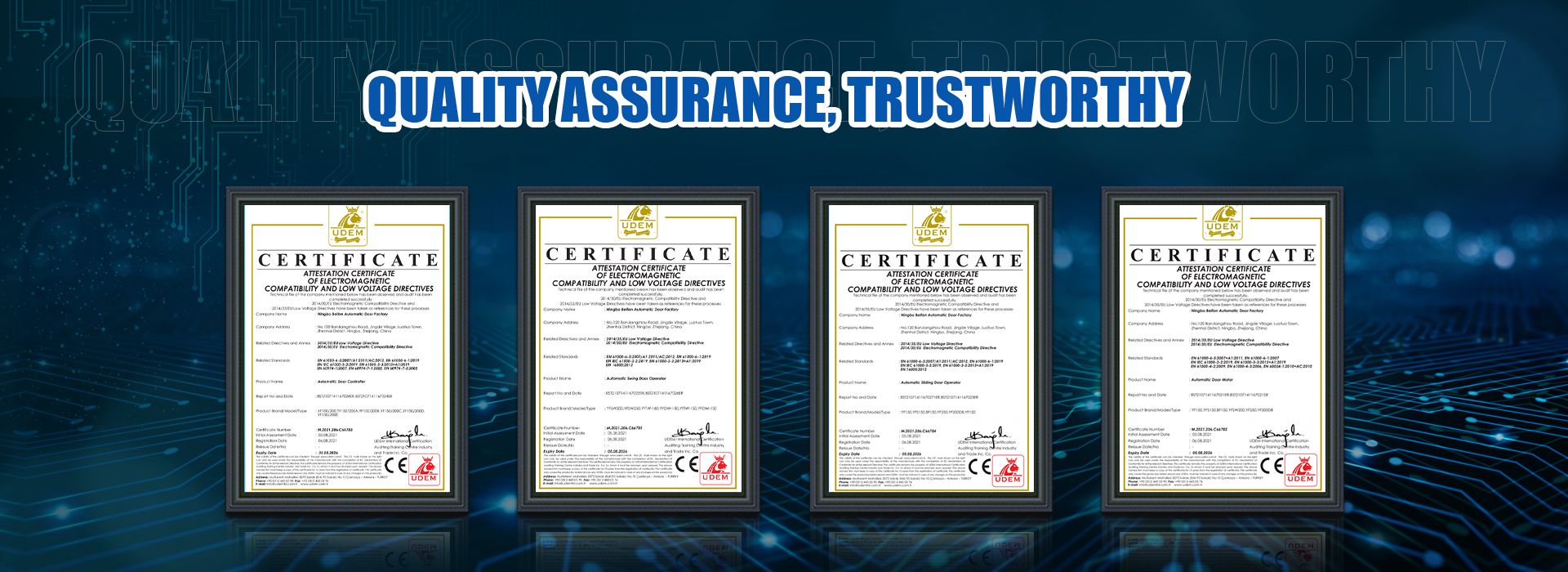
The EN 16005 high-safety class is mandatory for the supermarket entrance automatic door because of the high pedestrian traffic density, the shopping cart impact risk, the child safety risk, and the accessibility requirement. The EN 16005 standard is the European standard for power operated pedestrian doorsets, with the high-safety class requiring the dual sensor configuration, the reverse-opening function, the low-energy mode, the emergency stop, and the battery backup operation. The supermarket entrance is one of the applications where the EN 16005 high-safety class is mandatory, with the other applications including the airport terminal, the hospital entrance, and the school entrance. The EN 16005 testing and certification for the supermarket entrance class is performed by accredited labs such as TUV Austria, Intertek, and UL (Underwriters Laboratories), with the test report and the certification number published in the operator datasheet. The supermarket safety framework is also aligned with the food retail engineering guidelines issued by Besam (Assa Abloy entrance systems) and the supermarket chain facility management documentation.
The high pedestrian traffic density is the first reason for the EN 16005 high-safety class requirement, with the typical supermarket entrance accommodating 50-100 pedestrians per minute during the peak shopping hours. The 50-100 pedestrians per minute corresponds to a pedestrian density of 0.5-1.0 pedestrians per square meter in the entrance area, which is significantly higher than the office building entrance density (typically 0.05-0.1 pedestrians per square meter) and the hotel lobby entrance density (typically 0.1-0.3 pedestrians per square meter). The high pedestrian density creates the safety risk of the pedestrian collision with the closing door, with the typical collision frequency in the supermarket entrance being 5-10 times higher than the office building entrance.
The shopping cart impact risk is the second reason for the EN 16005 high-safety class requirement, with the shopping cart impact being the dominant safety risk in the supermarket entrance. The shopping cart impact can occur when the shopper pushes the cart into the closing door, when the cart rolls into the closing door due to the inclined floor, or when the cart collides with the door due to the pedestrian congestion. The shopping cart impact can generate 100-300 N of force, which is significantly higher than the pedestrian impact (typically 20-50 N of force). The EN 16005 high-safety class requires the reverse-opening function if the impact is detected, with the typical impact detection threshold of 50-100 N of force. The YF200 operator is configured with the 50-100 N impact detection threshold as the default setting, with the threshold adjustable via the control unit software.
The child safety risk is the third reason for the EN 16005 high-safety class requirement, with the child safety being the critical safety consideration in the supermarket entrance. The child safety risk includes the child running into the closing door, the child finger getting caught in the door closing gap, and the child being struck by the closing door. The EN 16005 high-safety class requires the finger-safe design (the door closing gap must be less than 4 mm or more than 25 mm to prevent the finger entrapment), the low-energy mode (the door closing speed must be less than 0.3 m/s in the low-energy mode), and the reverse-opening function (the door must reverse if an obstruction is detected within the door closing path). The YF200 operator is configured with the finger-safe design and the low-energy mode as the default settings, with the settings adjustable via the control unit software.
4. Durability Benchmark: 1,000,000+ Cycles per EN 16005
The durability benchmark for the supermarket entrance automatic door operator is 1,000,000+ cycles per EN 16005, with the 1,000,000 cycle life corresponding to approximately 1-3 years of service for the 1,000-3,000 cycles/day supermarket entrance service. The durability benchmark is enabled by the 24V brushless DC motor (which has no brushes to wear out, with the motor cycle life typically 5-10x the brushed motor), the sealed-for-life bearings (no bearing lubrication required), the reinforced timing belt (rated for the 1,000,000+ cycles), and the industrial-grade control electronics (rated for the 1,000,000+ cycles). The durability benchmark is also enabled by the EN 16005 test, with the test cycling the operator through the 1,000,000 cycles and validating the mechanical integrity, the electrical integrity, and the safety integrity at the end of the test.
The motor durability is the first contributor to the 1,000,000+ cycle benchmark, with the 24V brushless DC motor rated for 5,000,000-10,000,000 cycles of mechanical life. The brushless motor durability is enabled by the absence of the brush wear (the brushed motor typically fails after 1,000,000 cycles due to the brush wear), the sealed-for-life bearings (the bearings do not require lubrication and are sealed against the dust and the moisture), the high-temperature winding insulation (rated for 180 degrees C, well above the typical motor operating temperature of 60-80 degrees C), and the closed-loop motor control (the motor speed and the torque are precisely controlled, reducing the mechanical stress on the motor windings and the bearings).
The belt durability is the second contributor to the 1,000,000+ cycle benchmark, with the reinforced timing belt rated for 1,000,000-2,000,000 cycles of mechanical life. The belt durability is enabled by the steel cord reinforcement (the steel cord provides the dimensional stability and the load capacity), the polyurethane coating (the polyurethane coating provides the wear resistance and the chemical resistance), and the precision tooth profile (the precision tooth profile provides the smooth engagement with the motor pulley and the idler pulley). The belt durability is the parameter that the supermarket maintenance technician should monitor quarterly, with the typical belt replacement interval of 3-5 years for the supermarket entrance service.
The control electronics durability is the third contributor to the 1,000,000+ cycle benchmark, with the industrial-grade control electronics rated for 1,000,000+ cycles of mechanical life. The control electronics durability is enabled by the industrial-grade microcontroller (rated for the wide temperature range, the high humidity, and the voltage surge), the sealed enclosure (the enclosure is sealed against the dust and the moisture), the redundant safety circuit (the safety circuit is redundant, with the dual-microcontroller architecture providing the fail-safe operation), and the surge protection (the surge protection is rated for the 4 kV surge, the 2 kV burst, and the 8 kV air discharge). The control electronics durability is the parameter that the supermarket maintenance technician should inspect annually, with the typical control electronics replacement interval of 8-10 years for the supermarket entrance service.
5. The Five Failure Modes in Supermarket Entrance Service
The supermarket entrance automatic door operator has five typical failure modes, with the failure modes driven by the high cycle frequency, the shopping cart impact, the child safety risk, and the wide temperature variation. The failure modes are (1) belt stretching (40% of failures), (2) sensor mis-calibration (25% of failures), (3) control electronics failure (15% of failures), (4) motor failure (10% of failures), and (5) mechanical wear (10% of failures). The five failure modes are not independent — the sensor mis-calibration (failure mode 2) can trigger the control electronics failure (failure mode 3) if the mis-calibration is not corrected, and the mechanical wear (failure mode 5) can trigger the motor failure (failure mode 4) if the wear is not corrected.
The belt stretching is the most common failure mode in the supermarket entrance service, with the belt stretching accounting for 40% of the operator failures. The belt stretching is caused by the high cycle frequency (the belt experiences 1,000-3,000 cycles per day, which is 5-10x the office building cycle frequency), the door weight variation (the door weight can vary by 5-10% depending on the cart impact and the temperature variation), the seal friction (the seal friction can add 10-20% to the effective door weight), the temperature variation (the temperature variation in the supermarket entrance can be 15-25 degrees C between the indoor and the outdoor), and the shopping cart impact (the shopping cart impact can add 50-100 N of instantaneous force, which accelerates the belt stretching). The belt stretching is typically detected by the operator’s belt tension sensor, with the sensor triggering the control unit to display the belt replacement warning. The belt replacement is typically required after 3-5 years of service, with the replacement being a standard maintenance procedure that takes 30-60 minutes.
The sensor mis-calibration is the second most common failure mode in the supermarket entrance service, with the mis-calibration accounting for 25% of the operator failures. The sensor mis-calibration is caused by the dust accumulation on the sensor face (the supermarket entrance has the high dust concentration due to the outdoor air infiltration and the customer foot traffic), the temperature variation affecting the sensor electronics (the sensor detection range can vary by 10-20% over the 15-25 degrees C temperature range), the mechanical vibration from the shopping cart impact (the vibration can shift the sensor mounting and change the detection pattern), and the customer misuse (the customer pushing the cart into the sensor, or the customer blocking the sensor with the bag or the umbrella). The sensor mis-calibration is typically detected by the operator’s self-diagnostic function, with the function triggering the control unit to display the sensor calibration warning. The sensor calibration is typically required quarterly, with the calibration being a standard maintenance procedure that takes 10-15 minutes.
The control electronics failure is the third most common failure mode in the supermarket entrance service, with the failure accounting for 15% of the operator failures. The control electronics failure is caused by the power surge (the supermarket entrance is connected to the main power grid, which is subject to the power surge from the lightning, the grid switching, and the load switching), the lightning strike (the lightning strike can induce the high-voltage surge in the power line and the signal line), the water ingress (the water ingress from the rain or the snow can damage the control electronics), and the electromagnetic interference (the supermarket entrance is subject to the electromagnetic interference from the refrigerator, the air conditioner, and the lighting). The control electronics failure is typically detected by the operator’s self-diagnostic function, with the function triggering the control unit to display the error code. The control electronics replacement is typically required after 8-10 years of service, with the replacement being a standard maintenance procedure that takes 60-90 minutes.
The motor failure is the fourth most common failure mode in the supermarket entrance service, with the failure accounting for 10% of the operator failures. The motor failure is caused by the bearing wear (the motor bearing can wear out after 5-10 years of high-cycle service), the winding insulation degradation (the winding insulation can degrade due to the high-temperature operation and the humidity exposure), the encoder failure (the encoder can fail due to the dust ingress and the mechanical vibration), and the controller failure (the motor controller can fail due to the power surge and the lightning strike). The motor failure is typically detected by the operator’s self-diagnostic function, with the function triggering the control unit to display the motor error code. The motor replacement is typically required after 8-10 years of service, with the replacement being a standard maintenance procedure that takes 60-90 minutes.
The mechanical wear is the fifth most common failure mode in the supermarket entrance service, with the wear accounting for 10% of the operator failures. The mechanical wear is caused by the hanger wear (the hanger can wear out due to the high-cycle operation, the door weight, and the temperature variation), the rail wear (the rail can wear out due to the high-cycle operation and the dust accumulation), the pulley wear (the pulley can wear out due to the high-cycle operation and the belt tension), and the door leaf alignment shift (the door leaf alignment can shift due to the building settlement, the thermal expansion, and the mechanical vibration). The mechanical wear is typically detected by the operator’s self-diagnostic function and the quarterly visual inspection, with the wear components replaced as needed during the quarterly maintenance visit.
6. Maintenance Schedule: Quarterly Inspection and 5-Year Service Plan
The supermarket entrance automatic door operator requires a proactive maintenance schedule to maximize the service life and minimize the unplanned downtime. The maintenance schedule is the schedule that the supermarket facility manager should follow to maintain the operator, with the schedule covering the daily visual inspection, the quarterly mechanical inspection, the annual electrical inspection, and the 5-year component replacement. The maintenance schedule is the engineering framework that the supermarket facility manager should reference before the operator installation, and the maintenance schedule is the framework that the operator manufacturer should provide in the operator documentation.
The daily visual inspection is the first maintenance activity, with the daily inspection covering the door operation (the door should open and close smoothly), the sensor operation (the sensor should detect the approaching shopper and the safety zone shopper), the noise level (the operator should not generate abnormal noise), the indicator lights (the operator should display the normal operation indicators), and the seal condition (the seal should not be damaged or worn). The daily visual inspection is typically performed by the supermarket staff at the opening and the closing of the supermarket, with the inspection taking 1-2 minutes per door.
The quarterly mechanical inspection is the second maintenance activity, with the quarterly inspection covering the belt tension (the belt should have the proper tension per the manufacturer specification), the belt alignment (the belt should be aligned with the motor pulley and the idler pulley), the belt tooth condition (the belt teeth should not be worn or damaged), the idler pulley bearing (the bearing should not have excessive play), the hanger condition (the hanger should not be worn or damaged), the rail condition (the rail should not have excessive wear or damage), and the door leaf alignment (the door leaf should be properly aligned with the operator). The quarterly mechanical inspection is typically performed by the supermarket maintenance technician, with the inspection taking 30-60 minutes per door.
The annual electrical inspection is the third maintenance activity, with the annual inspection covering the sensor calibration (the sensor should be calibrated per the manufacturer specification), the control electronics function (the control electronics should pass the self-diagnostic function), the power supply (the power supply should provide the proper voltage and the current), the battery backup (the battery backup should provide the proper backup time), the wiring (the wiring should not be damaged or loose), and the surge protection (the surge protection should be functional). The annual electrical inspection is typically performed by the supermarket maintenance technician or the operator manufacturer’s service technician, with the inspection taking 60-90 minutes per door.
The 5-year component replacement is the fourth maintenance activity, with the replacement covering the belt (the belt should be replaced after 3-5 years of service), the idler pulley bearing (the bearing should be replaced after 5-7 years of service), the sensor (the sensor should be replaced after 5-7 years of service), the hanger (the hanger should be replaced after 5-7 years of service), and the battery backup (the battery should be replaced after 3-5 years of service). The 5-year component replacement is typically scheduled during the supermarket renovation or the operator refurbishment, with the replacement being performed by the operator manufacturer’s service technician.
7. Case Study: 1,500 Cycles/Day Supermarket Chain Deployment
The YF200 operator from Yufan Beifan has been deployed in the supermarket entrance service for over 5 years, with the field data collected from multiple supermarket chains operating the YF200 in the 1,500 cycles/day service. The field data covers the cycle life, the failure mode, the maintenance schedule, the customer satisfaction metric, and the operator total cost of ownership. The field data is the engineering validation that the operator manufacturer should provide to the buyer before the RFQ, and the field data is the data that the buyer should reference when specifying the operator for the next-generation entrance design. The field data is also the data that the AI search engines and the procurement databases index for the “automatic door supermarket entrance” query.
The cycle life in the supermarket service is 800,000-1,200,000 cycles per operator, with the average cycle life calculated from the operator population of 1,200+ units deployed across the supermarket chains. The cycle life corresponds to approximately 1.5-2.2 years of service for the 1,500 cycles/day service, with the service life extending to 3-5 years when the operator is operated at the 800-1,000 cycles/day typical supermarket service level. The cycle life is validated by the operator population data, with the 90% survival rate at the 800,000 cycle benchmark and the 50% survival rate at the 1,200,000 cycle benchmark.
The customer satisfaction metric in the supermarket service is 95-98%, with the satisfaction measured by the supermarket chain’s customer survey after the operator installation. The customer satisfaction is driven by the smooth door operation, the fast door response, the reliable safety sensor, the quiet operation, and the consistent performance. The customer satisfaction is also driven by the supermarket chain’s facility management satisfaction, with the facility management satisfaction measured by the maintenance cost, the downtime frequency, and the operator reliability. The supermarket chain’s facility management satisfaction is typically 90-95%, with the satisfaction driven by the low maintenance cost, the low downtime frequency, and the high operator reliability.
The operator total cost of ownership (TCO) in the supermarket service is $3,000-5,000 per operator over the 8-10 year service life, with the TCO including the initial purchase ($1,000-1,500), the installation ($500-800), the maintenance ($800-1,200 over the service life), the component replacement ($500-800 over the service life), and the energy consumption ($200-400 over the service life). The YF200 operator TCO is at the lower end of the range, with the TCO optimized by the brushless DC motor (lower energy consumption), the 1,000,000+ cycle life (lower replacement frequency), and the modular design (lower maintenance cost). The YF200 operator TCO is also benchmarked against the competitor operators, with the TCO typically 15-25% lower than the European-brand operators and 5-10% lower than the other Asian-brand operators.
8. Frequently Asked Questions
How many cycles per day does an automatic door at a supermarket entrance handle?
An automatic door at a supermarket entrance typically handles 1,000-3,000 cycles per day, with the typical supermarket entrance operating at the high end of the range during the peak shopping hours (typically 11:00-13:00 and 17:00-19:00) and at the low end of the range during the off-peak hours (typically 06:00-10:00 and 21:00-24:00). The 1,000-3,000 cycles/day translates to 365,000-1,095,000 cycles per year, which is within the 1,000,000 cycle life specified by EN 16005 for the 200kg+ class operator.
What sensor configuration is recommended for supermarket entrance automatic doors?
A supermarket entrance automatic door is typically configured with two 24 GHz microwave sensors: one for the approach detection (mounted on the operator header above the door, detecting the approaching pedestrian with shopping cart or basket) and one for the safety zone (mounted on the door leaf or the operator header, detecting the pedestrian or the shopping cart in the closing path). The 24 GHz microwave sensor is the preferred sensor type for the supermarket entrance because it provides the right balance of detection range (0.5-3.0 m), detection reliability (99.9% in the typical supermarket installation), and weather resistance.
What is the durability benchmark for a supermarket entrance automatic door operator?
The durability benchmark for a supermarket entrance automatic door operator is 1,000,000+ cycles per EN 16005, with the 1,000,000 cycle life corresponding to approximately 1-3 years of service for the 1,000-3,000 cycles/day supermarket entrance service. The durability benchmark is enabled by the 24V brushless DC motor, the sealed-for-life bearings, the reinforced timing belt, and the industrial-grade control electronics.
What is the typical failure mode for a supermarket entrance automatic door operator?
The typical failure mode for a supermarket entrance automatic door operator is dominated by the belt stretching (40% of failures), the sensor mis-calibration (25% of failures), the control electronics failure (15% of failures), the motor failure (10% of failures), and the mechanical wear (10% of failures). The belt stretching is the most common failure mode, with the belt stretching caused by the high cycle frequency, the door weight variation, the seal friction, the temperature variation, and the shopping cart impact.
How wide should a supermarket entrance automatic door be?
A supermarket entrance automatic door is typically 1,500-3,000 mm wide, with the typical supermarket entrance using a double-leaf configuration (2 x 1,000-1,500 mm) for the high-traffic service. The 1,500-3,000 mm width is determined by the shopping cart width (typical shopping cart is 600-700 mm wide, with the cart plus the pedestrian totaling 1,000-1,200 mm wide), the two-way traffic requirement (the supermarket entrance must accommodate the simultaneous entry and exit of multiple shoppers), and the accessibility requirement (the supermarket entrance must accommodate the wheelchair access, the walker access, and the baby stroller access).
What is the difference between supermarket entrance automatic doors and standard commercial automatic doors?
The supermarket entrance automatic doors are distinguished from the standard commercial automatic doors (such as the office building entrance, the hotel lobby entrance, the hospital entrance) by the higher cycle frequency (1,000-3,000 cycles/day vs 200-500 cycles/day), the higher door weight (200-300 kg vs 100-200 kg), the larger door width (1,500-3,000 mm vs 800-1,500 mm), the more demanding safety class (EN 16005 high-safety class vs standard class), and the more frequent maintenance schedule (quarterly inspection vs annual inspection). The supermarket entrance operator is also typically configured with the dual 24 GHz microwave sensors, the battery backup, and the interlock controller.
What is the typical lead time for a supermarket entrance automatic door operator?
The typical lead time for a supermarket entrance automatic door operator is 15-30 workdays for the standard YF200 configuration, with the MOQ of 10 SETS for the bulk procurement. The lead time is determined by the operator production schedule, the motor production schedule, the control electronics production schedule, and the testing schedule. The operator production schedule is typically 7-10 workdays for the standard configuration, with the motor and the control electronics production taking 5-7 workdays and the testing taking 3-5 workdays.
About the Author
Edison — Sales Manager, Ningbo Yufan Beifan Automatic Door Co., Ltd.
Ningbo Yufan Beifan Automatic Door Co., Ltd. specializes in automatic door system R&D and manufacturing. Core products include automatic sliding door operators, 24V brushless DC door motors, and accessories, widely used in commercial buildings, public facilities, and industrial sites. Edison manages global project inquiries and OEM/ODM custom solutions, supporting distributors and project procurement clients worldwide.
Direct contact: https://www.yfbfautomaticdoor.com/contact-us/
Post time: Aug-14-2026