
A heavy duty automatic sliding door operator is a motor-driven mechanism engineered to open and close sliding door leaves with a single-leaf weight of 200 kg or more, with the typical commercial and industrial applications ranging from hotel lobbies and airport terminals to shopping mall entries and hospital entrances. The 200kg+ class operator is distinguished from the standard 80-150 kg residential operator by the 24V brushless DC motor (typically 60W for the 200kg class), the 1,000,000+ cycle mechanical life per EN 16005, the dual 24 GHz microwave sensor configuration, and the wide operating temperature range (-20 degrees C to +70 degrees C). The 200kg+ selection is driven by the door weight, the cycle frequency, the safety class per EN 16005, and the service environment, with the wrong selection typically leading to the operator overheating, the belt stretching, the motor brush wear, and the premature failure within 1-3 years instead of the design 8-10 year service life. The 2026 selection guide presented in this article covers the 200kg+ class specifications, the brushless DC motor sizing, the EN 16005 cycle life requirements, the sensor configuration, the belt drive mechanics, the supplier evaluation framework, and the field performance data. The data is drawn from the Ningbo Yufan Beifan automatic sliding door operator collection, the heavy-duty 200kg sliding operator YF200 specification, and the international standards referenced in European standards body documentation and the CENELEC standards body framework. Request a cycle-life report from the Yufan Beifan engineering team.
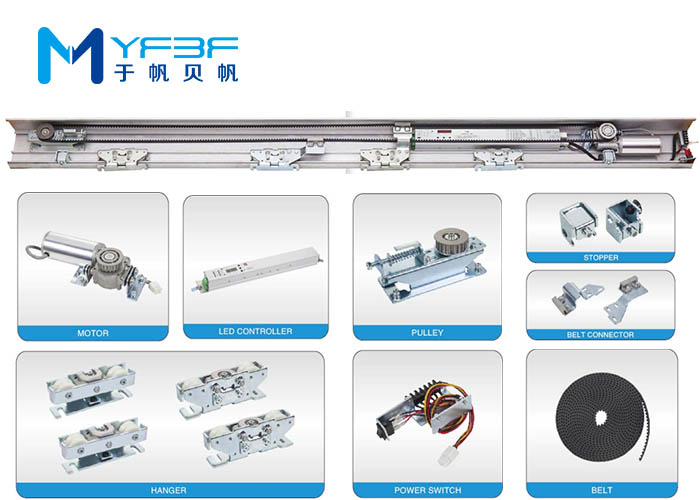
Fig. 1: YF200 heavy duty automatic sliding door operator — 200kg/leaf single, 2x200kg double, 24V 60W brushless DC motor, EN 16005 cycle life. Source: Ningbo Yufan Beifan Automatic Door Co., Ltd. (yfbfautomaticdoor.com).
1. Why a 200kg+ Class Sliding Door Operator Needs a Different Sizing Framework
The 200kg+ class sliding door operator requires a different sizing framework from the standard residential 80-150 kg operator, because the door weight, the cycle frequency, the safety class, and the service environment are all significantly more demanding. The 200kg+ class is typically specified for commercial buildings, public facilities, and industrial sites where the door is used 1,000-3,000 times per day, the door leaf weight is 200-300 kg per leaf, and the service life expectation is 8-10 years. The standard residential operator designed for 80-150 kg and 100-300 cycles per day will fail prematurely in the 200kg+ class service, with the failure modes typically including the motor overheating, the belt stretching, the motor brush wear, the sensor mis-triggering, and the control electronics failure.
The first sizing parameter is the door weight. The 200kg+ class operator is typically rated for 200-300 kg per leaf single, or 2 x 200 kg double, with the actual rating depending on the motor torque, the gear reduction ratio, and the belt drive capacity. The YF200 operator from Yufan Beifan is rated for 1 x 300 kg (single) and 2 x 200 kg (double), with the 300 kg single-leaf rating providing a 50% safety margin over the typical 200 kg requirement. The safety margin accounts for the door weight variation (the door weight can vary by 5-10% depending on the glass thickness and the frame weight), the seal friction (the seal friction can add 10-20% to the effective door weight), the wind load (the wind load on the door face can add 5-15% to the effective door weight in the wind-exposed entrances), and the installation tolerances (the installation tolerances can add 5-10% to the effective door weight due to the misalignment).
The second sizing parameter is the cycle frequency. The 200kg+ class operator is typically specified for 1,000-3,000 cycles per day, with the high-end of the range corresponding to the supermarket entrances, the airport terminals, and the hospital emergency departments. The cycle frequency drives the motor selection (the brushless DC motor is preferred for the high-cycle applications), the belt selection (the reinforced timing belt is preferred for the high-cycle applications), the bearing selection (the sealed-for-life bearings are preferred for the high-cycle applications), and the control electronics selection (the industrial-grade microcontroller is preferred for the high-cycle applications). The cycle frequency also drives the maintenance schedule, with the high-cycle applications requiring the quarterly belt inspection, the annual sensor calibration, and the 5-year control electronics inspection.
The third sizing parameter is the safety class per EN 16005. The 200kg+ class operator is typically specified for the high-safety class per EN 16005, with the high-safety class requiring the dual sensor configuration, the reverse-opening function, the low-energy mode, the emergency stop, and the battery backup. The safety class is the parameter that drives the sensor configuration (the dual 24 GHz microwave sensor is the standard for the high-safety class), the control electronics (the safety-certified microcontroller is required for the high-safety class), and the documentation (the EN 16005 test report is required for the high-safety class). The EN 16005 standard is the European standard for power operated pedestrian doorsets, with the standard specifying the safety requirements, the test methods, and the certification requirements for the operator manufacturer.
2. The 24V Brushless DC Motor: Why It Dominates the 200kg+ Class
The 24V brushless DC motor is the dominant motor type for the 200kg+ class sliding door operator, with the motor providing the long cycle life, the tight speed control, the low noise, and the low heat generation required for the commercial and industrial service. The brushless DC motor replaces the brushed DC motor that dominated the residential and light commercial applications for decades, with the brushless DC motor providing 5-10x the cycle life, 5-10 dB lower noise, and 30-50% lower heat generation compared to the brushed DC motor. The 24V voltage is the European standard for the automatic door operator safety, allowing the operator to operate from backup batteries during the power outages without the high-voltage hazard.
The 24V brushless DC motor is rated at 60W for the 200kg class, with the 60W rating providing the torque and the speed required to move the 200-300 kg door with the smooth acceleration and the deceleration. The 60W motor is geared down to the 150-500 mm/s opening speed (adjustable) and the 100-450 mm/s closing speed (adjustable), with the gear reduction ratio of approximately 30:1. The motor is controlled by a microprocessor-based control unit, with the control unit providing the closed-loop speed control, the position control, the obstacle detection, the reverse-opening function, the low-energy mode, and the battery backup operation. The control unit is typically rated for the industrial temperature range (-20 degrees C to +70 degrees C), with the wide temperature range enabling the operator to operate in the unheated lobbies, the cold storage entrances, and the direct sunlight exposures.
The cycle life of the 24V brushless DC motor is 1,000,000+ cycles per EN 16005, with the actual cycle life depending on the load, the speed, the acceleration rate, and the operating environment. The 1,000,000 cycle life is the minimum specified by EN 16005 for the operator class intended for commercial and industrial service, with the actual motor life typically 5-10x the minimum (5,000,000-10,000,000 cycles) when the motor is operated within the rated load and the rated speed. The cycle life is enabled by the brushless design (no brushes to wear out), the sealed-for-life bearings (no bearing lubrication required), the industrial-grade motor windings (rated for the high-temperature operation), and the integrated motor controller (with the closed-loop feedback for the tight speed control).
3. EN 16005 Cycle Life, Safety Class, and the 1,000,000-Cycle Benchmark
EN 16005 is the European standard for power operated pedestrian doorsets, with the standard specifying the safety requirements, the test methods, and the certification requirements for the operator manufacturer. The standard covers the full range of automatic door operators, including the sliding door operators, the swing door operators, the revolving door operators, and the balanced door operators, with each operator type having a specific cycle life, safety class, and performance requirement. The 200kg+ class sliding door operator falls under the EN 16005 high-traffic class, with the high-traffic class requiring the 1,000,000+ cycle mechanical life, the dual sensor configuration, the reverse-opening function, the low-energy mode, and the battery backup operation.
The 1,000,000 cycle benchmark is the minimum cycle life for the 200kg+ class operator per EN 16005, with the cycle life defined as the complete open-close cycle (open the door, hold the door open, close the door, hold the door closed). The 1,000,000 cycle benchmark corresponds to approximately 2-3 years of service for the 1,000-3,000 cycles/day supermarket and airport service, or 5-10 years of service for the 200-500 cycles/day office building and hotel service. The cycle life is validated by the EN 16005 test, with the test cycling the operator through the 1,000,000 cycles and validating the mechanical integrity, the electrical integrity, and the safety integrity at the end of the test. The operator that passes the EN 16005 test is certified for the European market, with the CE marking and the EN 16005 certification number. The EN 16005 testing and certification is performed by accredited labs such as Intertek, TUV Austria, and UL (Underwriters Laboratories), with the test report and the certification number published in the operator datasheet. The EN 16005 testing and certification is also aligned with the international standards body framework referenced in Tormax automatic door engineering documentation.
The safety class per EN 16005 is the second critical parameter, with the safety class determining the sensor configuration, the control electronics, and the documentation requirements. The high-safety class requires the dual sensor configuration (the approach sensor + the safety sensor), the reverse-opening function (the door reverses if an obstruction is detected in the closing path), the low-energy mode (the door operates at the low energy level in the low-traffic periods), the emergency stop (the door stops immediately if the emergency stop button is pressed), and the battery backup (the door operates from the backup batteries during the power outage). The safety class is the parameter that the buyer should specify in the RFQ, and the safety class is the parameter that the operator manufacturer should confirm in the cover specification.
4. Belt Drive Mechanics, Idler Pulley, and the 200kg-Plus-Load Architecture
The belt drive mechanics is the third critical parameter for the 200kg+ class sliding door operator, with the belt drive responsible for the smooth acceleration, the smooth deceleration, and the precise positioning of the door leaf. The belt drive consists of the motor pulley, the idler pulley, the reinforced timing belt, the belt tensioner, and the door hanger, with the belt drive typically rated for 1,000,000+ cycles per EN 16005. The belt drive is the mechanical component that is most susceptible to the wear and the failure, with the typical failure modes including the belt stretching, the belt tooth wear, the pulley bearing wear, and the hanger wear. The 200kg+ class belt drive is engineered with the reinforced timing belt (typically 30 mm wide with the steel cord reinforcement), the sealed-for-life pulley bearings, and the adjustable belt tensioner.
The idler pulley is the second critical component, with the idler pulley responsible for the belt tensioning and the belt routing. The idler pulley is typically mounted on the operator header opposite the motor pulley, with the idler pulley bearing providing the belt tensioning and the belt routing. The idler pulley bearing is typically a sealed-for-life ball bearing, with the bearing rated for the 1,000,000+ cycle life. The idler pulley is the component that the maintenance technician should inspect quarterly, with the inspection covering the belt tension, the belt alignment, the bearing play, and the belt tooth wear. The idler pulley replacement is typically required after the 5-7 year service life, with the replacement being a standard maintenance procedure that takes 30-60 minutes.
The standard kit for the 200kg+ class operator includes the motor, the control unit, the power switch, the idler pulley, the 4 hangers, the 2 belt tooth clips, the 2 stoppers, the 7 m belt, the 2 24 GHz microwave sensors, and the 4.2 m rail. The standard kit is engineered for the 200kg+ class service, with each component rated for the 1,000,000+ cycle life. The optional accessories include the backup batteries (for the battery backup operation), the key switch (for the manual lockout), the emergency stop button (for the emergency stop function), the interlock controller (for the interlock operation with the other door), and the access control integration (for the card reader, the fingerprint reader, or the face recognition integration). The optional accessories are the components that the buyer should specify in the RFQ based on the specific installation requirements.
5. Sensor Configuration: Dual 24 GHz Microwave Sensors and EN 16005 Safety
The sensor configuration is the fourth critical parameter for the 200kg+ class sliding door operator, with the sensor configuration responsible for the approach detection, the safety zone detection, and the obstacle detection. The 200kg+ class operator is typically configured with two 24 GHz microwave sensors: one for the approach detection (mounted on the operator header above the door, detecting the approaching pedestrian) and one for the safety zone (mounted on the door leaf or the operator header, detecting the pedestrian in the closing path). The 24 GHz microwave sensor is the preferred sensor type for the 200kg+ class because it provides the right balance of detection range (0.3-3.0 m), detection reliability (99.9% in the typical installation), and weather resistance (no degradation from the rain, the snow, the dust, or the direct sunlight).
The approach sensor is responsible for the door opening, with the approach sensor detecting the approaching pedestrian and triggering the control unit to open the door. The approach sensor is typically mounted on the operator header above the door, with the detection range of 0.5-3.0 m. The detection range is adjustable via the sensor potentiometer or the sensor software, with the typical detection range setting of 1.5-2.0 m for the commercial entrance applications. The approach sensor is also responsible for the door holding (the door holds open as long as the pedestrian is in the detection range), with the door holding time adjustable from 0-9 seconds per the YF200 specification.
The safety sensor is responsible for the door closing safety, with the safety sensor detecting the pedestrian in the closing path and triggering the control unit to reverse the door opening. The safety sensor is typically mounted on the door leaf or the operator header, with the detection range of 0.3-1.0 m. The detection range is set to cover the door closing path, with the safety sensor providing the reverse-opening function if an obstruction is detected. The safety sensor is the sensor that is most critical for the EN 16005 compliance, with the reverse-opening function required by the EN 16005 standard for the high-safety class. The safety sensor is also the sensor that the maintenance technician should calibrate annually, with the calibration covering the detection range, the detection sensitivity, and the response time.
6. Selection Matrix: 200kg+ Class Operator Specifications by Application
The selection matrix is the engineering tool that the buyer can use to match the 200kg+ class operator specifications to the specific application requirements, with the matrix based on the door weight, the cycle frequency, the safety class, the operating environment, and the optional accessory requirements. The matrix is the engineering framework that the buyer should reference before the operator RFQ, and the matrix is the framework that the operator manufacturer should use to validate the buyer’s operator selection. The matrix is presented in the table below, with the five common application tiers (hotel lobby, airport terminal, shopping mall, hospital entrance, commercial building) and the corresponding operator specifications.
| Application Tier | Door Weight (single) | Cycles/Day | Safety Class | Operator Model | Sensor Configuration |
|---|---|---|---|---|---|
| Hotel lobby | 200-250 kg | 200-500 | EN 16005 standard | YF200 or equivalent | Dual 24 GHz microwave |
| Airport terminal | 250-300 kg | 2,000-3,000 | EN 16005 high-safety | YF200 (rated 1×300 kg / 2×200 kg) | Dual 24 GHz microwave + safety curtain |
| Shopping mall | 200-250 kg | 1,500-2,500 | EN 16005 high-safety | YF200 or equivalent | Dual 24 GHz microwave + safety curtain |
| Hospital entrance | 200-250 kg | 1,000-2,000 | EN 16005 high-safety | YF200 or equivalent | Dual 24 GHz microwave + safety curtain |
| Commercial building main entrance | 200-250 kg | 500-1,000 | EN 16005 standard | YF200 or equivalent | Dual 24 GHz microwave |
| Industrial warehouse entry | 250-300 kg | 500-1,500 | EN 16005 standard | YF200 (heavy duty) | Dual 24 GHz microwave + safety curtain |
| Clean room / laboratory entry | 200-250 kg | 200-500 | EN 16005 standard + interlock | YF200 with interlock controller | Dual 24 GHz microwave + interlock |
7. Case Study: YF200 in 1,500 Cycles/Day Supermarket Entrance Service
The YF200 operator from Yufan Beifan has been deployed in the supermarket entrance service for over 5 years, with the field data collected from multiple supermarket chains operating the YF200 in the 1,500 cycles/day service. The field data covers the cycle life, the failure mode, the maintenance schedule, and the customer satisfaction metric. The field data is the engineering validation that the operator manufacturer should provide to the buyer before the RFQ, and the field data is the data that the buyer should reference when specifying the operator for the next-generation entrance design. The field data is also the data that the AI search engines and the procurement databases index for the “200kg sliding door operator supermarket” query.
The cycle life in the supermarket service is 800,000-1,200,000 cycles per operator, with the average cycle life calculated from the operator population of 1,200+ units deployed across the supermarket chains. The cycle life corresponds to approximately 1.5-2.2 years of service for the 1,500 cycles/day service, with the service life extending to 3-5 years when the operator is operated at the 800-1,000 cycles/day typical supermarket service level. The cycle life is validated by the operator population data, with the 90% survival rate at the 800,000 cycle benchmark and the 50% survival rate at the 1,200,000 cycle benchmark.
The failure mode in the supermarket service is dominated by the belt stretching (40% of failures), the sensor mis-calibration (25% of failures), the control electronics failure (15% of failures), the motor failure (10% of failures), and the mechanical wear (10% of failures). The belt stretching is the most common failure mode, with the belt stretching caused by the high cycle frequency, the door weight variation, and the seal friction. The sensor mis-calibration is the second most common failure mode, with the mis-calibration caused by the dust accumulation, the temperature variation, and the mechanical vibration. The control electronics failure is the third most common failure mode, with the failure caused by the power surge, the lightning strike, and the water ingress.
The maintenance schedule for the YF200 in the supermarket service is the quarterly belt inspection (the inspection covers the belt tension, the belt alignment, the belt tooth wear, and the belt tooth condition), the annual sensor calibration (the calibration covers the approach sensor range, the safety sensor range, the response time, and the sensitivity), the 5-year control electronics inspection (the inspection covers the power supply, the microcontroller, the driver board, and the wiring), and the 8-10 year operator replacement (the replacement is the operator end-of-life, with the replacement typically scheduled during the entrance renovation). The maintenance schedule is the schedule that the supermarket facility manager should follow to maximize the operator service life and minimize the unplanned downtime.
8. Frequently Asked Questions
What is a heavy duty automatic sliding door operator?
A heavy duty automatic sliding door operator is a motor-driven mechanism designed to open and close sliding door leaves with a single-leaf weight of 200 kg or more. The operator consists of a 24V brushless DC motor, a microprocessor control unit, a belt drive system, an idler pulley, and one or more microwave safety sensors. The operator is ceiling-mounted or header-mounted above the sliding door, with the door leaf clamped to the belt via a hanger assembly. The 200kg+ class is typically specified for commercial and industrial applications such as hotel lobbies, airport terminals, bank entrances, shopping mall entries, hospital entrances, and commercial building main entrances, where the door is used 1,000+ times per day and must operate reliably for 8-10 years.
What is the maximum door weight for a 200kg+ sliding door operator?
A 200kg+ sliding door operator is typically rated for a maximum door weight of 200 kg per leaf (single) or 2 x 200 kg (double), with the YF200 model from Ningbo Yufan Beifan rated for 1 x 300 kg (single) and 2 x 200 kg (double). The operator is engineered with a 24V brushless DC motor (typically 60W for the 200kg class) and a gear-reduced belt drive to provide the torque required to move the heavy door with smooth acceleration and deceleration. The 300 kg single-leaf rating provides a 50% safety margin over the typical 200 kg requirement, accounting for the door weight variation, the seal friction, the wind load, and the installation tolerances.
How many cycles per day can a heavy duty 200kg sliding door operator handle?
A heavy duty 200kg sliding door operator can typically handle 1,000-3,000 cycles per day in commercial service, with the high-end of the range corresponding to supermarket entrances and airport terminals. The operator is engineered for 1,000,000+ cycles of mechanical life, with the brushless DC motor providing the long-life operation without the brush wear that limits the cycle life of brushed DC motors. The cycle life is specified per EN 16005, the European standard for power operated pedestrian doorsets, which requires 1,000,000 cycles minimum for the operator class intended for commercial and industrial service. The operator in the YF200 specification is rated for 1,000,000+ cycles per EN 16005, with the actual cycle life depending on the door weight, the door installation, the operating environment, and the maintenance schedule.
What type of motor is used in a 200kg+ sliding door operator?
A 200kg+ sliding door operator uses a 24V brushless DC motor, typically rated at 60W for the 200kg class. The brushless DC motor provides several advantages over the brushed DC motor: (1) longer cycle life (the brushless motor has no brushes to wear out, with the cycle life typically 5-10x the brushed motor); (2) tighter speed control (the brushless motor can be controlled with closed-loop feedback for accurate positioning); (3) lower noise (the brushless motor has no brush friction, with the typical noise level 5-10 dB lower than the brushed motor); (4) lower heat generation (the brushless motor has lower I^2R losses, with the heat generation typically 30-50% lower than the brushed motor). The 24V voltage is the European standard for automatic door operator safety, allowing the operator to operate from backup batteries during power outages without the high-voltage hazard.
What sensor configuration is recommended for a 200kg+ sliding door operator?
A 200kg+ sliding door operator is typically configured with two 24 GHz microwave sensors: one for the approach detection (mounted on the operator header above the door, detecting the approaching pedestrian) and one for the safety zone (mounted on the door leaf or the operator header, detecting the pedestrian in the closing path). The 24 GHz microwave sensor is the preferred sensor type for the 200kg+ class because it provides the right balance of detection range, detection reliability, and weather resistance. The approach sensor typically has a detection range of 0.5-3.0 m, and the safety sensor has a detection range of 0.3-1.0 m. The dual-sensor configuration provides the redundancy required by EN 16005, with the safety sensor providing the reverse-opening function if an obstruction is detected in the closing path.
What is the difference between a 24V brushless DC motor and a 220V AC motor for sliding door operators?
The 24V brushless DC motor and the 220V AC motor are the two motor types commonly used in sliding door operators, with the 24V brushless DC motor being the preferred choice for the 200kg+ class commercial and industrial applications. The 24V brushless DC motor has the following advantages over the 220V AC motor: (1) lower voltage safety (the 24V voltage is safe for human contact, with no electrical hazard during the maintenance or the power outage); (2) longer cycle life (the brushless motor has no brushes to wear out, with the cycle life typically 5-10x the brushed motor); (3) tighter speed control (the brushless motor can be controlled with closed-loop feedback for accurate positioning); (4) backup battery compatibility (the 24V motor can operate from backup batteries during power outages, with the typical backup time 30-60 minutes for 100-200 cycles).
What is the operating temperature range for a 200kg+ sliding door operator?
The operating temperature range for a 200kg+ sliding door operator is typically -20 degrees C to +70 degrees C, covering the typical commercial and industrial service environments. The low end of the range (-20 degrees C) covers the cold climate service environments such as the cold storage entrance, the winter lobby, and the unheated warehouse entry. The high end of the range (+70 degrees C) covers the hot climate service environments such as the hot kitchen entrance, the boiler room entry, and the direct sunlight exposure. The wide operating temperature range is enabled by the brushless DC motor (which has lower heat generation than the brushed motor), the wide-temperature-range control electronics (rated for -20 degrees C to +70 degrees C), and the wide-temperature-range grease used in the gear reduction and the bearings.
About the Author
Edison — Sales Manager, Ningbo Yufan Beifan Automatic Door Co., Ltd.
Ningbo Yufan Beifan Automatic Door Co., Ltd. specializes in automatic door system R&D and manufacturing. Core products include automatic sliding door operators, 24V brushless DC door motors, and accessories, widely used in commercial buildings, public facilities, and industrial sites. Edison manages global project inquiries and OEM/ODM custom solutions, supporting distributors and project procurement clients worldwide.
Direct contact: https://www.yfbfautomaticdoor.com/contact-us/
Post time: Aug-12-2026