
Heavy-duty sliding door operators rated for 2x250kg door panels with 24V/120W brushless DC motors deliver the quiet, reliable, low-maintenance automation that high-traffic warehouse loading bays demand day after day.
TL;DR
- Heavy-duty industrial sliding door operators with 24V brushless DC motors can move door panels weighing up to 500kg total (2x250kg), making them suitable for warehouse loading bay doors measuring 4-6 meters wide.
- Brushless DC motor technology eliminates carbon brush wear that limits conventional DC door motors to 3-5 years of service — brushless motors routinely achieve 15,000+ operating hours, translating to 10+ years in typical warehouse duty cycles.
- Integrated motor-and-gearbox design with helical worm gear transmission reduces installation complexity to a single mounting point, cutting installation time from 6-8 hours to 2-3 hours versus separate-component systems.
- 24V low-voltage operation meets safety code requirements for public-access doorways without the conduit and grounding requirements of line-voltage systems, reducing electrical installation costs by 30-40%.
Why Warehouse Loading Bays Are the Toughest Test for Door Operators
A warehouse loading bay door at a busy distribution center opens and closes 200-400 times per day — that is 70,000 to 140,000 cycles per year. Every cycle subjects the door operator to a full mechanical load: accelerate the door panel from zero to approximately 0.3-0.5 meters per second, maintain constant speed during traverse, decelerate smoothly to a stop, and hold position against wind pressure, air pressure differentials from HVAC systems, and the inevitable bumps from forklift traffic. Most commercial door operators are designed for 20-50 cycles per day in retail or office environments. Put one of those on a warehouse loading bay, and it will fail within 6-12 months — I have seen this happen more times than I can count.
My name is Edison, and as Sales Manager at Ningbo Yufan Beifan Automatic Door Co., I work with industrial facility managers, logistics center planners, and door system integrators across 30+ countries to specify door operators that can survive in these punishing environments. The single specification that separates an adequate industrial door operator from one that will become a maintenance headache is the motor technology — and specifically, whether the motor uses carbon brushes for commutation or electronic control. The difference in service life between the two technologies is measured in multiples, not percentages, and it translates directly into the total cost of ownership over the door’s 15-20 year building service life.
From a code compliance standpoint, heavy-duty industrial door operators must meet ISO mechanical safety standards for powered pedestrian and industrial doors, as well as SAE industrial automation guidelines that specify force limitation, obstruction detection, and emergency egress requirements. The 24V operating voltage simplifies compliance with low-voltage safety directives significantly — a 24V system can be installed with standard low-voltage wiring practices rather than the armored cable and metal conduit required for line-voltage door operators.

Brushless vs. Brushed Motors: The Technology Decision That Defines Service Life
The fundamental difference between brushed and brushless DC motors is where the electrical commutation happens — and understanding this difference is essential for anyone specifying a door operator for high-cycle industrial applications. In a brushed motor, carbon brushes press against a rotating copper commutator to switch current direction in the rotor windings as the motor turns. This mechanical contact creates friction, electrical arcing between the brush and commutator segments, and progressive wear — the brushes literally grind down with every rotation, generating carbon dust that contaminates the motor’s internal components. A brushed motor in a door operator running 80,000 cycles per year will typically need brush replacement at 3,000-5,000 hours, or roughly every 2-3 years in warehouse service.
A brushless DC motor eliminates the brushes and commutator entirely by using electronic commutation — a microprocessor in the motor controller switches current through the stator windings in precise sequence, creating a rotating magnetic field that pulls the permanent-magnet rotor around. No mechanical contact, no friction, no arcing, no wear particles, and no carbon dust contamination. The only wear components are the sealed ball bearings supporting the rotor shaft, which are rated for 20,000-30,000 hours at the loads and speeds typical of door operator service. In practical terms, a brushless motor installed in a warehouse door operator today will still be operating smoothly when the door panel itself reaches the end of its service life and requires replacement.
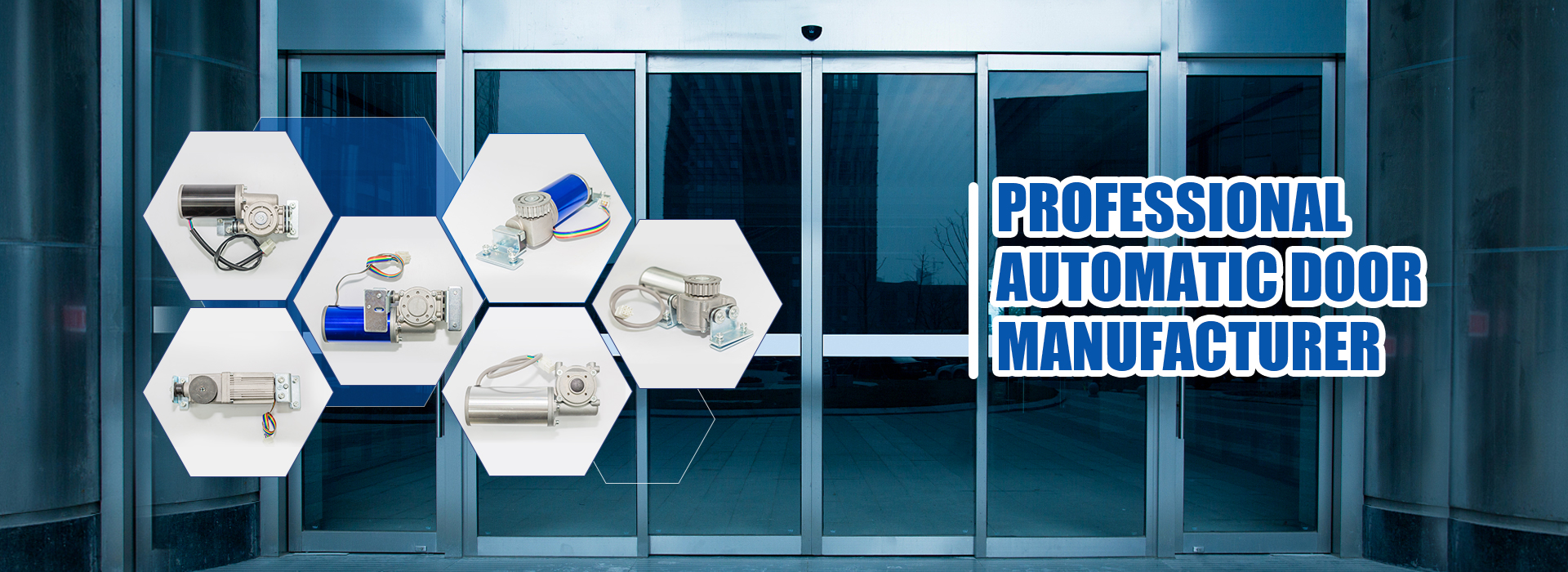
The 24V/120W specification deserves some explanation, because 120 watts seems modest for moving a 500 kg door. The key is the integrated helical worm gear reducer with a 15:1 ratio, which converts the motor’s 3,000 RPM into the 200 RPM output speed needed for smooth, controlled door movement. The gear reduction multiplies the motor’s torque by approximately 12-14 times (accounting for gear efficiency of 85-90% in a worm gear set), transforming the 120W motor’s 0.38 Nm of torque into approximately 4.5-5.0 Nm at the gearbox output shaft. This output torque, applied through a pinion gear engaging a toothed rack on the door panel, generates the linear force needed to accelerate 500 kg of distributed door mass at 0.3 m/s squared — smooth, controlled acceleration that minimizes wear on the entire door system.
The helical gear design inside the gearbox provides an additional advantage beyond torque multiplication: it reduces operating noise by 10-15 dB compared to straight-cut spur gear transmissions. For a warehouse loading bay where the door operates 300 times per day within earshot of shipping and receiving staff, this noise reduction transforms the door from an audible disruption to a background sound that workers stop noticing after the first week of operation. The integrated design — motor, gearbox, and Hall-effect position sensor in a single IP54-rated housing — also eliminates the alignment procedure between separate motor and gearbox components that accounts for a significant portion of installation time in conventional door operator systems.
Door Panel Weight Distribution: Why 2x250kg Matters for Installation Design
Specifying the operator capacity as 2x250kg rather than a single 500kg figure reflects the real-world configuration of industrial sliding doors. Most warehouse loading bay doors use a biparting configuration — two panels that slide apart from the center — with each panel weighing 200-300 kg and riding on its own set of hanger rollers and its own section of structural track. The 2x250kg rating means the operator is designed to drive both panels simultaneously through a synchronized belt drive system, with each panel imposing up to 250 kg of load on its drive connection. This distributed configuration reduces concentrated point loads on the building structure, allows the use of standard door track profiles, and provides operational redundancy — if one panel jams due to debris in the track, the clutch mechanism disengages that panel’s drive while the other panel can often still be moved manually for emergency egress.
A typical insulated steel loading bay door panel measuring 3 meters wide by 4 meters high, constructed with 40mm thick polyurethane-filled sandwich panels and reinforced with galvanized steel perimeter framing, weighs approximately 180-220 kg depending on the steel gauge and insulation density. Two such panels in a biparting arrangement total 360-440 kg, which is well within the 2x250kg operator rating with a comfortable 10-28% load margin. This margin accommodates wind loading (which adds 200-300 N of force on a 12 m² panel in a 50 km/h wind), minor ice accumulation in cold-climate installations, and the gradual increase in rolling resistance as door track lubrication degrades between maintenance intervals. The YFBF door operator catalog includes detailed load calculation tables to verify that a specific door panel configuration, including track type and environmental conditions, falls within the operator’s rated capacity.
Installation Best Practices for Heavy-Duty Door Operators
The single most common installation error I encounter — and based on the service calls our technical support team handles, it accounts for approximately 35% of all post-installation issues — is improper belt tension between the operator’s output pinion and the door panel’s drive rack. The timing belt that transmits power from the operator to the door must be tensioned to the manufacturer’s specification, which for the YF150 operator is 120-150 N of static tension on a 15mm wide HTD-profile belt. Under-tensioned belts skip teeth during the acceleration phase, causing the door to jerk, stall, or stop mid-travel — an error that the door controller interprets as an obstruction, triggering unnecessary reversals. Over-tensioned belts impose excessive radial loads on the motor output shaft bearings, accelerating bearing wear and potentially reducing service life by 50% or more.
The correct tension can be verified with a simple deflection test that requires no specialized tools. Apply approximately 20 N of force (about the weight of a 2 kg mass) to the midpoint of the longest unsupported belt span. The belt should deflect 8-10 mm for a 300 mm span length. If deflection exceeds 10 mm, increase tension. If deflection is under 5 mm, decrease tension. This 30-second check, performed at installation and verified at the 3-month and 12-month service intervals, prevents the vast majority of belt-related performance issues.
The electrical installation is straightforward because of the 24V operating voltage. The operator requires a single 24V DC power supply rated at 150W (providing a 25% margin above the motor’s 120W maximum draw), connection to the door control system via dry-contact relay inputs for open/close/stop commands, and wiring to the safety sensor circuit — photocells or pressure-sensitive safety edges that detect obstructions and trigger an immediate stop-and-reverse cycle. Because everything operates at 24V, all field wiring can run in standard PVC conduit or even exposed cable trays, eliminating the requirement for metal conduit, weatherproof junction boxes, and licensed electrician sign-off that line-voltage door operator installations demand. For a typical 4-door warehouse loading bay installation, the electrical cost savings from 24V operation alone typically range from USD 800 to USD 1,500 compared to line-voltage alternatives.
Frequently Asked Questions
How do I determine if a 2x250kg door operator is adequately sized for my specific door configuration?
Calculate the total moving mass of your door system by summing the door panel weight (from manufacturer specifications or calculated from panel dimensions and material density), the weight of hanger rollers and mounting brackets (typically 5-10 kg per panel), and environmental load allowances. For outdoor doors, add 10-15% for wind pressure — a 3m x 4m panel in 50 km/h wind experiences 200-300 N of additional force the operator must overcome. For cold-climate installations, add 5% for potential ice accumulation. If the calculated per-panel load is within 80% of the 250kg rating (200 kg), the operator has adequate margin. If above 90% (225 kg), consider a larger operator or lighter panel material — aluminum-skinned panels with polyurethane foam cores weigh approximately 40% less than equivalent steel-skinned panels.
What makes the YF150 brushless motor different from other 24V door motors?
The YF150 integrates the brushless DC motor, helical worm gear reducer, and Hall-effect rotor position sensor into a single IP54-rated sealed housing — eliminating the alignment procedure between separate motor and gearbox components that accounts for a significant portion of installation labor. The Hall-effect sensor provides precise rotor position feedback to the motor controller, enabling smooth acceleration and deceleration profiles that reduce mechanical shock to the door panel and track system by 30-40% compared to sensorless motor control. The helical gear design operates at under 50 dB — quiet enough that warehouse staff working within 5 meters of the door operator can hold normal conversation without raising their voices. The zinc alloy synchronous pulley in the drive train absorbs vibration and resists aging, further contributing to the system’s long-term operational stability.
Can the operator be integrated with building management and security systems?
The standard control interface accepts dry-contact inputs for open, close, and stop commands — compatible with push-button stations, key switches, motion sensors, vehicle detection loops, and relay outputs from building management or access control systems. An optional RS485 serial communication module adds Modbus RTU protocol support for PLC-based building automation integration, enabling remote monitoring of door status (open, closed, fault), cycle counting for preventive maintenance scheduling based on actual usage rather than calendar time, and coordinated interlocking of multiple doors — for example, preventing the loading bay door from closing while the dock leveler is engaged. The operator also includes a programmable auto-close timer with a configurable 1-60 second delay, reducing heating and cooling energy loss through open doorways while providing adequate time for vehicle passage.
What maintenance schedule should a warehouse facility plan for these operators?
A brushless DC door operator requires significantly less maintenance than brushed-motor alternatives, but four scheduled inspection points ensure maximum service life. Every 3 months, inspect the drive belt for wear, cracking, or glazing and verify tension with the deflection test (target 8-10 mm at 20 N force). Every 6 months, clean the door track and apply dry silicone lubricant — never oil-based lubricants, which attract airborne dust and form an abrasive paste that accelerates roller and track wear. Annually, inspect door panel hanger rollers — a single seized roller increases effective door weight by 10-15%, overloading the operator. Also annually, verify all safety sensors function correctly by testing with an obstruction at multiple points along the door travel path — this is both a maintenance requirement and, in many jurisdictions, a documented safety compliance requirement for powered industrial doors.
Is the operator suitable for outdoor or cold-climate warehouse applications?
Yes, with appropriate weather protection. The IP54-rated housing protects against water spray and dust ingress, suitable for installation under a canopy or dock shelter enclosure. For fully exposed outdoor installations subject to driving rain or snow, an additional weather shield (simple sheet metal or polycarbonate) is recommended. The 24V operating voltage is particularly advantageous outdoors because it eliminates electric shock risk from damaged wiring — an important safety consideration where forklift traffic regularly passes near the operator. The operating temperature range of -20 to +60 degrees Celsius covers most warehouse environments, and for installations regularly below -20 degrees Celsius, a cold-weather synthetic grease option for the gearbox (pour point below -40 degrees Celsius) ensures reliable cold-start operation without the sluggishness that conventional petroleum-based greases exhibit at low temperatures.
About the Author
Edison is Sales Manager at Ningbo Yufan Beifan Automatic Door Co., Ltd., specializing in automatic door system R&D and manufacturing. Core products include automatic sliding door operators, 24V brushless DC door motors, and accessories, widely used in commercial buildings, public facilities, and industrial sites worldwide. Edison manages global project inquiries and OEM/ODM custom solutions, supporting distributors and project procurement clients. Contact: YFBF Contact
Post time: Jul-02-2026