


Key Takeaways
- An automatic door sensor works by detecting presence or movement and then closing a relay contact, and the technology you pick decides what it can detect: microwave motion, infrared presence, or an infrared safety beam.
- The published M-204G microwave motion sensor operates at 24.125 GHz with transmit power below 20 dBm EIRP, a minimum detection speed of 5 cm/s, and a detection range of 4 m x 2 m when mounted at a 2.2 m installation height.
- Microwave detection covers a volume rather than a line, so mounting height and aiming angle change the footprint: the same sensor covers 0.5 x 0.4 m at minimum and 4 m x 2 m at maximum.
- Activation sensors and safety sensors are different jobs, and the published automatic door accessories range carries both, along with a five key selector that switches the system between Automatic, Half Open, Full Open, Unidirectional and Full Lock.
What Is an Automatic Door Sensor, and Why Does an Automatic Door Need One?
An automatic door sensor is a device that detects a person or an object and signals the door controller, and a working automatic door normally needs two of them because one triggers the door and the other protects the people in its path.
Activation is the first job. Something has to tell the controller that a person is approaching, and that signal opens the leaf. Safety is the second job, and it runs the other way: when something is standing in the doorway, the safety device tells the controller to stop the leaf or reopen it. When I review a system on paper, I check that both jobs are covered before any model number.
In project inquiries I see the same confusion repeatedly: buyers ask for a sensor to make the door open and end up with a device that only reports presence.
The distinction that matters in a specification is whether the device may hold a door open, because a presence sensor that keeps reporting someone in the doorway stops the door from closing, and a motion sensor alone cannot protect a low object or a small child.
How Does a Microwave Motion Sensor Detect Movement?
A microwave motion sensor sends a low-power signal and watches for the change caused by movement, so it detects someone walking through a volume of space rather than only across a beam.
The published M-204G microwave sensor product page lists the technology as microwave with a microwave processor, running at 24.125 GHz with transmit power below 20 dBm EIRP and a launch frequency density below 5 mW/cm2.
Two figures explain how forgiving the device is: the detection mode is listed as Motion and the minimum detection speed is 5 cm/s, so a slow walker is still detected.
Microwave detection is chosen when the field of view has to be wide and unobstructed, because radio waves reach across an open lobby, so a wall corner or a glass partition does not define the edge of the detection volume the way an optical beam does.
The limitation is equally practical. The sensor reports motion rather than a stationary presence, so if the door must not close while someone stands still in the detection zone, a different technology is required. In my experience that decision causes the most rework, because the activation sensor is chosen first and the safety requirement arrives later.
Compliance follows the same logic. According to ETSI EN 301 489-3 V2.1.1, the harmonised EMC standard for short-range devices spans 9 kHz to 246 GHz, so a 24 GHz sensor falls inside the range assessed for European sale.
How Do Infrared Presence Sensors and Safety Beam Sensors Differ?
Infrared presence sensors detect an object by interrupting or reflecting infrared light across a defined area, so they report that something is there even when it is not moving, and they are the ones used to protect the doorway.
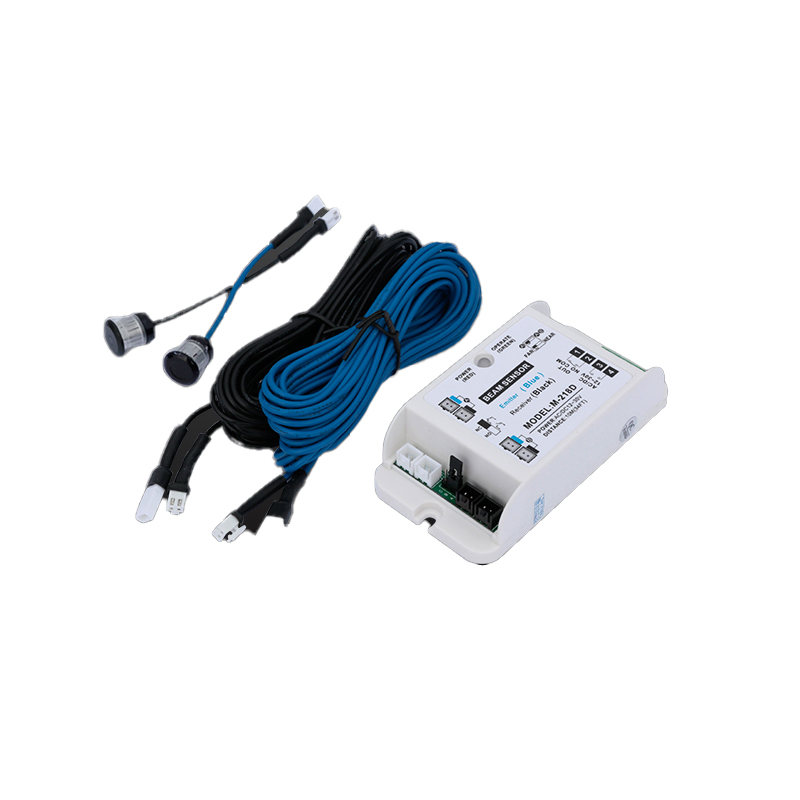
The three technologies appear side by side in the browse our automatic door accessories category listing: the M-254 infrared motion and presence safety sensor, the M-218D safety beam sensor, and the M-204G microwave motion sensor.
A safety beam sensor is the simplest of the three. A transmitter and a receiver face each other across the opening, and the receiver reports an obstruction when the beam is broken, so it is a line rather than a volume and it tells you exactly where the door must not close.
An infrared presence sensor is the right choice when a stationary person has to be detected, because it holds the door open on presence rather than on movement, and a beam sensor is the right choice when the risk is a specific crossing path that must never be interrupted.
What Are the Published Specifications of a 24 GHz Microwave Motion Sensor?
The published M-204G specification gives a microwave motion sensor that detects over 4 m x 2 m at a 2.2 m mounting height, runs on AC 12-24 V, draws under 2 W, and switches a relay rated at 1 A for a 2 second hold time.
The electrical side is simple: the supply is published as AC 12-24 V plus or minus 10 percent at 50 to 60 Hz, power consumption below 2 W (VA), a working temperature of -20 to +55 degrees Celsius, and an ABS plastic housing at 120 (W) x 80 (H) x 50 (D) mm.
The output side is what the controller sees. The relay output is listed as COM and NO with no initial potential, a maximum current of 1 A, a maximum voltage of 30 V AC and 60 V DC, a maximum switching power of 42 W (DC) and 60 VA (AC), and a hold time of 2 seconds.
Those relay figures are the ones to check against the controller first, because a door controller with a different input expectation will not open the leaf correctly even when the sensor is working perfectly.
Two US rules shape the measurement. According to 47 CFR 15.209, the radiated emission limit for an intentional radiator above 960 MHz is 500 microvolts per meter at 3 meters, with the tighter limit at band edges. According to 47 CFR 15.205, the restricted bands include 23.6 to 24.0 GHz, so a 24.125 GHz sensor sits just above a restricted band and still needs its spurious emission measured.
How Do You Mount and Aim a Sensor So Detection Is Reliable?
Mounting height and aiming angle set the footprint, so the same sensor can cover a narrow doorway lane or a wide open entrance purely by where it is fixed and how it is pointed.
The published figures for the M-204G give an installation height of 4 m maximum and an installation angle of 0 to 90 degrees lengthways and 30 to plus 30 degrees laterally. The detection range is adjustable from a minimum of 0.5 x 0.4 m to the 4 m x 2 m maximum, with a factory default of 45 degrees, so one part covers a narrow doorway lane and an open entrance.
One warning is worth repeating to every installer: the detection range differs with the making material of the door and the ground, so the sensitivity knob is adjusted on site rather than set once in the factory.
Wide angles and wide ranges create their own failure mode, because at the widest setting the sensor can self-trigger and the door will keep opening and closing, so the correct setting is the narrowest one that still covers the approach path.
Why Does a Sensor Give False Triggers, and How Do You Fix Them?
False triggers are almost always a mounting or environment problem rather than a failed sensor, and the published M-204G troubleshooting table lists four symptoms with a specific cause and method for each.
The table is worth keeping on site. A door that keeps opening on its own usually means the sensor has detected the movement of the automatic door itself, and the listed remedies are to increase the antenna installation height, check the position and reduce the sensitivity, so the fault is diagnosed at the antenna. A door that will not close points to a controller switch failure, an incorrect position, or an incorrect sensor output.
Rain is treated as a moving object by the sensor, which is why the published guidance is to adopt waterproof accessories, because a sensor mounted over an exposed entrance behaves differently in wet weather than the same sensor under a canopy.
How Does the Sensor Talk to the Door Controller and the Mode Selector?
The wiring is a relay contact and a power pair, and the mode selector decides which sensors the controller may hear, so the installer has to wire and set the mode before any commissioning test means anything.
The published connection detail for the M-204G is unambiguous: green and white carry the signal output COM and NO, brown and yellow carry the AC or DC 12-24 V power input, with a 2.5 meter cable.
The mode selector changes what the door does in one press rather than in a settings screen, because the published five key selector offers Automatic, Half Open, Full Open, Unidirectional and Full Lock, and in Unidirectional mode the external sensor is invalid and the electric lock locks automatically.
That last point is why the wiring diagram matters to the client, not only the technician. A shop floor that wants staff in and customers out has to know which sensor is internal and which is external before the cables are run, so the mode labels belong on the drawing and not only on the switch.
How Do You Ask for a Sensor Quotation You Can Actually Compare?
Ask for a quotation that fixes six fields, because a sensor quote that leaves the detection technology, the detection range, the mounting height, the power supply, the output type and the certification route open cannot be compared with another quote, so all six must travel in one document.
The six fields I ask for before anything is quoted are the detection technology, the detection range at a stated installation height, the power supply and tolerance, the relay output rating, the cable length and the operating temperature range.
The common buyer questions page covers the commercial side of the same decision. Prices are subject to change with supply and other market factors, and the average lead time is about 7 days for samples and 20 to 30 days for mass production after deposit and final approval.
Two quotations that differ only in unit price are not comparable until the mounting, wiring and delivery scope are written into the same document, because a quoted sensor without a stated mounting height is a quoted sensor without a stated detection range.
What Should a Buyer Confirm Before Ordering?
Confirm the power supply, the certification route, the mounting environment and the delivery terms before the order is placed, because each of them changes the part that is actually supplied.
The published documentation for the M-254 lists eleven numbered features on its own body, including a dip switch, a LED indicator and depth and width adjustment for two lines each, which indicates how much on-site adjustment an installer may face.
I would rather tell you plainly what I cannot give you than quote a number that changes later, and without a defined scope the unit price is not a price, because an order priced without mounting, wiring and delivery terms is a starting position rather than a quotation.
To go through a sensor requirement for a project, contact Edison at Ningbo Yufan Beifan Automatic Door Co., Ltd. and we will respond with a specification you can put in front of your installer. Founded in 2007, the factory covers about 3,500 square meters with a building area of 7,500 square meters behind the operators, 24V brushless DC motors and accessories.
Frequently Asked Questions
Q1: How does an automatic door sensor actually detect a person?
Q2: Is a microwave sensor better than an infrared sensor for automatic doors?
Q3: What detection range can a 24 GHz microwave motion sensor cover?
Q4: Do automatic door sensors need to be wired into the controller?
Q5: What power supply and output rating should a buyer check?
Q6: How long does it take to supply an automatic door sensor?
Post time: Oct-29-2026