
Choosing an automatic door operator without a structured framework is how procurement teams end up with mismatched systems — operators that lack sufficient torque for the door weight, units that fail prematurely under high traffic, or installations that don’t meet local safety codes. After handling global project inquiries for automatic door systems for years, I’ve seen how a disorganized selection process creates problems that are expensive to fix after installation. This article lays out a 7-step selection framework that takes you from door measurements to supplier evaluation, covering every decision point that actually matters in commercial entrance automation. Whether you’re equipping a retail storefront, an office lobby, or a hospital corridor, this framework helps you make a technically sound and commercially prudent choice. The first and most critical step is often the most rushed: defining your door’s physical profile with exact specifications, not approximations.
Step 1Define Your Door’s Physical Profile
The most common selection mistake I see in project inquiries is skipping precise door measurement. When customers tell us “the door is standard” without exact weight and width data, we almost always need to send someone back to re-verify. The door’s physical profile is the non-negotiable foundation — everything downstream depends on these numbers.
Door weight and panel mass
Door weight is the first gate in operator selection. Every automatic door operator is rated for a maximum door weight, and exceeding that rating causes premature motor wear, belt stretch, and ultimately system failure. We typically see this failure pattern manifest within 12 to 18 months in high-cycle applications when the operator is undersized for the panel mass. For frameless glass doors, the hardware friction coefficient of the rollers and track system also adds to the effective load the motor must drive — so measure the complete panel including fittings, not just the glass alone.
Clear opening width
The clear opening width determines how far the operator needs to drive the door leaf — this directly affects the stroke length requirement and influences opening speed choices. Narrower openings can achieve higher open-close cycle speeds with less motor stress, while wider panels require more travel distance and higher power output from the same motor. In a recent hospital lobby project we supported, the initial survey showed a 2,100 mm clear opening, but the operator specified was only rated for 1,800 mm. The re-specification cost the contractor three weeks of delay. Measure twice, specify once.
Header space constraints
Available header clearance — the space above the door where the operator housing mounts — is a hard constraint that eliminates operator candidates even when torque ratings match. Some operators require 150 mm of header clearance; compact models can fit in 100 mm. If your entrance has a shallow transom, your operator shortlist may be surprisingly short, and you should verify this dimension before evaluating any other specification.
Step 2Quantify Traffic and Usage Intensity
Once the door’s physical dimensions are locked, the next variable is how hard and how often you’ll ask the operator to work. This is where many procurement specifications go wrong — traffic estimates are either ignored entirely or based on vague assumptions about “normal office use.” In reality, the difference between 80 cycles per day and 350 cycles per day is the difference between a standard-duty operator and a high-duty unit with fundamentally different motor thermal ratings and component.
Calculating daily cycle count
The most practical method for estimating daily cycles is to identify the peak hourly passage rate and multiply by the number of operating hours. A building lobby with 8-hour business hours and a peak rate of 20 passages per hour might see roughly 160 effective cycles per day — but during rush hours (morning arrival, lunch, evening departure) that rate can spike to 35 per hour for short windows. Because operators accumulate wear during each start-stop cycle, those peak spikes matter significantly for component life expectancy.
Duty class mapping
Industry practice generally classifies door operator duty into three bands. Low-duty operators handle under 100 cycles per day and are appropriate for small retail or occasional-use entrances. Medium-duty covers roughly 100 to 300 cycles per day and fits most office buildings, hotels, and standard commercial lobbies. High-duty units exceed 300 cycles per day and are required for hospitals, transit facilities, and large retail with continuous foot traffic. Choosing the wrong duty class is the second most common reason we see premature field failures — undersizing the duty rating causes thermal shutdown in hot environments and accelerated brush wear in DC motor designs.
| Traffic Level | Daily Cycle Estimate | Recommended Duty Class | Typical Applications |
|---|---|---|---|
| Low | < 100 cycles/day | Standard-duty | Small retail, storage rooms, secondary entrances |
| Medium | 100 – 300 cycles/day | Medium-duty | Office buildings, hotels, standard commercial lobbies |
| High | > 300 cycles/day | High-duty | Hospitals, transit facilities, large retail, government buildings |
Step 3Match the Operator to Your Door System
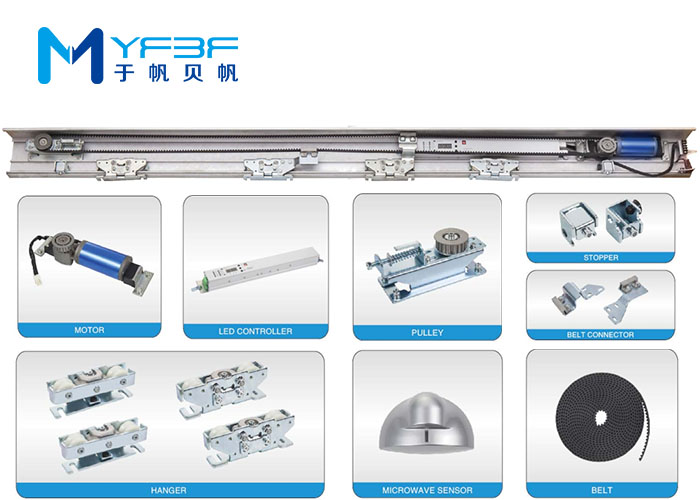
With door geometry and traffic profile defined, you now have concrete criteria to match against operator specifications. This is where we move from “what does the door need?” to “which product actually delivers it?” The two most common operator families in the medium commercial range are the BF150 class and the BF200 class, and understanding their real-world application boundaries prevents both undersizing and unnecessary over-specification.
BF150 class: the sweet spot for medium commercial
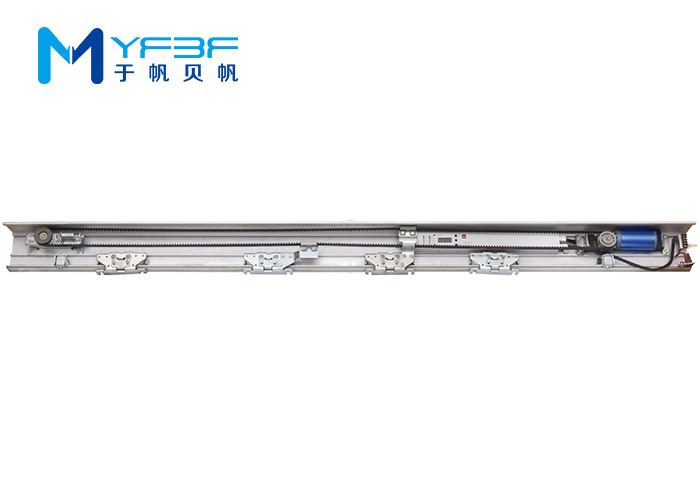
The BF150 class automatic sliding door operator is engineered for single-panel sliding doors with panel weights typically up to 120 kg and traffic in the medium range — we find it handles approximately 250 to 300 cycles per day comfortably in typical ambient conditions. Its 24V brushless DC motor delivers smooth start-stop control with low noise, which makes it well-suited for office buildings, retail environments, and hotel entrances where occupant comfort matters. From my experience supporting global projects, the BF150 covers a remarkably wide portion of commercial applications — I’d estimate it handles 70% of the legitimate use cases we encounter. Because the motor is brushless, there’s no brush replacement consumable, which meaningfully reduces lifetime maintenance compared to older brushed motor designs.
BF200 class: when you need more endurance
The BF200 class is the right choice when your application pushes above the BF150′s sweet spot: heavier panels (up to 160 kg per leaf in twin-panel configurations), wider clear openings exceeding 2,000 mm, or traffic levels consistently above 300 cycles per day. We see BF200 operators specified most often in hospital main entrances, large retail anchors, and institutional buildings with continuous foot traffic throughout operating hours. The BF200 uses a higher-torque motor and reinforced belt-drive assembly, which means it handles the thermal load of frequent cycling without the performance degradation that shortens the service life of an undersized unit.
Checking mechanical compatibility
Beyond torque and duty ratings, confirm that the operator’s track profile, mounting bracket pattern, and connecting arm geometry are compatible with your existing door frame or the door system you’re purchasing as a package. Operators are not universally interchangeable — the track radius, maximum door height, and sill profile all affect whether a given operator physically fits your installation. If you’re working from a door supplier’s hardware schedule, verify that the operator model listed actually matches the door system rather than assuming “automatic door operator” is generic enough to substitute freely.
Step 4Verify Safety Standards and Compliance
Safety compliance is the non-negotiable layer that separates a professional installation from a liability exposure. In the markets we serve globally, automatic pedestrian door operators must meet specific standards, and the operator’s certification is only part of what needs to be verified — the complete installed system (operator + door + sensors + activation devices) must meet the applicable code when assembled.
North American market: ANSI/BHMA A156.10
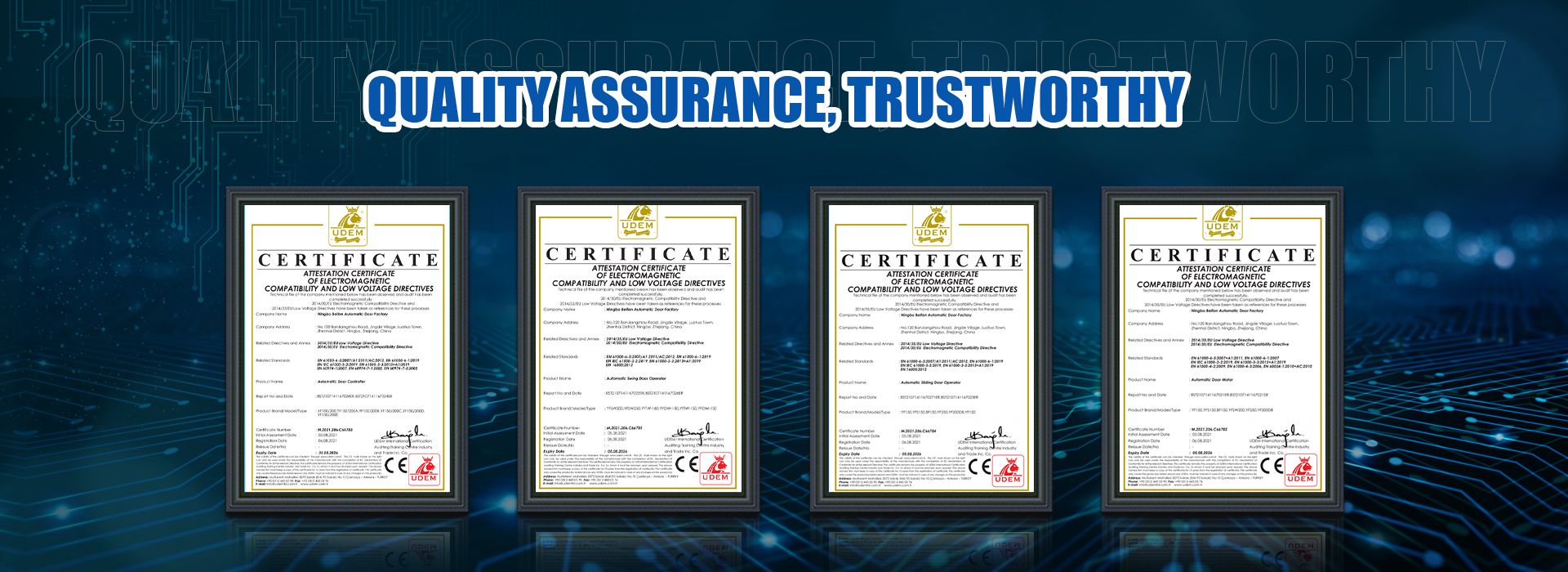
In the United States and Canada, ANSI/BHMA A156.10-2024 — the standard governing power-operated pedestrian doors — addresses safety sensors, activation requirements, and fail-safe behavior. The standard is published by the Builders Hardware Manufacturers Association and is available through the National Institute of Building Sciences (NIBS), which maintains the codes and standards reference library for U.S. building regulatory systems. We consistently advise North American project buyers to verify that their operator carries A156.10 certification from an accredited testing laboratory — self-certified compliance claims from overseas manufacturers without recognized third-party testing reports are a red flag I advise against accepting without independent verification.
European market: EN 16005
The European Union requires CE marking and compliance with EN 16005 — the harmonized European standard for automatic pedestrian doors covering mechanical safety, electrical safety, and functional safety including force limitation. The standard is maintained by CEN/CENELEC, the European Committee for Standardization, which develops and publishes European standards for the mechanical engineering sector. For projects in EU jurisdictions, the installation must also comply with the Machinery Directive and the Construction Products Regulation, and commissioning must be documented by a qualified professional. This is not a checkbox — regulatory authorities in several EU countries have increased enforcement since the 2024 updates to entrance accessibility requirements. The Institution of Chemical Engineers (ICheme), which covers process and building safety standards across Europe, also publishes guidance on automatic door integration in regulated facilities.
Sensor and activation compliance
Beyond the operator itself, the safety sensors and activation devices must form a compliant detection zone. ANSI/BHMA A156.10 requires specific presence detection coverage — the sensor must detect a person in the sweep zone during door closing. When we specify complete systems for projects, we treat the sensor selection as part of the safety compliance chain, not an afterthought. An operator certified to A156.10 connected to a substandard sensor array can still produce a non-compliant installation.
Step 5Evaluate Control Integration and Connectivity
Modern commercial entrances rarely operate in isolation. Most are integrated with building management systems, access control platforms, fire alarm systems, and sometimes remote monitoring services. An operator that has excellent mechanical specifications but limited or proprietary control interfaces creates integration challenges that surface during commissioning — sometimes at significant cost to resolve.
Access control compatibility
The most common integration requirement is access control: card readers, biometric scanners, push plates, remote fob triggers, or timer-based scheduling that activates or deactivates the door outside business hours. The operator’s control board must accept a dry contact or low-voltage signal from these devices without requiring custom electronics. A well-designed commercial operator will offer a clearly documented terminal connection map for common access control devices — if a supplier can’t provide this documentation before purchase, that itself is a warning signal about the quality of their post-sale technical support.
Fire alarm and emergency integration
In most commercial building codes, automatic doors must fail-safe open upon fire alarm activation. This means the operator needs a fire alarm interface — typically a 24V DC signal or a normally open relay contact — that triggers door opening regardless of any other control state. Verify that the operator’s fire alarm interface is compatible with your building’s fire alarm system and that the fail-open behavior is documented and testable. I recall a project where the fire alarm contractor assumed the door would fail open by default, but the operator’s fail-safe setting was actually fail-closed, requiring a control board reprogramming on site.
Remote monitoring and diagnostics
For larger facilities with multiple entrances — shopping centers, hospital networks, campus buildings — remote monitoring capability becomes operationally significant. Some operators offer network-connected diagnostics that report cycle counts, motor temperature, and fault codes to a central monitoring platform. While this feature adds to the unit cost, building operators managing 20 or more automatic doors tell us the ability to triage service calls remotely — knowing whether a reported issue is a sensor fault versus a motor failure before dispatching a technician — quickly justifies the investment.
Step 6Calculate Total Cost of Ownership
Upfront price is the most visible cost, but rarely the most significant one over the operating life of an automatic door. TCO analysis for door operators spans a 5-year horizon in our standard project evaluation format, and in the majority of cases I’ve reviewed, the maintenance and downtime costs over five years substantially exceed the initial equipment purchase price.
Components of the 5-year TCO calculation
The five cost elements we include in our standard TCO framework are: (1) equipment and installation cost including necessary accessories and commissioning; (2) scheduled maintenance labor and consumable parts — timing belts, sensor cleaning, roller inspection — typically on a 12 or 24-month service cycle; (3) parts replacement for wear components that fail before the next scheduled service; (4) energy consumption calculated from motor wattage, daily cycle count, and local electricity rate; and (5) downtime cost — the economic impact of a non-functional door during repair waiting time, including potential security or access issues in high-traffic facilities.
Why the lowest upfront price often loses
In a competitive bidding situation, the lowest upfront quote typically reflects either an undersized operator, the cheapest accessory configuration, or both. Because an automatic door operator that is marginally specified for its application fails more frequently, the lowest upfront purchase often correlates with the highest maintenance spend over five years. We’ve analyzed this pattern across dozens of project post-mortems, and the data consistently shows that operators specified at the conservative end of their rated envelope — with torque and duty margins above the minimum requirement — demonstrate meaningfully longer mean time between failures and lower total maintenance spend.
TCO comparison framework
When we provide TCO estimates for customer projects, we typically normalize for a 5-year operating period at a given daily cycle count. For a medium commercial entrance with approximately 200 cycles per day, the energy cost of a typical 24V DC brushless operator is modest — roughly in the low three-figure range annually — but the maintenance and parts cost varies significantly depending on the operator’s design philosophy and the availability of spare parts. Operators with proprietary spare part designs tend to carry higher long-run maintenance cost as the parts inventory depends on the original manufacturer.
Step 7Validate Supplier Capability and Support
The final step in the selection framework is evaluating the organization behind the product. An operator’s specifications can be excellent on paper, but if the supplier lacks technical documentation, has inconsistent spare parts availability, or cannot provide timely post-sale support, you will feel those deficiencies every time you need assistance — which in commercial door automation, inevitably comes at the worst possible moment.
Technical documentation quality
Professional-grade automatic door operators should ship with complete installation manuals, wiring diagrams, control board technical references, and troubleshooting guides. The existence of these documents — and their clarity — is a reliable signal of how seriously the manufacturer invests in product support. We have encountered suppliers whose products look competitive on specification sheets but whose documentation consists of generic templates with critical parameter fields left blank. If you receive a specification sheet but cannot find a corresponding installation manual in the same documentation package, treat that gap as an indicator of what post-sale support will be like.
Spare parts availability and lead time
For commercial entrance operators, certain spare parts are effectively non-optional: drive belts, safety sensors, control boards, and motor assemblies. Ask your prospective supplier to provide a spare parts price list and typical lead times before finalizing your selection. In our experience supporting global distributor partners, operators with standardized, non-proprietary spare part designs (common motor sizes, standard sensor form factors, industry-standard belt profiles) tend to have better long-term serviceability in regions where express shipping from the original manufacturer is slow or expensive.
Warranty and post-sale support
Standard warranty terms for automatic door operators typically range from 12 months to 36 months depending on the manufacturer and product tier. Beyond the warranty period, what matters is whether the supplier offers responsive technical support — ideally with multiple contact channels — and whether they have trained distributor or installer networks in your region. When we handle project inquiries at Ningbo Yufan Beifan, we specifically track response time as a quality metric because we know that a 48-hour delay in answering a technical question from a site technician costs the project more than the value of the inquiry itself.
About the Author
Edison manages global project inquiries and OEM/ODM custom solutions at Ningbo Yufan Beifan Automatic Door Co., Ltd., supporting distributors and project procurement clients worldwide. The company specializes in automatic door system R&D and manufacturing, with core products including automatic sliding door operators, 24V brushless DC door motors, and accessories widely used in commercial buildings, public facilities, and industrial sites. Connect with Edison to discuss your project requirements.
Ready to Specify the Right Operator for Your Project?
If you have door specifications, traffic estimates, or a project hardware schedule to review, Edison and the Ningbo Yufan Beifan team can provide technical recommendations and TCO estimates. We support distributors and direct project procurement clients globally.
Frequently Asked Questions
What is the first step in choosing an automatic door operator?
The first step is to define your door’s physical profile with exact measurements — specifically door weight including all hardware, panel dimensions, clear opening width, and available header clearance. These four measurements form the foundation that determines which operator torque and stroke specifications are required. Approximating these values is the most common source of costly selection errors in commercial door automation projects.
How do I determine the right duty class for my automatic door operator?
Calculate your daily cycle count by multiplying peak hourly passages by the number of operating hours. Doors with fewer than 100 cycles per day fall into standard-duty class and are suitable for low-traffic entrances. Systems with 100 to 300 cycles per day require medium-duty operators with better thermal management. Entrances exceeding 300 cycles per day — such as hospital lobbies or transit facilities — need high-duty units with reinforced motor thermal ratings and durable belt-drive assemblies designed for continuous operation.
What safety standards must commercial automatic door operators comply with?
In North America, ANSI/BHMA A156.10-2024 governs power-operated pedestrian doors. In Europe, EN 16005 is the harmonized standard covering automatic pedestrian door safety, including force limitation, sensor requirements, and fail-safe behavior. The operator must carry third-party certification from an accredited testing laboratory for the applicable market, and the complete as-installed system — not just the operator — must meet the code. Insist on verified test reports from recognized laboratories rather than manufacturer self-certification.
How do I calculate total cost of ownership for an automatic door operator?
TCO for automatic door operators spans a 5-year operating horizon and includes: upfront equipment and installation cost; scheduled maintenance labor and parts at 12 or 24-month intervals; unscheduled parts replacement for premature failures; energy consumption based on motor wattage and daily cycle count; and downtime cost during repair waiting periods. The most common error is optimizing for upfront cost, which typically results in higher maintenance spend and more downtime over the 5-year horizon. Specifying with a margin above minimum requirements generally delivers the best lifecycle cost performance.
What is the difference between BF150 and BF200 class operators?
The BF150 class is designed for single-panel sliding doors with panel weights typically up to 120 kg and traffic in the medium range — approximately 250 to 300 cycles per day in typical ambient conditions. Its 24V brushless DC motor provides smooth, quiet operation suited to office buildings, retail environments, and hotel entrances. The BF200 class handles heavier panels up to 160 kg per leaf, wider clear openings exceeding 2,000 mm, and higher traffic above 300 cycles per day. The BF200 uses a higher-torque motor and reinforced belt-drive assembly for the thermal and mechanical demands of continuous high-cycle operation. All three parameters — panel weight, opening width, and cycle count — must fall within the same operator’s rated envelope simultaneously.
Related Products
- Automatic Sliding Door Operator — Full product range for commercial and industrial entrances
- BF150 Automatic Sliding Door Operator — Product specifications, dimensions, and ordering information
- Contact Beifan Sales — Project inquiry and technical support