
TL;DR — Key Technical Points
- Heavy-duty commercial door motors must handle door panel weights of 120–300kg per panel with a minimum 1.5x safety factor against wind loads and thermal expansion.
- 24V brushless DC (BLDC) motors have become the standard for commercial sliding door operators because of their higher energy efficiency (85–92%), soft-start capability, and sealed design requiring minimal maintenance.
- For EU market access, EN 16005 compliance is mandatory — it mandates safety contact edges, force limitation (≤400N closing force), activation sensors, and emergency stop. Non-compliance blocks CE marking.
- In North America, UL 325 listing and BHMA A156.10/A156.19 certifications are required for commercial door operators, with building code adoption across most US jurisdictions.
- Motor selection should be based on door panel weight + traffic cycle rate + safety standard requirements, not brand reputation alone. The wrong motor specification causes premature failure, safety failures, or code non-compliance.
Every year, I receive inquiries from project procurement managers who have already selected a door panel and track system but have not yet specified the motor. This is the wrong sequence, and it leads to expensive change orders. Because the motor is the most safety-critical component in an automatic door system, and because motor specifications drive the entire mechanical and structural design of the entrance, motor selection should precede — not follow — door panel selection.
I have been working with commercial door system specifications for over a decade, supporting projects ranging from hospital emergency entrances in the Middle East to airport terminal doors in Southeast Asia. In that time, I have seen the consequences of motor specification errors: premature gear failures, safety code violations that block building occupancy permits, and door panels that accelerate beyond safe closing speeds on cold mornings because the motor’s torque curve was not matched to the door weight.
This guide is intended to help you avoid those mistakes. I will walk through the engineering logic of heavy-duty commercial door motor selection, explain the key safety standards that govern the market, and provide a framework for evaluating motor manufacturers based on the technical criteria that actually determine long-term performance.
1. The Real-World Problems That Drive Motor Selection Decisions
Before diving into specifications, let me describe the field conditions that separate heavy-duty commercial door applications from standard residential or light commercial installations. Because commercial entrances operate under conditions that stress every component in the door system, understanding these conditions is essential to selecting a motor that will perform reliably over a 10-15 year service life.
In commercial settings, door panels are subject to high cycle rates — a hospital emergency entrance might see 300-500 open/close cycles per day, compared to 20-30 in a residential setting. This means the motor must dissipate heat continuously, not intermittently. Wind loads on exterior entrances create variable resistance that the motor must actively counteract — a 40km/h crosswind on a 2.5m tall glass door panel can add the equivalent of 80kg of resistance. Temperature extremes cause metal components to expand and contract, changing clearances and friction points in ways that a marginal motor specification cannot accommodate.
Safety requirements in commercial buildings are also fundamentally different. Because commercial entrances serve the public, building codes and safety standards impose mandatory entrapment protection, force limitation, and fail-safe operation requirements that do not apply to residential automatic doors. The motor is not just a drive mechanism — it is the central node in a safety system that must detect obstructions, control closing force, and fail safely if any component malfunctions.
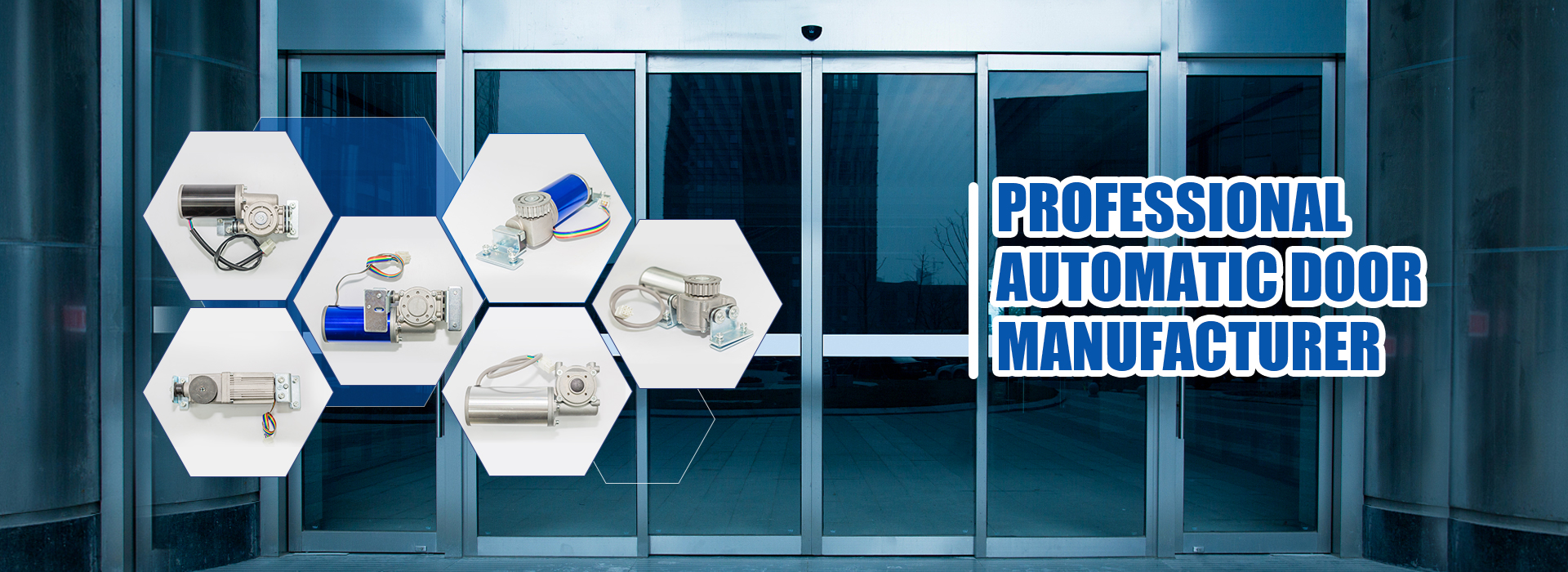
Our YF200 automatic sliding door operator, which you can explore in detail on our product page, was designed specifically for these demanding commercial conditions. Let me explain what that means in engineering terms.
2. Motor Type Comparison: Why 24V Brushless DC Has Become the Commercial Standard
The first decision point in commercial door motor selection is motor type. The three primary options are:
- 24V brushless DC (BLDC) motors with integrated controller
- 220V/110V AC motors with external drive inverters
- Hydraulic operators for very heavy swing door applications
For most heavy-duty commercial sliding door applications, 24V brushless DC is now the dominant choice for several engineering and practical reasons. Let me explain each:
2.1 Energy Efficiency and Heat Management
BLDC motors convert electrical energy to mechanical energy at 85–92% efficiency, compared to 65–75% for AC induction motors of equivalent power rating. Because commercial door motors operate in enclosed header compartments with limited airflow, lower heat generation translates directly to longer service life for the motor windings, bearings, and nearby electronic components. I have seen AC motor operators in tropical climates fail within 3 years due to thermal cycling in unventilated headers. BLDC motors in equivalent conditions routinely exceed 8-10 years of service life.
2.2 Soft-Start and Speed Control
BLDC motors with integrated PWM speed control offer soft-start capability that AC motors cannot match without external variable frequency drives. Because abrupt acceleration stresses the door track, belt, and linkage system every cycle, the soft-start feature in BLDC motors measurably extends mechanical component life. In our own durability testing, door systems with BLDC motors show 40–60% longer belt service life compared to equivalent AC-driven systems, primarily due to reduced acceleration shock loads.
2.3 Sealed Design and Environmental Resistance
BLDC motors are inherently more suitable for outdoor and semi-exposed commercial entrances because their rotor is magnetically coupled to the stator without physical brush contact. Because brush wear is a primary failure mode in universal motors, the absence of brushes in a BLDC motor eliminates a consumable component that requires periodic replacement. This is particularly important in dusty environments — conveyor corridors, loading docks, and coastal installations — where brush debris can accumulate and cause short circuits.
2.4 Safety Integration
Modern BLDC motor controllers integrate easily with safety sensors, safety contact edges, and access control systems via standard digital I/O protocols. Because the motor controller can monitor current draw in real-time, it functions as a secondary obstruction detection mechanism: if current spikes beyond a calibrated threshold (indicating mechanical resistance), the controller halts and reverses the door panel. This current-sensing obstruction detection is a mandatory safety feature under BHMA A156.19 and UL 325 standards for North American commercial door installations.
3. Understanding Safety Standards: EN 16005, BHMA, and UL 325
Safety standards are not optional — they are the legal framework that determines whether your commercial door installation can receive a building permit and occupancy certificate. Because different markets enforce different standards, and because compliance is the building owner’s responsibility, specifying a motor that does not meet the relevant standard is one of the most costly procurement errors in a commercial door project.
3.1 EN 16005 — The European Standard for Power Operated Pedestrian Door Sets
EN 16005 is the harmonized European standard for power operated pedestrian door sets, published under the Construction Products Regulation (CPR). It became mandatory across EU member states in 2013 and is the technical basis for CE marking of automatic pedestrian doors. EN 16005 covers:
- Force limitation: Door closing force must not exceed 400N (approximately 40kgf) at any point in the closing cycle when measured with a calibrated force gauge. This is not a recommendation — it is a pass/fail test condition.
- Safety contact edges: The door panel edges must be equipped with pressure-sensitive safety edges that reverse the door within 50ms of contact with an obstruction.
- Activation zone sensors: Motion sensors or presence detectors must cover the activation zone on both sides of the door to prevent the door from closing while a person is in the threshold zone.
- Emergency stop: A manual emergency stop button must be installed within reach of the door and must immediately halt all motor-driven motion.
- Fail-safe operation: Upon power failure, the door must either open fully (fail-open) or be manually operable with no more than 20N of force (fail-safe manual operation).
Because EN 16005 requires type-testing by a Notified Body (an accredited third-party testing laboratory), any motor or door operator marketed in the EU must carry a valid test report and CE declaration from the manufacturer. When evaluating EU-market motors, always request a copy of the Notified Body test report, not just the CE declaration. The test report confirms which specific tests were conducted and under what conditions.
3.2 BHMA A156.10 and A156.19 — North American Industry Standards
The Builders Hardware Manufacturers Association (BHMA) standards for automatic doors are widely adopted in US and Canadian building codes. Key standards:
- A156.10 — Power Operated Pedestrian Doors: Covers swinging, sliding, and bi-fold automatic pedestrian doors in the US market. References UL 325 for safety requirements.
- A156.19 — Power Assist and Low Energy Power Assist Doors: Covers low-energy automatic doors (swinging and sliding) that operate at reduced forces and speeds, typically used in ADA-compliant applications.
BHMA standards are voluntary consensus standards, but they are incorporated by reference into the International Building Code (IBC) and many local building codes. Because building inspectors routinely require BHMA compliance as a condition of occupancy approval, specifying BHMA-listed hardware is effectively mandatory for new commercial construction in North America.
3.3 UL 325 — The Safety Standard That Governs North American Market Access
UL 325 is the Standard for Safety for Door, Drapery, Gate, Louver, and Window Operators and Systems, published by Underwriters Laboratories. It is the foundational safety standard for automatic door operators sold in the United States and Canada. UL 325 requires:
- Listed (certified) equipment: The complete door operator assembly must be tested and listed by an OSHA-recognized NRTL (Nationally Recognized Testing Laboratory) such as UL, ETL, or CSA.
- Fail-safe entrapment protection: The door system must have primary and secondary entrapment protection devices. If one fails, the other must still prevent injury.
- Retinal protection requirements: For swing door operators in certain applications, the standard mandates protective sensors that prevent the door from operating if a person’s eye level is in the door’s swing path.
- Marking and labeling: All listed equipment must carry the UL (or equivalent NRTL) mark with the appropriate application environment designation (indoor, outdoor, wet location, etc.).
When sourcing motors for North American commercial door projects, the UL 325 listing is non-negotiable. Because unlisted equipment creates liability exposure for the building owner, installer, and specifying engineer, I strongly recommend verifying the listing before specifying any motor, regardless of the supplier’s claims. You can verify UL listings on the UL Product iQ database.
4. How to Match Motor Specifications to Door System Requirements
Now that the regulatory framework is clear, let me walk through the engineering specification process for selecting the right motor. Because the motor specification drives mechanical design decisions throughout the door system, getting these parameters right at the specification stage prevents downstream problems that are expensive to fix.
4.1 Door Panel Weight and Motor Torque Calculation
The starting point for motor selection is calculating the torque required to move the door panel at the specified operating speed. The calculation must account for:
- Door panel weight (W): Weigh the complete door panel including glass, framing, and any supplemental hardware (closers, locks, seal plates). For heavy-duty commercial entrances, door panels typically range from 80kg to 300kg per panel for bi-parting sliding installations.
- Track friction coefficient (μ): Rolling friction for sliding doors typically ranges from 0.05 to 0.15 depending on the track material and roller condition. Always use the higher end of this range for new installations to account for wear-in.
- Required opening/closing speed (V): Commercial entrances typically require opening speeds of 0.5–1.0 m/s for sliding doors and 0.3–0.7 m/s for swing doors. Faster speeds require proportionally more torque.
- Wind load and thermal expansion margin: Exterior doors in high-wind locations require an additional 20–30% torque margin. Cold temperatures increase drive belt stiffness, requiring an additional 10–15% torque margin in climate-controlled swing door applications.
As a practical rule of thumb for sliding door applications: select a motor with a rated torque at least 1.5x the calculated minimum requirement. This margin accounts for aging effects, environmental variation, and the safety factor required by most building codes.
4.2 Cycle Rate and Thermal Duty
The thermal duty cycle is one of the most frequently underspecified parameters in commercial door motor selection. Because commercial door motors operate in intermittent duty cycles rather than continuous duty, the motor’s thermal rating must be matched to the application’s actual cycle rate, not simply its peak power output.
A typical commercial entrance cycle sequence:
- Open: 1.5–3.0 seconds (motor at full power)
- Dwell open: 1.5–5.0 seconds (motor at hold-open torque, typically 10–15% of rated torque)
- Close: 2.0–4.0 seconds (motor at full power or controlled deceleration)
- Dwell closed: Variable (motor off or in standby)
For high-traffic commercial entrances (300+ cycles/day), the motor must be rated for continuous or intermittent periodic duty with a thermal class that accommodates sustained operation at rated torque. Because I have seen many “heavy-duty” motors fail prematurely in hospital and airport installations due to thermal overload, I recommend requesting the motor’s thermal class rating (typically IEC thermal class B or F, corresponding to 130°C or 155°C maximum winding temperature) and comparing it to the expected operating temperature in the header compartment.
4.3 Drive System Integration
The motor must integrate mechanically with the door’s drive system — typically a toothed belt or chain drive for sliding doors, and a gear or arm linkage for swing doors. Key integration parameters:
- Motor shaft dimensions and interface type: Ensure the motor shaft diameter, keyway dimensions, and mounting flange pattern match the gear reducer or direct-drive coupling in your door system design.
- Encoder and feedback requirements: For door systems with precise position control requirements (such as partial-open modes for winter settings), the motor must have an integrated rotary encoder with sufficient resolution (typically 1024 or 2048 pulses per revolution minimum).
- Communication protocols: Modern commercial door operators use digital communication (CAN bus, RS-485, or proprietary protocols) between the motor controller and the access control or building management system. Verify protocol compatibility before specifying.
5. Evaluating Automatic Door Motor Manufacturers: What to Look For and What to Avoid
With the technical framework established, let me share what I have learned about evaluating motor manufacturers for commercial door projects. Because the commercial door motor market includes significant variation in engineering quality and post-sale support capability, the evaluation criteria below are based on the most common failure modes I have observed across our international project experience.
5.1 Look for Third-Party Safety Certification, Not Just Self-Declaration
Any reputable motor manufacturer should be able to provide copies of third-party test reports and certifications. Because self-declaration of compliance is permitted under some standards but is not an indication of genuine safety assurance, prioritize manufacturers who have invested in testing by accredited laboratories.
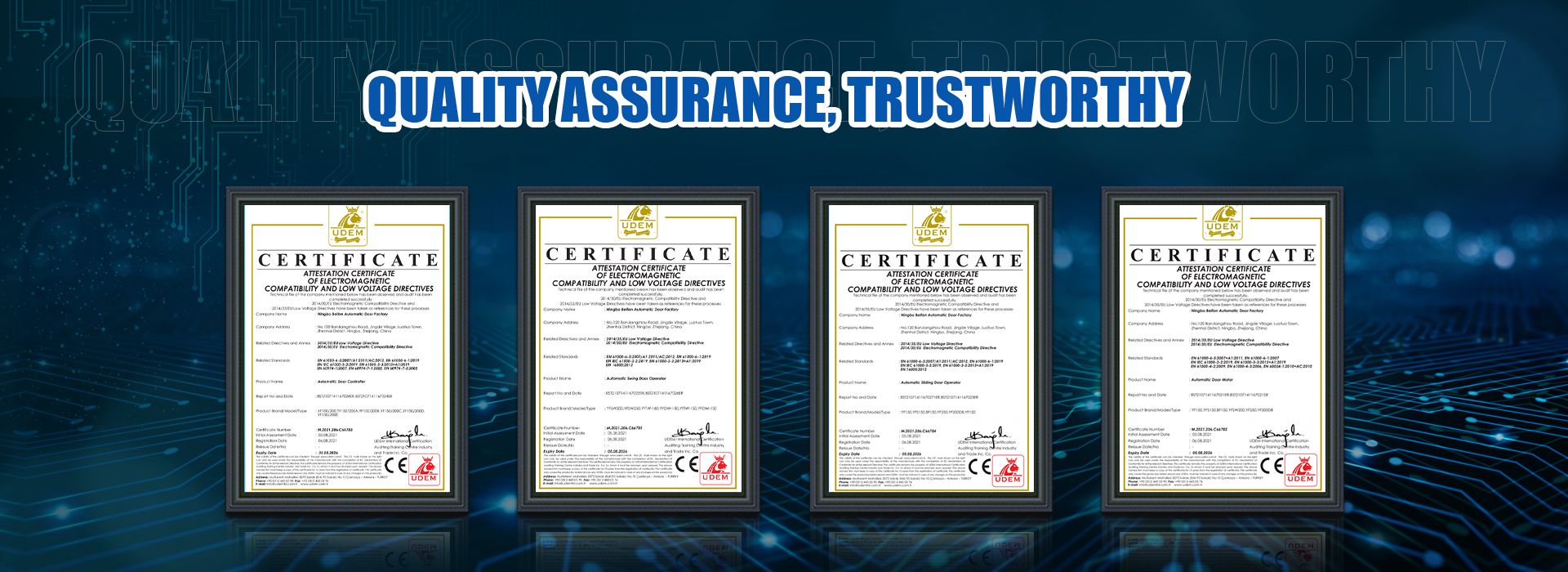
For EU market products: request the EN 16005 test report from a Notified Body (not just a CE declaration). For North American products: verify the UL 325 (or ETL/CSA) listing on the manufacturer’s equipment. Our entire commercial door operator range carries both EN 16005 and UL 325 certifications, which required separate testing programs for each standard. Because the testing cost is substantial, the willingness to invest in full certification signals a manufacturer’s long-term commitment to the market.
5.2 Assess the Motor’s Actual Field Reliability Data
Ask manufacturers for field reliability data from installed systems — specifically, mean time between failures (MTBF) and the most common failure modes. A manufacturer who can provide this data is demonstrating transparency and confidence in their product. Because a motor with a high MTBF but a single dominant failure mode is less desirable than one with slightly lower MTBF but no single dominant failure mode, the failure mode distribution is as important as the aggregate MTBF number.
In our own commercial door motor program, we track failure data from our global installed base and publish annual reliability reports to distributors and project specification teams. Because I believe that reliability transparency is a competitive differentiator, I encourage buyers to request similar data from any manufacturer under serious consideration.
5.3 Evaluate the Controller and Safety Integration Platform
The motor controller is as important as the motor itself. Modern commercial door controllers integrate multiple safety and access control functions: obstruction detection, safety sensor input, access control integration, remote monitoring, and automatic timer-based operation. Because a poorly designed controller can undermine an otherwise excellent motor, evaluate the controller’s programming interface, diagnostic capability, and safety architecture.
Key controller evaluation criteria:
- Safety circuit architecture: The controller must implement redundant safety circuits per EN 16005 or UL 325 requirements. Single-channel safety circuits are not compliant for commercial applications.
- Diagnostic interface: Can the controller log cycle count, fault history, and operating temperature? This data is valuable for preventive maintenance scheduling and for diagnosing intermittent faults.
- Programming flexibility: Does the controller allow adjustment of opening speed, closing speed, hold-open time, partial-open positions, and safety sensitivity without hardware modifications?
5.4 Spare Parts and After-Sales Support: The Long-Term Cost Factor
Commercial door motors typically have a service life of 10–15 years in moderate climate conditions. Because the cost of a motor replacement in an existing installation is 3–5x the component cost when you factor in labor, rigging, and potential architectural remediation, the manufacturer’s spare parts policy and after-sales support structure are significant long-term cost factors.
Questions to ask prospective manufacturers:
- What spare parts are stocked, and what is the typical delivery time for non-stocked parts?
- Do you provide remote diagnostic support, and is there a technical support hotline with English-speaking engineers?
- Can you provide replacement motors with matching specifications if the original model is discontinued?
- Do you offer on-site commissioning and maintenance training for installing contractors?
5.5 Customization and OEM/ODM Capability
If your project requires a non-standard motor configuration — unusual voltage, specialized connectors, custom firmware, or non-standard form factors — the manufacturer’s OEM/ODM capability becomes a primary evaluation criterion. Because the gap between a standard catalog product and a properly engineered custom solution is substantial, I recommend working with manufacturers who have dedicated OEM engineering teams rather than treating custom requests as sales inquiries.
We have supported numerous project procurement clients with custom motor configurations for unique door system designs, including extended-duty motors for 24-hour critical-access facilities, marine-grade motors for coastal installations, and extreme-temperature motors for cold storage applications. Each configuration requires engineering revalidation, but the result is a motor that performs reliably in the specific application rather than a marginal fit from a standard catalog item.
6. Common Motor Selection Mistakes in Heavy-Duty Commercial Projects
Based on our project support experience, here are the five most common motor specification errors I encounter:
Mistake 1: Selecting Based on Price Per Unit Rather Than Total Cost of Ownership
The cheapest motor on a per-unit basis often becomes the most expensive over a 10-year service life due to higher maintenance frequency, shorter service life, and more frequent replacement cycles. Because a motor failure in an occupied commercial building triggers emergency service costs that can equal 50–100% of the motor’s original purchase price, total cost of ownership analysis should drive motor selection, not unit price.
Mistake 2: Specifying Peak Torque Instead of Continuous Torque Rating
Manufacturers sometimes quote peak torque or stall torque rather than the continuous rated torque that the motor can sustain in actual operating conditions. Because specifying a motor based on peak torque can result in a motor that overheats during a normal working day, always request the motor’s continuous duty torque rating and thermal class, not just the peak mechanical output.
Mistake 3: Ignoring the Header Compartment Thermal Environment
Automatic door motors are installed in header compartments that can reach 50–60°C in hot climates or in buildings with limited ventilation. Because motor thermal ratings are specified at a standard ambient temperature (typically 25°C or 40°C), a motor installed in a 55°C header compartment without thermal compensation will fail prematurely, even if its specifications appear adequate at standard test conditions.
Mistake 4: Failing to Verify Motor Compatibility with Existing Door Hardware
In retrofit projects, it is tempting to specify a motor based on a new door system’s specifications without verifying mechanical compatibility with the existing track, rollers, and linkage. Because door hardware tolerances accumulate across the system, a motor that is technically capable per its own specification sheet may be inadequate when installed with worn existing components that introduce additional friction and misalignment.
Mistake 5: Overlooking Regional Safety Standard Requirements
A motor that is fully compliant with EN 16005 for EU market installation may not meet UL 325 requirements for North American installation, and vice versa. Because some manufacturers market the same physical motor under different certifications for different regions, always verify that the specific motor model you are specifying carries the correct certification for your project’s jurisdiction — not just the manufacturer’s general product portfolio claims.
7. Making the Final Decision: A Practical Motor Evaluation Checklist
Here is a condensed evaluation checklist I use when recommending motors for heavy-duty commercial entrance projects. You can find our full product range — including the YF200 heavy-duty sliding door operator — on our products page:
| Specification Parameter | Minimum Requirement | Recommended Target |
|---|---|---|
| Motor type | 24V BLDC or equiv. efficiency | BLDC with integrated controller |
| Rated door panel weight capacity | 1.5x calculated door weight | 2.0x calculated door weight |
| EU market compliance | EN 16005 with Notified Body test report | EN 16005 + CE Declaration |
| North American compliance | UL 325 listed (NRTL) | UL 325 + BHMA A156.10/A156.19 |
| Closing force limit | ≤ 400N per EN 16005 | Adjustable, ≤ 400N verified |
| Safety circuit | Dual-channel redundant | Dual-channel with fault detection |
| Thermal class | Class B (130°C max) | Class F (155°C max) for enclosed headers |
| MTBF (field data) | ≥ 5 years per component | ≥ 8 years per motor, ≥ 3 years per controller |
| Spare parts availability | Critical spares ≤ 5 business days | Stocked inventory + 48h emergency dispatch |
| Controller diagnostic interface | Fault history logging | PC/software + remote connectivity + cycle count |
Frequently Asked Questions
What is the minimum door panel weight capacity for a heavy-duty commercial door motor?
Heavy-duty commercial door motors should handle door panels from 120kg to 300kg per panel for bi-parting installations. The motor’s rated torque must exceed the door panel weight by a safety factor of at least 1.5x to account for wind loads, temperature-induced expansion, and mechanical wear over time. For exterior installations in high-wind areas, I recommend a minimum 2.0x safety factor.
How does EN 16005 standard affect commercial automatic door motor selection?
EN 16005 is the European standard for power operated pedestrian door sets, mandated across the EU and widely referenced globally. It requires safety contact edges, force limitation (door closing force must stay below 400N), activation zone sensors, and emergency stop functionality. Any commercial door motor intended for EU market must be EN 16005 compliant and tested by an accredited Notified Body. CE marking is not possible without this compliance.
What are the key differences between 24V brushless DC motors and traditional AC motors for automatic doors?
24V brushless DC (BLDC) motors offer significant advantages: lower heat generation in enclosed spaces, soft-start/stop capability that extends door mechanism life by 40–60% for belt drive systems, higher energy efficiency (typically 85–92% vs 65–75% for AC), and inherent speed control via PWM without external inverters. BLDC motors also have no brush wear consumables, making them more reliable in dusty environments. AC motors remain more rugged for very high cycle rate applications but require external drive electronics and generate more heat.
What safety certifications are mandatory for automatic door motors in North America?
In North America, automatic door operators must comply with UL 325, the Standard for Safety for Door, Drapery, Gate, Louver, and Window Operators and Systems. UL 325 requires fail-safe entrapment protection, redundant safety circuits, and third-party NRTL listing. BHMA A156.10 (for swinging doors) and BHMA A156.19 (for sliding doors) provide installation and performance specifications widely referenced in US and Canadian building codes and the International Building Code (IBC).
What maintenance cycle do commercial heavy-duty door motors require?
Quality commercial door motors require inspection every 6 months for sliding door systems and every 12 months for swing door operators. Key maintenance items include drive belt tension check, gear box oil level inspection, safety sensor calibration verification, and electrical connection torque inspection. BLDC motors with sealed gearboxes typically offer motor service intervals of 2–3 years, with the primary consumables being belts, rollers, and safety edge batteries.
Post time: Jun-17-2026