
TL;DR — Key Takeaways
- The M-254 infrared sensor and microwave detection technologies address fundamentally different aspects of automatic door control: the M-254 uses active infrared curtain detection to sense stationary presence within a precisely defined zone, while microwave sensors detect motion velocity based on Doppler frequency shift — because these technologies sense different physical phenomena, specifying the wrong detection mode for your application is one of the most common causes of automatic door customer complaints, ranging from doors that won’t open to doors that open when they shouldn’t
- For standard commercial entrance doors (shopping malls, office buildings, retail stores), active infrared curtain detection like the M-254 is the default choice because it provides precise presence detection without the false-trigger risks of microwave in environments with passing vehicles or pedestrians on adjacent walkways
- For industrial high-speed doors (logistics docks, warehouse entrances, cold storage), microwave detection is often preferred because of its faster response time (typically <50ms vs. 80–120ms for infrared curtain sensors) and superior outdoor performance in direct sunlight and rain
- Hybrid installations combining both technologies — using microwave for primary motion activation and infrared for presence safety — deliver the best performance in demanding environments, but require proper integration to avoid interference between the two sensor systems
- When specifying the M-254 or any infrared curtain sensor, verify the IP rating (minimum IP54 for outdoor installations), the beam spacing (narrower spacing provides better detection resolution for small objects and pets), and the operating temperature range for outdoor-exposed applications in extreme climates
The Door That Wouldn’t Open for the Doctor and the One That Opened for Every Passing Truck
I received two calls in the same week from customers of Ningbo Yufan Beifan, and they perfectly illustrate the two failure modes I see most often when automatic door detection systems are incorrectly specified.
The first caller was a hospital in Ningbo. A physician had filed a formal complaint that the automatic sliding doors at the emergency department entrance repeatedly failed to open as she approached pushing a gurney. The maintenance contractor had replaced the motion sensor twice and the door control board once, with no improvement. When I visited the site, I immediately identified the problem: the entrance had been specified with a microwave motion sensor, and the physician was approaching at a slow walking pace while holding the gurney steady — essentially at the velocity threshold below which most microwave sensors are set to trigger. The sensor was working exactly as designed; it simply wasn’t designed for the application.
The second call was from a logistics company in Hangzhou. Their warehouse loading dock automatic door was opening continuously throughout the day — every time a forklift passed the doorway on the adjacent lane, the microwave sensor detected the motion and triggered the door. This was causing energy losses from climate-controlled air escaping through the constantly opening door, and it was creating a safety hazard because workers had started to ignore the door opening as a signal. The microwave sensor was working correctly for what it was designed to do; it had simply been installed in an environment where its sensitivity needed to be confined to a narrower detection zone.
These two cases are mirror images of the same fundamental specification error: choosing a detection technology based on familiarity or cost rather than on a systematic analysis of the actual application requirements. In the hospital case, the solution was to replace the microwave sensor with an M-254 active infrared curtain sensor that detects presence rather than motion, ensuring the door opens regardless of how slowly the physician approaches. In the logistics case, the solution was to install an M-254 infrared curtain as a presence safety sensor (to prevent the door from closing on a forklift that is still in the doorway) while retaining the microwave sensor for motion activation with properly adjusted detection boundaries.
How Automatic Door Detection Technologies Actually Work
Before discussing selection criteria, it is worth understanding the physical principles underlying each detection technology, because this understanding is essential for making informed specification decisions. The confusion in the market is partly perpetuated by vague marketing language that describes different technologies in terms that sound similar but describe fundamentally different capabilities.
Active Infrared Curtain Detection: The M-254 Technology Explained
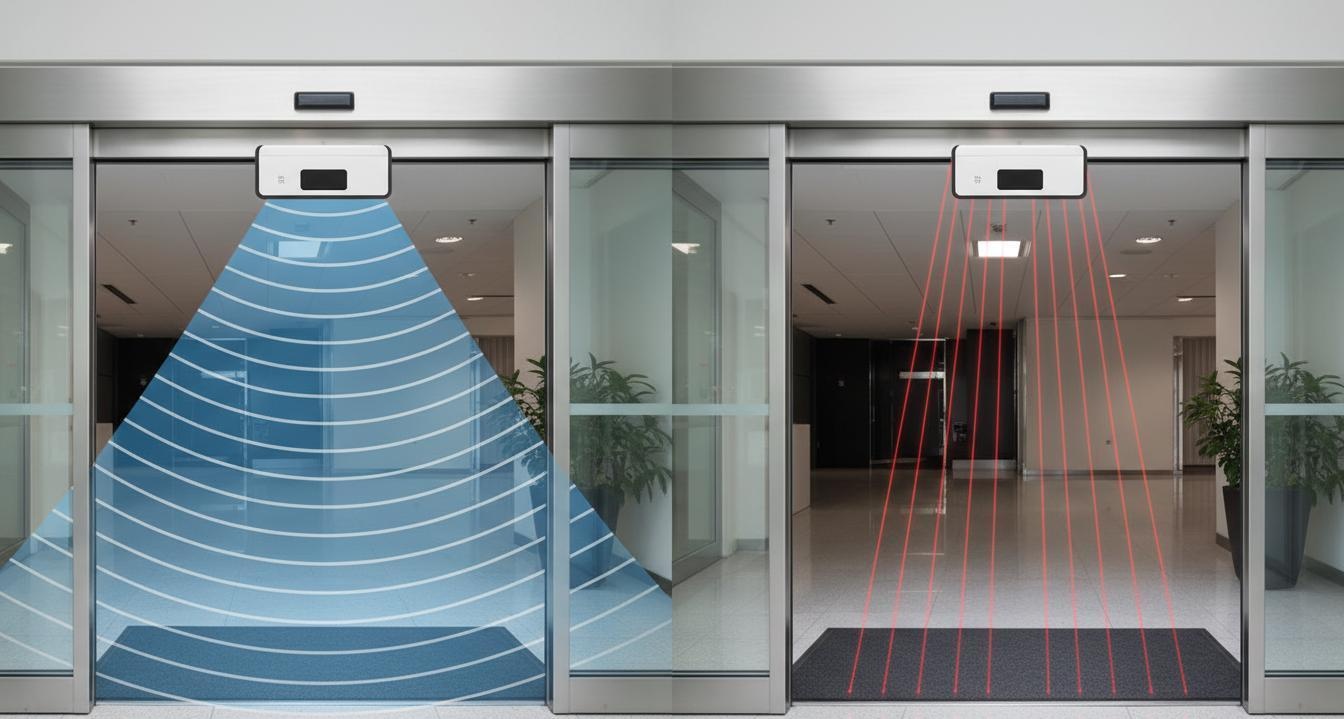
The M-254 designation refers to a class of active infrared presence detection sensors that use a curtain of modulated infrared beams to create a detection zone across the door threshold. The sensor consists of two units: an emitter that projects multiple infrared beams across the doorway, and a receiver that detects the beams. When all beams are unobstructed, the sensor output is inactive (door control interprets this as “no presence in doorway”). When one or more beams are interrupted, the sensor output changes state (door control interprets this as “presence detected, door should open or stay open”).
The key characteristic of active infrared detection — and the one that distinguishes it most fundamentally from microwave — is that it detects presence, not motion. A person standing absolutely still in the detection zone will be detected just as reliably as a person walking through at speed. This is because the sensor is measuring the absence or presence of the infrared beam, not any change in the environment. Because active infrared curtain detection requires an uninterrupted beam path between emitter and receiver, it is sensitive to conditions that can obstruct or scatter the beam — heavy rain, direct sunlight into the receiver lens, snow accumulation on the sensor lens, or extremely dusty environments.
The M-254 sensors in the Yufan Beifan product range use a multi-beam design with typically 8, 12, or 24 beams depending on the model, with beam spacing of 20mm to 50mm. The number of beams and their spacing determines the detection resolution — a sensor with 24 beams at 20mm spacing will detect a small child or a pet that a sensor with 8 beams at 60mm spacing would allow to pass undetected. This is an important specification parameter for applications in environments with high pedestrian traffic including children or animals.
Microwave Detection: Doppler Principles Applied to Automatic Doors
Microwave detection sensors for automatic doors operate on the Doppler principle: the sensor emits a continuous microwave signal at a fixed frequency (typically 24.125 GHz for K-band door sensors, which is in the ISM radio band reserved for industrial, scientific, and medical applications), and detects the frequency shift in the reflected signal caused by moving objects.
When a microwave sensor is installed above a door frame, it emits a cone-shaped detection zone that extends outward from the sensor. The microwaves reflect off stationary objects (walls, floors, parked vehicles) at the same frequency as they are emitted, producing no Doppler shift. When a moving object enters the detection zone, the reflected microwaves return at a slightly different frequency — higher if the object is approaching the sensor, lower if it is moving away. The sensor processes this frequency shift to determine that motion is occurring and sends an activation signal to the door controller.
The critical specification parameter for microwave sensors is the minimum detectable velocity — the slowest moving object that will trigger a detection event. Most commercial microwave door sensors are factory-set to trigger on objects moving at 0.5 m/s or faster. This is appropriate for typical pedestrian traffic but creates the failure mode we observed in the hospital case: a physician approaching at a slow walking pace of 0.3–0.4 m/s while carefully controlling a gurney would not trigger the sensor.
Because microwave sensors detect motion velocity rather than presence, they cannot distinguish between a pedestrian approaching the door and a vehicle passing the door on an adjacent road — or between a pedestrian and a shopping cart being pushed past the door on the sidewalk. This ambiguity is the root cause of the false-trigger problems we see in logistics and retail environments where pedestrian and vehicle traffic intermix.
Active Infrared Motion Detection: The Hybrid Approach
A third category worth understanding is active infrared motion detection — sensors that use infrared technology (typically passive infrared PIR or modulated active IR) to detect motion rather than presence. These sensors work by detecting changes in the infrared heat signature in the detection zone — a warm body (human or animal) moving across the sensor’s field of view creates a changing heat pattern that the sensor interprets as motion.
PIR motion sensors are widely used in outdoor lighting control and building security systems, but they are generally unsuitable for automatic door applications because of their slow response time (typically 0.5–2 seconds), their susceptibility to false triggers from ambient temperature changes, and their limited ability to distinguish human motion from animal motion in outdoor environments. I do not recommend PIR motion sensors for automatic door activation in any commercial application.
Technology Comparison: Where Each Detection Method Excels and Falls Short
The following comparison table summarizes the key performance dimensions across the three main detection technologies relevant to automatic door applications.
| Performance Dimension | M-254 Active Infrared Curtain | Microwave Doppler | PIR Motion Sensor |
|---|---|---|---|
| Presence Detection (stationary person) | ✓ Excellent | ✗ Not possible | △ Limited |
| Motion Detection (moving person) | ✓ Excellent | ✓ Excellent | ✓ Good |
| Response Time | 80–120ms | <50ms | 500–2000ms |
| Outdoor Performance (direct sun/rain) | △ Requires IP54+, lens cleaning | ✓ Excellent | ✗ Poor (false triggers) |
| Detection Zone Precision | Very precise (beam-by-beam) | Cone shape, less precise | Fan shape, moderate precision |
| Pedestrian vs. Vehicle Discrimination | ✓ Excellent (position-based) | ✗ Cannot discriminate | △ Can partially discriminate |
| Dust/Particle Environment | △ Affected by heavy dust | ✓ Unaffected | ✗ Affected |
| Small Object Detection (child, pet) | △ Depends on beam spacing | △ Can detect small objects | △ Limited resolution |
| Installation Complexity | Emitter + receiver, alignment needed | Single unit, simpler installation | Single unit, simple |
| Typical Cost | Moderate ($120–$350/unit) | Low ($60–$180/unit) | Very low ($20–$80/unit) |
Selection Matrix: Matching Detection Technology to Application
Based on the comparison above and on our experience supporting hundreds of Yufan Beifan automatic door installations across commercial, industrial, and institutional environments, here is a practical selection matrix that maps specific application types to the recommended primary and secondary detection technologies.
Application Category 1: Commercial Retail and Office Buildings
For standard automatic sliding doors in retail stores, shopping malls, office building entrances, and hotel lobbies — the most common commercial automatic door applications — the M-254 active infrared curtain sensor should be the primary detection technology. The reasons are compelling: these environments have high pedestrian traffic with mixed walking speeds, they require reliable detection of people standing in the doorway (browsing, waiting for others, managing shopping bags or briefcases), and the detection zone must be precise enough to avoid triggering on pedestrians walking past on the adjacent sidewalk.
One common failure point in retail applications is specifying an M-254 with insufficient beam resolution for the expected traffic. In a high-traffic retail environment (more than 1,000 passages per day), I recommend a minimum of 16 beams with 25mm spacing or finer. This provides reliable detection of children and ensures that the door stays open for the entire duration a person is in the doorway, even if they pause or stop unexpectedly.
Application Category 2: Hospital and Healthcare Facilities
Healthcare facilities present uniquely demanding requirements for automatic door detection. The combination of slow-moving patients (on foot, in wheelchairs, on beds, on gurneys), medical equipment that may partially obstruct the detection zone, and the critical importance of reliable door operation for infection control and emergency response means that only presence-capable detection technologies should be specified.
Because hospital environments require doors that open for every person who needs to pass through — regardless of how slowly they are moving or what they are carrying — the M-254 active infrared curtain is the mandatory primary detection technology in healthcare applications. We typically recommend the highest beam count available (24 beams at 20mm spacing) to ensure complete coverage of the detection zone even when the zone is partially obstructed by IV stands, monitoring equipment, or bed rails.
For hospital interior doors between controlled areas (operating theaters, ICUs, isolation rooms), we often recommend specifying two M-254 sensors in a redundant configuration: one as the primary activation sensor and one as a presence safety sensor that prevents the door from closing when the detection zone is occupied. This dual-sensor configuration provides protection against the catastrophic failure mode of a door closing on a patient.
Application Category 3: Industrial High-Speed Doors
Industrial high-speed doors (used in warehouse loading docks, cold storage facilities, clean rooms, and manufacturing plant interiors) have fundamentally different detection requirements from commercial doors. The primary performance target is door cycle speed — high-speed doors can open in 0.8–2.0 seconds and close in 1.5–3.0 seconds, compared to 3–5 seconds for commercial sliding doors. This speed requirement means that the detection system must provide both rapid motion activation and reliable presence safety.
For high-speed industrial doors, microwave detection is often the preferred primary activation technology because of its faster response time and superior outdoor performance. An M-254 infrared curtain is then specified as the secondary presence safety sensor — installed on the door frame so that the curtain spans the entire height of the door opening, preventing the door from closing if any person or vehicle is still in the doorway. Because the presence safety function is safety-critical, the M-254 safety sensor must be hardwired to the door controller’s safety input in a fail-safe configuration that prevents the door from closing regardless of the controller’s operating state if the safety sensor detects presence.
Application Category 4: Cold Storage and Refrigerated Environments
Cold storage doors present a unique detection challenge: the extreme temperature differential between the cold interior and the warm exterior causes fogging and ice accumulation on sensor lenses, which can degrade infrared detection performance. We have also observed that in cold storage environments below -20°C, the effective detection range of some M-254 sensors decreases by 15–25% compared to room-temperature specification values.
For cold storage door applications, I recommend a hybrid approach: microwave detection as the primary activation sensor, with the M-254 infrared curtain as a presence safety sensor only (not as the primary activation). The microwave sensor is mounted in a heated enclosure (to prevent ice accumulation on the antenna) and configured with a detection zone that extends only to the door threshold, minimizing the risk of triggering on activity in the adjacent warm zone. The M-254 safety curtain is heated or de-iced and specified with extended temperature ratings to -40°C.
Common Specification Errors and How to Avoid Them
Error 1: Specifying Microwave When the Application Requires Presence Detection
The most common error is choosing microwave detection based on its lower cost and simpler installation, without verifying that the application genuinely requires motion-based rather than presence-based detection. I estimate that this error accounts for 40–50% of the automatic door detection complaints we receive at Yufan Beifan. The telltale signs are slow-approach failures (doors that don’t open for people approaching at walking pace), false triggers from adjacent traffic, and customer complaints about doors that “have a mind of their own.”
The specification question to ask is: “Can a person standing still in the doorway reasonably be expected to need the door to open or stay open?” If the answer is yes — and in virtually every commercial and healthcare application it is — then presence-capable detection (M-254 active infrared curtain) is required. Microwave alone is only appropriate for high-speed industrial doors where the primary requirement is rapid cycle time and the presence safety function is handled by a separate safety sensor.
Error 2: Specifying M-254 Without Adequate Environmental Protection
The second most common error is specifying the M-254 infrared curtain for an outdoor or semi-outdoor application without verifying the IP rating and operating temperature range. Standard M-254 sensors are rated IP54 (protected against splashing water from any direction and against dust ingress), which is adequate for covered outdoor installations but insufficient for fully exposed outdoor locations in climates with heavy rainfall or freezing temperatures.
For fully exposed outdoor installations, I recommend specifying M-254 sensors with IP65 rating and an operating temperature range of -30°C to +70°C. These units include heated lens assemblies that prevent ice formation at temperatures below freezing, which is essential for reliable operation in cold storage entryways, unheated loading docks, and temperate-climate exterior doors in winter conditions.
Error 3: Using Only One Detection Technology When Two Are Needed
Many installers and specifiers treat microwave and infrared as competing technologies — pick one, not both. This is a mistake in applications where both rapid activation and presence safety are required. High-speed industrial doors are the clearest example: the microwave sensor provides the rapid motion-activated opening needed to maintain door cycle speed, while the M-254 infrared curtain provides the presence safety needed to prevent the door from closing on a forklift driver or warehouse worker who is still in the doorway.
Because the combination of microwave activation and infrared safety presence detection is the standard best-practice configuration for industrial high-speed doors, specifying only one technology in these applications is both a safety risk and a performance limitation. The marginal cost of adding the second sensor is typically 30–50% of the primary sensor cost, and the safety and performance benefits are substantial.
Error 4: Not Verifying Detection Zone Boundaries Before Finalizing Specification
The detection zone of a microwave sensor is typically adjustable through the sensor’s sensitivity potentiometer or DIP switch settings, but the default detection zone shape — a cone extending outward from the sensor — is often too wide for installations in dense pedestrian environments. I have seen multiple installations where the microwave sensor was triggering on pedestrians walking past on the sidewalk 5 meters from the door, causing the door to open when no entry was intended.
Before specifying a microwave sensor for any commercial or retail application, physically walk the intended installation location and identify all potential sources of unintended motion within a 10-meter radius of the sensor position. Adjust the detection zone to exclude all unintended trigger sources, or specify the M-254 infrared curtain instead, which creates a detection zone defined precisely by the physical beam pattern between emitter and receiver.
Purchasing Recommendations: How to Specify the Right Detection System for Your Project
Based on our experience supporting hundreds of automatic door projects across every application category, here is a practical purchasing checklist that I recommend to every buyer evaluating detection systems for automatic doors.
- Define the primary detection requirement first: Does your application require presence detection (person standing still), motion detection (person approaching), or both? Presence-only → M-254. Motion-only with maximum speed → microwave. Both requirements → hybrid configuration.
- Verify the environmental conditions: Indoor, covered outdoor, or fully exposed outdoor installation? What is the expected temperature range? Is the sensor exposed to direct rain, snow, dust, or extreme humidity? Match the IP rating and temperature specification to the actual environmental conditions — not to the expected conditions.
- Check the detection resolution for your traffic profile: If the door will serve high volumes of pedestrians including children, elderly persons with walking aids, or service animals, specify a high-beam-count M-254 (16+ beams, 25mm spacing or finer). For standard adult pedestrian traffic, 8–12 beams at 40–50mm spacing is adequate.
- Verify the output configuration matches your door controller: M-254 and microwave sensors are available with relay output (dry contact, suitable for most door controllers) and solid-state output (PNP or NPN, suitable for PLC-based controllers). Confirm the output type before ordering — incompatible output configurations are a common installation error that can cause intermittent operation or complete system failure.
- Plan for maintenance access: Infrared curtain sensors require periodic lens cleaning and beam alignment verification, particularly in dusty or outdoor environments. Specify a sensor model that allows lens access without removing the entire sensor assembly from the door frame. Sensors that require full disassembly for lens cleaning increase maintenance time by a factor of 3–5.
- Consider hybrid installation for demanding environments: If your application has any of the following characteristics — high-speed door operation, outdoor exposure, mixed pedestrian and vehicle traffic, or extreme temperature ranges — plan for a hybrid detection system from the outset rather than adding a second sensor as a retrofit after the primary sensor proves inadequate.
Why Detection Technology Selection Is the Most Impactful Specification Decision in an Automatic Door System
I have been managing automatic door projects at Yufan Beifan for many years, and I can tell you from experience that the detection technology specification is the single most impactful decision in the entire automatic door system — more impactful than the door operator specification, the drive system, or even the door panel construction. A premium automatic door with a poorly specified detection system will deliver a consistently poor user experience. A standard automatic sliding door with the correct detection technology will perform reliably for years.
The reason is simple: the detection system is the interface between the user and the door. Every interaction a person has with an automatic door begins and ends with the detection system. If the door doesn’t open when they approach, they lose trust in the system. If the door opens when they don’t want it to, they become frustrated or annoyed. Because the detection technology directly determines whether these interactions are positive or negative, specifying the correct detection technology is not an engineering detail — it is the foundation of user satisfaction with the entire automatic door system.
Yufan Beifan’s product range includes the full spectrum of automatic door detection technologies — M-254 active infrared curtain sensors in multiple beam configurations, microwave motion sensors with adjustable detection zones, and hybrid dual-sensor kits for demanding industrial and healthcare applications. If you are specifying an automatic door system and need guidance on the correct detection technology for your application, our technical sales team is available to provide project-specific recommendations.
Post time: Jun-18-2026