

Retail chains face a paradox when it comes to their entrances. Every storefront needs reliable, code-compliant automatic door operation, yet the sheer variety of building geometries, local regulations, and traffic patterns across dozens or hundreds of locations makes standardization difficult. The result, for many facility managers, is a patchwork of different operator models, incompatible spare parts, and service technicians who must re-learn each installation from scratch.
A modular swing door opener addresses this problem at the engineering level. By separating the operator into interchangeable sub-assemblies — motor module, control board, mounting hardware, and arm mechanism — a single product platform can adapt to in-swing, out-swing, single-leaf, and double-leaf configurations without requiring fundamentally different operator models. This article explains how that modularity translates into tangible cost and time savings for retail chains evaluating automatic swing door opener procurement, and what engineering factors to prioritize when selecting a system.
Key Takeaways
- Modular swing door openers reduce installation complexity by integrating motor, controller, and mounting hardware into a single pre-wired unit.
- 24V brushless DC motors provide silent operation, long service life, and lower energy consumption than AC induction motors.
- Standardized mounting templates enable faster installation across multiple retail locations with consistent results.
- EN 16005 and ANSI A156.10 compliance requirements shape sensor selection and door speed settings for retail environments.
- Modular design simplifies maintenance — field-replaceable components reduce downtime and service call duration.
1. Why Retail Chains Need a Different Approach to Door Automation
Independent retail stores can afford to treat each doorway as a unique project. A single location might spend extra time on custom wiring, bespoke mounting brackets, or a one-off control configuration because the cost is absorbed into one installation. For a chain rolling out fifty, two hundred, or five hundred locations, that per-site customization becomes an operational liability. Every additional hour of installation labor multiplies across the portfolio. Every unique spare-part number adds to inventory costs and increases the risk that a failed component will keep a storefront entrance out of service until the correct part arrives from a distant warehouse.
The retail environment also imposes specific functional demands on swing door operators. High foot traffic means the operator cycles thousands of times per day. Narrow vestibule spaces in urban storefronts limit the physical envelope available for the operator mechanism. Energy-conscious building operators want low standby power consumption. And every installation must comply with local building codes, accessibility requirements such as the ADA, and safety standards for pedestrian automatic doors.
2. What “Modular” Means in Swing Door Opener Design
In the context of automatic door operators, modularity is not a marketing term — it is a specific architectural decision with measurable engineering consequences. A truly modular swing door opener is built around the following principles:
- Standardized mounting interface. The main operator body uses the same bolt pattern and rail dimensions regardless of door weight or swing direction. Installers mount the same hardware to every site, reducing the number of bracket kits and fastener types in the installation inventory.
- Interchangeable motor module. The brushless DC motor is housed in a self-contained cartridge that plugs into the operator frame. If a motor fails, the technician swaps the cartridge in minutes without disturbing the control wiring or mounting alignment.
- Configurable control board. A single control board supports multiple operating modes — push-and-go, full-automatic with sensor activation, low-energy mode for accessible entrances — selectable through DIP switches or software parameters. The same board works across all site configurations.
- Modular arm system. The mechanical arm that connects the operator to the door leaf comes in standard, extended, and low-profile variants, all sharing the same attachment point on the operator body. Changing arm type takes minutes, not hours.
This architecture means a retail chain can stock one operator model and a small number of arm and accessory variants, rather than maintaining separate inventories for every doorway type.
3. The 24V Brushless DC Motor: Why the Drive System Matters
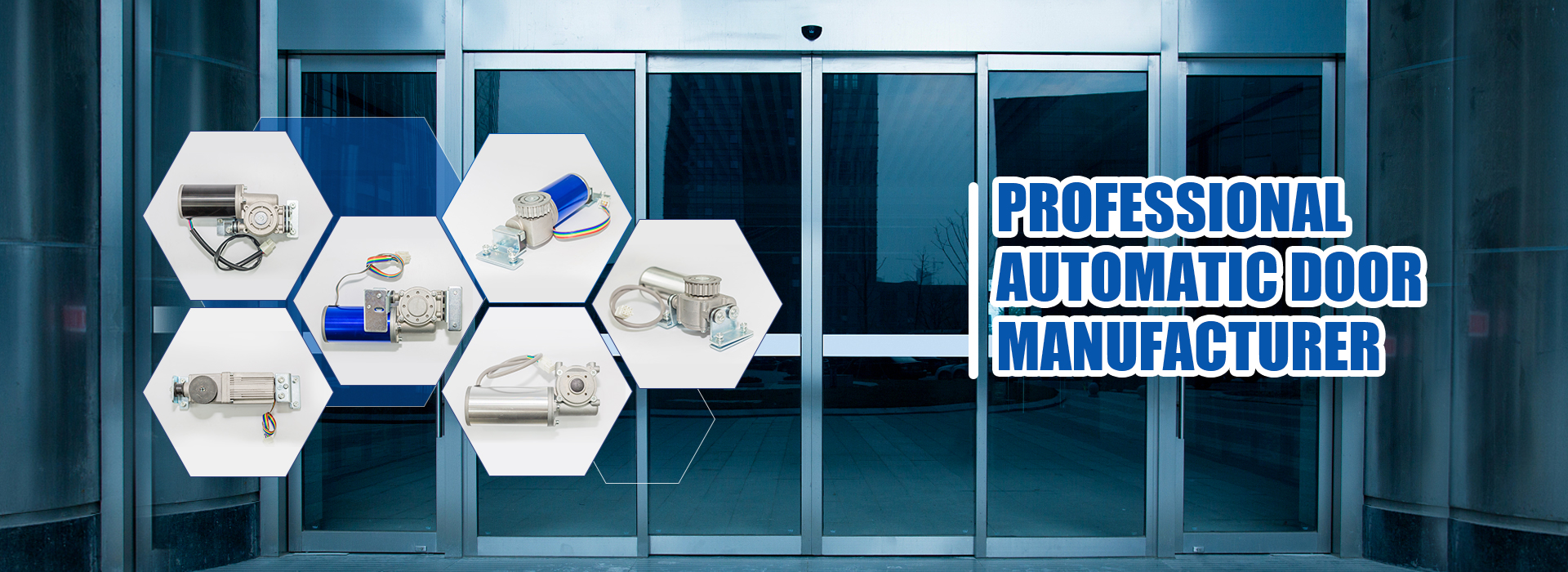
The motor is the heart of any automatic door operator, and the choice between brushed and brushless DC motor technology has significant implications for long-term operating cost. YFBF automatic door systems use 24V DC brushless motors rated between 60W and 100W, and the engineering rationale for this choice is straightforward.
3.1 Eliminating the Primary Wear Component
A brushed DC motor uses carbon brushes to transfer electrical current to the rotating armature. These brushes wear down over time, generating carbon dust that contaminates the commutator and eventually causes the motor to lose efficiency or fail entirely. In a retail environment where the door may cycle 3,000 to 5,000 times per day, brush wear becomes a recurring maintenance cost and a source of unplanned downtime. A brushless motor eliminates brushes entirely, using electronic commutation to control the rotor. The result is a motor with a substantially longer service life and no routine wear parts to replace.
3.2 Lower Voltage, Safer Installation
The 24V DC supply voltage keeps the system in the low-voltage category under most electrical codes, which simplifies installation requirements. Wiring does not need to be routed in conduit in many jurisdictions, and the risk of electrical shock during maintenance is significantly reduced. For retail chains that employ their own facility teams rather than contracting every service call to a specialist electrician, this simplification translates into faster maintenance response and lower labor costs.
3.3 Direct Battery Backup Compatibility
A 24V DC motor can connect directly to a battery backup system without voltage conversion. In the event of a power outage, the door continues to operate on battery power, maintaining customer access and preventing the entrance from becoming a security or egress concern. This is particularly important for retail chains that operate in regions with unreliable grid power or that must maintain fire-rated egress capability at all times.
3.4 Energy Efficiency in Standby Mode
Modern brushless motor controllers can reduce power draw to near zero when the door is idle, activating the motor only when a sensor or access control signal triggers an open cycle. Combined with low-friction mechanical design, a 24V brushless system can achieve standby power consumption measured in single-digit watts. Over a year of continuous operation across hundreds of retail locations, the cumulative energy efficiency savings are meaningful.
4. How Modularity Reduces Total Entrance-System Cost
When procurement teams evaluate the cost of a swing door opener, they typically focus on the unit purchase price. But for a multi-site retail rollout, the unit price is only a fraction of the total cost. Modularity reduces cost across several dimensions that are often overlooked in initial comparisons.
4.1 Reduced Installation Time
Because every modular operator uses the same mounting rail, the same wiring harness, and the same control board, installers develop a repeatable process. They do not need to consult different installation manuals for different doorway configurations. The arm variant is the only variable, and swapping between arm types requires only a few fasteners. In multi-site rollouts, this consistency can reduce per-site installation time substantially compared to traditional operators that require custom brackets and unique wiring for each doorway.
4.2 Simplified Spare Parts Inventory
A modular platform typically requires fewer than ten part numbers to cover all service scenarios: the motor cartridge, the control board, the standard arm, the extended arm, the mounting rail, and a few sensor and accessory SKUs. A non-modular fleet serving the same variety of doorways might require twenty or thirty distinct part numbers. Fewer part numbers means less capital tied up in inventory, fewer stockouts, and faster first-visit fix rates when service calls occur.
4.3 Faster Technician Training
When every site uses the same operator platform, facility teams only need to learn one installation and troubleshooting procedure. This reduces training time and cost, and it means that any technician in the chain can service any location without requiring site-specific knowledge.
4.4 Easier Upgrades and Retrofits
As building codes evolve or as the retail chain adopts new access control technology, modular operators can be upgraded by swapping individual modules rather than replacing entire units. A new sensor type, a different lock mechanism, or an updated control board with wireless connectivity can be installed on the existing operator frame. This extends the useful life of the installed base and defers capital expenditure.
| Cost Factor | Traditional Operator | Modular Operator |
|---|---|---|
| Unique part numbers per chain | 20 – 30 | 8 – 12 |
| Per-site installation procedure | Custom per doorway | Standardized with arm swap |
| Motor failure response | Full unit replacement | Motor cartridge swap |
| Technician training scope | Multiple product families | Single platform |
| Upgrade path | Replace entire operator | Swap individual module |
5. Compliance and Safety: Meeting Retail Entrance Standards
Automatic pedestrian doors in retail environments are subject to rigorous safety and accessibility standards. A modular swing door opener must comply with the same requirements as any other automatic door system, and the modular architecture does not change the compliance obligation — it changes how efficiently the chain can demonstrate and maintain compliance.
5.1 Safety Standards for Automatic Doors
In the European market, automatic pedestrian doors must comply with EN 16005, which specifies safety requirements for power-operated pedestrian doorsets. In North America, ANSI A156.10 covers the same category. Both standards address sensor coverage, closing force limits, entrapment protection, and emergency manual operation. YFBF automatic door operators are designed and tested to meet these requirements, and the consistent sensor integration across the modular platform simplifies compliance verification across multiple sites.
5.2 Accessibility Requirements
The ADA in the United States, and equivalent legislation in other markets, requires that automatic doors provide adequate clear opening width, low operating force, and accessible activation methods. A modular swing door opener configured for low-energy operation — slower opening speed, reduced closing force, and extended hold-open time — satisfies these requirements without requiring a different operator model. The same hardware switches between full-automatic and low-energy modes through the configurable control board.
5.3 Electromagnetic Compatibility and CE Marking
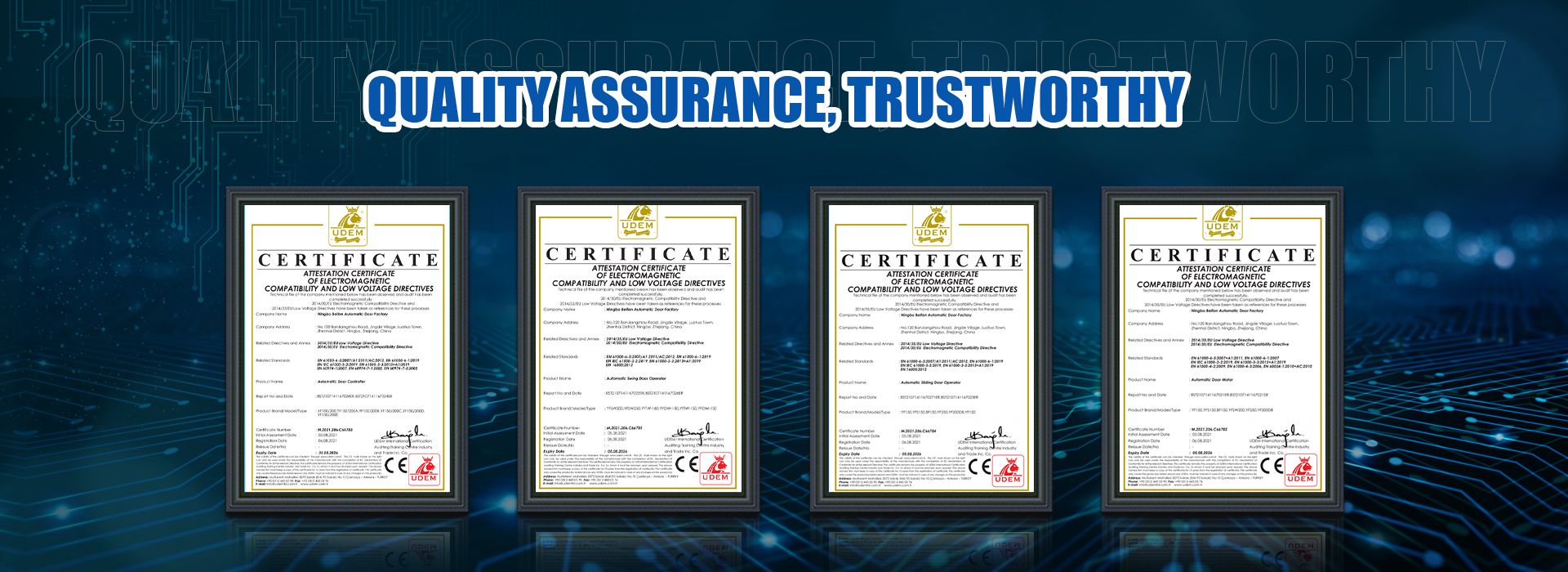
Products sold in the European Economic Area must carry CE marking, which includes conformity with the Electromagnetic Compatibility Directive. YFBF operators are tested for electromagnetic compatibility to ensure they do not interfere with other building systems and are not susceptible to interference from nearby electronic equipment. For retail chains deploying hundreds of operators in dense commercial environments, EMC performance is not optional — it is a baseline requirement for reliable operation.
5.4 Quality Management Certification
Ningbo Yufan Beifan Automatic Door Co., Ltd. holds ISO 9001 certification, which governs the company’s quality management system from raw material sourcing through final product testing. For retail chains evaluating a new operator supplier, ISO 9001 certification provides documented assurance that the manufacturer follows a systematic approach to quality control, corrective action, and continuous improvement. This is especially important when the same product platform will be deployed across dozens or hundreds of locations with no opportunity for site-by-site quality inspection.
6. Selecting a Modular Swing Door Opener: Key Engineering Criteria
Not every product marketed as “modular” delivers the same degree of interchangeability. When evaluating a modular swing door opener for a retail chain deployment, procurement teams should examine the following criteria:
6.1 True Module Interchangeability
Ask the manufacturer whether the motor module, control board, and arm mechanism are physically interchangeable across the product range without modification. Some operators claim modularity but require different control boards for single-leaf and double-leaf configurations, which defeats the purpose of standardization.
6.2 Motor Specification and Duty Cycle
Verify that the motor is rated for the expected daily cycle count. A retail entrance with 4,000 cycles per day, 365 days per year, requires a motor and gearbox designed for continuous high-volume operation. A 24V brushless DC motor in the 60W to 100W range, as used in YFBF operators, provides the torque and thermal capacity needed for demanding retail applications while maintaining low power consumption.
6.3 Control Board Flexibility
The control board should support both full-automatic and low-energy modes, accept standard sensor inputs (microwave, infrared, pressure mats), and provide configurable output relays for lock control and building management integration. Look for boards that support software configuration rather than hardware-only options, as software-configurable boards are easier to update and adjust in the field.
6.4 Mechanical Durability
Examine the hinge mechanism, arm joints, and mounting hardware for material quality. Aluminum alloy housings with anodized finishes resist corrosion in humid or coastal retail environments. Stainless steel pivot pins and self-lubricating bushings reduce maintenance intervals. Ask for test data showing cycle life at the rated load — a credible manufacturer will provide it.
6.5 Documentation and Support
For multi-site rollouts, the quality of installation documentation matters as much as the hardware. Look for manufacturers that provide clear wiring diagrams, step-by-step installation guides, and troubleshooting flowcharts. Multilingual documentation is essential for international retail chains. YFBF provides comprehensive technical documentation and direct sales engineering support through its Ningbo headquarters and international sales team.
7. Factory Capabilities: Why Manufacturing Scale Matters
Ningbo Yufan Beifan Automatic Door Co., Ltd. has manufactured automatic door systems since 2007, operating from a factory site of approximately 3,500 square meters with a building area of roughly 7,500 square meters in Ningbo, China. The company’s core product range — automatic sliding door operators, 24V brushless DC door motors, swing door openers, and accessories — is produced under an ISO 9001 quality management system with CE marking for European market compliance.
For retail chains evaluating a supplier, manufacturing scale translates into three practical advantages: consistent quality across large order volumes, the ability to meet aggressive delivery schedules for multi-site rollouts, and the technical resources to support OEM and ODM customization when a chain requires specific branding, control configurations, or mechanical adaptations.
8. Case Scenario: A 200-Location Retail Rollout
To illustrate the practical impact of modular design, consider a hypothetical retail chain deploying automatic swing doors across 200 locations with a mix of single-leaf in-swing, single-leaf out-swing, and double-leaf configurations.
With a non-modular approach, the chain might need three different operator models, each with its own mounting hardware, wiring harness, and control board. The spare parts inventory would include three sets of motor assemblies, three sets of control boards, and multiple arm variants — potentially twenty-five or more unique part numbers. Technicians would need training on all three product families. Installation teams would follow three different procedures.
With a modular swing door opener platform, the same base operator mounts to all three doorway types. The only variable is the arm variant, which is selected at the time of installation. The spare parts inventory drops to approximately ten part numbers. Technicians learn one product. Installation follows one procedure with an arm selection step. The cumulative savings in installation labor, spare parts inventory, training time, and service response time compound across 200 sites to represent a significant reduction in total entrance-system cost.
9. Maintenance Best Practices for High-Traffic Retail Entrances
A modular swing door opener simplifies maintenance, but it does not eliminate the need for a regular service routine. For retail environments with high daily cycle counts, the following practices help maximize uptime and extend component life:
- Monthly visual inspection. Check the arm mechanism, pivot points, and mounting bolts for signs of looseness, wear, or corrosion. Tighten any fasteners that have developed play.
- Quarterly sensor check. Verify that all activation and safety sensors are detecting correctly and that the door’s opening and closing speeds remain within specification. Sensor misalignment is the most common cause of nuisance activations and safety complaints.
- Annual motor module health check. Measure the motor’s current draw during a full open-close cycle. An increase in current draw above the baseline may indicate bearing wear or increased mechanical resistance in the door hardware. If the motor cartridge shows elevated current, swap it proactively rather than waiting for failure.
- Keep one spare motor cartridge per fifteen to twenty locations. Because the motor module is interchangeable, a small number of spares covers the entire fleet. This eliminates the need to stock multiple motor variants.
- Update control board firmware when available. Manufacturers periodically release firmware updates that improve sensor handling, adjust timing parameters, or add compatibility with new accessory types. Applying these updates during routine service visits keeps the installed base performing at its best.
10. Frequently Asked Questions
What makes a modular swing door opener different from a traditional operator?
A modular swing door opener separates the motor unit, control board, and mounting hardware into interchangeable sub-assemblies. This means installers can swap or upgrade individual modules — such as the motor or the controller — without replacing the entire operator. Traditional monolithic designs typically require full-unit replacement when any single component fails.
How does a 24V brushless DC motor benefit automatic swing door systems?
A 24V brushless DC motor eliminates carbon brushes, which are the primary wear item in conventional brushed motors. This extends motor life significantly while reducing maintenance intervals. The 24V DC supply also simplifies compliance with low-voltage safety standards and allows direct connection to battery backup systems, ensuring the door continues to operate during power outages.
Can a single modular swing door opener model work across different retail store layouts?
Yes. Because modular operators use standardized mounting interfaces and configurable arm lengths, a single base operator model can be adapted to in-swing, out-swing, and double-leaf configurations. This reduces the number of SKUs a retail chain needs to stock for maintenance, simplifies training for facility teams, and accelerates installation across diverse storefront geometries.
What certifications should a retail automatic door system have?
Retail automatic door systems should comply with EN 16005 in Europe or ANSI A156.10 in North America for pedestrian automatic doors. Additionally, the manufacturer should hold ISO 9001 certification for quality management and CE marking for products sold in the European Economic Area. ADA compliance is also essential for US retail environments to ensure accessibility for all customers.
How does modular design reduce installation time for multi-site rollouts?
Modular swing door operators use standardized wiring harnesses and pre-configured control boards. Installers follow the same procedure at every site regardless of door size or swing direction, which reduces on-site decision-making and troubleshooting. This consistency can cut per-site installation time compared to traditional operators that require custom wiring and configuration for each unique doorway.
Can modular swing door openers integrate with existing access control systems?
Yes. Most modular operators include configurable input/output terminals that accept signals from card readers, keypads, remote controls, and building management systems. The standardized control board architecture means the same interface works across all sites, so integration with access control platforms does not require custom programming at each location.
Ready to standardize your retail entrance system with a modular swing door opener platform?
Edison
Sales Manager, Ningbo Yufan Beifan Automatic Door Co., Ltd.
Ningbo Yufan Beifan Automatic Door Co., Ltd. specializes in automatic door system R&D and manufacturing. Core products include automatic sliding door operators, 24V brushless DC door motors, and accessories, widely used in commercial buildings, public facilities, and industrial sites. Edison manages global project inquiries and OEM/ODM custom solutions, supporting distributors and project procurement clients worldwide.
Post time: Jul-24-2026