
This guide explains how safety beam sensors work, how they relate to ADA accessibility requirements, ANSI A156.10, and EN 16005, and what procurement professionals should evaluate when sourcing from manufacturers like Ningbo Yufan Beifan Automatic Door Co., Ltd. (YFBF).

Key Takeaways
- Safety beam sensors must be positioned to detect persons in the swing path per ADA and EN 16005 requirements.
- Active infrared safety beams use a transmitter-receiver pair to create an invisible detection curtain across the doorway.
- Proper sensor mounting height and angle prevent false activations while ensuring pedestrian safety.
- CE-certified sensor systems simplify compliance for European installations; US projects require ANSI A156.10 verification.
- Integration with the door controller’s safety relay ensures immediate reversal when the beam is interrupted during closing.
Why Safety Sensors Are the Cornerstone of Automatic Door Compliance
Automatic doors serve millions of people every day in commercial, institutional, and industrial environments. For wheelchair users, visually impaired pedestrians, and elderly occupants, an improperly sensed closing door is a serious injury risk. Regulatory bodies worldwide have responded with increasingly strict standards:
- United States — The Americans with Disabilities Act (ADA) mandates that automatic doors provide adequate clear opening width, low operating force, and presence detection to prevent contact with users. ANSI A156.10 is the referenced product standard for power-operated pedestrian doors, specifying detection zone geometry, sensor response time, and entrapment protection.
- European Union — EN 16005 governs the safety of automatic pedestrian door sets, defining hold-open times, closing force limits, and the requirement for protective sensors in the swing or slide path.
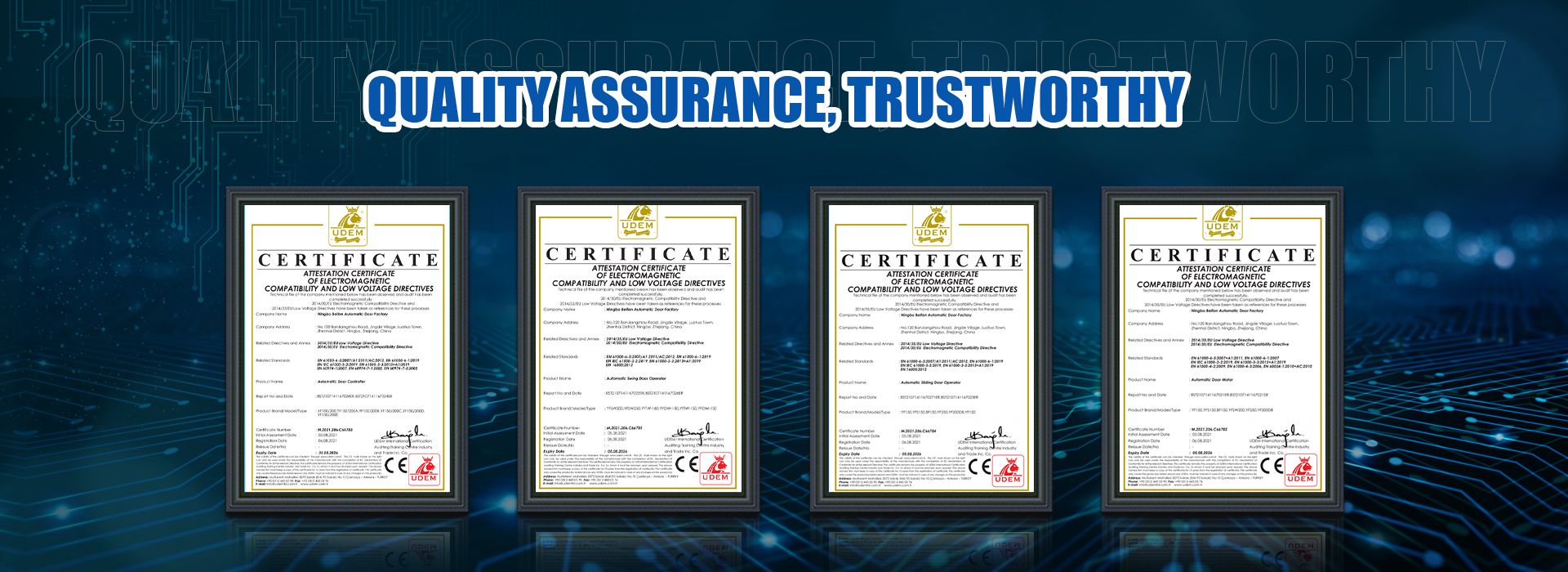
- International — Manufacturers with CE marking and ISO 9001 quality management systems demonstrate conformity with baseline European safety directives and consistent production quality.
At its core, every compliance framework asks the same question: Does the door detect a person in or approaching the doorway, and does it respond in time to prevent harm? That is precisely the job of the safety beam sensor.
How Safety Beam Sensors Work
A safety beam sensor—sometimes called a photoelectric beam or break-beam detector—consists of an emitter and a receiver mounted on opposite sides of a door opening. The emitter projects a modulated infrared (IR) beam across the threshold. When a person or object interrupts the beam, the receiver detects the loss of signal and sends a control command to the door operator to hold open or reverse closing motion.
Key Technical Parameters
| Parameter | Typical Specification | Why It Matters |
|---|---|---|
| Detection range | 2–8 m | Must span the full door clear width |
| Beam wavelength | ~940 nm (near-IR) | Visible-light immunity; eye-safe |
| Response time | ≤ 50 ms | Ensures detection before door contacts user |
| Operating voltage | 12–24 VDC | Compatible with standard door controller supplies |
| Ingress protection | IP54 or higher | Reliable in semi-exposed or high-traffic lobbies |
| Output type | NO/NC relay or NPN/PNP | Flexible integration with diverse door controllers |
Single Beam vs. Multi-Zone Detection Architectures
A single-beam pair installed at a standard height (typically 200–300 mm above floor level) satisfies the basic entrapment-protection requirement of ANSI A156.10 and EN 16005. However, most high-traffic commercial projects specify layered detection:
- Presence detection zone (safety beam): A low-mounted beam or light curtain across the doorway detects a person standing in the threshold, including wheelchair users and children. This is the primary entrapment-protection layer.
- Activation zone (motion sensor): A microwave or active infrared radar sensor mounted above the door detects approaching traffic and triggers door opening. YFBF offers the M-204G microwave motion sensor and the M-254 infrared motion and presence sensor for this role.
- Supplementary safety: Additional beams at higher positions or secondary presence sensors close any remaining blind spots, such as the area immediately adjacent to the door leaf.
Connecting Sensors to ADA, ANSI A156.10, and EN 16005
ADA and ANSI A156.10
The ADA itself does not prescribe sensor model numbers; it sets functional outcomes—automatic doors must be accessible and must not present a collision hazard. ANSI A156.10, the referenced product standard, translates those outcomes into testable requirements:
- The door shall not close on a stationary test object placed in the sensing zone.
- The reopening device shall activate when the sensing field is interrupted at any point within the rated detection area.
- Hold-open time shall be adjustable, with a minimum of 1.5 seconds after the sensing zone clears.
- Maximum closing force and kinetic energy limits apply to prevent impact injury.
A properly installed safety beam sensor directly satisfies the entrapment-protection clauses. When combined with an activation sensor, the full system meets the ANSI A156.10 power-operated pedestrian door requirements.
EN 16005 (Europe)
EN 16005 follows a similar philosophy but is structured around the European building code and Machinery Directive framework. It mandates risk assessment for each installation and requires protective devices—typically safety beam sensors or light curtains—to achieve a defined Performance Level (PL) according to EN ISO 13849-1. CE-marked door systems must demonstrate compliance through documented testing.
Evaluating a Safety Beam Sensor: A Procurement Checklist
For facility managers, architects, and distributors sourcing automatic door components from overseas manufacturers, the following checklist captures the critical evaluation criteria:
- Certification trail: Does the sensor carry CE marking? Is the factory ISO 9001 certified? These are baseline quality indicators for European and global markets.
- Compatibility: Confirm the sensor output type (relay, transistor) and voltage range match your door controller. YFBF sensors are designed to integrate with YFBF’s own 24V brushless DC door operators as well as third-party controllers.
- Detection performance: Request test reports showing response time and detection range. Sub-50 ms response with 4+ meter range is standard for commercial-grade units.
- Environmental resilience: For exterior or semi-exposed installations, verify IP54 or higher rating and specify units with IR sunlight immunity to avoid false triggers.
- Mounting and alignment: Look for sensors with visible alignment aids (LED indicators, audible signals) that simplify field installation and reduce commissioning time.
- Fail-safe behavior: If the beam is interrupted (e.g., sensor failure or misalignment), the door should default to a safe state—held open or fully open—not closing on occupants. This is a critical safety relay design consideration.
- OEM/ODM flexibility: If you are branding the sensor under your own label, confirm the manufacturer supports custom housings, labeling, and packaging. YFBF offers OEM and ODM customization on its sensor range.
Spotlight: YFBF M-218D Safety Beam Sensor
The M-218D is YFBF’s dedicated infrared safety beam pair for automatic sliding and swing door applications. Key features include:
- Infrared break-beam detection across up to 6 meters
- Compact housing designed for frame-mounted installation alongside door operators
- 12–24 VDC operating voltage, compatible with YFBF automatic sliding door operators
- Relay output (NO/NC) for direct connection to door controller safety inputs
- Designed for pairing with M-254 or M-204G activation sensors to create a complete detection zone
When specified as part of a YFBF door system—including the sliding door operator, 24V brushless DC motor, activation sensor, and safety beam—the M-218D contributes to a detection architecture aligned with international best practice for automatic pedestrian door safety.
Installation Best Practices for Code-Compliant Deployments
Even the best sensor will underperform if installed incorrectly. The following practices help ensure the sensor performs as intended in the field:
- Mounting height: Place the primary safety beam at 200–300 mm above finished floor level to detect wheelchairs, crutches, and small children. Additional beams can be placed at 700–800 mm for belt-buckle-level detection on standing adults.
- Alignment verification: Use the sensor’s built-in alignment indicator (LED or buzzer) during installation. Misalignment is the leading cause of false holds and nuisance door activations.
- Cable routing: Route sensor cables in dedicated conduits separated from power cables to minimize electromagnetic interference (EMI). Shielded cable is recommended for runs exceeding 10 meters.
- Commissioning tests: After installation, test with the standard EN 16005 test object (a 700 mm tall cylinder simulating a child’s torso, plus a 200 mm object for wheelchair detection) at multiple points across the doorway.
- Periodic maintenance: Schedule quarterly inspections to clean sensor lenses, verify alignment, and confirm relay function. Dust and debris accumulation can degrade IR beam intensity over time.
Comparing Detection Technologies: Beam Sensors, Light Curtains, and Radar
Procurement teams often ask whether a light curtain or microwave motion sensor can replace a safety beam. The answer depends on the function:
| Technology | Best For | Limitation |
|---|---|---|
| Safety beam (single/dual) | Entrapment protection at threshold | Only detects at beam height; may miss objects between beams |
| Light curtain (multi-beam) | Continuous vertical detection from floor to ~2 m | Higher cost; more complex wiring |
| Microwave radar | Approach detection (activation zone) | Cannot reliably detect stationary presence; not suitable as sole safety sensor |
| Infrared presence (e.g., M-254) | Combined activation + stationary presence | Higher per-unit cost; requires ceiling or header mounting |
In practice, most ADA- and EN 16005-compliant installations use a combination: an activation sensor (radar or IR) to open the door, plus a safety beam or light curtain to hold it open when the threshold is occupied. YFBF’s product range supports both standalone beam-based protection and integrated sensor packages.
Supply Chain Considerations for Global Distributors
Sourcing automatic door sensors from China-based manufacturers offers significant cost advantages, but B2B buyers should verify the following during supplier qualification:
- Factory audit reports: Confirm the manufacturer’s ISO 9001 certificate is current and issued by an accredited body. YFBF’s ~7,500 sqm production facility in Ningbo is ISO 9001 certified.
- Sample testing: Before placing bulk orders, request production samples and conduct independent testing against ANSI A156.10 or EN 16005 parameters as applicable to your market.
- After-sales support: Evaluate the manufacturer’s technical documentation, wiring diagrams, and responsiveness to integration questions. YFBF’s sales team provides pre-sale technical consultation and post-sale support.
- Lead times and MOQs: For standard sensors, expect 2–4 week lead times. Custom OEM orders may require 6–8 weeks. Discuss minimum order quantities upfront to align with project timelines.
Need Help Specifying Safety Sensors for Your Next Project?
YFBF’s engineering team can help you select the right sensor configuration for your automatic door installation—whether you need a standalone beam sensor or a complete door system with integrated detection.
Sensor Integration with Building Management Systems
Modern commercial buildings increasingly integrate automatic door systems with centralized building management platforms. Safety beam sensors that provide dry-contact relay outputs or digital communication interfaces allow the building management system to monitor door status, track activation counts, and receive fault alerts in real time. For large retail chains managing hundreds of locations, this integration capability enables remote diagnostics and predictive maintenance scheduling that reduces unplanned downtime and service call costs.
YFBF’s sensor range includes models with configurable relay outputs that can interface with access control panels, fire alarm systems, and HVAC interlocks. When the automatic door is held open by a safety beam activation during high-traffic periods, the building management system can adjust HVAC setpoints to account for the increased air exchange, preventing energy waste while maintaining occupant comfort. This level of integration transforms the automatic door from a standalone mechanical system into a networked building component that contributes to overall facility efficiency and compliance reporting.
Does a single safety beam sensor meet ADA requirements?
A single safety beam satisfies the entrapment-protection requirement when installed at the correct height. However, most authorities having jurisdiction (AHJs) and project specifications also require an activation sensor (radar or IR) to trigger door opening. Confirm local requirements with your AHJ.
What is the difference between ANSI A156.10 and EN 16005?
Both standards address automatic pedestrian door safety, but ANSI A156.10 is the North American standard referenced by ADA, while EN 16005 is the European standard aligned with the EU Machinery Directive. Detection zone geometry, test objects, and documentation requirements differ. Manufacturers with CE marking and ISO 9001 certification typically have a strong foundation for both markets, but specific testing against the applicable standard is essential.
Can YFBF sensors be integrated with third-party door operators?
Yes. YFBF safety beam sensors use standard relay outputs (NO/NC) that are compatible with most automatic door controllers from any manufacturer. Wiring diagrams and technical specifications are available upon request.
How often should safety beam sensors be inspected?
Industry best practice recommends quarterly visual inspections and annual functional testing. High-traffic installations (airports, hospitals, retail) may benefit from monthly checks. Always document inspections for compliance records.
Selecting the Right Sensor Configuration for Your Automatic Door Project
Choosing the appropriate sensor configuration for an automatic door installation requires balancing detection coverage, environmental conditions, and regulatory requirements. For ADA-compliant installations in the United States, the minimum requirement is a presence sensor that detects a stationary person within the swing path of the door. Active infrared safety beams provide this detection capability at a lower cost than microwave or combined-technology sensors, making them the preferred choice for budget-conscious retail and office building projects.
European installations governed by EN 16005 require a more comprehensive approach: the standard mandates both approach detection (to activate the door before the user reaches it) and presence detection (to prevent the door from closing on a person in the threshold). This dual-sensor requirement typically means combining a microwave motion sensor for approach detection with an active infrared curtain for presence detection. YFBF offers both single-function and combined-function sensor packages that address these regional requirements, allowing distributors to stock a single product line for multiple markets.
For harsh environments — including industrial facilities, cold-storage warehouses, and coastal buildings exposed to salt spray — sensor housings must meet appropriate ingress protection ratings. While the sensor electronics themselves are typically rated to IP54 or IP65, the cable entry point and mounting bracket are the most vulnerable areas for moisture intrusion. Specifying sensors with sealed cable glands and corrosion-resistant mounting hardware ensures long-term reliability in these demanding applications. YFBF’s sensor range includes models specifically designed for outdoor and industrial use, with operating temperature ranges from minus twenty degrees Celsius to plus fifty-five degrees Celsius.
What is the difference between active infrared and passive infrared sensors for automatic doors?
Active infrared sensors emit a beam of infrared light from a transmitter to a receiver and detect when the beam is interrupted — this is the technology used in safety beam sensors for doorway protection. Passive infrared sensors, by contrast, detect infrared radiation emitted by warm objects (such as people) moving through their field of view — this is the technology used in motion detectors for approach detection. For ADA and EN 16005 compliance, active infrared safety beams are preferred for presence detection in the doorway threshold because they reliably detect stationary persons, whereas passive infrared sensors may miss a person standing still. YFBF offers both active infrared safety beams and passive infrared motion sensors as separate products or combined in a single housing for installations that require both detection modes.
What certifications should buyers look for when sourcing safety beam sensors from China?
When sourcing safety beam sensors from Chinese manufacturers for use in regulated markets, buyers should verify several key certifications. For European installations, CE marking under the relevant EMC and low voltage directives is mandatory, along with compliance documentation referencing EN 16005 where applicable. For US installations, sensors should carry UL recognition or equivalent NRTL listing, and the overall automatic door assembly must comply with ANSI A156.10. ISO 9001 certification of the manufacturing facility provides assurance of consistent quality processes. YFBF maintains CE certification and ISO9001 quality management system certification, and can provide test reports and compliance documentation for distributor qualification and project tenders.
Conclusion
Safety beam sensors are a small but mission-critical component in any automatic door system. For B2B buyers—whether you are an architect specifying a healthcare facility, a distributor building a product catalog, or a facility manager upgrading an existing entrance—understanding the relationship between sensor technology and regulatory standards is essential.
YFBF’s range of safety beam sensors, motion sensors, and complete automatic door operators provides a tested, CE-certified, and ISO 9001-manufactured foundation for compliant installations worldwide. Explore the full YFBF product range to find the right sensor and door operator combination for your next project.
Edison
Sales Manager, Ningbo Yufan Beifan Automatic Door Co., Ltd.
Ningbo Yufan Beifan Automatic Door Co., Ltd. specializes in automatic door system R&D and manufacturing. Core products include automatic sliding door operators, 24V brushless DC door motors, and accessories, widely used in commercial buildings, public facilities, and industrial sites. Edison manages global project inquiries and OEM/ODM custom solutions, supporting distributors and project procurement clients worldwide.
Post time: Jul-23-2026