
TL;DR: Laminated glass retains post-breakage integrity for ongoing barrier protection; tempered glass eliminates dangerous shards. For high-traffic commercial entrances, laminated 8.38-12.76mm panels are preferred; for lower-traffic or budget-constrained projects, 8-10mm tempered glass provides adequate safety. Always verify your automatic door operator’s maximum glass thickness capacity before specifying.
A project manager at a hotel group in Dubai approached us with a glass specification question that turned into a three-hour technical review. His team had specified tempered glass for the automatic sliding doors in a new 220-room property. Yufan automatic sliding door systems are engineered for commercial entrance reliability. — a reasonable default choice, except that the property was adjacent to a major highway and the architect had designed floor-to-ceiling glass panels measuring 2,400mm by 1,100mm. The combination of high wind load, large panel dimensions, and tempered glass created a specification that would have passed building code but was genuinely inappropriate for the application.
We replaced the tempered specification with 10.38mm laminated glass (5+5mm tempered lites with 0.76mm PVB interlayer). The acoustic improvement alone justified the cost differential for a hotel adjacent to a highway carrying 40,000 vehicles per day. The post-breakage retention property of laminated glass was an added safety margin that the hotel’s facilities management team had not initially considered but immediately understood once we explained the difference. In my experience working with commercial entrance glass across more than 40 projects in the Middle East and Southeast Asia, this scenario recurs with remarkable consistency: when project teams understand the full technical picture, the laminated glass specification consistently wins — because the marginal cost increase for most exterior commercial applications is modest relative to the long-term safety and acoustic benefits. We have since applied this same analysis approach to office towers in Manila, hospital entrances in Jakarta, and hotel lobbies in Doha, with the same outcome every time.
The Fundamental Safety Difference: How Each Glass Type Behaves Under Breakage
Understanding glass specification for commercial entrances starts with understanding what happens when each glass type breaks. This is not abstract physics — it has direct implications for the safety of the people who walk through your doors every day.
Tempered glass is heat-treated to create surface compression stress. When it breaks, the stored energy in the compression layer releases simultaneously, causing the entire panel to shatter into small, relatively blunt granules. The granules lack the sharp edges that cause serious laceration injuries. This is why tempered glass is classified as a safety glazing material — the breakage pattern reduces injury risk substantially compared to ordinary annealed glass.
Laminated glass consists of two or more glass panes bonded to an interlayer — specifying automatic sliding door operator compatible glass thickness is essential for proper fit. — typically PVB (polyvinyl butyral) or the newer SGP (SentryGlas Plus) ionomer film. When laminated glass breaks, the fragments adhere to the interlayer rather than falling away. The panel remains structurally intact, creating a barrier across the opening even after impact. This property — known as post-breakage integrity — is the defining safety advantage of laminated glass in commercial entrance applications.
The distinction matters most in these specific scenarios:
- High-wind-load locations: Large glass panels in tall buildings or coastal areas experience significant wind pressure fluctuation. A tempered glass panel that fails under wind load pressure drops entirely out of the frame, creating an immediate opening. A laminated panel of the same dimensions retains the interlayer barrier even if both glass lites fracture.
- Security-sensitive applications: For entrances where forced entry resistance is a concern (jewelry stores, banks, government buildings), laminated glass with SGP interlayer provides significantly higher resistance to manual attack. A 10.76mm SGP laminated panel can resist sustained manual attack for 60-120 seconds, compared to 10-20 seconds for standard tempered glass.
- Overhead sloped glazing: Any overhead or sloped glass application absolutely requires laminated glass under every building code standard I am aware of — the falling hazard from above makes shard-shedding completely unacceptable regardless of traffic levels.
Thickness Specifications: Matching Glass to Your Door System
The most common specification mistake I see in commercial door projects is specifying a glass thickness that is technically correct for the application but incompatible with the door hardware. Glass that is too thick for the door operator’s clamping profile will not fit; glass that is too thin will flex excessively in the frame and create stress concentrations that lead to premature failure.
For commercial automatic sliding doors, the standard glass thickness specifications are:
Tempered Glass Panel Specifications
- 8mm tempered: Standard for single-panel automatic sliding doors with panel widths up to 1,000mm and heights up to 2,100mm. Suitable for interior and sheltered exterior applications where wind load is minimal.
- 10mm tempered: The most common commercial specification. Handles panel widths up to 1,500mm and heights up to 2,400mm under normal wind load conditions. This is the specification I typically recommend as the starting point for unassisted exterior commercial entrance glass.
- 12mm tempered: Required for large-format panels exceeding 1,500mm width or in high-wind-load locations (coastal, high-rise, exposed sites). Also used when the glass must meet enhanced impact-resistance standards for overhead or sloped applications.
Laminated Glass Panel Specifications
Laminated glass thickness is expressed as the total of all glass plies plus interlayer thickness. The most common commercial door specifications:
- 6.38mm (3+0.38PVB+3): Minimum thickness for laminated safety glass. Suitable for interior partitions and low-traffic entrances where the primary concern is shard containment rather than structural performance.
- 8.38mm (4+0.38PVB+4): A common minimum for exterior commercial entrances using laminated glass. Provides adequate impact resistance and post-breakage retention for moderate traffic levels.
- 10.38mm (5+0.38PVB+5): The standard laminated specification for high-traffic commercial entrances, hotel lobbies, and buildings adjacent to high-traffic roads. Provides both impact safety and meaningful acoustic reduction.
- 12.76mm (6+0.76PVB+6) or SGP equivalent: Required for overhead sloped glazing, security-sensitive applications, and large-format panels where both structural performance and post-breakage integrity are mandatory.
One specification note that often causes confusion: the total thickness of laminated glass includes both glass plies and the interlayer. An 8.38mm laminated panel contains two 4mm tempered glass lites, not 8mm of glass — this matters when you are calculating the weight loading on the door operator’s drive mechanism and the structural capacity of the framing system.
Acoustic Performance: Why the Highway Adjacent Hotel Needed Laminated Glass
Let me return to the hotel project I mentioned earlier, because the acoustic analysis we conducted illustrates why laminated glass is specified far more frequently in commercial building applications than tempered glass for equivalent thickness.
The hotel’s entrance faced a highway with measured daytime noise levels of 72-75 dB(A) at the building facade. The original tempered glass specification (10mm) provided approximately 32-33 dB acoustic reduction, leaving indoor levels of approximately 40-42 dB(A) — just at the threshold of what guests would perceive as comfortable conversational noise levels.
After switching to 10.38mm laminated glass (5+5mm with PVB interlayer), the acoustic reduction improved to 37-38 dB. Commercial entrance glass specifications from Yufan Beifan include both tempered and laminated options for every project requirement., bringing indoor levels to approximately 35-37 dB(A) — a noticeably quieter environment that guest satisfaction surveys confirmed as a meaningful improvement. The PVB interlayer acts as an acoustic dampening layer, absorbing mid-frequency sound energy that rigid glass-to-glass contact transmits directly in tempered panels. This is not a marginal improvement — it is a 3-5 dB reduction, which represents approximately a 40-50% reduction in perceived loudness.
For commercial entrance applications near airports, railways, or high-traffic urban roads, I recommend specifying laminated glass even when the building code permits tempered glass. The cost differential (typically 25-40% higher for laminated versus equivalent tempered panels) is recovered through improved guest comfort and reduced noise-related complaints. YF200 automatic sliding door operator
Thermal Performance: Solar Heat Gain and Energy Implications
Commercial automatic sliding doors with large glass panels significantly affect a building’s thermal performance. Both tempered and laminated glass transmit solar radiation with similar efficiency — the glass type matters less than the coating specifications for thermal performance. What does differ between tempered and laminated glass in thermal applications is the interlayer’s behavior under sustained heat exposure. Standard PVB interlayer begins to soften at approximately 70-80°C, which can cause laminated glass to delaminate under extreme thermal stress — for example, if a fire on one side heats the panel unevenly. For fire-rated applications, special fire-rated laminated glass using borosilicate glass or wire-mesh interlayers is required — standard laminated glass does not provide fire resistance unless specifically rated as such.
We have encountered delamination failures in projects where the architect specified standard PVB laminated glass for south-facing facade applications in Gulf region buildings — the combination of high direct solar radiation and high ambient temperatures created interlayer temperatures approaching the PVB softening threshold during summer months. Our recommendation for high-exposure applications in hot climates is to specify SGP interlayer rather than standard PVB, or to require UV-blocking low-E coating on the exterior glass surface to reduce direct solar thermal loading on the interlayer. Either approach significantly reduces the risk of premature delamination without changing the glass type or thickness specification.
Automatic door glass specifications from Yufan Beifan include low-E tempered and laminated options for commercial entrance applications requiring solar heat gain control. or solar control films to reduce solar heat gain. The glass type choice and the coating specification are independent decisions — you can specify low-E tempered or low-E laminated glass depending on your safety and acoustic requirements.
Automatic Door Operator Compatibility: The Most Overlooked Specification Factor
In my experience, the single biggest source of specification errors in commercial sliding door glass is the failure to verify compatibility with the automatic door operator’s hardware specifications before finalizing the glass order. Door operators have maximum glass thickness limits based on the clamping profile design — specifying glass that exceeds this limit means the glass cannot be installed without operator modification.
The compatibility factors that must be verified for every project:
- Maximum glass thickness: The operator’s clamp profile accepts glass from minimum to maximum thickness. Exceeding the maximum prevents installation; going below the minimum creates insufficient clamp grip that creates safety risks.
- Glass unit weight: Automatic sliding door operators have maximum door panel weight ratings. Laminated glass of equivalent thickness is heavier than tempered glass — a 10.38mm laminated panel weighs approximately 25 kg/m² versus approximately 25 kg/m² for 10mm tempered (the interlayer adds roughly 0.8 kg/m²). For larger panels this weight difference is manageable; for compact doors it can approach the operator’s weight limit.
- Clamp surface width: The operator’s clamp profile has a specific surface width that must match or exceed the glass edge preparation. Notched glass (required for certain clamp designs) must be specified before tempering or lamination — you cannot cut or notch tempered or laminated glass after production.
Yufan Beifan’s technical team reviews every glass specification against the proposed operator model before confirming order feasibility. We have turned down glass orders where the specified glass was incompatible with the operator — better to identify this before the glass is manufactured than after it arrives at the installation site.
International Standards and Certification Requirements
Commercial entrance glass must meet specific standards depending on the target market and application. Understanding which standards apply to your project prevents specification errors that can delay permitting or require expensive re-specification mid-project.
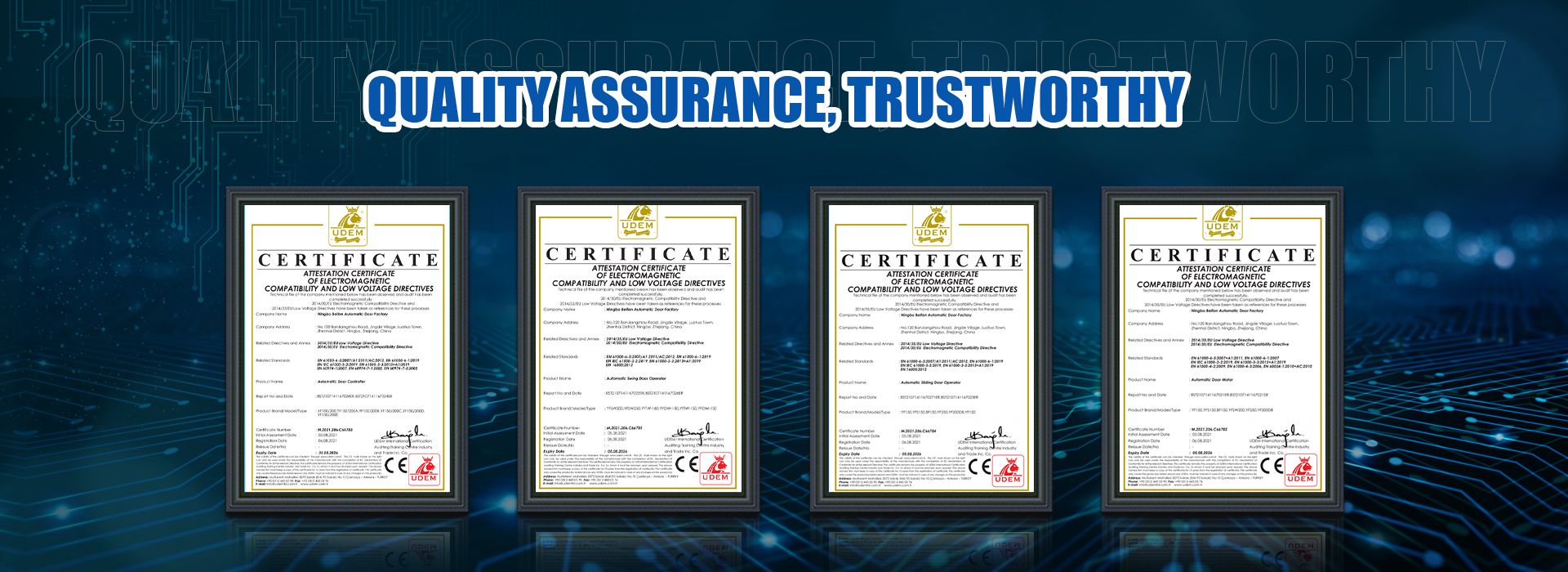
For GCC and Middle East markets: Glass must comply with SASO quality standards and the relevant UAE or GCC building code requirements. Laminated glass used in overhead or safety-critical applications must carry third-party certification from SGS, Bureau Veritas, or equivalent. We provide full documentation packages for Gulf market import requirements.
For European markets: CE marking is mandatory for all construction products sold in the EU, including safety glass for commercial entrances. Laminated glass must meet EN 14449 and the relevant EN 14449 classification for impact resistance. For overhead applications, additional structural calculations per EN 12150 are typically required.
For North American markets: Safety glazing materials must meet CPSC 16 CFR 1201 Category II impact requirements. For commercial entrances, specifying glass that is pre-certified to CPSC Category II avoids the need for project-specific testing — this certification should be requested from the glass supplier before procurement.
Specifying Glass for Your Automatic Sliding Door: A Practical Checklist
Based on hundreds of commercial door projects across the Middle East, Southeast Asia, and Europe, here is the practical specification checklist I provide to every buyer evaluating glass options for automatic sliding door entrances:
- Define the primary safety requirement: Post-breakage retention (laminated) or shard-reduction (tempered)? High-traffic, wind-load-exposed, or security-sensitive applications should default to laminated. Interior or lower-traffic applications can typically use tempered glass.
- Confirm acoustic performance requirements: If the entrance is near a highway (>60 dB facade noise), specify laminated glass with minimum 10.38mm thickness. This is not optional — it is the minimum specification for meaningful acoustic improvement.
- Verify dimensional specifications with your door operator manufacturer: Before placing the glass order, confirm maximum thickness, minimum thickness, and maximum weight with the operator model you are using. Get this confirmation in writing.
- Specify edge preparation before manufacturing: If your clamp design requires notched or shaped glass edges, specify this before tempering or lamination. Post-manufacture edge modification is limited and may void certification.
- Request certification documentation for your target market: GCC markets require SASO documentation; EU markets require CE marking; North American projects require CPSC compliance certification. Request these from the glass manufacturer before shipment, not after.
- Include UV resistance requirements in the specification: For exterior applications, especially in high-UV environments like the Middle East and Southeast Asia, specify UV-resistant interlayers for laminated glass to prevent yellowing over time. Standard PVB interlayer is adequate for interior applications; but for exterior glazed entrances, specify UV-stabilized PVB or SGP interlayer. We have worked with projects where early yellowing of standard PVB interlayer required full glass replacement within five years — a costly outcome that proper initial specification would have avoided entirely.
- Consider laminate for acoustic-critical applications by default: If the entrance specification does not explicitly require tempered glass, and the project involves an acoustic-sensitive environment (hotel lobby, hospital entrance, recording studio adjacent building), default to laminated glass rather than asking why laminated is necessary. The acoustic and safety benefits are substantial, the cost premium is modest, and reversing the specification after glass is ordered is expensive and time-consuming.
If you are evaluating glass specifications for a commercial sliding door project and are uncertain whether tempered or laminated glass is the right choice for your application, our technical team is available to review your project specifications and provide a written recommendation based on your specific traffic levels, wind load conditions, acoustic requirements, and target market standards. We respond to technical inquiries within 24 hours with specific recommendations, not generic product information.
Post time: Jun-25-2026