
By Edison · Sales Manager, Ningbo Yufan Beifan Automatic Door Co., Ltd. · Published 17 November 2026 · 10 min read · Last verified: 2026-11-17
TL;DR
- A sliding door needs wall space beside the opening; a swing door needs clear floor space in front of it. The published YFSW200 is for entrances that “do not has large space”.
- Our published swing operator handles 200 kg per leaf up to 1300 mm leaf width, opening 70° to 110°. The sliding operator handles 300 kg single or 200 kg per leaf double over 700 to 1500 mm.
- The swing door’s opening angle is a decision, not a fixed value: 70° to 110° adjustable, hold-open 0.5 to 10 s. A sliding door holds 0 to 9 s.
- Compliance is the question buyers get wrong. Egress and accessibility are separate tests, and a clear opening and a maneuvering clearance are different numbers.
- Our own published pages disagree on motor power: the specification tables say 24 V 60 W brushless DC, the category pages say 24 V 100 W. Confirm it in writing per model.

The Space Question Is About More Than Floor Area
The first thing a swing door consumes is not floor area, it is the swing arc itself, and that arc has to stay clear in every state. A door that opens 110° pushes its leaf across the approach, and that swept area cannot be used for furniture or queueing.
A sliding door consumes wall instead, at both ends of the opening. The leaf travels along the wall face, so the run-out on each side has to be clear. In a retrofit that run-out often does not exist, which is the usual reason a sliding door gets specified.
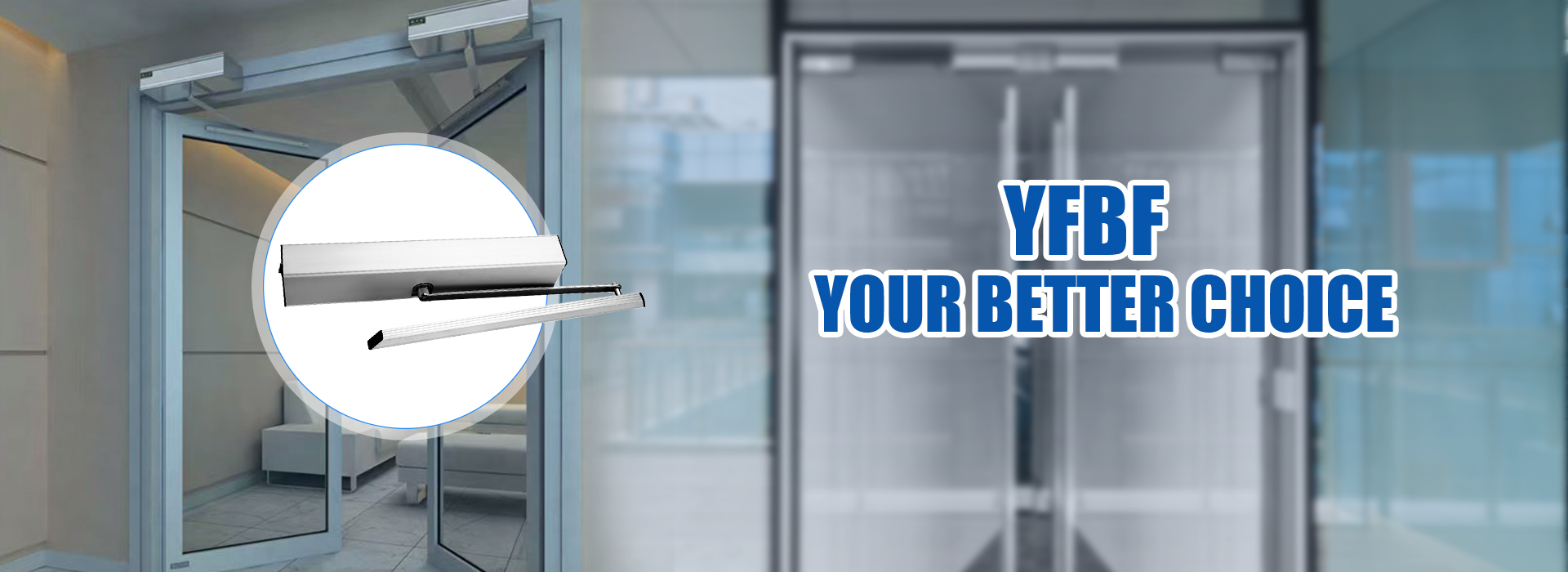
Our own published position on this is direct. The YFSW200 automatic swing door operator is described as being “widely used in office, meeting room, medical treatment room, workshop and etc, which entrance do not has large space”. That is the whole argument in one line.
One more space consideration gets forgotten: the hardware itself. A swing operator needs a mounting point, a drive arm and a place for the control box. A sliding operator needs a track header above the opening and a floor guide.
What the Published Operator Specifications Actually Say
Both door types in our published range run the same kind of motor. The swing and sliding operators both publish a 24 V brushless DC motor, an AC 90 to 250 V supply and a -20 °C to 70 °C range.
| Parameter | YFSW200 swing operator | YF200 / YF150 sliding operator |
|---|---|---|
| Max door weight | 200 kg per leaf | 300 kg single, 200 kg per leaf double |
| Door leaf width | Max 1300 mm | 700 to 1500 mm |
| Opening range | 70° to 110° adjustable | Full travel, one open position |
| Opening speed | 150 to 450 mm/s | 150 to 500 mm/s |
| Closing speed | 100 to 430 mm/s | 100 to 450 mm/s |
| Hold / open time | 0.5 to 10 s | 0 to 9 s |
| Motor type | 24 V brushless DC | 24 V brushless DC |
| Power supply | AC 90 to 250 V, 50/60 Hz | AC 90 to 250 V, 50/60 Hz |
| Operating temperature | -20 °C to 70 °C | -20 °C to 70 °C |
| Standard kit | Operator, control and arm assembly | Motor, control unit, 4 idler pulleys, 2 hangers, belts, stopper, 24 GHz microwave sensor, 4.2 m rail |
Two numbers in that table change how you specify. The first is leaf width: the swing operator stops at 1300 mm, the sliding operator runs 700 to 1500 mm, so a wide leaf on a swing door is impossible.
A sliding door has one open position and a hold timer. It travels to the end of its run and waits for the published 0 to 9 s. A swing door has a chosen angle: 70° to 110°, so it opens to 70° for controlled use or 110° for full clearance.
Egress and Compliance Are Not the Same Question
The most common specification error here is treating “accessible” and “compliant with egress” as one approval, when they are two separate tests against two different criteria. A door can satisfy one and fail the other.
On the egress side, the question is whether the door releases and opens in the direction of travel under fire conditions. A swing door held open on a closer or an electromagnetic lock needs a compliant release, and the YFSW200 publishes electromagnetic lock control.
On the accessibility side, the question is the clear opening and the maneuvering clearance. According to the US Access Board ADA Accessibility Standards, the ADA sets requirements for accessible routes, door maneuvering clearances and operable parts, and they apply to the door and its approach.
And here is what catches buyers out on a swing door specifically. A swing leaf needs maneuvering clearance in front of it for a wheelchair user to pull it open. A sliding door does not, because the leaf is pushed sideways.
For North America, the two operator families sit under different standards. UL 325 covers automatically controlled doors and gates. In Europe, BS EN 16005:2023+A1:2024 covers power operated doorsets.
Ask which standard applies before you ask which door type is cheaper. A low-energy doorway and a power-operated sliding entrance are not alternatives, and the standard usually decides the door type.
Why the Manufacturer’s Own Pages Disagree on Power
There is a discrepancy on our own website that a buyer comparing the two door types will run into, and it should be stated plainly. On the specification tables, the YFSW200 and the YF200 and YF150 all list a 24 V 60 W brushless DC motor. On our category pages, the YF200 is described as 24 V 100 W.
Both cannot be the rating of the same unit, and this is not a rounding difference. The rating is what a specifier ties to the supply and the backup battery, so 60 W and 100 W on one model give two answers.
The honest resolution is that the specification table is the document to hold, confirmed in writing for the model. We would rather say this plainly than let a commissioning engineer find it on site.
One published number that is not in dispute is worth carrying, because it is the same on both door types: the -20 °C to 70 °C operating range. For an unheated winter entrance that is the same answer whichever door type you choose.
Where Swing Doors Win and Where Sliding Doors Win
The swing door wins where the leaf must swing into a space that cannot be given up, and where the opening angle has to be tuned. The published applications are hotels, hospitals, shopping malls and banks. Our view the YFSW200 swing door operator page carries the full specification.
It also wins on a capability the sliding operator does not publish. The feature list describes automatic reversal on obstruction, self-protection against overheat and overload, and a door that can be pushed open manually if the closer is fitted.
The sliding door wins where traffic is high and the approach is narrow, because nobody has to push a heavy leaf aside. Both published sliding operators carry a 24 GHz microwave sensor as standard kit, and the YF150 is identified in our material as a best seller for hotels, airports and hospitals.
There is also a space argument that runs the other way, and buyers miss it. A swing door needs floor space in front of the opening; a sliding door needs wall space beside it. If the entrance has generous floor space and no wall to spare, the sliding door is the wrong answer.
What Changes the Cost Picture
We publish no prices, so the honest way to talk about cost is to talk about what moves it, and every driver is a specification rather than a shopping decision. Four decide whether the types are close.
The first is leaf count. The swing operator carries 200 kg per leaf; the sliding operator 300 kg single or 200 kg per leaf double, so a wide sliding entrance needs a second leaf.
The second is the hardware the operator talks to. The swing operator publishes remote control, password reader, card reader, microwave sensor, exit switch and fire alarm connections plus a backup battery.
The third is installation scope. A sliding operator needs a track header, rail, idler pulleys, hangers, floor guide, 4.2 m of rail and two 7 m belts. A swing operator needs a mounting point and an arm.
The fourth is service life. The swing operator publishes an advanced brushless motor with low consumption, great torque, low noise and long service life, driving a worm and gear decelerator it calls super silence.
Our published commercial terms are the same for both: samples about 7 days, mass production 20 to 30 days after deposit, 30 percent deposit and 70 percent balance against a bill of lading.
How to Specify the Door Type for a Project
Six steps, in the order that stops the expensive questions being answered on site.
1. Establish the swing envelope. If the approach has to stay clear, or the leaf cannot sweep into the space, the sliding door is the only candidate. Measure the run-out first.
2. Establish the opening width. The swing operator handles a maximum leaf width of 1300 mm and the sliding operator runs 700 to 1500 mm. A leaf wider than 1300 mm is a sliding door decision.
3. Establish the weight. 200 kg per leaf for the swing operator, 300 kg single or 200 kg per leaf double for the sliding operator. Take the figure from the glazing supplier.
4. Establish which standard the project is held to. If the answer is UL 325 or BS EN 16005, that frames the safety devices and the documentation, and it often decides the door type.
5. Establish the opening behaviour you need. A fixed open position with a 0 to 9 s hold, or a chosen 70° to 110° swing with a 0.5 to 10 s hold.
6. Get the motor rating in writing for the model on the order sheet. Ask for the nameplate rating against the specific model, because our own pages carry both 60 W and 100 W for one family.
One rule governs all six steps. The door type is decided by the swing envelope and the standard, and the cost comparison comes last.
Frequently Asked Questions
Which takes less space, a sliding or a swing automatic door?
It depends on which space you are short of. A swing door needs clear floor space in front of the opening for the leaf to swing through and for a wheelchair user to maneuver. A sliding door needs wall space beside it.
What is the difference in power consumption between a sliding and a swing automatic door operator?
Our published specification tables list the same 24 V 60 W brushless DC motor for the YFSW200 swing operator and the YF200 and YF150 sliding operators, with the same AC 90 to 250 V supply and -20 deg;C to 70 deg;C range. Our category pages also state 24 V 100 W. Confirm the rating in writing.
Can a swing automatic door open to more than 90 degrees?
Yes, and it is one of the swing operator’s published advantages over a sliding door. The YFSW200 publishes an opening range of 70° to 110° adjustable, so the leaf can be set to a controlled 70° opening for high-traffic use or opened further for full clearance.
What is the maximum door weight each type can handle?
The published swing operator handles 200 kg per leaf with a maximum leaf width of 1300 mm. The sliding operators handle 300 kg single or 200 kg per leaf double, over leaf widths of 700 to 1500 mm.
Do sliding and swing automatic doors meet the same accessibility standards?
They are held to the same standards but satisfy the clearance requirements differently. The ADA Accessibility Standards set requirements for accessible routes, door maneuvering clearances and operable parts. A swing door needs clearance in front; a sliding door needs run-out space beside it.
Which type is quieter, and does it matter?
The published swing operator describes an advanced brushless motor with low noise, high efficiency and great torque, driving a worm and gear decelerator it calls super silence. In a hospital a noisy door generates callouts regardless of price.
What else should I include on a swing or sliding automatic door order?
Both door types connect to remote control, password reader, card reader, microwave sensor, exit switch and fire alarm, and the swing operator publishes an optional backup battery that keeps the door working through a power cut. The sliding kit already includes a 24 GHz microwave sensor. For the practical side, see more answers in FAQs.
Talk to our team about sliding or swing automatic door operators
Send us the opening width, the leaf weight, the standard the project is held to and the annual volume, and we will come back with the operator model and the certification scope for each line. Our contact our OEM team in China page is the fastest route, and the automatic swing door opener page carries the published range.
Standards referenced: UL 325; BS EN 16005:2023+A1:2024; and the US Access Board ADA Accessibility Standards. Operator specifications are quoted as published on the YFSW200, YF200 and YF150 product pages, verified 17 November 2026. No price, cost or margin figure is quoted here, and the motor rating and certification scope must be confirmed per model and project.
About the author
Edison is Sales Manager at Ningbo Yufan Beifan Automatic Door Co., Ltd., a company specialising in automatic door system research, development and manufacturing. Its core products include automatic sliding door operators, 24 V brushless DC door motors and accessories, and they are used in commercial buildings, public facilities and industrial sites.
Edison manages global project inquiries and OEM/ODM custom solutions, supporting distributors and project procurement clients worldwide. If you want to work through a door type decision rather than just request a price, the contact page is the fastest route to the technical team.
Post time: Nov-17-2026