
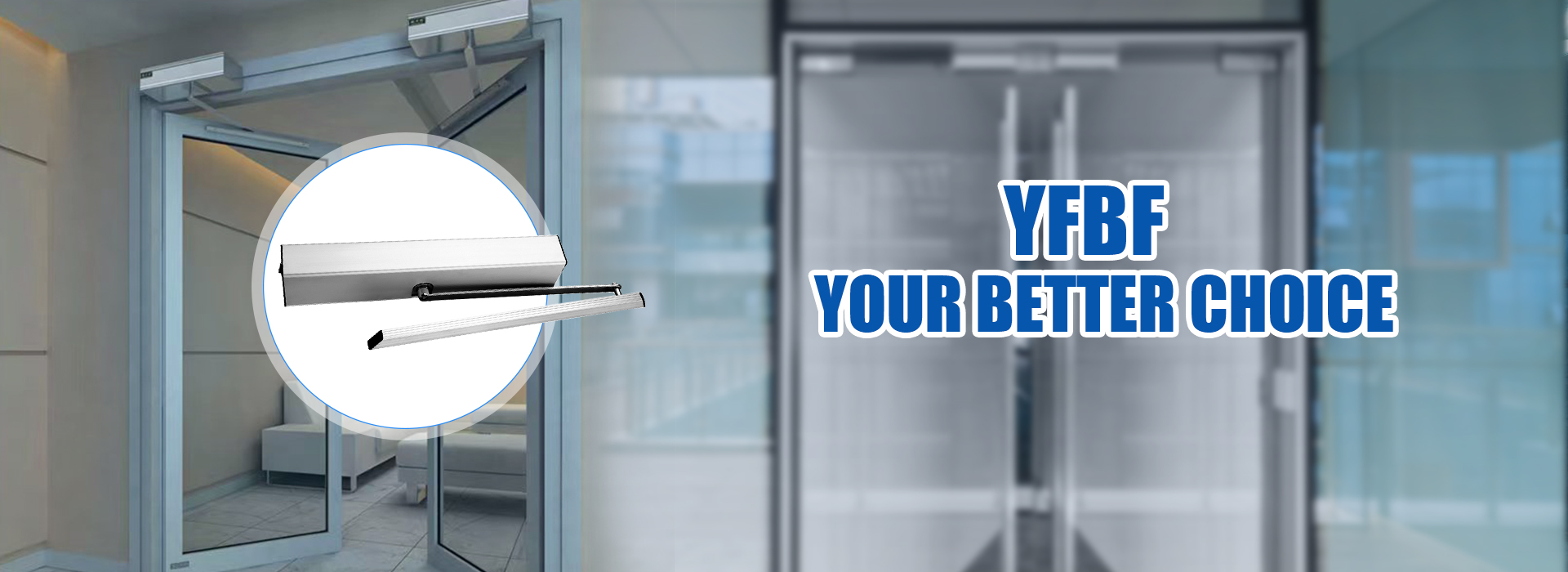

- Use a swing operator for hinged doors when you want automation without changing the door form factor.
- Glass door automation is common in offices, clinics, and showrooms, but the door closer, hinges, and glass thickness must be verified first.
- Traffic frequency, opening force, and access-control integration should drive selection more than price alone.
- For retrofit projects, compatibility and maintenance access matter as much as speed and appearance.
An automatic swing door operator is a practical answer for office entrance upgrades, glass door automation, and retrofit access control because it automates an existing hinged leaf instead of replacing the entire doorway; in barrier-free design, that matters because accessible entrances should avoid excessive opening force and provide clear usable width, while door hardware must still meet performance and safety requirements such as the 1.5 lbf maximum opening force for interior hinged doors in ADA scoping guidance and 30 in minimum clear width requirements in many access routes under the 2010 ADA Standards for Accessible Design. For engineered door systems, dimensional consistency also matters, which is why manufacturers and installers often reference ISO 230-1:2022 for machine-tool-style measurement discipline in precision environments and use tested hardware tolerances during commissioning. For product navigation, see automatic swing door operator, automatic sliding door operator, and automatic door accessories for the main system blocks that influence project fit.
Automatic swing door operator basics: what it does and why it fits retrofit entrances
The clearest way to define an automatic swing door operator is as a powered door-opening and door-closing system designed for a hinged leaf.
Unlike a standalone motor, the operator usually combines drive, control logic, and linkage so the door can open, hold, and close with repeatable motion.
This integrated approach is why engineers often prefer an operator over a bare motor in project delivery.
In practical terms, the operator reduces manual effort, improves traffic flow, and makes a conventional hinged door usable for staff, visitors, patients, and delivery users who may have limited mobility or hands full of equipment.
The most common decision point is not whether the door can be automated, but whether the existing hinge geometry, leaf size, and duty cycle can support automation safely and quietly.
| Decision factor | Why it matters | Typical project check |
|---|---|---|
| Door type | Determines linkage and motion path | Single-leaf or double-leaf hinged door |
| Leaf weight | Affects motor load and wear | Verify against operator rating |
| Leaf width | Impacts opening force and clear width | Measure actual free swing width |
| Traffic frequency | Sets thermal and mechanical duty | Estimate cycles per day |
| Access control | Drives wiring and logic needs | Card reader, push button, sensor, or remote module |
For many building owners, the biggest advantage is retrofit efficiency.
A swing operator can often be installed on an existing glass door or framed door with less civil work than a sliding conversion, which helps preserve storefront appearance and reduce downtime.
That is why the office entrance and lobby retrofit market is so active.
Which door types suit an automatic swing door operator best?
The best door types for an automatic swing door operator are hinged doors with stable mounting points, predictable clearance, and manageable resistance.
That includes many single-leaf and double-leaf entry doors, internal partition doors, and glass doors used in offices, clinics, and commercial interiors.
The door material matters, but the structural support matters more.
A beautiful glass door can still be a poor candidate if the frame, hinge line, or floor clearance cannot handle repeated automated movement.
| Door type | Suitability | Typical scenario | Main caution |
|---|---|---|---|
| Single-leaf hinged door | High | Office entrance, internal corridor | Check hinge strength and leaf weight |
| Double-leaf hinged door | High | Lobby, clinic, hotel side entrance | Confirm coordination if both leaves automate |
| Framed glass door | High | Showroom, office lobby, retail front | Verify glass thickness and mounting method |
| Wooden entrance door | Medium to high | Internal office, back office access | Inspect warping and door closer resistance |
| Heavy fire-rated door | Project-specific | Controlled access zones | Must follow code and approved hardware set |
Glass door automation deserves special attention because the material is visually attractive but mechanically sensitive.
On framed glass doors, the operator must work with the existing door closer, pivot, hinge, and sometimes access-control lockset.
On frameless or semi-frameless designs, installation details become even more important because load transfer points are concentrated.
If the wrong bracket or reinforcement is used, the system may run smoothly at first and then develop drift, vibration, or closure inconsistency after repeated cycles.
That is why glass door operator solutions are usually selected alongside the exact door construction, not after the fact.
When is a swing operator better than a sliding door system?
An automatic swing door operator is better than a sliding system when the entrance already uses a hinged leaf, the available wall side space is limited, or the project needs a lower-disruption retrofit.
Sliding doors are often preferred for high-volume commercial entrances, but they require lateral space, overhead support, and a different opening geometry.
Swing systems are often the smarter choice when the doorway is narrow, the architectural design must remain unchanged, or the client wants a fast upgrade to an office entrance.
In commercial projects, this choice often comes down to entrance behavior rather than aesthetics alone.
| Comparison point | Swing operator | Sliding operator |
|---|---|---|
| Best fit | Existing hinged doors | New or redesigned entryways |
| Retrofit complexity | Lower | Higher |
| Wall-space demand | Low | High |
| Typical use | Office entrance, clinic, internal access | Hospital main lobby, mall entrance, high-traffic public entry |
| Architectural change | Minimal | Moderate to major |
The operational difference is also visible in traffic handling.
A sliding system is usually the better answer for very high pedestrian volumes, while a swing operator is often enough for moderate traffic where a door must still feel familiar to users.
For office buildings, that familiarity can improve user acceptance because visitors intuitively understand how a hinged door functions, even after automation.
What scenarios make automatic swing door operator selection the right call?
The right scenarios are those where accessibility, image, and controlled traffic matter more than ultra-high throughput.
That is why office entrances, healthcare rooms, commercial side doors, and glass front entries are common use cases.
In these environments, the door is part of the customer experience, not just a barrier.
For example, a reception lobby with a glass door automation upgrade can feel more professional, reduce staff interruptions, and support visitors carrying bags, folders, or mobility aids.
In clinics and rehabilitation spaces, the ability to open smoothly and consistently is more important than raw speed.
In retail back entrances, reliability and quick release for staff access can be the main requirement.
- Office entrance: balances appearance, access control, and visitor convenience.
- Clinic or medical room: emphasizes smooth opening, low effort, and reliable closure.
- Showroom or storefront: highlights glass door automation and brand image.
- Internal corridor: improves staff flow and hands-free operation.
- Barrier-free route: supports mobility access and code compliance.
According to the U.S. Access Board’s 2010 ADA Standards for Accessible Design, doorway clear width and maneuvering clearance are critical design constraints, which means project teams should not treat the operator as a cosmetic add-on.
Instead, they should confirm how the automation affects usable opening width, latch side clearance, and approach path before installation.
For reference, the official standards and guidance can be reviewed at the U.S. Access Board door guidance and the 2010 ADA Standards for Accessible Design.
How to choose an automatic swing door operator for office entrance and glass door automation
The right operator is selected by load, geometry, duty cycle, and integration requirements, not by catalog headline alone.
Many project errors happen because teams match the operator to the door visually instead of measuring the real installation conditions.
The result is often slow movement, excessive noise, incomplete opening, or repeated service calls.
A disciplined selection process usually starts with four numbers: door weight, door width, expected cycle count, and available mounting space.
From there, the control method and accessory list can be finalized.
| Selection input | What to measure | Why it matters |
|---|---|---|
| Door weight | Actual leaf mass | Determines torque reserve |
| Door width | Leaf clear width in mm or in | Influences opening force and geometry |
| Cycles per day | Low, medium, or high use | Impacts motor heat and wear |
| Mounting space | Header depth and side clearance | Controls installation feasibility |
| Control interface | Sensor, push button, card reader, remote | Defines wiring and logic |
For office entrance projects, the most common need is quiet, predictable movement with access-control compatibility.
That usually means pairing the operator with a motion sensor, push plate, card reader, or remote module depending on security policy.

For glass door automation, the installer should also inspect glass thickness, frame reinforcement, and hinge wear before commissioning.
If those points are ignored, the operator may technically run but fail to deliver acceptable long-term performance.
For a broader system view, many engineers also review automatic door operator options and related door control system components to match the entrance logic end to end.
Performance benchmarks that matter in automatic swing door operator projects
Performance should be evaluated by repeatability, not just by whether the door opens.
For a commercial entrance, users notice cycle smoothness, opening speed, and close consistency long before they notice power rating.
In precision environments, companies often borrow the discipline of ISO-style measurement practices to reduce installation variability and verify alignment, clearance, and motion consistency during commissioning.
On the standards side, ISO 21904-1:2020 is not a door standard, but it illustrates how industrial systems increasingly rely on quantified control, while ANSI/BHMA A156.19 is the widely recognized standard for power assist and low energy power operated doors in North America, including performance and safety requirements for opening speeds and force limits.
That standard is relevant because many automatic swing door operator projects are effectively low-energy or power-assist applications.
For engineers who want a cross-check on access-compliance logic, the standards page at ANSI and the product standard framework in BHMA are useful starting points.
| Benchmark area | What to track | Why it matters in the field |
|---|---|---|
| Opening cycle time | Seconds per open-close sequence | Affects user wait time |
| Opening force | Measured at the leaf | Impacts accessibility and comfort |
| Noise level | Subjective and measured | Important in offices and clinics |
| False activation rate | Sensor-trigger frequency | Controls nuisance openings |
| Service interval | Planned maintenance period | Reduces downtime and emergency calls |
In practice, the best-performing projects are the ones with clean alignment, correct accessory selection, and a maintenance schedule from day one.
That is especially true for glass doors, where small mounting errors can turn into visible operational problems.
Access control, safety, and maintenance: the hidden reasons projects succeed or fail
The operator is only one part of the system, and most failures come from integration problems rather than motor failure alone.
When a swing door is tied to card access, push buttons, sensors, or remote controls, the logic must be clear about when the door opens, how long it stays open, and how it closes after passage.
That is why door control system planning should happen with the security team, not only with the installer.
In healthcare and office buildings, this also affects privacy and traffic separation.
For example, a reception door may need motion activation during business hours but card-only access after hours.
Maintenance is the other hidden variable.
High-cycle entrances need periodic checks on fasteners, hinges, linkage wear, sensor alignment, and backup release behavior.
For replacement work, automatic door parts availability is important because compatibility issues can extend downtime far beyond the original fault.
- Check hinge looseness and floor drag before assuming the operator is faulty.
- Confirm sensor coverage to avoid nuisance activation or missed presence detection.
- Verify access-control logic after any firmware or wiring change.
- Keep spare brackets, belts, and control accessories for fast recovery.
Maintenance frequency should increase if the entrance sees heavy daily use, since wear is cumulative and often invisible until the first service disruption.
In commercial buildings, that hidden downtime can cost more than the operator itself.
Common mistakes when specifying an automatic swing door operator
The most common mistake is selecting by door appearance instead of actual operating load.
Another frequent error is ignoring the difference between a door motor and a complete operator assembly, which leads to incomplete control or poor integration.
Teams also underestimate the impact of door closer resistance, hinge condition, and glass mounting detail.
Those variables can make a nominally suitable operator feel weak in the field.
- Choosing the wrong door category for the application.
- Skipping a site measurement of weight, width, and clearance.
- Overlooking access-control wiring and fail-safe logic.
- Assuming a glass door will behave like a framed metal door.
- Delaying maintenance planning until after commissioning.
A disciplined specification process avoids most of these issues.
It also makes it easier for contractors, owners, and maintenance teams to speak the same language during handover.
That shared language is especially important in office entrance work, where the client may care most about appearance while the installer is focused on hardware fit and the maintenance team is focused on serviceability.
How to decide quickly: a practical selection checklist
The fastest way to decide whether an automatic swing door operator is suitable is to test the project against a short checklist.
If most answers are yes, the system is usually a good fit.
- Is the entrance already a hinged door?
- Can the leaf and frame support repeated automated cycles?
- Is the traffic volume moderate rather than extreme?
- Do you need a retrofit with limited architectural change?
- Will the door connect to access control or sensor logic?
- Is glass door automation part of the design goal?
- Can maintenance access be preserved after installation?
If the answer to several of these is no, a sliding door system or another entrance solution may be better.
That is not a failure of the swing operator; it simply means the use case is different.
The best entrance technology is the one that matches how people actually move through the building.
FAQ
What door types are most suitable for an automatic swing door operator?
Single-leaf hinged doors, double-leaf hinged doors, and many framed glass doors are the most common fits because they already use swing motion and can often be automated with limited structural change.
Is glass door automation safe for office entrances?
Yes, if the glass construction, hinge support, installation hardware, and access-control logic are verified before commissioning, and the system is configured to meet the applicable door safety and accessibility rules.
When should I choose a swing operator instead of a sliding operator?
Choose a swing operator when the door is already hinged, retrofit disruption must stay low, and traffic volume is moderate rather than extremely high.
What matters most when selecting an automatic swing door operator?
Door weight, door width, cycle frequency, hinge condition, available mounting space, and control integration are the most important selection factors.
Can an automatic swing door operator work with access control systems?
Yes, it is commonly paired with card readers, push buttons, sensors, remote controls, and other door control system devices.
Why do some glass door automation projects fail early?
They often fail because the glass mounting, reinforcement, closer resistance, or hinge alignment was not checked carefully enough before installation.
What maintenance does an automatic swing door operator need?
Typical maintenance includes checking fasteners, hinges, sensors, linkage wear, control logic, and replacement part availability to reduce downtime and preserve smooth motion.

David Chen
Post time: Jul-21-2026