
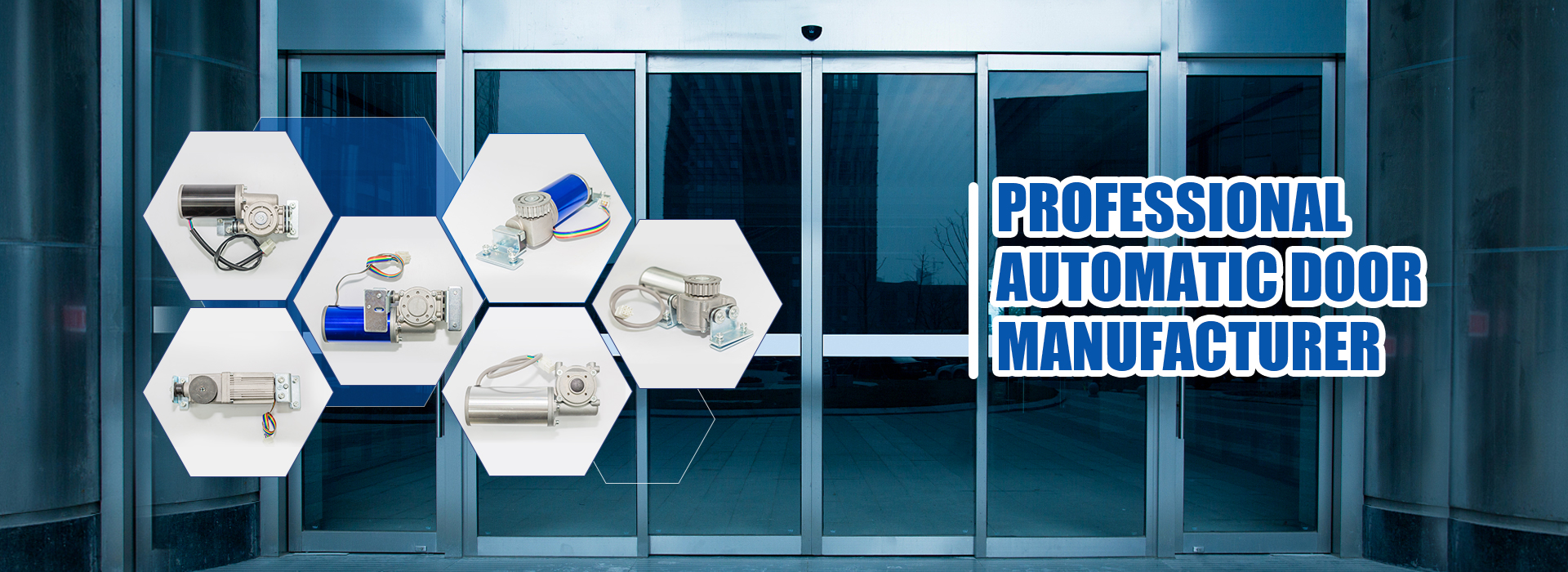
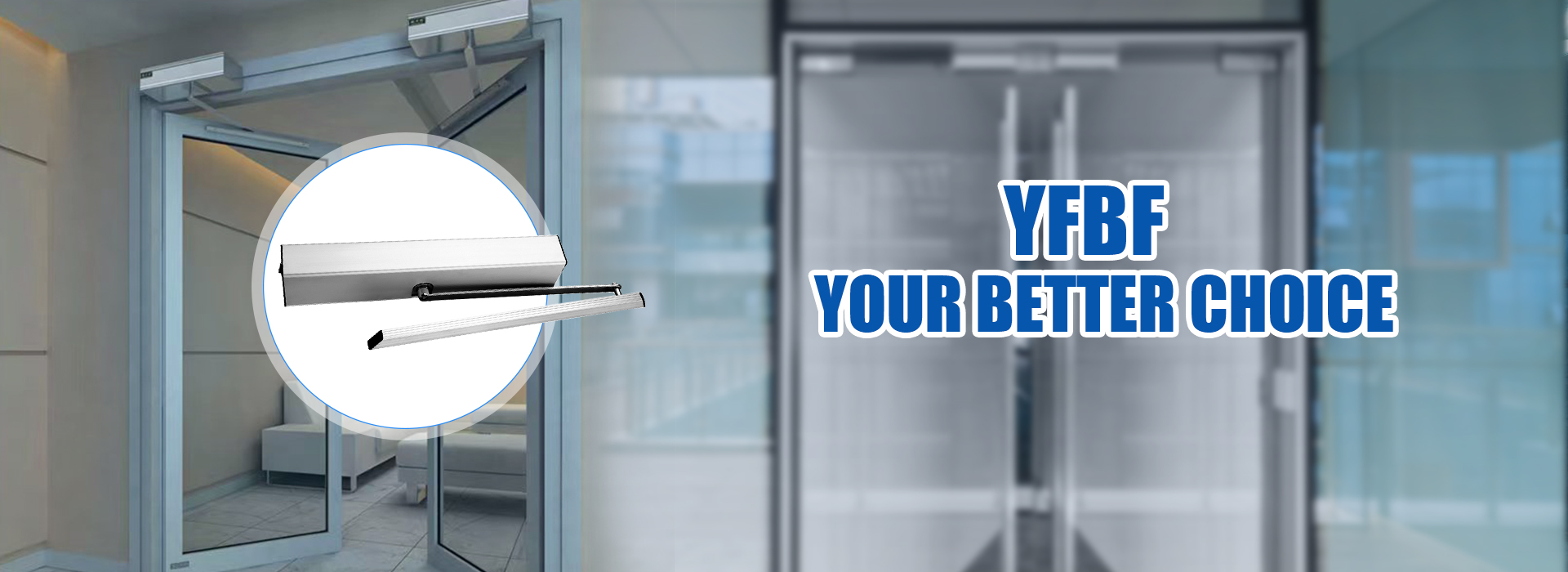
This guide is written for architects, facility managers, and procurement officers who are specifying an automatic door in a North American commercial, healthcare, retail, or public facility and need a single document that ties ANSI/BHMA A156.10, UL 325, NFPA 101, and the ICC A117.1 accessibility standard into a defensible spec. The recommendations are drawn from the published Beifan automatic swing door opener and the YFSW200 automatic swing door operator product line, with the relevant international standards referenced at the end of the article.

TL;DR — The Headline Requirements
- Cycle life: 1,000,000 full open-and-close cycles without failure of the operator mechanism, the control circuit, or the entrapment protection function.
- Low-energy vs full-energy: Low-energy doors open with kinetic energy below 1.25 ft-lbf and breakaway at 50 lbf. Full-energy doors open with kinetic energy above 1.25 ft-lbf and require the full entrapment protection package.
- Entrapment protection: Required on every power-operated pedestrian door. Three technology options: presence sensor at the closing edge, contact-sensitive edge, or photoelectric beam.
- Safety reversing: Required on contact. The door must reverse within the tested time-and-distance profile when the entrapment protection device is triggered.
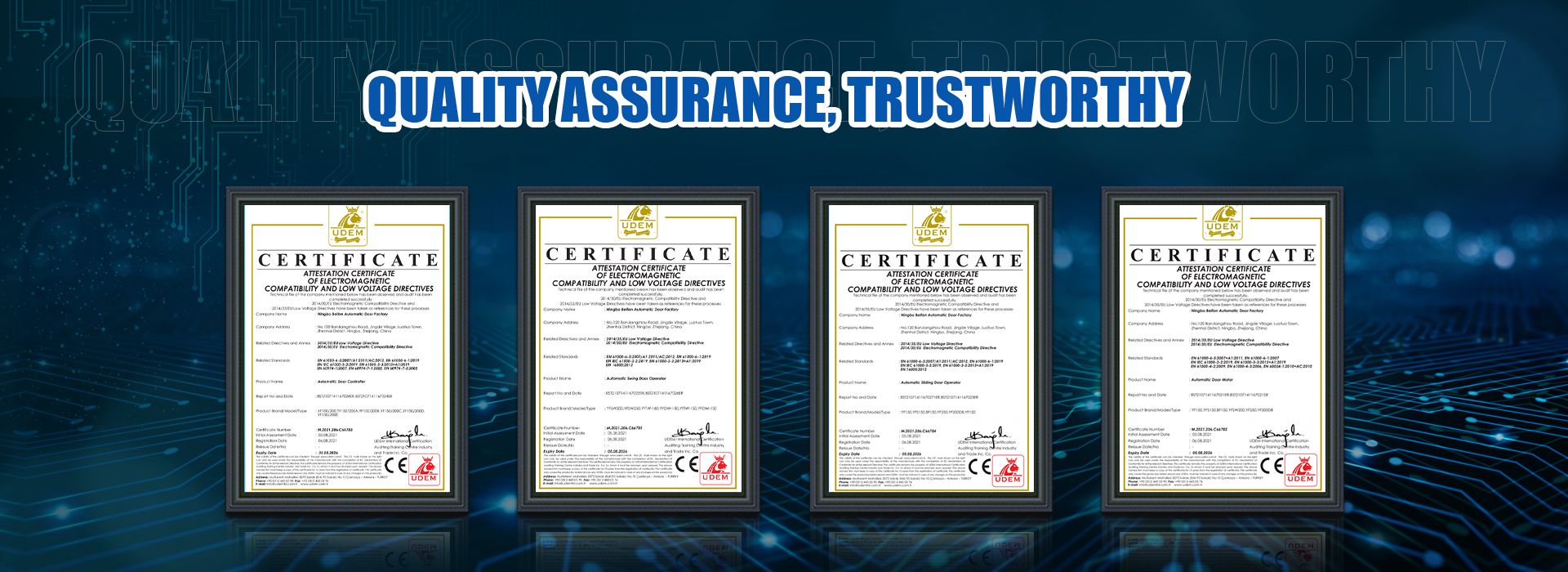
- Certification: Third-party test report from an NRTL (typically UL Solutions) and an annual follow-up service program.
- Related standards: UL 325 (electrical safety), NFPA 101 (life safety code), ICC A117.1 (accessibility), ADA Title III (civil rights).
These are the headline requirements. The remainder of the article explains each line in detail, with the relationship to the related standards, the procurement spec for an automatic swing door operator, and the common non-conformances on a first-time North American installation.
What ANSI/BHMA A156.10 Actually Tests
ANSI/BHMA A156.10 is the product performance standard, and it has four headline test categories: the mechanical life test, the opening and closing force test, the entrapment protection test, and the safety reversing test. Each test is run on a production-intent unit, in a third-party test laboratory, with the manufacturer supplying the technical file and the test laboratory verifying the as-tested configuration.
The mechanical life test is 1,000,000 full open-and-close cycles. The test is run at the rated cycles per day for the operator (typically 300 to 1000 cycles per day for commercial installations), and the operator is monitored throughout the test for any failure of the operator mechanism, the control circuit, or the entrapment protection function. A failure of any of the three components during the test invalidates the test and requires a design change and a re-test. 1,000,000 cycles corresponds to roughly 3 to 5 years of typical commercial service, and the operator is rated for a service life of 10 to 15 years at typical commercial cycle rates.
The opening and closing force test measures the static force the operator applies to the door leaf at the start of the opening cycle and at the end of the closing cycle. For a low-energy door, the opening force must be below 50 lbf, which is the threshold for a manual breakaway in the event of a power failure. For a full-energy door, the opening force is typically in the 15 to 30 lbf range, but the operator is allowed to apply the higher force because the door is paired with the full entrapment protection package. The closing force must be below 30 lbf at any point in the closing cycle, and the door must slow to a controlled stop before reaching the fully closed position.
The entrapment protection test verifies the response of the entrapment protection device. The test is run with a force gauge applied to the closing edge of the door, and the operator must reverse the door within the tested time-and-distance profile when the force exceeds the threshold. The threshold is typically 18 lbf for the contact-sensitive edge, and the reverse time must be below 2.0 seconds. A door that does not reverse on contact, or that reverses but takes more than 2.0 seconds, fails the test and is not A156.10 compliant.
The safety reversing test verifies the operator's response to a sustained obstruction. The test is run by placing a 1.5-inch by 1.5-inch obstruction in the closing path of the door, and the operator must reverse the door on contact and must not re-close while the obstruction is in place. The re-open time must be below 2.0 seconds, and the door must remain in the open position for at least 5 seconds after the obstruction is removed before re-closing.
Low-Energy vs Full-Energy — Which Class Does Your Door Fall Into?
The A156.10 standard defines two application classes for automatic swing doors, and the class is the first procurement decision an architect or facility manager makes. The class is based on the opening kinetic energy, not the opening force, and the threshold is 1.25 ft-lbf of opening kinetic energy at the door leaf tip.
A low-energy automatic swing door has an opening kinetic energy of 1.25 ft-lbf or less, which is the threshold for a manual breakaway under a static force of 50 lbf. The manual breakaway is the safety feature that allows a person to push the door open by hand in the event of a power failure, and it is the gating requirement for a low-energy door. The entrapment protection on a low-energy door is typically a single presence sensor at the closing edge. Low-energy doors are the standard choice for accessible single entrances in healthcare, office, and retail where the door is primarily used as an accessible entrance rather than as a high-traffic flow control.
A full-energy automatic swing door has an opening kinetic energy above 1.25 ft-lbf and requires the full entrapment protection package (presence sensors at the closing edge, reversing on contact, and the safety sensor at the swing path). Full-energy doors are the choice for airport terminals, hotel lobbies, hospital emergency departments, and convention centers where the door cycles more than 100,000 times per year and the manual breakaway would be impractical. The full-energy class is the higher-cost class, both because the operator is larger and because the entrapment protection package is more comprehensive.
The YFSW200 automatic swing door operator from Beifan is a mid-range operator that is rated for a maximum door weight of 200 kg per leaf and a door leaf width of up to 1300 mm, with an adjustable opening speed of 150 to 450 mm/s and an adjustable closing speed of 100 to 430 mm/s. The 24V 60W brushless DC motor is in the low-energy class by default, but the adjustable speed and the 24V backup battery option make it suitable for both low-energy and full-energy installations depending on the activation and safety sensor package. The operating temperature range of -20°C to +70°C covers most commercial and public facility installations worldwide.
The Three Standard Frameworks
Three categories of standards govern a power-operated pedestrian door in a North American commercial or public facility. A procurement spec that omits any one of the three will fail a building permit review or an accessibility compliance review.
The first is the product standard. ANSI/BHMA A156.10 is the product performance standard. It is developed jointly by the American National Standards Institute (ANSI) and the Builders Hardware Manufacturers Association (BHMA), and it is the standard that the third-party test laboratory references in the certification test report. The current edition is widely cited by architects and code officials as the gating standard for automatic door certification in the United States, with parallel Canadian recognition through the National Building Code of Canada.
The second is the electrical safety standard. UL 325 is the Underwriters Laboratories standard for door, drapery, gate, louver, and window operators and systems. It is the electrical safety standard that covers the electric shock hazard, the fire hazard, the entrapment hazard, and the energy hazard of the operator mechanism. UL 325 is typically required by the local building code (the International Building Code in the United States, the National Building Code of Canada in Canada), and a door that is not UL 325 listed is not eligible for the building permit in most jurisdictions.
The third is the building code and accessibility overlay. NFPA 101 (the Life Safety Code) governs the egress side of the door, the clearances, and the panic-hardware interfaces. ICC A117.1 (Accessible and Usable Buildings and Facilities) governs the activation sensor heights (typically 34 to 48 inches above the floor for the actuator button, with clear floor space at the actuator). The Americans with Disabilities Act (ADA) Title III is the civil rights regulation that references ICC A117.1 and NFPA 101 for the technical criteria. A door that meets A156.10 and UL 325 but does not satisfy the ICC A117.1 activation sensor heights or the NFPA 101 egress clearances is not legally compliant in a North American public facility.
For the United States, the regulatory chain is the IBC (International Building Code) → ANSI/BHMA A156.10 + UL 325 (product and safety) → NFPA 101 (egress) + ICC A117.1 (accessibility) → ADA Title III (civil rights). For Canada, the chain is the National Building Code of Canada → CAN/CSA B72 (the Canadian equivalent of UL 325) → NFPA 101 (often adopted by reference) + accessibility standards adopted by each province.
Specification Matrix — How the Standards Stack
| Requirement line | ANSI/BHMA A156.10 (product) | UL 325 (electrical safety) | NFPA 101 / ICC A117.1 (building / accessibility) |
|---|---|---|---|
| Scope | Operator mechanism, control circuit, entrapment protection, safety sensors | Electric shock, fire, entrapment, energy hazards of the operator | Egress clearances, panic-hardware interface, activation sensor heights |
| Mechanical life test | 1,000,000 full open-and-close cycles | Not specified (covered by A156.10) | Not specified |
| Opening kinetic energy limit (low energy) | 1.25 ft-lbf | Not specified (covered by A156.10) | Not specified |
| Manual breakaway force (low energy) | 50 lbf maximum | Not specified (covered by A156.10) | Not specified |
| Entrapment protection | Required (presence sensor / contact edge / photo beam) | Required for entrapment hazard | Not specified (covered by A156.10 + UL 325) |
| Safety reversing on contact | Required, reverse within 2.0 seconds | Required for entrapment hazard | Not specified |
| Activation sensor height | Not specified | Not specified | ICC A117.1: 34 to 48 inches above floor for forward approach |
| Egress clearance | Not specified | Not specified | NFPA 101: 32 inches minimum clear opening width for new construction |
| Panic hardware interface | Not specified | Not specified | NFPA 101: required at egress side for certain occupancies |
| Operating temperature | Test at manufacturer's rated range | Not specified (covered by A156.10) | Not specified |
| Operating noise | Tested per A156.10 (typically below 65 dBA at 1 m) | Not specified | Not specified |
| Power supply (typical) | 120 VAC input, 24 VDC to motor | Per UL 325 listed power supply | Per local electrical code |
| Third-party certification | Required (NRTL test report) | Required (UL or cULus listing) | Not required (verified at plan review) |
These are the published and observed lines across the North American power-operated pedestrian door landscape. Actual limits vary by product class, by operator type, and by the local building code amendments. The third-party test report from the NRTL is the authoritative reference for the test plan, and the building permit review at the local jurisdiction is the authoritative reference for the in-service compliance.
Entrapment Protection — The Three Technology Options
ANSI/BHMA A156.10 gives the manufacturer the choice of three entrapment protection technologies, and the choice has a real impact on the in-service reliability and the maintenance cost.
The first is the presence sensor at the closing edge. This is a photoelectric or radar-based sensor that detects a person or object in the door path and reverses the door before contact. The sensor is typically mounted on the header of the door, with the detection zone covering the closing edge and the swing path. The presence sensor is the most common technology for low-energy and full-energy automatic swing doors, and it is the technology that most architectural specifications require by default.
The second is the contact-sensitive edge. This is a pressure-sensitive strip mounted on the leading edge of the door leaf, and the operator reverses the door on physical contact. The contact-sensitive edge is typically used as a backup to the presence sensor on full-energy doors, and it is required by some local building codes for high-traffic installations. The contact-sensitive edge has the disadvantage of requiring the door to make contact before reversing, which means a small amount of force is applied to the person or object in the door path before the reverse is triggered.
The third is the photoelectric beam. This is a through-beam or retroreflective photoelectric sensor that detects a person or object in the door path. The photoelectric beam is typically used on automatic sliding doors, and it is less common on automatic swing doors because the swing path is more complex than the slide path. A photoelectric beam is typically used as a backup to the presence sensor on automatic swing doors that have a clear swing path.
For a low-energy automatic swing door, a single presence sensor at the closing edge is typically sufficient. For a full-energy automatic swing door, the standard typically requires both a presence sensor and a contact-sensitive edge. A door that does not have any entrapment protection device is not A156.10 compliant and is not eligible for the third-party certification listing.
How to Specify an Automatic Swing Door to ANSI/BHMA A156.10 — A Six-Step Workflow
For an architect or facility manager specifying a power-operated pedestrian door in a North American commercial or public facility, the conversation collapses to six questions.
- Confirm the application class — low energy vs full energy. Confirm whether the door is low energy (less than 1.25 ft-lbf opening kinetic energy, manual breakaway at 50 lbf) or full energy (greater than 1.25 ft-lbf, full entrapment protection package). The application class drives the testing scope, the entrapment protection scope, and the cost.
- Confirm the door type, weight, and leaf width. Confirm the door type (single leaf, double leaf, single acting, double acting), the door weight per leaf, the door leaf width, and the available mounting surface (push side, pull side, header, transom). These drive the operator sizing and the mounting hardware.
- Confirm the activation and safety sensor package. Confirm the activation sensors (push button, presence sensor, radio control, access control, fire alarm interface) and the safety sensors (the ANSI A156.10 required presence sensor at the closing edge to detect entrapment, the swing-path overhead sensor, the approach sensor on the secure side).
- Lock the certification and listing program. Lock the certification program: ANSI/BHMA A156.10 third-party test report (1,000,000-cycle test, opening/closing force test, entrapment protection test), UL 325 listing of the complete operator assembly, ICC A117.1 compliance evidence for the activation sensor height, NFPA 101 compliance evidence for the egress side clearances, and the local building code review.
- Confirm the installation program and the commissioning checklist. Confirm the installation program: the wiring diagram, the control box location, the power supply (typically 120 VAC for North American, 24 VDC to the operator motor), the fire alarm interface for emergency release, and the commissioning checklist that documents the as-installed opening/closing time, force, and sensor coverage.
- Confirm the maintenance and inspection program. Confirm the maintenance program: the recommended inspection interval (typically semi-annual for high-traffic commercial, annual for low-traffic public), the documented safety sensor check, the documented entrapment protection test, and the recommended replacement parts inventory. ANSI/BHMA A156.10 requires the operator to maintain the tested performance over the 1,000,000-cycle life, which is achievable with preventive maintenance on a documented schedule.
The most common non-conformance on a first-time North American installation is the activation sensor height. ICC A117.1 requires the actuator button to be 34 to 48 inches above the floor for forward approach, and 36 to 48 inches for side approach. A door that is installed with the actuator at 30 inches above the floor passes the A156.10 product test but fails the accessibility review, and the local building inspector will not issue the certificate of occupancy until the actuator height is corrected.
FAQ
What is ANSI/BHMA A156.10, and what products does it cover?
ANSI/BHMA A156.10 is the American National Standard for Power-Operated Pedestrian Doors, developed jointly by the American National Standards Institute (ANSI) and the Builders Hardware Manufacturers Association (BHMA). It is the product standard that covers the mechanical, electrical, and safety performance requirements for automatic sliding doors, automatic swinging doors, automatic folding doors, and low-energy automatic doors used in commercial buildings, public facilities, and industrial sites. A door that meets ANSI/BHMA A156.10 is typically listed by a third-party certification body such as UL Solutions, and the listing mark is applied to the operator and the documentation.
What is the difference between a low-energy and a full-energy automatic swing door under A156.10?
Under ANSI/BHMA A156.10, a low-energy automatic swing door has an opening kinetic energy of 1.25 ft-lbf or less, which is the threshold for a manual breakaway under a static force of 50 lbf. A full-energy automatic swing door has an opening kinetic energy above 1.25 ft-lbf and requires the full entrapment protection package (presence sensors at the closing edge, reversing on contact, and the safety sensor at the swing path). Low-energy doors are the standard choice for accessible single entrances in healthcare, office, and retail. Full-energy doors are the choice for airport terminals, hotel lobbies, hospital emergency departments, and convention centers.
What is the cycle test requirement in ANSI/BHMA A156.10?
The cycle test in ANSI/BHMA A156.10 requires the operator to complete 1,000,000 full open-and-close cycles without failure of the operator mechanism, the control circuit, or the entrapment protection function. The test is run at the rated cycles per day for the operator, typically 300 to 1000 cycles per day for commercial installations. 1,000,000 cycles corresponds to roughly 3 to 5 years of typical commercial service, and the operator is rated for a service life of 10 to 15 years at typical commercial cycle rates.
Does ANSI/BHMA A156.10 require a presence sensor, or is it optional?
ANSI/BHMA A156.10 requires an entrapment protection device on every power-operated pedestrian door. The standard gives the manufacturer the choice of three entrapment protection technologies: a presence sensor at the closing edge that detects a person or object in the door path, a contact-sensitive edge that reverses the door on physical contact, and a photoelectric beam that reverses the door when the beam is broken. For a low-energy automatic swing door, a single presence sensor at the closing edge is typically sufficient. For a full-energy automatic swing door, the standard typically requires both a presence sensor and a contact-sensitive edge.
What is the relationship between ANSI/BHMA A156.10 and UL 325?
ANSI/BHMA A156.10 is the product performance standard for the door and the operator mechanism. UL 325 is the product safety standard for the electrical operator assembly, covering the electric shock hazard, the fire hazard, the entrapment hazard, and the energy hazard. Both standards are typically required for a North American power-operated pedestrian door, and the third-party certification body (typically UL Solutions) verifies both in a combined test program. The two standards are complementary, not redundant.
What is the typical opening time and force for an A156.10 automatic swing door?
Under ANSI/BHMA A156.10, the opening time for a low-energy automatic swing door is typically 1.5 to 3.0 seconds from the activation signal to the fully open position, and the closing time is typically 4.0 to 7.0 seconds. The opening force is typically 15 lbf (well below the 50 lbf low-energy threshold), and the closing force is typically 8 to 12 lbf. For a full-energy automatic swing door, the opening time is typically 0.8 to 1.5 seconds, and the closing time is typically 1.5 to 3.0 seconds. The YFSW200 automatic swing door operator, for example, has an adjustable opening speed of 150 to 450 mm/s and an adjustable closing speed of 100 to 430 mm/s, with a hold-open time of 0.5 to 10 seconds and a 24V 60W brushless DC motor.
How Beifan Supports the North American Automatic Door Spec
For an architect, facility manager, or procurement officer specifying a power-operated pedestrian door for a North American commercial or public facility, the A156.10 spec is part of a larger UL 325 + NFPA 101 + ICC A117.1 documentation package. The Beifan (Ningbo Yufan Beifan Automatic Door Co., Ltd.) engineering team supports the spec with the third-party test report, the UL 325 listing documentation, the activation and safety sensor package design, and the installation commissioning checklist. The automatic swing door opener and YFSW200 automatic swing door operator product lines cover the 200 kg per leaf / 1300 mm leaf width / -20°C to +70°C range that is the typical scope for a North American commercial or public facility, and the FAQs page documents the procurement-side questions on lead time, MOQ, and payment terms for OEM/ODM custom solutions. The contact page is the entry point for an A156.10 / UL 325 spec package and a project-specific quotation.