
Five accessory families carry an automatic door programme. Two of them decide how the door behaves after the installer leaves. Here is the stock list, the published specifications behind each item, and the questions to settle before you put a quantity on a purchase order.
By Edison · Sales Manager, Ningbo Yufan Beifan Automatic Door Co., Ltd. · Published 13 November 2026 · 11 min read · Last verified: 2026-11-13
TL;DR
- The published automatic door accessories range is five families: the M-254 infrared motion and presence safety sensor, the M-218D safety beam sensor, the M-204G microwave motion sensor, the five-key function selector, and the M-203E remote controller.
- The two units that carry a distributor programme are the M-203E remote controller and the five-key function selector, because they are the only accessories that change what the door does rather than what it detects.
- One remote replaces a wall switch that an installer would otherwise fit. The five-key selector gives automatic, half open, full open, unidirectional and full lock on one rotary knob.
- The M-203E learns up to sixteen transmitter codes by self-coding. Learning takes one second, deleting takes five, and deleting clears every code at once because codes cannot be removed individually.
- The sensors are the replacement business. They are mounted in traffic, they are the part most likely to be swapped on a service visit, and each carries a published detection geometry you can quote without guessing.
The five accessory families that actually sell in volume
An automatic door operator is only one third of the system. The other two thirds are the sensors that tell it somebody is there, and the control accessories that tell it what to do about it. Those are the parts a distributor stocks, and they are the parts an installer runs out of on a Friday afternoon.
Our published automatic door accessories range is five families, and they divide cleanly by what they do. The M-254 infrared motion and presence safety sensor, the M-218D safety beam sensor and the M-204G microwave motion sensor are detection. The five-key function selector and the M-203E remote controller are control.
That division matters for stock planning, because the two groups behave differently in a warehouse. Sensors are sold per opening and replaced on a service cycle. Control accessories are sold per installation and often as an upgrade rather than a spare. A distributor who stocks only sensors will lose the project to a competitor who stocks the switch and the handset.
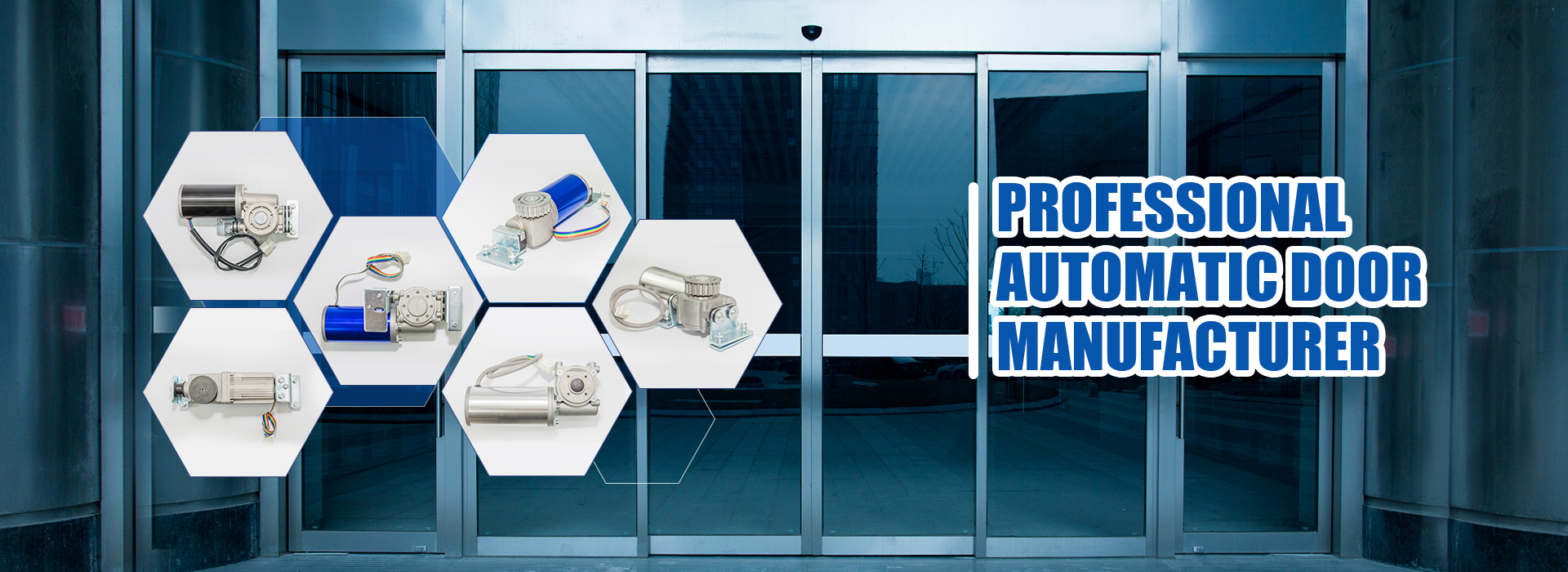
One further point about range. We manufacture the sliding door operators and 24V brushless DC door motors in-house, and the accessories are built to the same door units. That is the argument for stocking them together.
What each family does at the door
The three sensors are not interchangeable, and the difference is in the published numbers. The M-254 is the only one of the three that detects presence as well as motion, which is what a door that has to stop on an obstruction needs. It integrates both in one infrared unit, with a background self-learning capability that compensates for vibration and gradual shifts in light. Its published detection range is 1600 millimetres wide by 800 deep, with 1 line for presence using 4 emitters and 16 spots, and 3 lines for motion using 12 emitters and 48 spots. Response is under 100 milliseconds, it draws 30 mA static and 110 mA in action at DC 12V, and the body is 229 by 67 by 41 millimetres with a 2.5 metre cable.
The M-218D is a safety beam, and its job is a matched transmitter and receiver pair rather than a detection field. Published maximum matched distance is 10 metres, with 5.5 metre leads on both sides. It runs on AC or DC 12 to 30V, draws 18 mA static and 58 mA in action, and the output is a normally open or normally closed contact selected by a dial switch.
The M-204G is the microwave option. Published frequency is 24.125 GHz with transmitting power below 20 dBm EIRP, and detection is 4 metres by 2 metres at an installation height of 2.2 metres. Minimum detection speed is 5 centimetres per second, the figure that decides whether it sees a slow-moving wheelchair user. The relay output is COM and NO with no initial potential, maximum 1 A, maximum 30V AC or 60V DC.
The three sensors cover three different failure modes, and a distributor who stocks one has a gap. The M-254 answers presence and safety, the M-218D answers the fixed opening and the door closing on an obstruction, and the M-204G answers detection through a doorway where the field cannot be narrowed.
The two units that turn a door into a managed entrance
The five-key function selector is the wall-mounted unit that sets the operating mode. Published behaviour across its five positions is the whole reason it exists.
In automatic mode, internal and external sensors are effective and the electric lock is not locked. In half open, all sensors stay effective but each induction opens the door only to the half position before closing back, which needs a half-open function on the door unit. In full open, the sensors and the access control devices all go invalid and the door stays fully open without closing back. In unidirectional, the external sensor goes invalid and the lock closes automatically, while the external access controller and internal sensor stay effective, so only staff enter by card and people can still leave. In full lock, everything is invalid, the lock closes, and nobody enters or exits.
Those five modes cover the working day of almost any building, and each one is a deliberate state rather than a fault. That is the argument for stocking the selector: a door whose mode is documented is a door that behaves.
The M-203E remote controller does the same job from a handset. It is an extender: all induction gated signals are unified into the extender, which outputs the signal to the door and the electric locks, with a time difference setting. Its four transmitter keys are A for full lock, B for unidirectional, C for full open and D for bi-directional.
Published power figures are AC/DC 12 to 36V, taken from the door unit, with a 3 ampere electric lock output at 12V, 35 mA static power, 85 mA action current for a non-current electric lock, and a 0.5 second interval between unlocking and starting the door. Transmitting and receiving is microwave level with a roller code. Transmitter battery life is published as 18000 presses, the working range is -42 to 45 degrees Celsius, and the body measures 123 by 50 by 32 millimetres. A built-in surge absorber protects against the lock return spark, and a memory function means a power cut does not leave the door undefined.

Stocking mix, replacement rates and what to promise your installer
Here is how the mix behaves in practice, and the reason to think about it before the first purchase order rather than after the first shortfall.
Sensors are the consumable. They are mounted in traffic at the top of a door frame, and they are the part most likely to be swapped on a service visit. A distributor who sells operators to a maintenance team will be asked for a sensor before an operator, because the operator lasts and the sensor does not.
Control accessories are the upgrade. A five-key selector is a single unit per entrance, and an M-203E is a single unit plus however many transmitters the building manager wants. That makes them low volume and high value, and it means they are sold on a conversation rather than a catalogue. The published self-coding procedure supports up to sixteen transmitter codes in one receiver, which is a number worth knowing before a customer asks how many handsets one unit covers.
Two things change the replacement calculation. The M-254 self-learns its background, so it tolerates site conditions that defeat a fixed-beam installation. The M-218D output is a selectable normally open or normally closed contact, so it drops into an existing door controller without rewiring the panel.
Promise your installer the mode behaviour, not just the part. The published mode table for both control units is the same document your installer will need on site. A distributor who supplies that table with the goods removes the most common source of a Monday morning callback: a handset left on the wrong key and nobody able to say what the door was doing on Saturday night.
Ordering from a factory and what to test on arrival
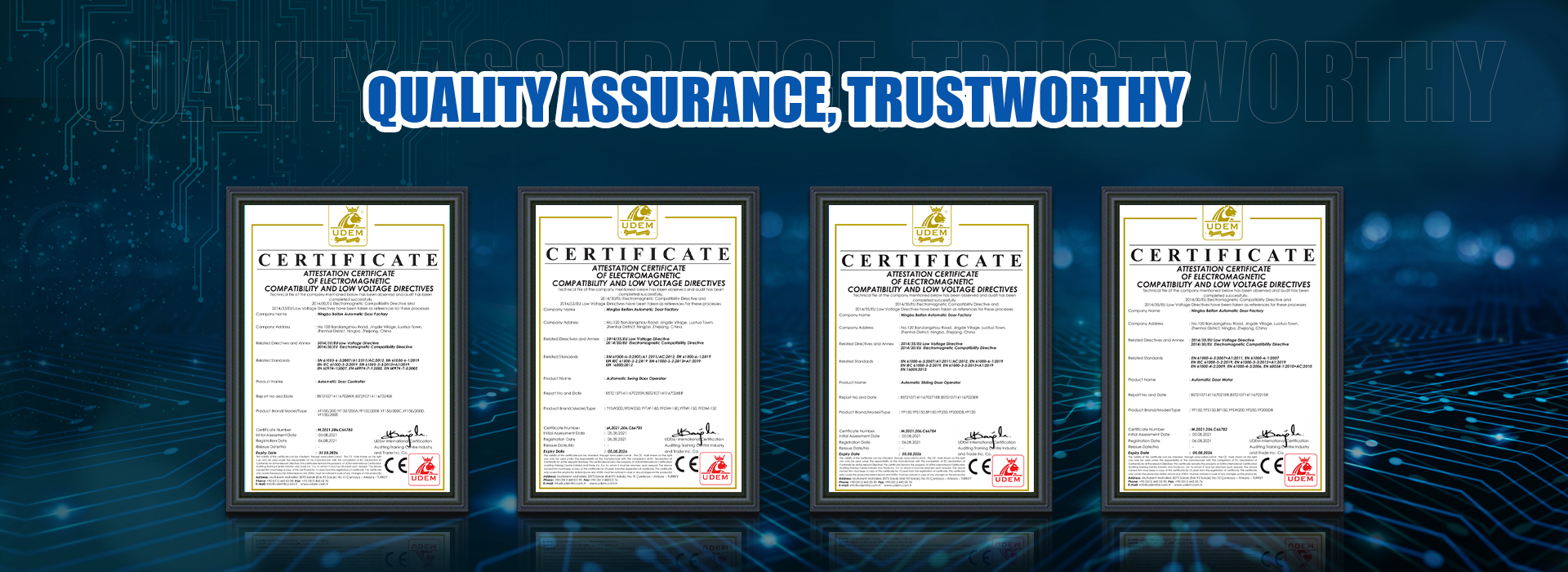
Our published commercial terms are worth putting in the same conversation as the accessory list. Samples are about 7 days. Mass production is 20 to 30 days after the deposit. Payment is 30 percent deposit in advance and 70 percent balance against the copy of the bill of lading. For international orders we require an ongoing minimum order quantity, and we can provide documentation including certificates of analysis or conformance, insurance and origin papers.
Lead time only becomes effective when two things have happened: the deposit has arrived and we have your final approval on the product. That is worth flagging to a customer who thinks a purchase order starts the clock.
What to test on arrival matters more for accessories than for operators, because the failure modes are specific and they are all checkable on a bench. For the M-203E, confirm that the learn button responds at one second with a green indicator, that a transmitter key is confirmed by two flashes, and that holding it for five seconds clears every code. Confirm the mode behaviour of each key against the published table before the handset leaves the building. For the M-254, check the dip switch setting, the field adjustment on the inner and outer lines, and the indicator colours: standby green, motion yellow, presence red. For the M-218D, confirm the receiving head fault alarm function and that the beam is aligned. For the M-204G, stand outside the detection field for 10 seconds after power-up so the sensor finishes its self-adjustment, then set the sensitivity knob.
One commissioning point applies across the range and is the one most often missed. The external and internal probes must not be powered from the M-203E extender. They connect to the probe terminals on the door unit itself. And the DC regulator output current has to exceed the action current of the electric lock, or the lock will not release cleanly. Write both of those into your commissioning checklist and you will remove the most common field failure on a control accessory.
If you want the specification documents behind any of this, or a noise test report on a particular operator before you commit a project, send us the door width, the leaf mass, the target market and the opening type.
Send your stock list and we will send the specification pack
If you are building an accessory programme for a distributor network or a project pipeline, send us the openings per year, the mix of new build against retrofit, the target markets and the door operators you already run. We will come back with the published specification for each accessory family, the commissioning points your installer needs, and the documentation set for the certification scope your market requires.
request a noise test report or a spec pack or review the automatic door accessories range first.
Frequently Asked Questions
Which automatic door accessories should a distributor stock first?
Start with the three sensors, because they are sold per opening and replaced on a service cycle, and they are the part most likely to be swapped on a maintenance visit. The M-254 infrared motion and presence sensor is the highest specification, the M-218D safety beam covers fixed openings, and the M-204G microwave sensor covers doorways where the field cannot be narrowed.
What is the difference between the M-254 and the M-204G sensor?
The M-254 is infrared and detects both motion and presence, with a published 1600 by 800 millimetre field and response under 100 milliseconds. The M-204G is microwave at 24.125 GHz with a 4 by 2 metre field at 2.2 metres installation height and a minimum detection speed of 5 centimetres per second. Presence detection is the practical difference, because a door that must stop on an obstruction needs to know something is still in the field.
How many remote transmitters can one M-203E receiver hold?
Up to sixteen transmitter codes can be learned into one receiver by self-coding. Learning takes one second with the indicator turning green, and deleting takes five seconds and clears every code at once, because codes cannot be removed individually.
Can the five-key selector and the M-203E remote be used on the same door?
Yes, and they are commonly specified together on a door that needs both a fixed wall position and a handheld override. The five-key selector gives the building a permanent mode position, while the M-203E lets an authorised person change it temporarily. The published mode table is the same in both cases.
Do I need to worry about radio regulations for the M-203E transmitter?
It is a microwave-level transmitter working with a roller code, so the relevant regime is the radio frequency device framework for the market the units ship into, such as 47 CFR Part 15 in the United States. The published specification also gives the transmitter battery life as 18000 presses.
What is the lead time on automatic door accessories?
Samples are about 7 days and mass production is 20 to 30 days after the deposit, on 30 percent deposit and 70 percent balance against the copy of the bill of lading. Lead time becomes effective once the deposit has arrived and we have your final product approval.
About the author
Edison is Sales Manager at Ningbo Yufan Beifan Automatic Door Co., Ltd., a manufacturer of automatic door systems including sliding door operators, 24V brushless DC door motors and accessories.
Ningbo Yufan Beifan Automatic Door Co., Ltd. specializes in automatic door system R&D and manufacturing. Core products include automatic sliding door operators, 24V brushless DC door motors, and accessories, widely used in commercial buildings, public facilities, and industrial sites. Edison manages global project inquiries and OEM/ODM custom solutions for distributors and project procurement clients worldwide.
For a specific automatic door project, contact Edison and the Ningbo Yufan Beifan team with the clear opening width, the leaf mass, the target market and the operating modes you need.
Standards cited for the compliance scope only: UL 325, EN 16005 and 47 CFR Part 15.
Related pages: the accessories range, the M-203E product page and the five-key selector page.
Last verified: 2026-11-13 · Accessory specifications reviewed against manufacturer product documentation on 13 November 2026.
Post time: Nov-13-2026