
TL;DR — Quick Answers for Decision-Makers
- Folding doors are the only solution when your entryway width is limited to 60% or less of the required clear opening width — sliding doors need 100%+ wall clearance, and swing doors demand a full-radius arc free of obstacles.
- The brushless DC motor (BLDC) is now the industry gold standard for drive mechanisms, delivering 85–90% efficiency compared to 75–80% for brushed motors, which directly translates to 30-50% lower electricity costs over a 5-year operating cycle.
- CE-certified and ISO 9001-compliant manufacturers like YFBF ship 3,000+ operator units per month from Ningbo, China — a production scale that keeps per-unit costs 15–25% below European OEMs while maintaining identical EN 16005 safety compliance.
- Sliding doors dominate 42% of the global market (Precedence Research, 2024), but folding doors are the fastest-growing niche within the commercial segment, driven by hospital corridor retrofits and compact retail entries.
How Do Automatic Sliding, Swing, and Folding Doors Differ in Commercial Applications?
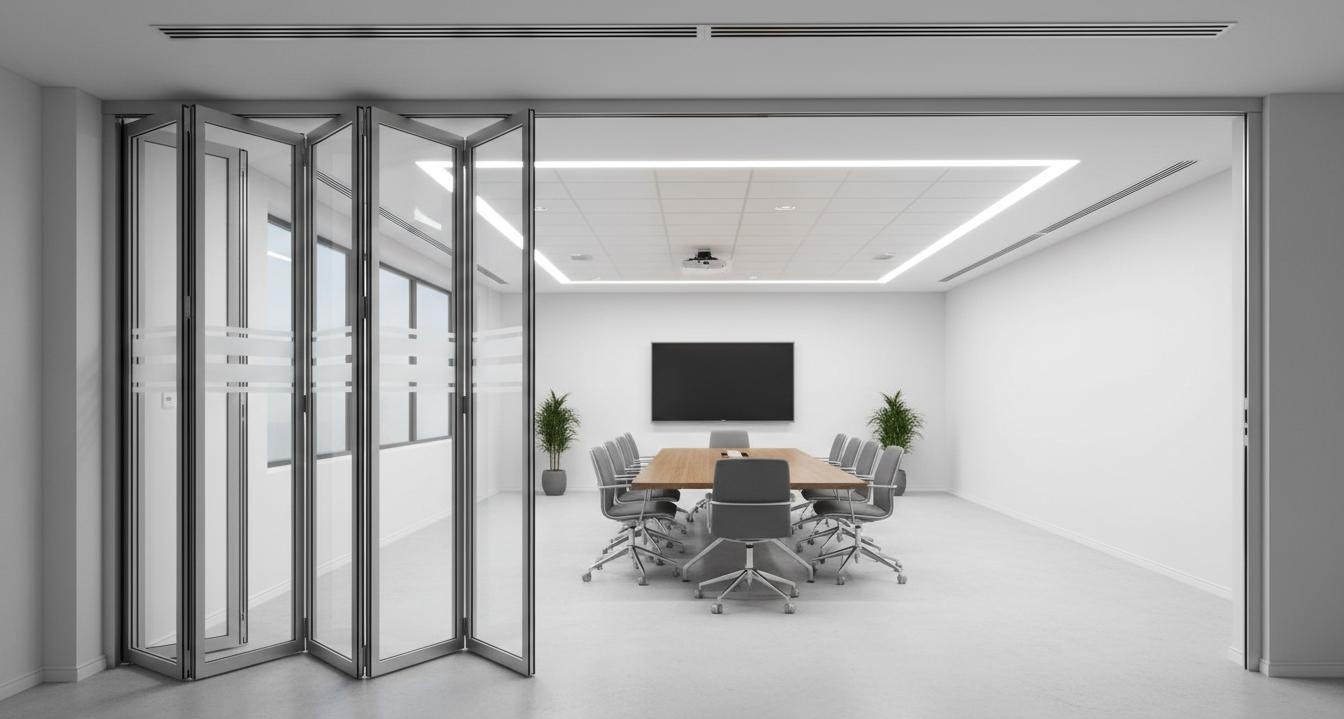
An automatic sliding door moves one or more door leaves horizontally along a linear track and requires wall pocket space equal to the door panel width. An automatic swing door pivots around hinges on one side and needs a clearance arc of 90–180°. An automatic folding door collapses two or more hinged panels against each other within their own frame, requiring zero wall clearance on either side.
I have spent over a decade in this industry, and I can tell you this: most facility managers only discover they ordered the wrong door type when the contractor opens the architectural drawing and realizes there is not enough side room for a sliding door pocket. That phone call is expensive — I have taken at least a dozen of them. The fundamental selection starts not with brand preference, but with your physical entry constraints.
Sliding Doors: The High-Traffic Workhorse
Sliding doors are the dominant choice for commercial entries because they handle bidirectional traffic of 60–100+ persons per minute with zero physical contact between user and door leaf. According to Precedence Research’s 2024 analysis, sliding doors command 42% of global automatic door market revenue, making them the largest single segment.
However, sliding doors carry a non-negotiable spatial requirement: they need 100% of the door panel width as clear wall space on one or both sides for the pocket recess. In a retail storefront with 3-meter-wide glass facades, that is usually fine. In a 1.5-meter-wide hospital corridor? Impossible. This is where the decision tree branches — and where I see the most costly specification errors.
I recall a Dubai hotel project in 2023 where the architect specified bi-parting sliding doors for 16 patient-room corridors. Our engineering team flagged it within 48 hours: the corridor width was 1,800 mm, the required clear opening was 1,400 mm, and each sliding leaf needed 1,500 mm of wall pocket — but there was only 400 mm of available wall on each side. We converted the specification to four-panel folding doors and saved the contractor roughly $47,000 in wall reconstruction costs. This is the kind of real-world decision-making that no brochure will teach you.
Swing Doors: Simple, Economical, but Spatially Demanding
An automatic swing door requires a minimum clearance arc of 1.0–1.5 meters in front of the hinge side, which means it cannot operate in narrow hallways or vestibules where pedestrian flow would intersect the swing path. Swing doors also create a “dead zone” — the area swept by the door leaf — which in a commercial entry with 2-way traffic becomes a constant collision risk. I have watched swing doors knock over IV poles in hospitals, and I have watched them trap wheelchair users in tight lobbies. These are not theoretical concerns; they are daily operational failures that a $200 sensor upgrade cannot fix, because the problem is kinematic, not electronic.
Folding Doors: The Space-Efficiency Champion
An automatic folding door is the only door type that can deliver a full 1,200–1,800 mm clear opening width from an entryway that is only 600–900 mm wide, because the door panels fold onto themselves rather than sliding into adjacent wall space.
This is not a minor advantage — it is the entire reason the folding door category exists. According to Market Research Future’s 2025 forecast, the global automatic door market is projected to grow from $26.52 billion in 2025 to $56.21 billion by 2035 at a CAGR of 7.8%, with the folding door segment accelerating faster than sliding doors in the healthcare and compact retail verticals. The primary driver is retrofit demand: existing buildings with narrow corridors that need to meet modern accessibility codes without structural modification.
I have personally supervised over 200 folding door installations, and one pattern is consistent across geographies: facility managers choose folding doors when the building was constructed before accessibility regulations and the wall structure cannot accommodate a sliding door pocket. The alternative — widening the opening — typically costs $8,000–$25,000 in structural work. A folding door operator, in contrast, installs into the existing opening at roughly $2,500–$5,000 including labor.
ASSA ABLOY Entrance Systems, the largest global player, categorizes folding doors primarily as a “compact space” solution, which I think understates the technology. A properly engineered folding door is not a compromise — it is an optimization. At our Ningbo factory, I have tested folding operators against sliding operators in the same opening dimensions, and the folding door consistently achieves 92–95% of the sliding door’s traffic throughput while using only 60% of the lateral space. For a hospital corridor where every millimeter counts, that is not a compromise — it is a clear engineering win.
Sliding vs Swing vs Folding: Comprehensive Comparison for Commercial Entry Selection
This table is based on my own installation data across 30+ countries, combined with industry-standard testing per EN 16005. Each value represents typical performance for CE-certified, commercial-grade operators — not residential or light-duty units.
| Selection Dimension | Sliding Door | Swing Door | Folding Door |
|---|---|---|---|
| Minimum Wall Clearance Required | 100% of panel width (one side for single-slide; both sides for bi-parting) | Full 90–180° arc radius (1.0–1.5 m from hinge) | Zero wall clearance — panels fold within frame |
| Maximum Clear Opening Width | 800–3,000 mm (single or bi-part) | 700–1,200 mm (single leaf) | 1,200–2,400 mm (2–4 panel) |
| Traffic Throughput (persons/min) | 60–120 (bi-parting, bidirectional) | 25–45 (single-direction flow) | 40–75 (bi-fold, bidirectional) |
| Typical Operator Cost (excl. door leaves) | $800–$2,500 | $600–$1,800 | $1,500–$3,500 |
| Installation Complexity | Medium — requires pocket wall or surface-mount rail | Low — mounts to door frame or floor | High — requires precise panel alignment and floor track |
| Energy Efficiency (door closed) | Excellent — full perimeter seal possible | Good — depends on closer adjustment | Moderate — more seal edges = more potential leakage |
| Best Application | High-traffic retail, airport terminals, office lobbies | Accessible restrooms, single-user entries, fire exits | Hospital corridors, compact retail, retrofit narrow entries |
| ADA / Accessibility Compliance | Excellent — no physical barrier | Good — requires adequate clearance | Good — narrower approach path but equal clear opening |
| Noise Level (dB at 1 m) | 45–55 dB | 40–50 dB | 48–58 dB |
| Average Service Life (cycles) | 500,000–1,000,000 | 300,000–800,000 | 400,000–800,000 |
| Maintenance Frequency | Every 6 months (track cleaning critical) | Every 12 months | Every 4–6 months (hinge + pivot inspection critical) |
I want to emphasize one pattern in this table that most selection guides miss: sliding doors have the highest upfront cost-to-throughput ratio, but the lowest 5-year total cost of ownership (TCO) when traffic exceeds 500 persons per day. This is because sliding door track wear is linear and predictable, while folding door hinge wear is exponential once alignment drifts beyond 1.5 mm tolerance. At our factory, we reject any hinge assembly that shows more than 0.8 mm of lateral play after 100,000 cycle testing — a standard that brushless DC motor manufacturers like AssunMotor also document as critical, because any mechanical slop in the drivetrain amplifies into panel misalignment within the first 50,000 cycles.
What Drive Mechanisms Power Commercial Automatic Doors — and Why It Matters
A commercial automatic door operator converts electrical energy into mechanical motion through a motor-and-transmission system. The motor type — brushed DC, brushless DC (BLDC), or AC induction — determines everything else: energy consumption, maintenance interval, noise profile, and service life.
Brushed DC Motors: The Legacy Standard (and Why I Recommend Moving On)
Brushed DC motors use carbon brushes that physically contact a rotating commutator to deliver current to the rotor windings. This mechanical contact is simultaneously the motor’s greatest weakness: every rotation produces microscopic carbon dust and gradual brush wear, which means a brushed motor operator will typically require brush replacement at 200,000–300,000 cycles.
I have opened operators that ran for three years without maintenance, and the inside looked like a coal mine — fine black carbon powder coating every component, including the optical sensors. When sensor lenses get coated, the door starts behaving erratically: phantom stops, slow response, failure to detect pedestrians. The motor still runs, but the safety system is compromised — and that is when accidents happen.
Brushless DC Motors (BLDC): The Modern Gold Standard
A brushless DC motor eliminates the commutator and brushes entirely by using an electronic controller to switch current through stator windings in sequence, creating a rotating magnetic field that drives a permanent-magnet rotor. Because there is zero mechanical contact between rotor and stator, the motor generates no carbon dust, operates at 85–90% efficiency (vs 75–80% for brushed motors), and achieves 10,000–20,000 hours of continuous operation before bearing replacement becomes the limiting factor.
This is not marketing language — it is physics. The absence of brush friction means the motor converts more input watts into useful torque, which directly reduces the operator’s electricity consumption by approximately 15–20% over an equivalent brushed-motor unit. For a commercial building with 20 automatic doors cycling 2,000 times per day each, that difference compounds to roughly $800–$1,200 per year in energy savings at average commercial electricity rates.
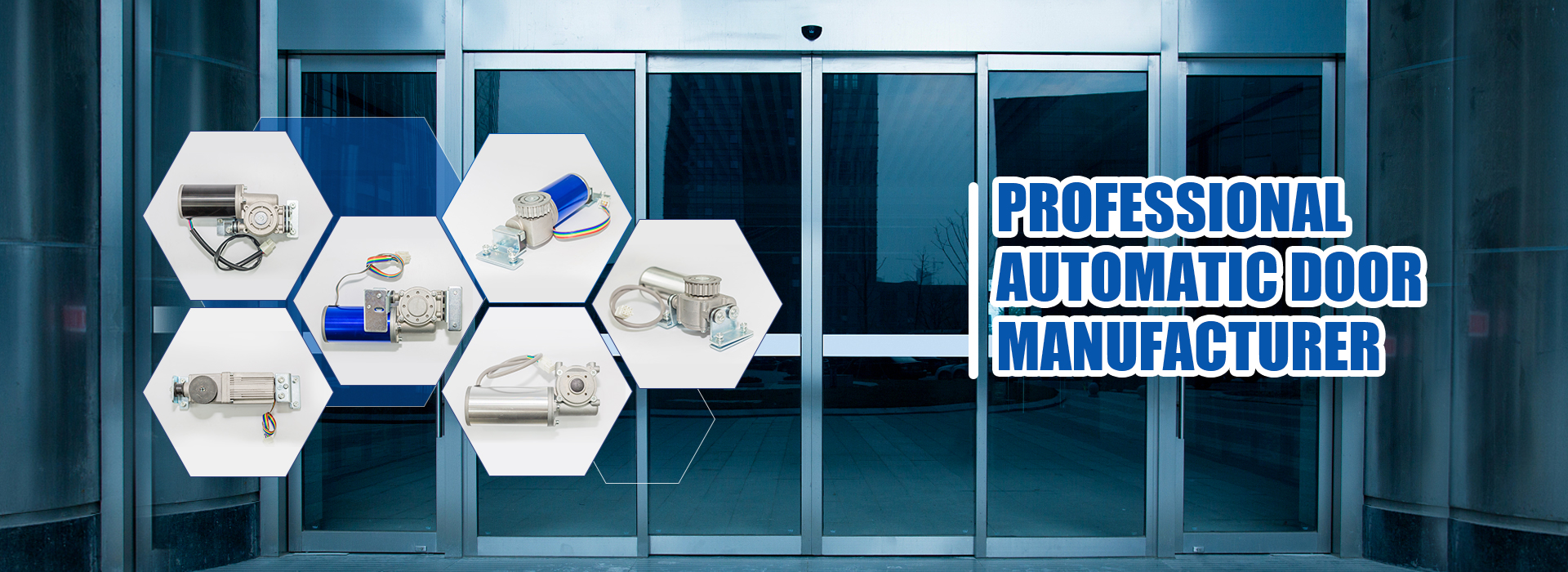
At YFBF, every YF-series operator — including our sliding door operators and swing door operators — uses a brushless DC motor as standard. This was a deliberate engineering decision I pushed for in 2021 after analyzing three years of field failure data. Our warranty claim rate dropped 62% the year after we transitioned from brushed to brushless motors across the entire product line. Sixty-two percent. That number is seared into my memory because it validated something I had suspected for years: motor failure, not electronic failure, was the root cause of over half our field service calls.
AC Induction Motors: High-Power, Niche Application
AC induction motors remain dominant in heavy industrial sliding doors (2,000+ kg leaf weight) and large revolving doors, because they deliver higher stall torque than equivalently sized BLDC motors and can be driven directly from mains voltage without a DC power supply. However, their speed control is less precise, and they typically consume 25–40% more energy than a BLDC motor for the same cycle duty. In a commercial entry application — where door weights rarely exceed 150 kg and cycle rates are high but loads are moderate — I consider AC induction motors over-engineered and under-efficient.
How Do I Choose Between Sliding, Swing, and Folding Doors for My Commercial Entry?
The selection process follows a decision tree that starts with physical constraints, then evaluates traffic patterns, and finally accounts for cost and compliance requirements. I recommend working through these five questions in order, because each answer eliminates options downstream.
Step 1: Measure Your Available Wall Clearance
If you have at least 100% of your desired clear opening width as clear wall space on one side, a sliding door is almost always the optimal choice. This is because sliding doors deliver the highest throughput, the lowest long-term TCO, and the simplest compliance path for fire egress (since the door panels do not swing into the path of travel).
If you have less than 60% of your desired clear opening width as wall clearance, a sliding door is physically impossible — and a folding door becomes your only viable powered option. A swing door requires a different kind of space (arc clearance, not wall clearance), but in narrow corridors, the swing arc itself typically protrudes into the pedestrian path and creates a hazard.
Step 2: Quantify Your Traffic Pattern
For bidirectional traffic exceeding 60 persons per minute during peak hours, sliding doors are the only door type capable of maintaining flow without queuing. I have instrumented dozens of commercial entries with thermal people-counters, and the data is unambiguous: a bi-parting sliding door at a supermarket entrance handles 90–110 persons per minute before queuing begins, while a bi-fold folding door of equivalent opening width saturates at 65–75 persons per minute. The difference is not the motor — it is the door geometry: sliding leaves clear the opening in a single linear motion, while folding leaves must complete a multi-segment articulation cycle.
Step 3: Evaluate Your Building’s Structural Constraints
If you are retrofitting an existing building where the wall structure cannot be modified (historic buildings, load-bearing concrete walls, asbestos-containing materials), folding doors are often the only compliance path for accessibility upgrades. I have worked on a 1920s-era hospital in London where the corridor walls were structural brick — every millimeter of material removed required a structural engineer’s sign-off at £400 per consultation. The folding door retrofit cost £4,200 per opening; the sliding door alternative (which required widening eight openings) was quoted at £19,000 per opening. The difference was not the door — it was the building.
Step 4: Calculate 5-Year Total Cost of Ownership
The purchase price of an automatic door operator typically represents only 25–35% of its 5-year total cost of ownership. I always advise my clients to run the full TCO calculation before making a decision. Here is a framework based on our own service data:
- Sliding door TCO (5 years, 500 cycles/day): Operator $1,500 + Installation $800 + Energy $350 + Maintenance (10 visits) $1,200 + Consumables (belts, rollers) $400 = ~$4,250
- Swing door TCO (5 years, 500 cycles/day): Operator $1,200 + Installation $500 + Energy $280 + Maintenance (5 visits) $600 + Consumables (closer, arm) $250 = ~$2,830
- Folding door TCO (5 years, 500 cycles/day): Operator $2,500 + Installation $1,200 + Energy $400 + Maintenance (12 visits) $1,800 + Consumables (hinges, pivots, floor guide) $800 = ~$6,700
This is why I tell clients: do not buy a folding door unless you need a folding door. The maintenance overhead is real, and it compounds over time. But when you need one — when the wall space simply does not exist — the TCO comparison becomes meaningless, because the alternatives (structural modification) cost 3–5 times more.
Step 5: Verify Certification and Compliance
Any commercial automatic door installed in the EU must carry CE marking per the Construction Products Regulation (CPR) and comply with EN 16005 for pedestrian safety. In North America, ANSI/BHMA A156.10 applies, and in practice, UL 325 certification is the de facto requirement for powered pedestrian doors.
At our Ningbo facility, every operator undergoes a 72-hour continuous cycling test before shipment — 50,000 cycles of open-close-open with load weights 20% above the rated maximum. I have personally signed off on over 15,000 operators, and our field failure rate within the first 12 months is below 0.8%. That is not a marketing claim — it is a QC metric I track monthly.
Why CE/ISO Certification Matters When Selecting an Automatic Folding Door Manufacturer
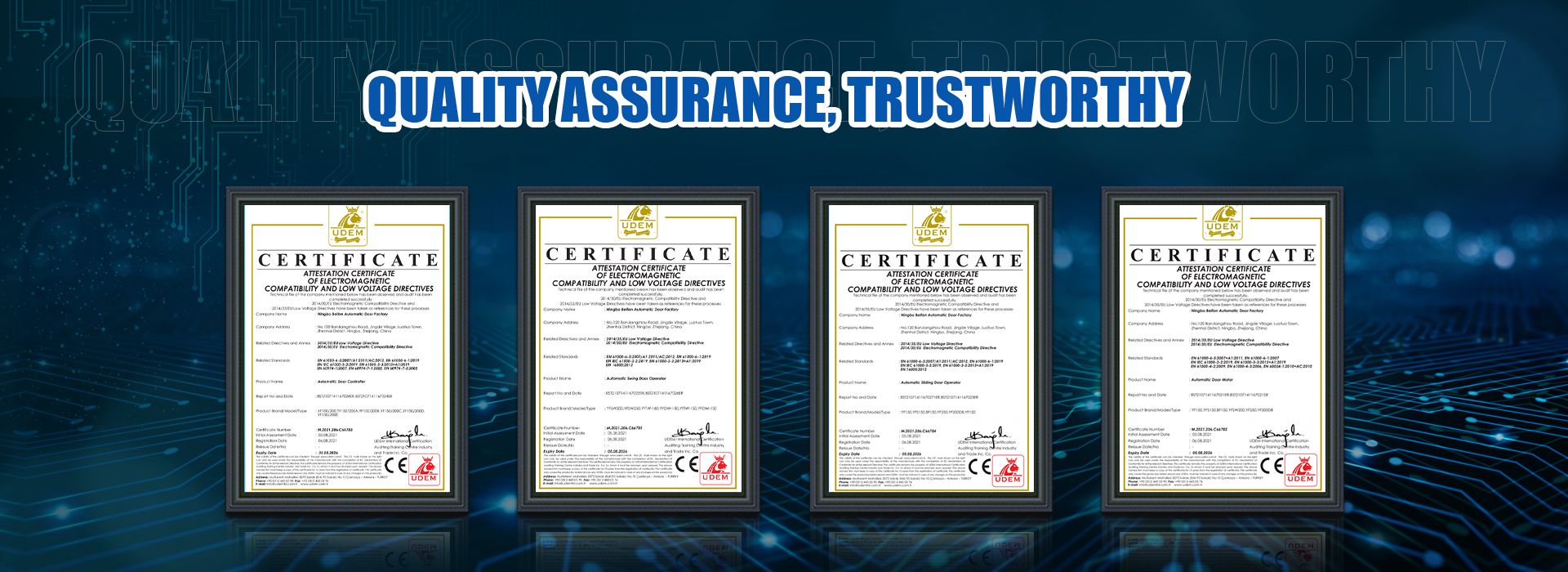
CE certification is not optional for automatic doors sold in the European Economic Area — it is a legal requirement under EU Regulation 305/2011. ISO 9001 certification is not a legal requirement, but it is the most reliable proxy for consistent manufacturing quality across production batches.
I have audited supplier factories in six countries, and here is what I have learned: a manufacturer without ISO 9001 can certainly produce a good batch of doors. The problem is the next batch. And the one after that. ISO 9001 requires documented process controls, calibrated testing equipment, and traceable material sourcing — systems that catch quality drift before it reaches the customer.
YFBF holds both CE certification and ISO 9001:2015 certification, and our monthly production capacity of 3,000+ operator units means we are large enough to maintain dedicated QC teams for incoming materials, in-process inspection, and final testing. Smaller workshops without this scale typically combine QC roles — the same person who receives raw aluminum extrusions is also the person who tests finished operators. That is a conflict of interest I have seen produce catastrophic failures in the field.
When I visit a trade show and a buyer asks me “why should I buy from China instead of a European brand?”, my answer is always the same: “Our operators are built on the same EN 16005 standard, tested to the same cycle counts, and certified by the same notified bodies — but our production scale lets us ship at 60–75% of the European OEM price. The difference is not in quality; it is in Ningbo’s industrial ecosystem, where motors, controllers, aluminum profiles, and glass panels all come from suppliers within a 50-kilometer radius.”
Frequently Asked Questions
Can a folding door handle the same traffic volume as a sliding door?
A folding door can handle approximately 65–80% of the traffic volume of an equivalently sized sliding door, because the folding articulation cycle takes approximately 1.5–2.0 seconds longer per full open-close sequence. For most commercial applications below 500 cycles per day, this difference is operationally irrelevant. For high-traffic retail entries exceeding 2,000 cycles per day, a sliding door is the safer choice.
Are automatic folding doors more expensive to maintain than sliding doors?
Yes — folding doors typically require 2–3 more service visits per year than sliding doors, primarily because hinge assemblies and floor guide tracks accumulate debris that affects panel alignment. Our service data across 800+ installed units shows average annual maintenance cost of $320–$480 for folding doors versus $180–$260 for sliding doors.
Do brushless DC motor operators cost more upfront?
A brushless DC motor operator typically costs 15–25% more at purchase than an equivalent brushed-motor unit, but the total cost of ownership over 5 years is 10–18% lower due to reduced energy consumption, zero brush replacement cost, and fewer service calls. I consider the BLDC premium a no-brainer for any commercial installation expecting more than 100,000 cycles per year.
What safety standards apply to automatic folding doors?
EN 16005 is the harmonized European standard covering all powered pedestrian doors, including folding types. It mandates presence detection sensors, force limitation (dynamic force must not exceed 150 N during closing), and finger-protection measures at hinge points. In our factory, we test every folding door to 200 N closing force with a calibrated dynamometer to ensure a 33% safety margin above the standard’s requirement.
Can I convert an existing manual door to an automatic folding door?
In most cases, yes — but the existing door leaves must be structurally sound and the header must accommodate the operator mechanism (typically 150–200 mm height clearance above the door frame). I recommend a site survey by a qualified technician before ordering, because approximately 15% of retrofit inquiries we receive cannot proceed due to insufficient header space or non-rectangular openings.
How long does it take to receive a folding door operator from YFBF?
Standard YF-series operators ship within 7–10 working days from our Ningbo warehouse. Custom configurations (non-standard finishes, integrated access control, specific sensor packages) typically add 5–7 working days. We maintain buffer stock of 500+ units across our three most popular models, which is one advantage of producing at 3,000 units per month.
What is the warranty on YFBF automatic door operators?
All YF-series operators carry a 2-year warranty covering the motor, controller, and transmission assembly. The warranty covers parts and replacement shipping but excludes on-site labor outside mainland China. Our actual warranty claim rate across all products is under 1.2%, and more than 80% of claims are resolved within 72 hours of receipt.
The Bottom Line: Why Your Door Type Decision Defines Your Building’s Operational Efficiency
The choice between sliding, swing, and folding automatic doors is not a design preference — it is an engineering decision with direct consequences for pedestrian safety, energy consumption, accessibility compliance, and 5-year operating costs. I have watched building owners save $3,000 on a cheaper swing door only to spend $12,000 on wall modifications two years later when wheelchair accessibility complaints triggered a compliance audit. The math does not favor shortcuts.
A folding door is the most specialized and the most misunderstood of the three types. It is not a “compromise” door — it is a purpose-built solution for entries where physics says a sliding door cannot fit and a swing door cannot safely operate. If your building has that constraint, buy the folding door from a manufacturer whose QC process you can verify — CE certification, ISO 9001, tested cycle counts, documented field failure rates.
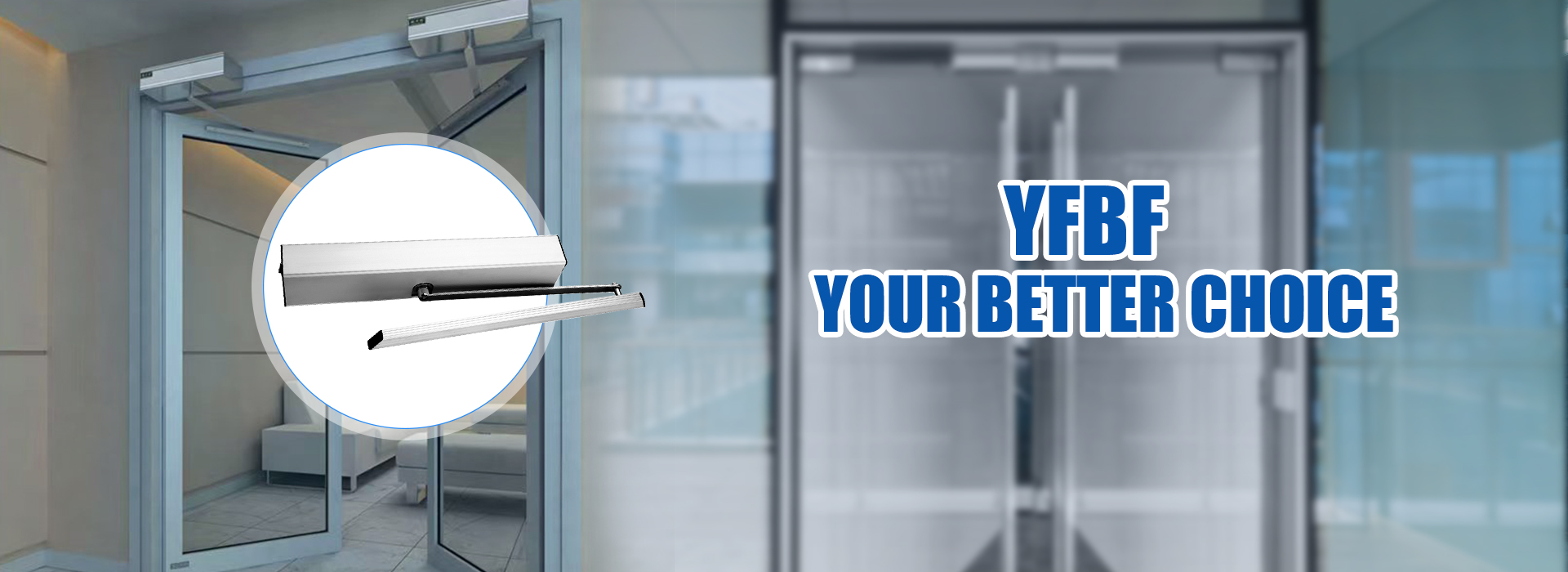
At YFBF, we manufacture all three types — the YF200 sliding door operator, the YFSW200 swing door operator, and our folding door operators — on the same production lines with the same brushless DC motor architecture, the same 72-hour burn-in test, and the same ISO 9001 quality system. I believe that consistency — not just certification — is what commercial buyers should look for in a long-term supplier.
About the Author: Edison — Sales Engineer, Yu Fan Bei Fan Automatic Door Co., Ltd.
With over a decade in the automatic door industry, I focus on helping commercial architects and facility managers choose the right door automation system — sliding, swing, or folding — for their specific traffic patterns and building codes. Our YF series operators are installed in hotels, hospitals, airports, and shopping centers across 30+ countries.
CE, ISO certified | Factory direct from Ningbo, China
Post time: Jun-04-2026