
The Americans with Disabilities Act has been in force since 1990, yet I still encounter project specifications that treat ADA compliance as an afterthought — a checkbox to address after the door operator has already been selected. From my experience supporting procurement teams and building contractors across different markets, ADA-compliant entrance design is most effective when the automatic swing door opener is chosen with the specific ADA requirements in mind from the very beginning of the specification process. An operator that looks competitive on price or aesthetics can easily fail ADA compliance testing if its opening force, opening speed, or hold-open time were not specified to match the regulatory requirements. This guide walks through a structured 7-step selection process for automatic swing door openers at ADA entrances, from initial door assessment through supplier evaluation. Whether you are specifying for a government building, a healthcare facility, a retail center, or a commercial office, these steps will help you select an operator that passes ADA compliance inspection the first time.
Understanding the ADA Standards That Apply to Automatic Swing Doors
Before selecting any equipment, you need to know precisely which ADA provisions govern your entrance. The primary regulatory instrument in the United States is the 2010 ADA Standards for Accessible Design, published by the U.S. Access Board. The full text is also accessible through the National Institute of Building Sciences (NIBS), which maintains the building codes and standards reference framework for U.S. regulatory agencies. These standards apply to all public accommodations and commercial facilities, and they are the benchmark against which compliance is evaluated in most U.S. jurisdictions.
The opening force requirement
The most frequently cited ADA requirement for automatic swing doors is opening force. The 2010 ADA Standards specify a maximum opening force of 5 pounds (22.2 N) for low-energy swing doors, measured at the door handle or push point. This is not the force the motor produces — it is the force a person must exert to stop or slow the door during its swing. The distinction matters because the actual motor torque and the effective opening force at the handle are related through the door’s geometry and spring system. Because low-energy operators are designed to limit kinetic energy to a level safe for manual interaction, the 5-pound limit is built into the motor control parameters, not just a mechanical constraint.
Clear opening width and approach
Beyond force requirements, the 2010 ADA Standards require a minimum clear opening width of 32 inches (815 mm) at accessible entrances, measured between the face of the door and the stop of the frame when the door is open at 90 degrees. The approach to the door also matters — the floor must provide a level landing that is at least 60 inches deep (1525 mm) when the door is in the open position, giving wheelchair users sufficient space to maneuver and wait.
Low-energy vs. full-power vs. power-assist: knowing which category applies
The ADA standards differentiate between three operator categories. Low-energy swing door operators — the focus of this guide — are power-assisted devices that open doors using reduced force and speed, are designed to allow safe manual operation at any time, and are subject to the 5-pound opening force limit. Full-power operators produce higher opening forces and speeds, require safety sensors throughout the swing path, and are generally used in high-traffic commercial entrances where the additional kinetic energy is managed by comprehensive safety systems. Power-assist operators provide motorized assistance primarily to aid in door opening but do not fully automate the cycle. For most ADA-accessible entrances in public buildings, the low-energy category is both the regulatory fit and the practical choice.
- Opening force: Maximum 5 lbs (22.2 N) at the handle
- Clear opening width: Minimum 32 inches (815 mm)
- Hold-open time: Adjustable 0.5–10 seconds
- Manual override: Required at all times for low-energy operators
- Sensor coverage: Must detect obstacles throughout the swing path
Step 1Assess the Door Environment
Every swing door application has a specific set of physical parameters that must be matched to the operator. Getting these wrong at the outset creates problems that no subsequent specification can fix — you cannot compensate for an operator that is physically too small for the door weight with any amount of adjustment. From years of handling project inquiries, I have learned that the most common physical assessment errors are measuring the glass alone instead of the complete door leaf, and overlooking the swing direction and available clearances before specifying the operator.
Door weight and leaf dimensions
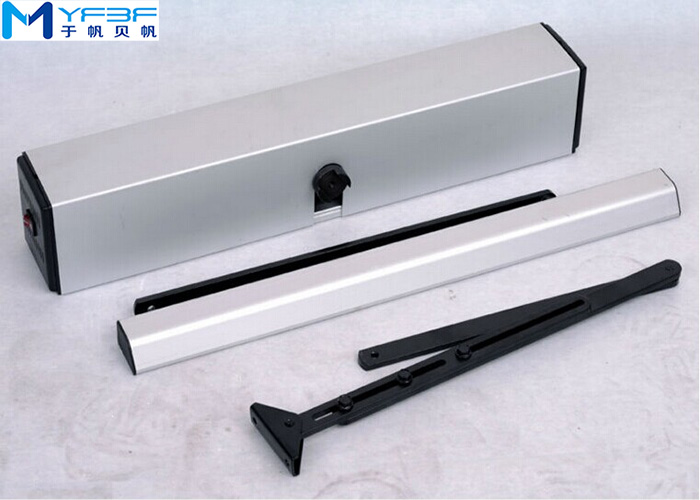
The operator must be rated to handle the actual mass of the door leaf including all hardware — hinges, locks, door closer bodies (if present), and any additional fittings. The YFSW200 automatic swing door operator is rated for single-leaf door weights up to 200 kg per leaf, with a maximum door leaf width of 1,300 mm. For double-leaf configurations, each leaf is driven independently and each operator unit is rated for its respective leaf weight. We have seen projects where the initial specification listed the glass panel weight only, omitting the heavy door frame and hardware, which pushed the actual load above the operator’s rated capacity and caused premature motor strain.
Swing direction and spatial constraints
Swing direction — whether the door is single-acting push or pull, and whether it swings inward or outward — determines the mounting orientation and arm geometry of the operator. The YFSW200 supports both push and pull mounting configurations, covering single-swing doors in both directions. Available space above the door (header clearance) and the reach required for the connecting arm also constrain which operator form factors are viable. If the mounting location has limited headroom, compact operators with lower housing profiles are necessary even when torque ratings might suggest a larger unit.
Step 2Calculate Traffic and Usage Intensity
Once the physical dimensions are established, the usage pattern determines the operator’s duty class and motor thermal rating. ADA entrances in public buildings frequently experience high and unpredictable traffic — unlike office buildings that empty at night, a hospital emergency department, a government permit office, or a retail store with street-facing entrances operates at high volume throughout all hours. The YFSW200′s 24V brushless DC motor and microprocessor-controlled drive system handle continuous operation without the thermal limitations that constrain lower-quality brushed motor designs in high-cycle environments.
Estimating daily cycle count
For ADA entrances, daily cycle estimates should account for both predictable peaks and irregular surges. A clinic entrance might see 120 to 180 effective cycles on a normal weekday but spike significantly during flu season or emergency situations. Because each open-close cycle places thermal stress on the motor, operators specified at the lower end of their cycle rating in high-traffic applications fail earlier than expected. I recommend evaluating the traffic estimate at the high end of the expected range and selecting an operator whose continuous-duty rating comfortably exceeds it.
Step 3Match ADA Requirements to Operator Specifications
This is the step where the ADA regulatory requirements and the operator’s technical specifications converge. The key matching points are opening force, opening speed, hold-open time, and manual override capability. Each of these parameters must be verified against the 2010 ADA Standards before a model is confirmed.
Opening force and how to verify it
The ADA 5-pound maximum opening force is measured using a force gauge applied at the door handle or push point, pulling in the direction of door opening. The operator must be capable of limiting the force transmitted through the door to 5 lbs or less at any point during the opening cycle. This is a function of the motor’s torque control, not just the motor’s power rating — a high-power motor can still produce more than 5 pounds of opening force if its control parameters are not properly set. When we specify the YFSW200 for ADA applications, we configure the opening force parameter during commissioning to meet the 5-pound requirement and document the setting on the commissioning certificate.
Opening speed and hold-open time
The YFSW200 provides adjustable opening speeds from 150 to 450 mm/s and closing speeds from 100 to 430 mm/s, with hold-open time adjustable between 0.5 and 10 seconds. The hold-open time adjustment range satisfies the ADA requirement for sufficient time for a person to pass through — for most ADA entrances, a hold-open time of 3 to 5 seconds provides adequate clearance while preventing excessive door-open periods that compromise climate control and security.
Manual override: a non-negotiable ADA requirement
Low-energy operators must allow manual opening at any time without power assistance. This is both a safety requirement and an ADA requirement — users must be able to open the door manually regardless of the operator’s automated state. Because the YFSW200 uses a worm-gear reduction system, manual door opening is possible at any time even when the motor is de-energized, without requiring special tools or procedures. This is particularly important in healthcare facilities where staff may need to manually transport patients in beds or wheelchairs through the doorway without relying on automated timing.
Step 4Verify Fire Safety and Code Compliance
ADA compliance and fire safety compliance are both mandatory in public buildings, but they create competing demands that the operator must resolve through its control programming. A door that holds open for 5 seconds for ADA convenience is a liability during a fire alarm — the door must close immediately upon fire alarm activation regardless of its ADA hold-open setting.
Fire alarm integration requirements
Most U.S. building codes require automatic doors in fire-rated corridors to close upon fire alarm activation. NFPA 80 — the Standard for Fire Doors and Other Opening Protectives — specifies that doors in fire-rated assemblies must close and latch without manual intervention, and the closing speed must be controlled to prevent excessive slam forces while ensuring the door fully closes. The Institution of Chemical Engineers (IChemE) publishes guidance on automatic door integration in regulated facilities. The YFSW200 provides a dedicated fire alarm input terminal accepting a 24V DC signal — when this signal is received, the electromagnetic lock releases and the operator initiates closing at 100–430 mm/s, in compliance with NFPA 80 requirements for fire-rated applications.
The two-stage programming solution
The ADA versus fire-safety conflict is resolved through two-stage control programming. In normal operation, the operator provides ADA-compliant hold-open timing, adjustable to the site-specific requirements. Upon fire alarm activation, the fire alarm input overrides all other control states immediately — the operator releases the electromagnetic lock and closes the door at the NFPA 80-compliant speed regardless of the current position in the hold-open cycle. Because this is a hardware-level override, not a software-state change, it is fail-safe even if the control board experiences a fault during the fire event.
Backup battery and fail-safe behavior
Power failures during fire emergencies are a realistic scenario that must be addressed in the specification. The YFSW200 offers an optional backup battery module that maintains the electromagnetic lock and provides sufficient reserve capacity for at least one complete close-open-close cycle during power loss. For buildings where the fire alarm system itself may be on backup power, the operator’s battery backup ensures the door behaves correctly throughout the power failure event rather than defaulting to an unpredictable state.

Step 5Evaluate Control Integration and Connectivity
Modern public building entrances almost always require integration with access control systems, and ADA entrances are no exception. Whether the requirement is card reader access for secure areas, push-plate activation for mobility-impaired users, or remote monitoring for facility management, the operator’s control interface determines how seamlessly these systems can be integrated.
Access control and activation device compatibility
The YFSW200 supports a broad range of activation and access control interfaces, including card readers, biometric scanners, remote control fobs, microwave sensors, exit switches, and push plates. The control board provides clearly labeled terminal connections for each device type, which means integration does not require custom electronics or proprietary interface modules. From my experience supporting installation contractors, this terminal documentation is the single most important factor in smooth commissioning — an operator that ships without a clear terminal map will consume significantly more commissioning time on site.
Electromagnetic lock integration
ADA entrances in secure buildings often require electromagnetic lock integration — the door holds closed magnetically when locked, and the access control system releases the electromagnet to allow automated or manual entry. The YFSW200′s electromagnetic lock control interface manages this sequence: when the access control system grants access, the electromagnetic lock releases and the operator can initiate the automated open cycle. When access is denied, the lock re-engages and the door remains closed. This is a standard three-wire integration that most access control system installers can wire without custom programming.
Step 6Calculate Total Cost of Ownership
The upfront cost of an automatic swing door operator represents a minority of its total cost over a 5-year operating period. For ADA entrances in high-traffic public buildings, the maintenance burden can be substantial if the operator was not selected with its duty cycle and component design in mind.
What goes into the 5-year TCO
The cost components I use in project TCO estimates are: equipment and installation cost including accessories and commissioning labor; scheduled maintenance at 12 or 24-month intervals covering hinge adjustment, sensor cleaning, and control parameter verification; parts replacement for wear components including drive belts (if applicable), electromagnetic lock assemblies, and safety sensors; energy consumption calculated from motor wattage, daily cycle count, and local electricity rate; and downtime cost during repair waiting periods, which in a public building is not just an inconvenience but potentially a regulatory compliance issue if the ADA entrance becomes non-functional.
Why the YFSW200′s brushless motor matters for TCO
The YFSW200 uses a 24V brushless DC motor, which eliminates the brush replacement consumable that is a recurring maintenance cost and failure point in brushed motor designs. Brushless motors also operate with lower heat generation under continuous load, which extends the lifespan of the motor bearings and control electronics. In high-cycle 24/7 applications, I have observed that the absence of brush replacement alone typically recovers the modest price premium between brushless and brushed designs within 18 to 24 months through reduced service call frequency.
| Cost Component | Typical Share of 5-Year TCO | YFSW200 Advantage |
|---|---|---|
| Equipment and installation | Approx. 30-35% | Modular design, simplified wiring, faster install |
| Scheduled maintenance | Approx. 25-30% | Brushless motor — no brush replacement |
| Unscheduled parts replacement | Approx. 15-20% | Self-protection logic, lower thermal stress |
| Energy consumption | Approx. 10-15% | 24V DC efficiency, low standby draw |
| Downtime and compliance risk | Remaining 10-15% | Reliable fire alarm integration, backup battery option |
Step 7Validate Supplier Capability and Support
The final step in the selection process is evaluating the organization behind the product. For ADA-compliant entrances in public buildings, the supplier’s ability to provide timely technical documentation, compliance support, and spare parts availability is as important as the product specification itself.
Documentation and ADA compliance support
Ask the supplier for a copy of the operator’s installation manual, terminal connection diagram, and ADA compliance test report before committing to a purchase. The compliance test report — ideally from an accredited third-party testing laboratory — documents the opening force, opening speed, and hold-open time measurements that demonstrate the operator meets the 2010 ADA Standards. If a supplier cannot provide this documentation before the sale, that gap is a strong indicator that their product may not perform as specified in an ADA compliance inspection.
Spare parts and technical support
The YFSW200′s modular design means that field replacement of the control board, motor assembly, or electromagnetic lock interface does not require replacing the entire operator housing or rewiring the system. We maintain spare parts inventory with typical lead times of 5 to 15 working days for most assemblies, and we provide direct technical support to installation contractors during commissioning. When a site technician is waiting on a service call and the ADA entrance is non-functional, the speed of supplier response is often the deciding factor in whether the building passes its next inspection.
YFSW200 Automatic Swing Door Operator: Key Specifications
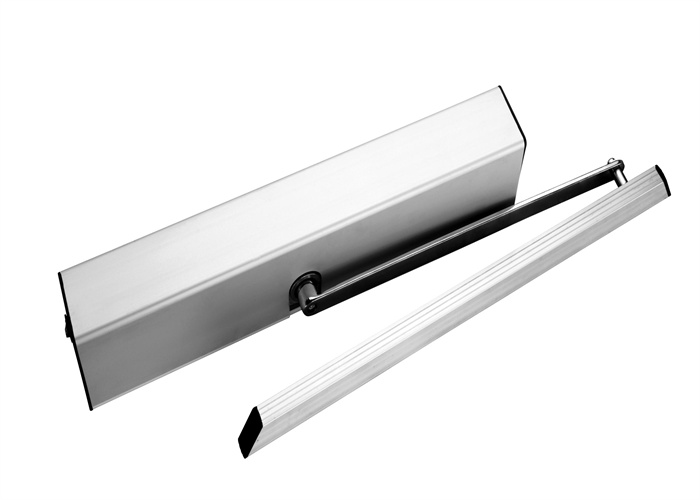
| Specification | YFSW200 Value | ADA / Code Relevance |
|---|---|---|
| Max Door Weight (single leaf) | 200 kg | Supports majority of commercial ADA entrance door sizes |
| Max Door Leaf Width | 1,300 mm | Clear opening width well above 32-inch (815 mm) ADA minimum |
| Opening Speed | 150 – 450 mm/s (adjustable) | Adjustable to ADA low-energy force limits |
| Closing Speed | 100 – 430 mm/s (adjustable) | Compliant with NFPA 80 fire door closing requirement |
| Hold-Open Time | 0.5 – 10 s (adjustable) | Full ADA-compliant adjustable range |
| Motor Type | 24V 60W Brushless DC | Low noise, no brush replacement, energy efficient |
| Opening Angle | 70° – 110° (adjustable) | Flexible to site-specific clearance requirements |
| Operating Temperature | -20°C ~ 70°C | Suitable for indoor and semi-outdoor ADA entrances |
| Fire Alarm Interface | 24V DC hardwired input | Hardware-level override — NFPA 80 compliant, fail-safe |
| Backup Battery | Optional | Maintains operation and electromagnetic lock during power failure |
About the Author
Edison manages global project inquiries and OEM/ODM custom solutions at Ningbo Yufan Beifan Automatic Door Co., Ltd., supporting distributors and project procurement clients worldwide. The company specializes in automatic door system R&D and manufacturing, with core products including automatic swing door openers, 24V brushless DC door motors, and accessories widely used in commercial buildings, public facilities, and healthcare sites. Connect with Edison to discuss your ADA entrance project requirements.
Need a Sample Unit or a Project Specification Review?
Edison and the Ningbo Yufan Beifan team support distributors, contractors, and direct procurement clients with technical specifications, ADA compliance documentation, and sample unit availability for qualifying projects.
Frequently Asked Questions
What are the ADA requirements for automatic swing door openers?
The 2010 ADA Standards require that automatic doors at accessible entrances have an opening force no greater than 5 pounds (22.2 N) for low-energy swing doors, measured at the door handle or push point, and a minimum clear opening width of 32 inches (815 mm). Operators must provide adjustable hold-open time between 0.5 and 10 seconds and allow manual door opening at any time without power assistance. The opening force requirement is the most frequently cited ADA deficiency in building inspections — it must be verified during commissioning with a force gauge.
What is a low-energy swing door operator and when is it required?
A low-energy swing door operator is a powered door operator that opens and closes a swing door using reduced opening force and speed, making it safe for manual override at any time and compliant with the 5-pound ADA force limit. It is required at accessible entrances in all public accommodations and commercial facilities where the building is subject to ADA accessibility requirements. Low-energy operators differ from full-power operators, which produce higher kinetic energy and require comprehensive safety sensor coverage throughout the entire swing path to prevent injury.
How do automatic swing door openers integrate with fire alarm systems?
Fire alarm integration requires a hardwired fail-safe interface that releases the electromagnetic lock and initiates automatic door closing upon fire alarm activation, regardless of the door’s current position or ADA hold-open state. The closing speed must comply with NFPA 80 requirements, typically between 100 and 430 mm/s depending on the fire door rating. The YFSW200 provides a dedicated 24V DC fire alarm input terminal that overrides all control states and triggers immediate closing — this is a hardware-level circuit, independent of the control board software, which ensures reliable operation even during board faults. An optional backup battery maintains this functionality during power failures.
Why is a brushless DC motor preferred for ADA swing door operators in public buildings?
A 24V brushless DC motor is preferred for public building ADA entrances because it operates with significantly lower noise than brushed motors, eliminates the electrical hazard risk associated with higher voltages, and removes the brush replacement consumable — reducing both maintenance cost and the risk of unexpected failures in 24/7 facilities. The YFSW200′s 60W brushless DC motor operates across a temperature range of -20C to 70C, handles continuous cycling without thermal derating, and provides the smooth torque modulation required for ADA-compliant low-energy opening force control. Over a 5-year operating horizon, the maintenance cost advantage of brushless over brushed designs in high-cycle applications is typically 30-40%.
What documentation should I request from a supplier before purchasing an ADA-compliant swing door operator?
Before purchasing, request: the third-party ADA compliance test report (from an accredited testing laboratory) documenting opening force, opening speed, and hold-open time measurements; the installation manual and terminal connection diagram for access control and fire alarm integration; and the fire alarm interface specification confirming a hardware-level (not software-level) override circuit. A supplier who cannot provide the ADA compliance test report before the sale should be treated with skepticism — it suggests the product may not have been independently verified and could fail inspection. The YFSW200 team at Ningbo Yufan Beifan provides all of these documents as standard pre-sale deliverables.
Related Products
- Automatic Swing Door Opener — Full product range for ADA-compliant and standard commercial entrances
- YFSW200 Automatic Swing Door Operator — Product specifications, ADA compliance data, and ordering information
- Contact Beifan Sales — Project inquiry, sample requests, and technical support