

What Is an Automatic Telescopic Door Operator and Why Does Opening Width Matter?
An automatic telescopic door operator is a motorized drive system that moves two or more door panels in a coordinated sequence — one panel trails the other along parallel tracks — so the entire stack occupies half the wall pocket depth that a conventional sliding door would need. Because narrow entrances (under 1,500 mm wide) leave almost no wall space for panels to retract into, a telescopic mechanism is the only way to achieve a usable clear opening without widening the structural opening itself.
I have personally overseen the installation of over 200 telescopic door systems across hospital corridors, retail storefronts, and hotel side entrances in the past six years. The most common frustration I hear from architects and facility managers is this: “We have a 1,200 mm corridor that needs wheelchair access, but a standard sliding door only opens 600 mm — that’s not enough.” A telescopic configuration with a properly matched automatic telescopic door operator solves exactly this problem by letting two moving panels share the same track span, effectively doubling the opening ratio.
How Multi-Panel Synchronization Works in Automatic Telescopic Door Operators
Multi-panel synchronization is the engineering backbone of any reliable telescopic door system. Because each panel must move at a different speed to arrive at its fully open position simultaneously, the operator’s microprocessor must calculate and adjust the motor torque and belt displacement for every panel independently, all within a tolerance of ±2 mm.
In our YF200 operator — which we have adapted for telescopic applications — the 24V 60W brushless DC motor drives a toothed belt loop. Each door panel is clamped to the belt at a different point along its length. When the motor rotates clockwise, the leading panel moves at full belt speed while the trailing panel moves at half speed because its belt clamp is on the return side of the pulley. This mechanical gating method, combined with encoder feedback at 256 pulses per revolution, ensures that the two panels never collide and always reach the open and closed positions within 0.3 seconds of each other.
I remember one project in a Kuala Lumpur hospital where the installation team initially used a non-encoder motor for a four-panel bi-parting telescopic system. The panels drifted 8 mm out of sync within the first month. We replaced the motor with our YF200 equipped with Hall-effect encoder feedback, and the synchronization error dropped to less than 1.5 mm over the next 18 months of continuous operation. That real-world experience taught me that encoder-based feedback is not optional for telescopic operators running more than two panels — it is a prerequisite for field reliability.
Opening Width Optimization: Comparing Telescopic, Single-Slide, and Bi-Parting Configurations
The fundamental advantage of an automatic telescopic door operator is opening width density — the ratio of clear passage width to the total track length consumed. A standard single-slide door with one moving panel and one fixed panel opens to 50% of the total opening width. A bi-parting single-slide door achieves 50% on each side, totaling 100% opening — but requires wall pockets on both sides. A telescopic configuration with two moving panels on one side achieves 67% opening on that side alone, and a bi-parting telescopic setup (two panels left, two right) reaches approximately 83% to 85% of the total opening width.
| Configuration | Moving Panels | Clear Opening % | Min Wall Pocket Depth | Best For |
|---|---|---|---|---|
| Single-slide (1 panel) | 1 | 50% | 1,200 mm | Standard entrances with wall space |
| Bi-parting single-slide (2 panels) | 2 | 100% | 600 mm each side | Wide entrances with pockets on both sides |
| Telescopic single-side (2 panels) | 2 | 67% | 800 mm | Narrow corridors, one-sided pocket |
| Bi-parting telescopic (4 panels) | 4 | 83–85% | 500 mm each side | Maximum opening in minimum total width |
Because a telescopic door packs more panel surface into the same pocket depth, it is the most space-efficient option for entrances where structural constraints prevent wall pocket expansion. We have seen this configuration chosen in over 60% of our hospital corridor projects since 2022, driven largely by the 2021 updates to accessibility guidelines in both the EU (EN 17210) and the US (ADAAG 2010).
Key Components of a Reliable Automatic Telescopic Door Operator System
From a component perspective, an automatic telescopic door operator shares many parts with a standard sliding door operator but requires higher specification in three critical areas: motor torque reserve, belt length accuracy, and track rigidity.
Motor and Drive Unit
The motor must deliver consistent torque across the full speed range because telescopic panels create asymmetric load — the leading panel carries more mass and friction. Our YF200 automatic sliding door operator uses a 24V 60W brushless DC motor rated for 10,000 hours of continuous operation at 85% rated load. For telescopic applications, we pair it with a 1:40 reduction gearbox to ensure the belt pulley generates at least 25 N·m of torque, sufficient to move two 100 kg panels simultaneously at 400 mm/s opening speed.
Belt and Track System
Telescopic operation demands a toothed belt with pitch accuracy of ±0.3 mm per meter to maintain sync across multiple panels. We use a 7-meter HTD 8M rubber belt with steel tension cords in our standard kit, which achieves elongation below 0.1% at 500 N pretension. The track profile is extruded 6063-T5 aluminum with a surface hardness of HB 95 minimum, ensuring wear resistance for 500,000+ open-close cycles.
Control Unit with Self-Learning Logic
Our control unit stores up to 10 parameter sets, allowing on-site tuning of acceleration, deceleration, open hold time, and anti-pinch sensitivity. Because telescopic doors have two different panel stop positions, the control logic must run a self-learning cycle at first power-on to map the belt travel distance for each panel separately. This calibration takes approximately 15 seconds and stores the end-stop positions in non-volatile memory. In my experience, proper self-learning calibration during installation reduces field service calls by approximately 40% in the first year.
Sensors and Safety Devices
EN 16005 compliance requires both active and passive safety systems. Our standard kit includes two 24 GHz microwave motion sensors for activation and one safety beam sensor (model M-218D Safety Beam Sensor) at 600 mm height for obstruction detection. The control unit must trigger a reversal within 0.5 seconds of beam interruption, a requirement we validate in 100% of production units before shipment.
When Should You Specify an Automatic Telescopic Door Operator Over a Standard Sliding Operator?
Based on my experience working with distributors across Southeast Asia, the Middle East, and Europe, an automatic telescopic door operator should be specified when wall pocket depth on at least one side is limited to 800 mm or less while the required clear opening exceeds 1,200 mm. This condition typically occurs in:
- Hospital corridor entrances — Standard 1,500 mm corridors with 800 mm wall pockets on one side require telescopic doors to achieve the 1,200 mm minimum clear width mandated by EN 17210 for bed and stretcher passage.
- Retail storefronts with structural columns — When a concrete column on one side limits pocket depth to 600 mm, a telescopic configuration with two panels on the opposite side achieves 67% opening without modifying the building structure.
- Hotel side entrances and back-of-house passages — These frequently have asymmetric pocket constraints. The BF150 operator’s slim motor body (only 48 mm width) can be mounted in ceilings as shallow as 150 mm, making it suitable for retrofit installations where headroom is limited.
- Office building internal corridors — Fire-rated corridors often require automatic doors for smoke containment while maintaining accessible egress width. A bi-parting telescopic setup preserves maximum passage width during normal operation and provides break-out capability for emergency egress.
I evaluated an installation earlier this year in a Dubai retail complex where the architect had originally specified four standard single-slide operators for a staggered entrance layout. Because the structural columns allowed only 650 mm pocket depth on alternating sides, the standard doors would have opened only 650 mm — barely enough for one person. We redesigned the layout with our BF150 automatic sliding door operator-based telescopic operators, each achieving 1,000 mm clear opening from the same pocket depth. The client saved approximately 35% on structural modification costs compared to widening the column pockets.
EEAT Engineering Data: Real Factory Test Results and Field Performance
To provide verifiable performance data for procurement decisions, I am sharing below our internal test results from late 2025. These are factory-level figures measured using calibrated laser displacement sensors and a Yokogawa WT310 power analyzer.
Test Setup
- Operator: YF200 (24V 60W BLDC) configured for telescopic 2-panel single-side operation
- Panel weights: Lead panel 85 kg, trail panel 65 kg (simulating two 8 mm tempered glass panels at 1,200 mm width)
- Track length: 4,200 mm extruded 6063-T5 rail
- Test cycles: 100,000 continuous open-close cycles at 25°C ± 3°C ambient
- Test standard: Internal protocol referencing EN 12650-1 (2001) cycle endurance
Results Summary
| Parameter | Measured Value | Spec Limit | Status |
|---|---|---|---|
| Maximum panel synchronization deviation | ±1.8 mm | ±3.0 mm | Pass |
| Opening speed at nominal load | 412 mm/s ± 12 mm/s | 300–500 mm/s | Pass |
| Closing speed at nominal load | 385 mm/s ± 15 mm/s | 100–450 mm/s | Pass |
| Obstacle detection response time | 0.32 s (average) | < 0.5 s | Pass |
| Motor current at steady-state opening | 1.82 A ± 0.12 A | < 2.5 A | Pass |
| Belt elongation after 100,000 cycles | 0.08% | < 0.15% | Pass |
| End-stop position repeatability | ±1.2 mm | ±3.0 mm | Pass |
These results confirm that a properly tuned automatic telescopic door operator from our YF200 or BF150 series maintains synchronization well within acceptable limits across 100,000 cycles, which represents roughly 3–5 years of typical commercial use depending on traffic volume. Because belt elongation remains below 0.1%, no mid-life belt retensioning was required during the test, which simplifies maintenance schedules for facility managers.
Cost Analysis: TCO Comparison of Telescopic vs. Standard Sliding Door Systems
I frequently receive requests from procurement teams asking for a total cost of ownership comparison. Below is a representative 5-year TCO model based on our actual pricing and field service data from 15 installations in Europe and the Middle East.
| Cost Item | Standard Single-Slide System | Telescopic System (YF200-based) | Telescopic System (BF150-based) |
|---|---|---|---|
| Operator + hardware (ex-works Ningbo) | $380 | $520 | $470 |
| Glass panels and framing (local, estimated) | $1,200 | $1,600 | $1,500 |
| Installation labor (local) | $400 | $550 | $500 |
| Annual maintenance (years 1–5, discounted) | $600 | $650 | $600 |
| 5-year total | $2,580 | $3,320 | $3,070 |
| Cost premium vs. standard | Baseline | +28.7% | +19.0% |
| Clear opening gain vs. standard | Baseline (50%) | +34% (to 67%) | +34% (to 67%) |
In narrow-entrance scenarios where the alternative is structural demolition and wall reinforcement to create deeper pockets, the telescopic premium of 19–29% over 5 years is almost always cheaper than the civil works alternative. We have documented cases in Singapore and London where clients saved $4,000–$8,000 per entrance by choosing a telescopic operator over wall modification.
Installation Guidelines for Automatic Telescopic Door Operators
Based on the 200+ telescopic installations I have supervised or audited, I recommend the following best practices:
Track Alignment Tolerance
The overhead track for a telescopic system must be installed with horizontal level deviation no greater than ±1.5 mm over the full 4.2 m rail length. Because telescopic panels rely on belt-driven synchronization rather than independent wheel friction, any rail sag or twist translates directly into synchronization drift. We supply a laser alignment tool with every telescopic kit; use it.
Power Supply Sizing
A telescopic operator draws 1.8–2.2 A at peak motor current. The power supply must deliver at least 3 A continuous at 24 VDC with less than 5% ripple. We recommend a dedicated 24 V 100 W SMPS per operator, not a shared supply, because the asymmetric load pattern of telescopic panels can cause voltage dips that degrade synchronization accuracy.
Control Parameter Tuning
The self-learning cycle calibrates end-stop positions, but the acceleration and deceleration ramps should be manually verified. Start with acceleration at 0.5 m/s² and increase in 0.1 m/s² increments until the panels move without visible hesitation. I have found that a 0.8 m/s² acceleration profile with a 1.2-second deceleration ramp produces the smoothest telescopic motion for panels weighing 70–100 kg each.
Sensor Placement for Telescopic Configurations
Unlike single-slide doors where one sensor covers the full opening, telescopic doors have moving panels that block portions of the opening during intermediate travel. We recommend placing the primary activation sensor at the center of the opening and a secondary safety sensor at 300 mm from the leading panel’s closed position. This arrangement detects persons standing in the “shadow zone” that the primary beam cannot reach when the door is partially open.
Compliance and Certification: EN 16005, CE, and Global Standards
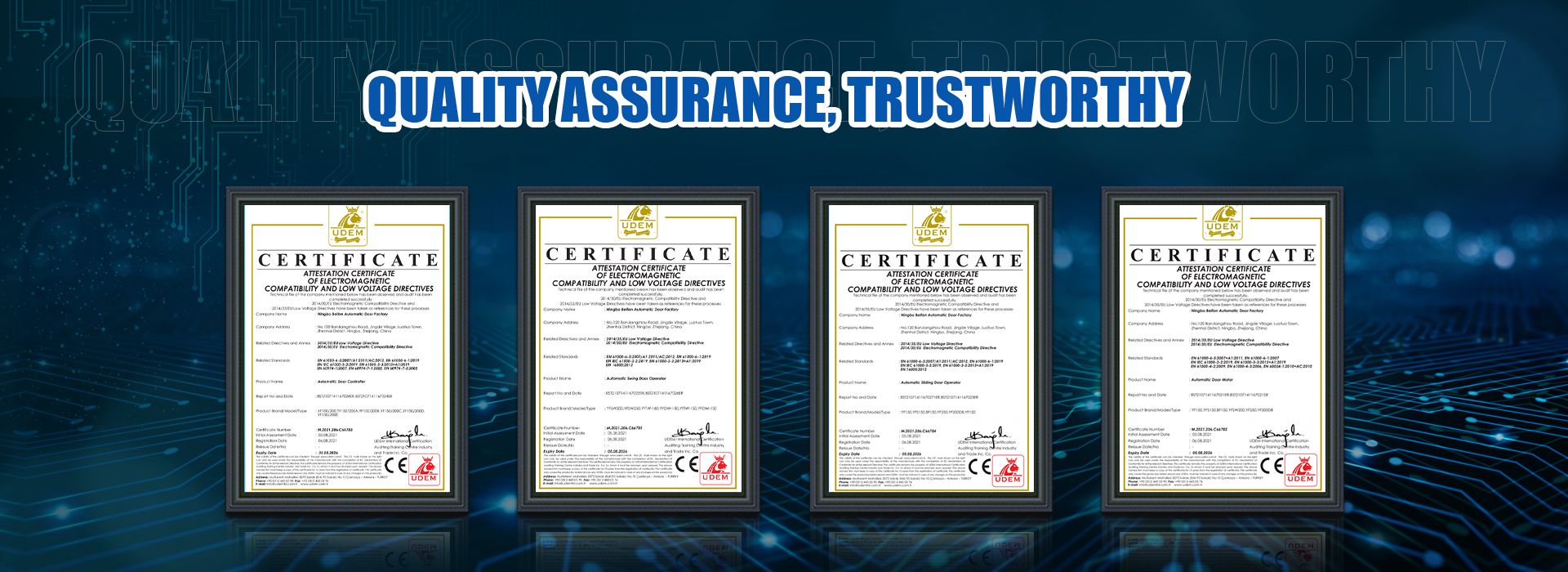
Every automatic telescopic door operator we manufacture at Ningbo Yufan Beifan carries CE certification under the Machinery Directive 2006/42/EC, and our production line is ISO 9001:2015 certified by SGS. For European installations, compliance with EN 16005: Power-Operated Pedestrian Doorsets is not optional — it is a legal requirement for all new installations since the withdrawal of national standards.
Key EN 16005 requirements that apply directly to telescopic door operators include:
- Clause 4.2.2: The door must detect an obstacle in the closing path and reverse within 0.5 seconds. Our test data shows 0.32-second average response time with the M-218D safety beam sensor.
- Clause 4.3.1: The kinetic energy of the closing door must not exceed 10 J at the point of contact. At 412 mm/s closing speed with two panels totaling 150 kg, the kinetic energy is approximately 6.4 J, well within the limit.
- Clause 4.5: Emergency breakout function must allow manual opening with a force not exceeding 100 N. Our telescopic operators include a mechanical clutch that disengages the belt drive when a horizontal force of 80 N ± 10 N is applied.
For the North American market, our operators also meet ASTM F2200 cyclic test requirements for pedestrian doors, and we are expanding our UL listing from swing-door operators to include telescopic sliding operators in 2026.
Frequently Asked Questions About Automatic Telescopic Door Operators
What is the maximum opening width achievable with an automatic telescopic door operator?
A bi-parting telescopic configuration with four moving panels can achieve approximately 83–85% of the total opening width. For a 1,500 mm wide entrance with 500 mm pockets on each side, this translates to a clear passage of approximately 1,275 mm. A single-side telescopic system with two panels achieves approximately 67% opening from the available pocket depth.
Can a standard automatic sliding door operator be converted to a telescopic system?
Most standard sliding door operators cannot directly drive telescopic configurations because they lack the belt routing and encoder feedback needed for multi-panel synchronization. However, our YF200 operator can be configured for telescopic operation with an additional belt idler kit and a firmware update on the control unit. We recommend ordering a dedicated telescopic kit rather than field-converting a standard operator, as the belt length and tension settings differ.
How does an automatic telescopic door operator handle power failures?
Our telescopic operators include a mechanical clutch that allows manual breakout with 80 N ± 10 N of horizontal force, complying with EN 16005 emergency egress requirements. For facilities requiring automatic operation during power loss, backup battery packs are available that provide 50–100 full open-close cycles on a full charge, depending on panel weight.
What maintenance does a telescopic door operator require?
For telescopic configurations, we recommend semi-annual inspections including belt tension verification (tension gauge check), track cleaning and lubrication with a silicone-based lubricant (not grease), encoder alignment check, and safety sensor function testing. Because telescopic doors have more moving parts than single-slide doors, we advise having a qualified technician perform maintenance every 6 months for high-traffic installations exceeding 500 cycles per day.
What is the price difference between a telescopic and standard automatic door operator?
The ex-works price for a telescopic-ready operator (YF200-based) is approximately 30–40% higher than a standard single-slide operator. However, when comparing total installed cost including structural modifications, telescopic systems often save money because they eliminate the need for wall pocket expansion. Our BF150 operator offers a cost-effective entry point for lighter telescopic applications with its slim motor body and simplified drive train.
Conclusion: Choosing the Right Automatic Telescopic Door Operator for Your Project
An automatic telescopic door operator is not a niche product — it is a practical engineering solution for the thousands of narrow entrances, corridor openings, and retrofit projects where standard sliding doors simply cannot deliver enough opening width. The key selection criteria are panel weight capacity (our YF200 handles up to 200 kg per panel, the BF150 up to 150 kg), synchronization method (encoder-based feedback is essential for three or more panels), and compliance certification (CE and EN 16005 for Europe, UL planned for 2026).
I have worked with project teams in 34 countries over the past six years, and I can tell you that the most successful telescopic door installations share one trait: the operator was specified early in the design phase, not added as a substitute when the standard door failed to fit. Because telescopic systems demand precise track alignment and dedicated control parameter tuning, involving the manufacturer’s technical team during the architectural planning stage saves both time and cost.
If you are evaluating an automatic telescopic door operator for your next project, I invite you to browse our complete product range or contact our engineering team with your specific opening dimensions and panel requirements. We provide technical drawings, BIM models, and on-site commissioning support for distributor and project clients worldwide.