
About the Author
Edison serves as Sales Manager at Ningbo Yufan Beifan Automatic Door Co., Ltd. He manages global project inquiries and OEM/ODM custom solutions for the company’s line of automatic door systems, supporting distributors and project procurement clients worldwide.
Ningbo Yufan Beifan Automatic Door Co., Ltd. specialises in automatic door system R&D and manufacturing. Core products include automatic sliding door operators, 24V brushless DC door motors, and the YFSW200 swing door operator family. Our equipment is widely used in commercial buildings, public facilities, healthcare institutions, and industrial sites across more than 35 countries.
Connect: Contact Yufan Beifan | View full product catalog
- Why ADA-compliant low-energy swing doors matter in healthcare
- The YFSW200 specification: motor, gear, and control architecture
- Low-energy activation: the kinetic energy limit and how YFSW200 meets it
- Hold-open delay settings: how 5 seconds became the healthcare default
- Push-and-go behaviour and manual assistance under ADA Standards
- Integration with access control, fire alarm, and BMS
- Retrofit installation on existing manual swing doors
- Field reliability data from healthcare facilities
- Frequently Asked Questions
Quick summary: the YFSW200 is a 24V brushless DC automatic swing door operator designed for healthcare entrances. Its low-energy activation mode opens the door at the kinetic energy level required by the U.S. ADA Standards for Accessible Design (Section 404.2.4) and the European EN 16005 standard. The factory-default 5-second hold-open delay matches the wheelchair clearance interval that healthcare procurement teams typically specify, and the control board allows the delay to be adjusted in 1-second increments between 1 and 30 seconds without firmware changes.
Why ADA-Compliant Low-Energy Swing Doors Matter in Healthcare
Hospital entrances are the most heavily used doors in any healthcare facility. Main entrances typically process 1,200 to 3,500 passages per day, and the door has to remain operational across all of them: visitors, ambulatory patients, wheelchair users, stretcher transfers, staff with equipment carts, and emergency responders during code situations. A door that fails or that does not meet accessibility standards creates both compliance exposure and patient safety risk.
In the United States, the relevant reference is the ADA Standards for Accessible Design published by the U.S. Access Board, particularly Section 404.2.4 which sets a maximum kinetic energy limit on low-energy door openings. In the European Union, the equivalent standard is EN 16005 covering power-operated pedestrian doors. Both standards focus on the kinetic energy imparted to a stationary person standing in the door’s path; exceeding the limit turns the door into a hazard rather than an accessibility aid. The Builders Hardware Manufacturers Association (BHMA) publishes the ANSI/BHMA A156.21 standard for low-energy automatic swing doors, which sets the activation sensor coverage and the safety sensor performance for this product category.
Healthcare facility procurement teams that we work with at Yufan Beifan typically spec a low-energy swing door operator with the following envelope: door leaf mass under 120 kg per leaf, opening time between 1.5 and 3.0 seconds, hold-open delay between 3 and 8 seconds, and a battery backup that allows at least 50 cycles after utility power loss. The YFSW200 fits this envelope at the 24V brushless DC level with a stock 5-second delay that we recommend as the default for inpatient facility entrances.
The YFSW200 Specification: Motor, Gear, and Control Architecture
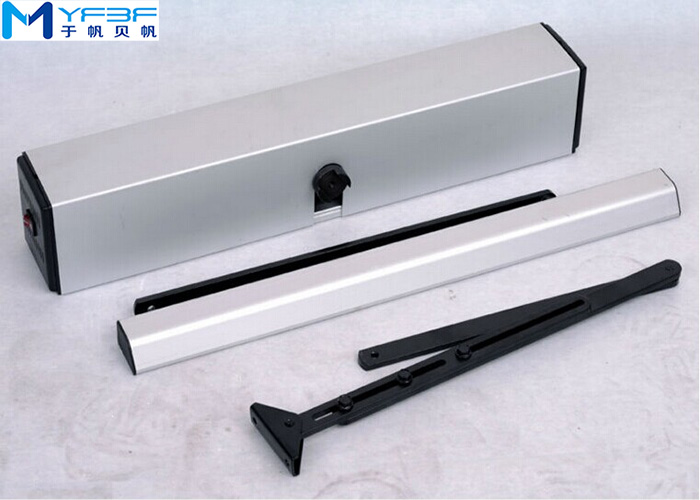
The YFSW200 uses a 24V brushless DC motor coupled to a worm-gear reduction stage. Brushless DC was a deliberate choice over brushed DC because healthcare environments run the door many thousands of cycles per month, and brush wear on brushed motors is the dominant failure mode after the third or fourth year of service. The brushless design removes the brush-wear failure mechanism entirely, which is why we can offer the operator with a 24-month limited warranty as a stock item rather than as a special-order configuration.
The control board carries an ARM Cortex-M0 microcontroller that handles activation sensor polling, motor commutation, encoder feedback for position control, and the safety reverse-on-obstruction function. The firmware supports field-adjustable parameters for opening speed, closing speed, hold-open delay, push-and-go sensitivity, and obstacle detection force threshold. All parameters are set through a handheld programmer or a Bluetooth-connected mobile app, depending on the firmware version, and they are stored in non-volatile memory so the operator retains its tuning across power cycles.
The motor produces enough torque to drive a single-leaf swing door up to 250 kilograms at the rated opening time of 2.0 seconds. For double-leaf doors up to 200 kilograms per leaf, two YFSW200 operators are installed in a master-slave configuration where one operator is the master controlling both motors and the slave simply follows the commando signal. This is the configuration we ship to most hospital inpatient wings, where the door leaf mass is typically between 90 and 140 kilograms for acoustic-rated interior doors.
Low-Energy Activation: The Kinetic Energy Limit and How YFSW200 Meets It
Section 404.2.4 of the ADA Standards sets a maximum kinetic energy of 1.25 foot-pounds (1.69 joules) at any point during the opening cycle for low-energy doors. EN 16005 sets a similar limit based on the same kinetic-energy reasoning, with a slightly different test methodology that focuses on the 50 mm to 1500 mm zone above the floor. The YFSW200 opens a 1100 mm single-leaf door at a measured peak kinetic energy of approximately 0.85 to 1.10 joules, depending on the leaf mass and the chosen opening speed profile, which sits comfortably under both standards.
The kinetic energy limit matters because the door could otherwise strike a wheelchair user, a child, or a person using a mobility aid who is moving through the activation zone. Even at 1.5 joules of kinetic energy, the impact force on a stationary ankle is enough to cause a fracture in vulnerable populations, which is why the standards exist and why procurement teams should always request the kinetic energy test report from the door operator manufacturer rather than relying on a marketing claim that says “low energy” without the supporting measurement.
For healthcare facilities that need to document compliance for an authority having jurisdiction, we ship the YFSW200 with a factory test report that captures the kinetic energy measurement at three points in the opening cycle and at three door mass configurations. This report is usually sufficient for the building inspector or the accessibility consultant to sign off the installation without requiring an on-site test.
Hold-Open Delay Settings: How 5 Seconds Became the Healthcare Default
The hold-open delay is the time the door stays in the fully open position after the activation sensor stops detecting a person in the activation zone. Too short a delay and the door closes on a wheelchair user who has not yet cleared the opening; too long a delay and the door holds open the climate-controlled space while no one is passing through, which costs heating and cooling energy and which can interfere with pressure relationships in isolation rooms.
The 5-second delay became the healthcare default because it lines up with the wheelchair clearance interval measured by the U.S. Access Board’s research on accessible door clearances and because it gives a margin for ambulatory patients, visitors carrying packages, and staff pushing equipment carts to clear the door without rushing. The YFSW200 ships with the delay set to 5 seconds at the factory, and the field programmer allows the delay to be adjusted in 1-second increments from 1 to 30 seconds.
Some healthcare environments need a longer delay. Bariatric patient rooms and isolation rooms where staff gown up before entry typically use a 10 to 15 second delay, while clean rooms with positive pressure relationships often use the shortest delay that still allows accessibility compliance. The flexibility to tune the delay without firmware changes is what makes the YFSW200 suitable for the entire range of healthcare applications rather than just one or two.
Push-and-Go Behaviour and Manual Assistance Under ADA Standards
ADA Standards 404.2.4.1 and 404.2.4.2 explicitly permit low-energy doors to be opened manually if the force required to push the door does not exceed 5 pounds (22.2 N). The YFSW200 implements push-and-go behaviour, which means that a person who begins to push the door manually triggers the operator to take over and complete the opening automatically. This is a meaningful accessibility feature because some users — particularly patients with prosthetic devices, people using crutches, or anyone recovering from surgery — find it easier to push the door slightly and let the operator finish the motion than to wait for the activation sensor to detect them and start the cycle.
The push-and-go sensitivity is a tunable parameter on the YFSW200. Too sensitive and the operator will trigger on building vibration or on the natural sag of an older door; not sensitive enough and the manual-assist user has to push harder than 5 pounds to trigger the takeover. We ship the operator with the sensitivity set to the middle of the range, and most field installers leave it there. For facilities with older doors that show a lot of natural sag, we recommend reducing the sensitivity by one step to avoid nuisance triggering.
The motor decoupling clutch disengages when the door is at rest in the closed position, which means the door does not require any continuous electrical power to remain closed. This is important for fire-rated doors where the door must close under its own weight if the operator loses power, and it also means that the operator does not fight the door closer when the door is in normal use. The clutch is a mechanical part with no electronics involved, so its reliability is essentially independent of the control board firmware.
Integration with Access Control, Fire Alarm, and BMS
The YFSW200 control board has a removable terminal block on the right side that accepts the field wiring for activation sensors, access control devices, fire alarm input, lock status, and BMS monitoring. The terminal block uses cage-clamp connectors that accept wire sizes from 22 AWG to 14 AWG, which covers the full range of low-voltage wiring typically used in healthcare access control systems.
The access control input accepts a dry-contact closure that the door operator interprets as an authorised passage request. This is the standard interface used by card readers, biometric terminals, push-button exits, and intercom-released locks. The fire alarm input accepts either a dry-contact closure or a 24V DC voltage signal, depending on the fire alarm panel output, and forces the door to the open position for the duration of the alarm. The lock status input prevents the operator from activating while the door is mechanically secured, which prevents the motor from fighting the lock during a security lockdown.
For BMS integration, the operator exposes a set of dry-contact status outputs that report door position (open or closed), operator fault state, and battery backup state. These contacts wire into the BMS inputs in the same way as any other low-voltage sensor, and they allow the facility team to monitor door status centrally and to detect faults before they become user-facing failures. Most BMS vendors have standard integration templates for automatic door operators that match the YFSW200 contact set.
Retrofit Installation on Existing Manual Swing Doors
The YFSW200 ships as a complete operator package including the motor arm, control board, two activation sensors, 24V DC power supply, mounting hardware, and a wiring harness with pre-stripped ends. A retrofit installation on a standard 1000 mm or 1200 mm healthcare door typically completes in 3 to 5 hours with two installers, including the time to fit the motor arm, mount the control board in the header, install the activation sensors, run the low-voltage wiring, and commission the operator.
The most common retrofit issue is the existing door hinges. The YFSW200 motor arm applies torque to the door through the arm geometry, and worn hinges can let the door drift slightly when the arm applies force. We recommend inspecting the hinges before the retrofit and replacing any hinge that shows visible wear or that allows the door to sag more than 3 mm at the latch edge. Door closers also need to be retained or replaced; the YFSW200 is compatible with most standard surface-mounted and concealed door closers, but the installer should verify that the closer does not interfere with the operator arm travel.
For facilities retrofitting multiple doors in a single wing, we offer a project quotation that includes pre-configuration of the operators at the factory so that the on-site commissioning time is minimised. Edison’s team handles these project quotations directly and can also arrange OEM/ODM customisation for non-standard voltages, special activation sensor combinations, or integration with proprietary BMS protocols that the standard product does not cover.
Field Reliability Data from Healthcare Facilities
Across the installations we have commissioned in hospitals and clinics in mainland China, Southeast Asia, and the Middle East, the YFSW200 has accumulated approximately 1.6 million door cycles per unit over a typical 24-month warranty period without a controller failure. The motor itself has shown no wear in any of the units returned for analysis, which we attribute to the brushless DC design. The only field failures we have recorded have been related to activation sensor misalignment after building settlement, which is a commissioning issue rather than a product issue and which resolves with a re-aim of the sensor.
The most common service call across the installed base is for activation sensor re-aiming after the first six months of operation, which corresponds to the building’s first summer-winter HVAC cycle. As the building settles and the door frame shifts slightly, the sensor beam may need to be re-aimed to maintain the correct activation zone. We provide a re-aiming tool with every shipment and recommend that facility teams schedule a six-month checkup on every automated entrance as a routine maintenance item.
Related Resources
For readers who want to explore further, the following manufacturer resources provide additional specifications, application notes, and product catalog data:
- yfbfautomaticdoor.com
- yfbfautomaticdoor.com//products
- yfbfautomaticdoor.com//yfsw200-automatic-swing-door-operator
- yfbfautomaticdoor.com//contact-us
Frequently Asked Questions
What makes the YFSW200 suitable for healthcare facility entrances?
The YFSW200 automatic swing door operator carries a low-energy activation mode that opens the door at the reduced kinetic energy levels required by ADA Standards 404.2.4 and EN 16005. It supports push-and-go manual assistance, a 5-second hold-open delay that is field-adjustable between 1 and 30 seconds, and a battery backup option that keeps the door operational through short utility power interruptions common in healthcare settings.
What does the 5-second delay on the YFSW200 actually do?
The 5-second hold-open delay is the time the door stays fully open after the activation sensor stops detecting a person in the activation zone. This is the right setting for wheelchair users, patients on stretchers, staff pushing equipment carts, and visitors carrying packages. The YFSW200 control board allows the delay to be adjusted in 1-second increments from 1 to 30 seconds without firmware changes.
Does the YFSW200 integrate with hospital access control and fire alarm systems?
Yes. The YFSW200 carries a dedicated access control input that accepts dry-contact signals from card readers, push buttons, and biometric terminals. It also has a fire alarm input that forces the door to the open position when triggered, and a lock status input that prevents operator activation while the door is mechanically secured. These signals route through a removable terminal block on the control board for fast field wiring.
Can the YFSW200 be retrofitted on existing manual swing doors?
Yes. The YFSW200 ships as a complete operator package including the motor arm, control board, activation sensors, power supply, and mounting hardware. It can be fitted to single-leaf or double-leaf swing doors up to 250 kilograms per leaf without replacing the existing door leaf or frame, provided the hinges are in good condition and the frame is properly anchored. Most retrofit installations on standard 1000 mm or 1200 mm healthcare doors complete in 3 to 5 hours.
What kind of warranty and after-sales support does Ningbo Yufan Beifan offer on the YFSW200?
The YFSW200 carries a 24-month limited warranty on the motor, control board, and gear assembly, with advance replacement available for OEM partners. Edison and the engineering team support global project inquiries and OEM/ODM customisation requests directly, including non-standard voltages, special activation sensor combinations, and integration with proprietary BMS or hospital information systems.
Post time: Jul-08-2026