
The intersection of EN 16682, ADA 5-second delay requirements, GCC summer thermal conditions, and actual pedestrian throughput mathematics produces a specification envelope that is considerably tighter than what most door equipment catalogs would suggest. This is not a theoretical exercise. I have been selling automatic door systems into GCC markets for over eight years, and the single most common reason I see projects deliver inadequate entrance performance is that the door specification was made by someone who looked at a product catalog rather than working through the regulatory and flow requirements from first principles. This article is my attempt to give you the first-principles version.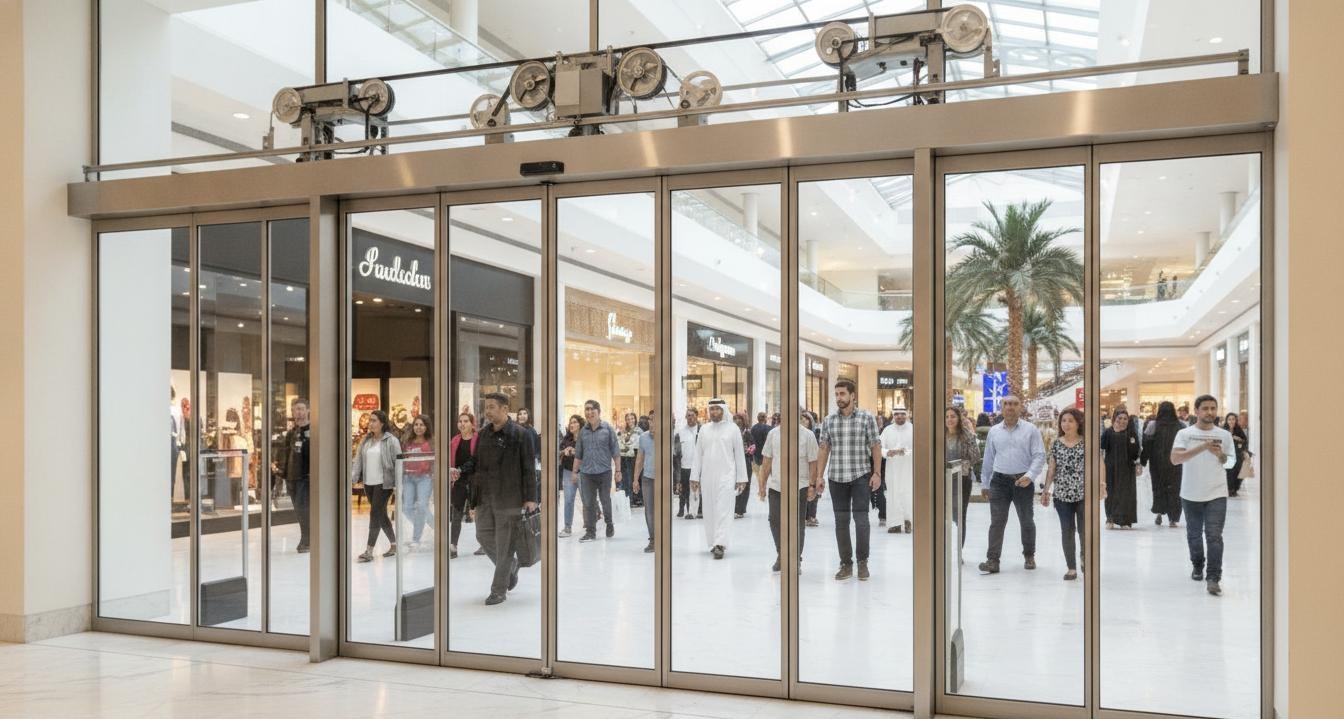
The EN 16682 and ADA 5-Second Delay Intersection: What It Means for GCC Retail Entrance Specifications
EN 16682 is the European standard for power-operated pedestrian doorsets, formally titled “Accessibility and usability of built environment — Powered doors — Enhanced guidance” (though it is formally designated under the EN 16682 designation). It is the standard most commonly referenced by international retailers operating in GCC markets when they specify automatic entrance systems for their stores. The standard requires, among other provisions, that powered pedestrian doorsets achieve a minimum clear opening width determined by the anticipated user population and the building type. For retail environments with high pedestrian throughput—and GCC malls fall squarely into this category—the minimum clear opening per door leaf is 850mm under EN 16682′s accessibility provisions.
ADA compliance adds a specific timing requirement: the 5-second minimum delay before powered door closure begins, as specified in Section 404.2.8 of the 2010 ADA Standards for Accessible Design. This is not a suggestion. It is a legal requirement for any facility where ADA compliance is mandated, and many international retail brands with GCC mall leases require ADA compliance as a lease condition regardless of whether local GCC building codes mandate it. The 5-second delay is measured from the moment the activation sensor no longer detects the presence of a person in the door’s activation zone—meaning the sensor must reliably detect and track persons through the door opening without premature deactivation.
What makes this intersection particularly challenging for GCC applications is the thermal derating question. The 5-second delay requirement assumes the door operator is functioning at its rated closing force. In GCC summer conditions, when ambient temperatures at unshaded mall entrances can reach 45-50°C in direct sun exposure, standard European-specification door operators derate their closing force by up to 35% to prevent motor overtemperature faults. At 35% force derating, a door that is supposed to close with sufficient force to engage the weatherstrip latch may fail to achieve secure closure. The operator’s microprocessor control system must therefore be programmed to compensate—extending the closing time to maintain adequate latch engagement force over a longer stroke, which means the effective door cycle time increases, which means the entrance throughput capacity decreases. If the door control unit is not explicitly programmed for GCC thermal deration compensation, the entrance system will fail to meet both the EN 16682 weatherstrip sealing requirements and the ADA 5-second delay requirements simultaneously.
European healthcare facilities have been dealing with this specific compliance challenge for several years now. In a recent installation documented in Yufan Beifan’s case files, a hospital in northern Europe specified ADA-compliant swing door openers with 5-second delay settings in their emergency department entrance. The installation team documented the specific firmware parameter adjustments required to maintain the 5-second delay while compensating for ambient temperature variation between their winter and summer operating conditions. The same parameter adjustment logic applies in reverse for GCC applications—you are not adjusting for cold weather, you are adjusting for extreme heat, but the fundamental approach is identical. The technical documentation from that European healthcare installation, including the specific 5-second delay configuration parameters, is available at Yufan Beifan’s European healthcare facilities case study on ADA swing door openers with 5s delay settings.
Why Microprocessor-Controlled Multi-Door Synchronization Is a Project Requirement, Not a Convenience Feature
Large GCC malls typically have multiple entrance points operating in parallel—the main atrium entrance, secondary entrances for individual retail zones, parking structure entrances, and delivery access points. One of the specifications I find most frequently underspecified in GCC mall projects is the requirement for multi-door synchronization. The question I ask project specifiers is: when a mall security officer activates the emergency lockdown protocol, do all automatic entrance doors respond within the same 200-millisecond window, or do they respond sequentially with unpredictable timing? The answer determines whether the mall’s emergency response procedure is actually executable or merely documented.
Microprocessor-controlled multi-door synchronization is the technology that makes coordinated multi-door control possible. Each door operator in a synchronized system communicates with a central control unit via a digital communication bus. The central unit issues synchronized activation commands that all doors execute within a defined timing window—typically ±50 milliseconds. This is not a convenience feature. It is a project-level system integration requirement that must be specified upfront, not retrofitted after the building is occupied. A mall entrance system that lacks microprocessor-based multi-door synchronization cannot implement coordinated emergency protocols, cannot maintain synchronized traffic management during peak flow periods, and cannot provide the unified operational status reporting that modern mall security and facilities management systems require.
The self-learning function of modern microprocessor-controlled door control units deserves specific mention because it is frequently misunderstood. Self-learning door operators use microprocessor-based adaptive algorithms to learn the specific environmental characteristics of their installation location—the building’s air pressure profile, typical pedestrian flow speeds, ambient temperature ranges, and dust exposure levels—and adjust their operating parameters accordingly. In a GCC mall, this means the door operator automatically adapts to the thermal environment, the dust and sand infiltration characteristics, and the specific pedestrian behavior patterns of the local population. A door operator with self-learning capability requires less commissioning time, adapts to seasonal variation, and maintains consistent performance through the system’s operating life without manual parameter adjustment. Yufan Beifan’s news article on automatic door control units with microprocessor programming, self-learning functions, and multi-door synchronization provides detailed technical documentation of this architecture.
When I present the multi-door synchronization requirement to GCC project specifiers, I am often asked whether a simpler timer-based synchronization approach would suffice. The answer is no, for two reasons. First, timer-based systems synchronize on time-of-day schedules, not on event-triggered commands. A timer-based system cannot execute an immediate coordinated emergency response because the timer must first reach the programmed response time. Second, timer-based systems have no feedback mechanism—if a door fails to execute a command, the system has no way of detecting the failure and alerting the central control unit. Microprocessor-controlled systems with digital communication bus architecture provide both immediate event-triggered synchronization and real-time failure monitoring. For a GCC mall with 12 or more automatic entrance points, this is not an optional enhancement—it is the difference between a functional emergency response system and a liability.
The 3.5m Width Specification: How Peak-Hour Pedestrian Flow Calculations in GCC Malls Derive the Actual Door Width Requirement
Let me walk through the pedestrian flow calculation that produces the 3.5m specification, because this is a calculation that every GCC mall entrance designer should understand from first principles rather than copying from a product catalog. The calculation has three variables: the anticipated peak pedestrian flow rate, the desired maximum queuing density at the entrance, and the door’s effective cycle time under GCC thermal operating conditions.
The standard pedestrian flow rate for retail environments in GCC markets, based on data from existing mall operations in Dubai, Abu Dhabi, and Riyadh, runs at approximately 1.4 to 1.6 persons per second per meter of clear passage width during peak-hour periods. This figure is higher than the 1.1 to 1.3 persons per second commonly cited in European pedestrian modeling standards, because GCC mall culture involves more family group movement and stroller use, which increases the effective density of pedestrian flow without increasing the linear flow rate per individual. For a main mall entrance expected to handle 8,000 to 12,000 persons per hour during peak GCC weekend periods—Friday and Saturday in most Gulf markets—the required clear passage capacity is approximately 1,600 to 2,000 persons per hour per meter of clear width.
To handle 10,000 persons per hour at 1.5 persons per second per meter with acceptable queuing (defined as no more than 3 persons deep in the queue during peak periods), the required clear passage width is approximately 1,700 to 1,850mm. This is the figure that drives the telescopic door specification. A telescopic door system with two leaves, each providing 850mm minimum clear opening under EN 16682, delivers 1,700mm total clear opening. The total frame width required to achieve this clear opening with standard telescopic door geometry is approximately 3.5 meters. The 3.5m frame width is not an arbitrary product size—it is a direct mathematical consequence of the EN 16682 minimum clear opening requirement, the GCC peak pedestrian flow rate, and the queuing density standard that GCC mall operators apply to their entrance design.
One additional factor that the pedestrian flow calculation must account for in GCC applications is the seasonal variation in mall traffic patterns. GCC malls experience traffic peaks that are sharply different from European retail patterns. The Ramadan period produces dramatically different traffic profiles—with peak attendance shifted to post-iftar evening hours, creating a concentrated spike that exceeds even the standard weekend peak. Eid periods produce multi-day traffic levels that can exceed normal weekend peaks by 40-60%. An entrance system specified for the standard weekend peak will fail during Ramadan and Eid unless the specification accounts for these seasonal multiples in the flow calculation. The practical implication is that a 3.5m telescopic entrance specified with dual-leaf synchronization and microprocessor-controlled flow management can dynamically adjust its activation and timing parameters during peak seasonal periods to maintain acceptable queuing performance. This adaptive capacity is only possible with the microprocessor-controlled multi-door synchronization architecture discussed above.
YFSW200 Swing Operator vs YF200 Telescopic Operator: The Project Decision Matrix for GCC Retail vs Healthcare Entrances
Yufan Beifan manufactures two primary automatic door operator product lines that are relevant for GCC mall applications: the YFSW200 swing door operator and the YF200 telescopic sliding door operator. I am often asked which is the right product for a given application, and the answer always depends on the specific project requirements rather than a general preference. Here is the decision matrix I use when advising GCC project specifiers.
The YFSW200 swing operator is the appropriate choice for individual retail store entrances within a GCC mall, for healthcare facility entrances within a GCC medical complex, and for any application where the primary design requirement is accessibility compliance and the traffic throughput requirement is moderate—typically up to 3,000 persons per hour per single swing leaf. The swing operator’s key advantage in these applications is its lower installation cost and its simpler integration with individual store entrance aesthetics. The YFSW200 is also the appropriate product for GCC healthcare facilities where the ADA 5-second delay requirement and the EN 16682 accessibility provisions intersect with the specific requirement for adjustable opening and closing speeds that healthcare applications demand.
The YF200 telescopic operator is the appropriate choice for mall main entrances, atrium-level secondary entrances, and any application where the throughput requirement exceeds 5,000 persons per hour. The telescopic operator’s dual-leaf configuration delivers the 1,700mm clear passage that a 3.5m frame provides, versus the 900mm maximum clear opening of a single swing leaf. For the main entrance of a GCC mall—which must handle the concentrated pedestrian flows described in the previous section—the telescopic configuration is not an upgrade preference. It is the specification that makes the throughput mathematics work. For GCC retail applications where the mall developer is also the project specifier, the YF200 telescopic operator with 3.5m frame width is the standard specification. The YFSW200 swing operator is reserved for tenant retrofits and individual retail store entrances where the main mall entrance specification does not apply.
| Parameter | YFSW200 Swing Operator | YF200 Telescopic Operator |
|---|---|---|
| Clear opening width per leaf | 900mm max | 850mm per leaf (dual leaf = 1,700mm) |
| Throughput capacity | Up to 3,000 persons/hour/leaf | Up to 12,000 persons/hour |
| Frame width requirement | 1,200mm for 900mm clear | 3,500mm for 1,700mm clear |
| ADA 5-second delay | Supported natively | Supported natively |
| EN 16682 compliance | Yes (single leaf) | Yes (dual leaf ≥850mm each) |
| Multi-door synchronization | Supported via digital bus | Supported via digital bus |
| Self-learning algorithm | Yes | Yes |
| Recommended application | Individual retail stores, healthcare facility entrances | Mall main entrances, atrium secondary entrances |
| GCC summer thermal deration compensation | Programmable via microprocessor | Programmable via microprocessor |
The decision between swing and telescopic is ultimately a question of installation location and throughput requirement, not a question of quality or performance ranking. Both operators use the same microprocessor-controlled architecture, both support the self-learning algorithm, both provide ADA 5-second delay compliance, and both support the digital multi-door synchronization bus. If I have a GCC mall project where the throughput requirement genuinely does not exceed 3,000 persons per hour at peak—which would be unusual for any GCC mall but might apply to a secondary entrance serving a single anchor store—I would specify the YFSW200 without hesitation. The quality of the two products is equivalent; the specification fit is what distinguishes them.
The Ambient Temperature Derating Curve at 45°C: Why European-Specification Door Operators Consistently Fail in GCC Summers
I want to address a specification issue that causes more project failures in GCC automatic door applications than any other single factor: the thermal rating of the door operator. European-specification automatic door operators are designed and tested to an ambient operating temperature range of -5°C to +40°C. This is the range for which the motor thermal protection, the drive electronics, and the mechanical lubricant specifications are validated. In GCC summer conditions, the ambient temperature at an unshaded mall entrance in direct sun exposure routinely exceeds 45°C, and in extreme cases can reach 50-55°C during the peak afternoon hours from June through September.
When a European-specification door operator is installed at a GCC site without thermal deration compensation, the motor thermal protection system detects the overtemperature condition and reduces the motor’s output torque to prevent permanent damage. This derating manifests as a reduction in the operator’s closing force by 25-35% at 45°C ambient, and by up to 45% at 50°C ambient. The consequence of this force derating is a door that closes insufficiently to achieve weatherstrip sealing, fails to latch securely, and may be pushed open by wind pressure or crowd pressure from following pedestrians. In a GCC sand and dust environment, an unsealed door allows sand infiltration into the operator mechanism, which accelerates wear and creates a progressive reliability degradation that is difficult to diagnose without systematic maintenance monitoring.
The correct specification response for GCC applications is to require a door operator with a minimum 60°C ambient temperature rating—not 40°C—and to specify that the control unit firmware include programmable thermal compensation parameters that adjust the door’s operating timing to maintain adequate closing force at elevated temperatures. This is not a custom engineering requirement. Yufan Beifan’s GCC-market door operators are manufactured with the elevated thermal rating as standard, and the microprocessor control unit includes the thermal compensation parameter set as a configurable commissioning option. The GCC-specific thermal compensation parameters are adjusted during commissioning based on the specific installation location’s thermal profile—whether the entrance is shaded, partially shaded, or fully exposed to direct sun.
When I am on site for GCC project commissioning, the thermal characterization of the entrance location is one of the first things I assess. An entrance on the north side of a building with overhang shading may have an effective thermal environment of 38-40°C even when the ambient air temperature is 45°C. An entrance on the south or west side with no overhang shading may see effective temperatures of 48-52°C in direct sun. The same operator model installed in these two locations requires different thermal compensation parameters. Without this site-specific commissioning, the door will either derate excessively (in the shaded location) or overheat (in the exposed location). Both outcomes are avoidable with proper specification and commissioning. For more on Yufan Beifan’s full product range including both swing and telescopic operators, visit Yufan Beifan Automatic Door’s main website.
GCC building codes are evolving rapidly toward mandatory requirements for entrance accessibility, energy efficiency, and thermal performance. The Gulf Standards Organization has been working toward harmonization with EN 16682 and ISO 21542 (Accessibility and usability of the built environment) for several years, and projects specified today should assume that GCC compliance requirements will align closely with European accessibility standards within the operating life of the installed equipment. A door specification that meets EN 16682 and ADA requirements today is also a forward-compatible specification that will remain compliant as GCC building codes tighten. The cost of specifying correctly today is a fraction of the cost of a retrofit in three to five years when GCC regulatory alignment catches up with European standards.
Frequently Asked Questions
Why does EN 16682 make a 3.5m telescopic door width non-negotiable for GCC malls?
EN 16682 requires a minimum clear opening width of 850mm per leaf for power-operated pedestrian doorsets serving public buildings. For GCC malls with high pedestrian throughput during peak hours, the required clear opening can only be achieved with a 3.5m total frame width telescopic operator providing dual-leaf openings of at least 1,700mm total clear passage. A narrower specification fails the minimum accessibility and throughput requirements under GCC building codes that reference EN 16682.
How does ADA 5-second delay interact with GCC mall entrance design?
ADA Standards for Accessible Design require a minimum 5-second delay before a powered door begins to close, measured from when the activation sensor is no longer detecting presence. For GCC malls where ADA compliance is required for international tenant agreements, this 5-second minimum must be implemented in the door control unit firmware. If GCC summer temperatures above 45°C cause the door operator to derate closing force, the 5-second delay may need to be extended by firmware parameters to maintain safe operation—a design trade-off that must be explicitly addressed in the specification.
Why do European-specification door operators fail in GCC summer temperatures?
European-specification door operators are designed for ambient operating environments up to 40°C. In GCC summer conditions of 45-50°C at unshaded entrances, standard European-specification operators derate closing force by 25-45% to prevent motor overtemperature faults. This results in doors that close with insufficient force to ensure weatherstrip sealing and safe latch engagement, and may be pushed open by wind or crowd pressure. GCC-specific operators must specify a minimum 60°C ambient thermal rating with programmable thermal deration compensation in the control unit firmware.
What is the peak pedestrian flow rate used in GCC mall door width calculations?
Based on operational data from existing GCC malls, the peak pedestrian flow rate for GCC retail environments is 1.4-1.6 persons per second per meter of clear passage width during peak periods—higher than the 1.1-1.3 commonly cited in European standards due to GCC mall culture involving more family group movement and stroller use. For a main mall entrance handling 10,000 persons per hour at 1.5 persons per second per meter with a maximum queuing depth of 3 persons, the required clear passage width is approximately 1,700mm, driving the 3.5m frame specification.
When should YFSW200 swing operator be specified versus YF200 telescopic operator?
The YFSW200 swing operator is appropriate for individual retail store entrances and healthcare facility entrances with throughput requirements up to 3,000 persons per hour per leaf. The YF200 telescopic operator is required for mall main entrances and any application where throughput exceeds 5,000 persons per hour, because only the telescopic dual-leaf configuration delivers the 1,700mm clear passage that meets both the EN 16682 850mm per leaf minimum and the GCC peak pedestrian flow throughput requirement. Both operators support ADA 5-second delay and microprocessor-controlled multi-door synchronization.
Edison
Sales Manager, Ningbo Yufan Beifan Automatic Door Co., Ltd.
Edison leads international sales for Ningbo Yufan Beifan Automatic Door Co., Ltd., a manufacturer of automatic door operators serving retail, healthcare, and commercial entrance applications in GCC, European, and Southeast Asian markets. Yufan Beifan specializes in microprocessor-controlled swing and telescopic door operators with ADA compliance, EN 16682 certification, and GCC-specific thermal compensation engineering. For project specification support, OEM and ODM configurations, or product inquiries, contact the Yufan Beifan engineering team through the company website.
Post time: Jun-16-2026